Россия, Волгоград

СДЕЛАЙТЕ СВОИ УРОКИ ЕЩЁ ЭФФЕКТИВНЕЕ, А ЖИЗНЬ СВОБОДНЕЕ
Благодаря готовым учебным материалам для работы в классе и дистанционно
Скидки до 50 % на комплекты
только до
Готовые ключевые этапы урока всегда будут у вас под рукой
Организационный момент
Проверка знаний
Объяснение материала
Закрепление изученного
Итоги урока
Была в сети 17.12.2025 14:39

Кожевникова Анастасия Вячеславовна
учитель английского языка
36 лет
 387
387
 124 422
Местоположение
Специализация
"Relatives" (придаточные предложения в английском языке)
Категория:
Английский язык
21.06.2025 17:27

Просмотр содержимого документа
«"Relatives" (придаточные предложения в английском языке)»
Relatives
(придаточные определительные)
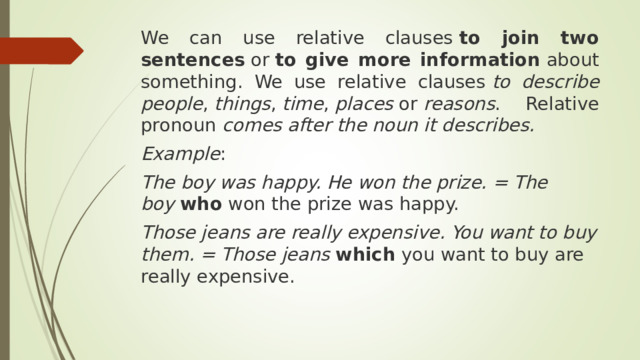
We can use relative clauses to join two sentences or to give more information about something. We use relative clauses to describe people , things , time , places or reasons . Relative pronoun comes after the noun it describes.
Example :
The boy was happy. He won the prize. = The boy who won the prize was happy.
Those jeans are really expensive. You want to buy them. = Those jeans which you want to buy are really expensive.
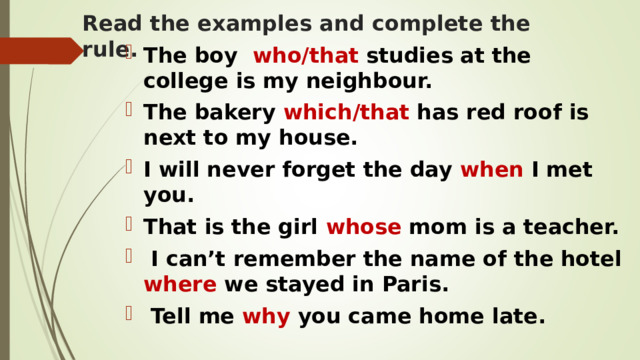
Read the examples and complete the rule.
- The boy who/that studies at the college is my neighbour.
- The bakery which/that has red roof is next to my house.
- I will never forget the day when I met you.
- That is the girl whose mom is a teacher.
- I can’t remember the name of the hotel where we stayed in Paris.
- Tell me why you came home late.
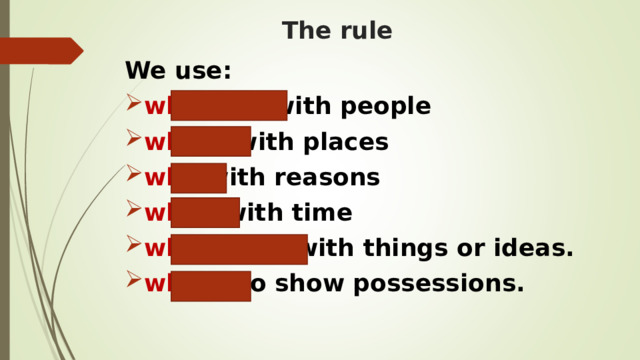
The rule
We use:
- who/that with people
- where with places
- why with reasons
- when with time
- which/that with things or ideas.
- whose to show possessions.
Вебинар для учителей
Свидетельство об участии БЕСПЛАТНО!