Россия, Батамай

СДЕЛАЙТЕ СВОИ УРОКИ ЕЩЁ ЭФФЕКТИВНЕЕ, А ЖИЗНЬ СВОБОДНЕЕ
Благодаря готовым учебным материалам для работы в классе и дистанционно
Скидки до 50 % на комплекты
только до
Готовые ключевые этапы урока всегда будут у вас под рукой
Организационный момент
Проверка знаний
Объяснение материала
Закрепление изученного
Итоги урока
Была в сети 30.04.2026 05:58

Чемезова Амгалена Кимовна
учитель
40 лет
 16
16
 294 437
Местоположение
Республика Саха Якутия
Категория:
География
01.12.2025 17:53

Просмотр содержимого документа
«Республика Саха Якутия»
Municipal budget educational Institution “Secondary school № 33” Yakutsk Sakha Republic
The Republic Sakha
Performed by Denis Makarov
Student of the 5 “e” Grade
Tutor: Antonina Antonovna Rufova
Republic Sakha(Yakutia)
The Republic Sakha is the biggest republic of Russia. The area is 3 million square kilometers. It is less than inhabitants than 1 million. There is a lot of natural resources. Capital of the republic city of Yakutsk.
Geographical position
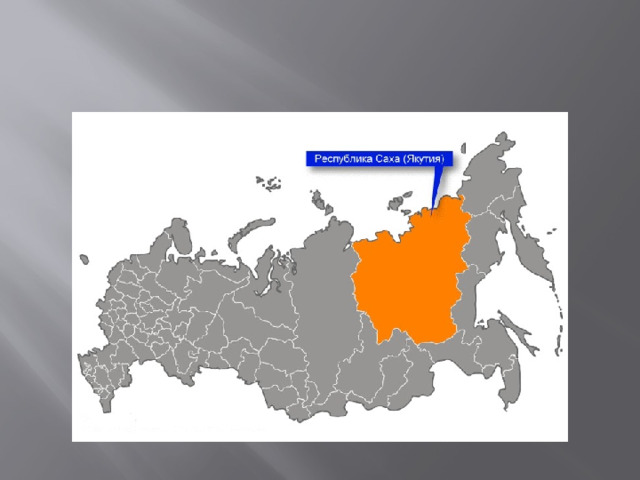
Yakutia is located in the north of Eastern Siberia in basins of the Lena, Yana, Indigirka Rivers and in lower reaches of the Kolyma River. Extent of the territory of Yakutia from the North to the south about 2000 km, from the West to the east — 2100 km. Includes New Siberian Archipelago.
Borders: in the south – with the Amur region, in the southeast – with Khabarovsk Krai and the Magadan region, in the east – with Chukotka Autonomous Area, in the north – with Dolgan-Nenets and Evenki autonomous areas, in the southwest — with the Irkutsk region. In the north the republic is washed by the Laptev Sea and the East Siberian Sea.
Environment
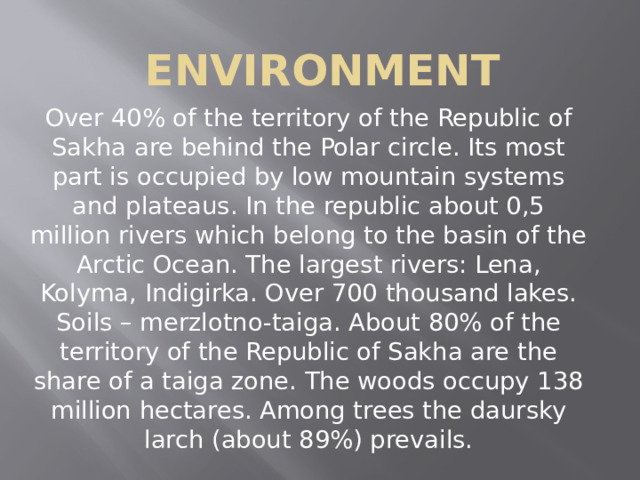
Over 40% of the territory of the Republic of Sakha are behind the Polar circle. Its most part is occupied by low mountain systems and plateaus. In the republic about 0,5 million rivers which belong to the basin of the Arctic Ocean. The largest rivers: Lena, Kolyma, Indigirka. Over 700 thousand lakes. Soils – merzlotno-taiga. About 80% of the territory of the Republic of Sakha are the share of a taiga zone. The woods occupy 138 million hectares. Among trees the daursky larch (about 89%) prevails.
Economic advantages and disadvantages
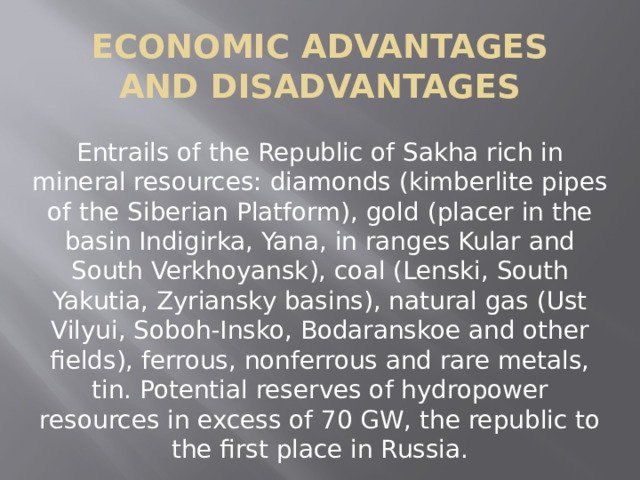
Entrails of the Republic of Sakha rich in mineral resources: diamonds (kimberlite pipes of the Siberian Platform), gold (placer in the basin Indigirka, Yana, in ranges Kular and South Verkhoyansk), coal (Lenski, South Yakutia, Zyriansky basins), natural gas (Ust Vilyui, Soboh-Insko, Bodaranskoe and other fields), ferrous, nonferrous and rare metals, tin. Potential reserves of hydropower resources in excess of 70 GW, the republic to the first place in Russia.
The main drawbacks - peripheral economic and geographical position, harsh climatic conditions, remote areas, the dependence of the economy and the lives of people in many parts of the republic on the outside fuel and food. Of great importance in terms of socio-economic development of the country given the project of integrated development of South Yakutia.
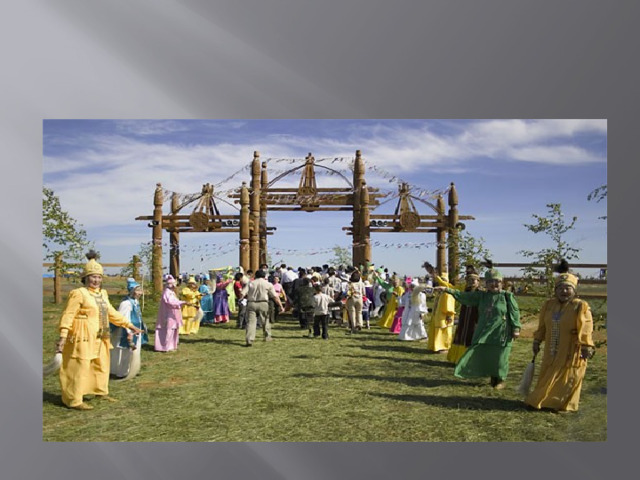
Ysyakh
Ysyakh-summer holiday. It is a spring-summer festival in honor aiyy deities and the rebirth of nature, accompanied by ritual prayers, abundant refreshments and kumysopitiem, dances, folk games, horse races , competition strong and dexterous.
Celebration
Yakut Ysyakh - the most important holiday in Yakutia. Ysyakh word literally translates as "abundance", associated with the cult of the sun gods, the religious cult of fertility. Traditionally Ysyakh celebrated the summer solstice - on 21 June. In fact it is the Yakut New Year.
Before the war Ysyakh performed as expected on June 22 - the summer solstice. After the war, on the moral and ethical reasons (Ysyakh date coincided with the beginning of the Great Patriotic War of June 22, 1941) became Ysyakh held between 10 June and 25 June, according to the ulus, schedule holidays, local preferences, and so on. Etc. .
History ysyakh
Researchers believe that the ancestral home of the summer holiday are kumysnyh steppes of Central Asia. Yakut holiday elements have similarities with the summer holidays of the Turkic nations. Tuvan, Altai, Tatars, Bashkirs and others have Yakuts preserved an ancient tradition, characteristic of pastoral peoples - to divide the year into two halves, and the Ysyakh was a kind of boundary between old and new, past and future.
The first written evidence of Western scholars can be found in the diaries of the Dutch traveler I. Ples, a passing through Siberia to China at the end of the XVII century. He noted that this holiday is coping with great solemnity: Yakuts bonfires and support them throughout the holiday.
During the celebrations, symbolizing the beginning of summer, and the awakening of nature, here taken to remember their ancestors and their customs. Ethnographer Ekaterina Romanova believes that the Yakut similar celebration not just an excuse to have fun. "In Yakutia, a very long winter, - she says. - And the only opportunity to meet all the born -. It is here "
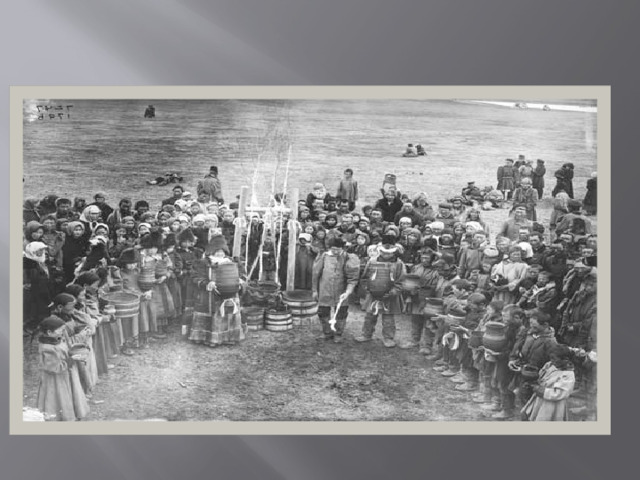
osuokhay
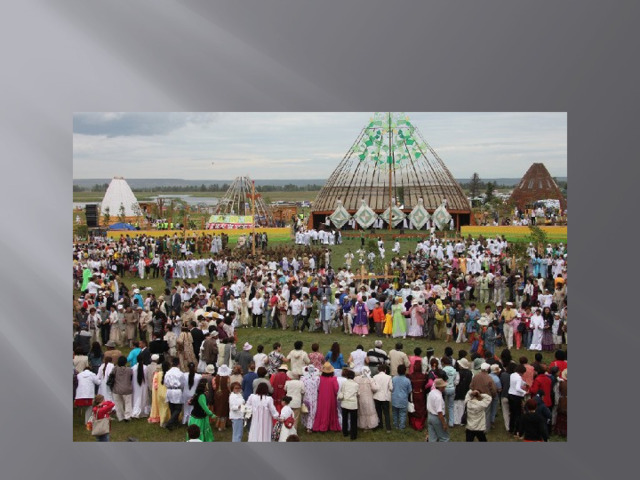
The universal symbol of unity of people dance osuokhay meaning circle of life. During his dancing, moving at a leisurely pace in the direction of movement of the sun, as it were, make a circle in time and space, and paid tribute to the luminary of light and heat, donated by the people. At present the dance master (olonkhosut), whose responsibilities include the performance of songs dedicated to the environmental reality and erecting what is happening around the praise.
This dance is continuously lasted until the morning, sometimes large clans organized osuokhay for three days and nights. Of course, participants are changing, it is believed that anyone who enters the circle, is charged with energy for the whole year. The culmination of the festival - the rite of sprinkling fire, grass and trees traditional drink made from mare's milk - mare's milk. The ritual symbolizes the birth of the universe and man .
Yakut knife
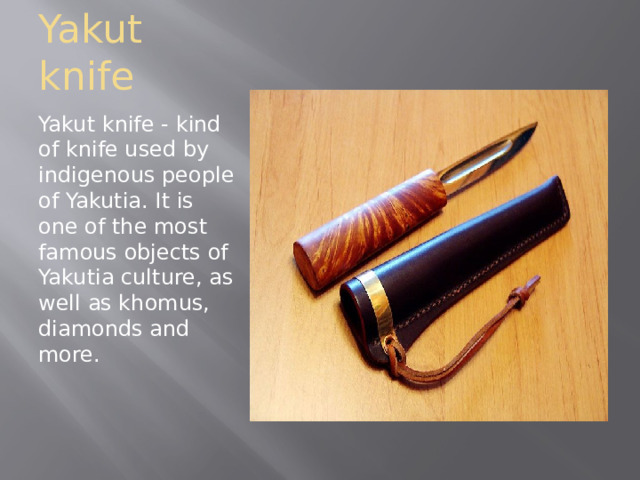
Yakut knife - kind of knife used by indigenous people of Yakutia. It is one of the most famous objects of Yakutia culture, as well as khomus, diamonds and more.
Variations knife and properties
Archaeological excavations carried out on the territory of modern Yakutia show that knives samples extracted from various burial grounds and ancient human sites are undoubted similarities with Yakut knives.
There are many regional variations Yakut knife, but the classic version is a knife blade length from 110 to 170 mm, fitted on a wooden handle made of birch burl with a leather sheath.
Blade
Yakut knife blade pointed, has a blade on one side and a straight (or nearly straight) butt. A special feature is the asymmetrical Yakut knife sharpening blade - marked the first explorers More Yakut life. On one side of the flat blade has a proportion (when viewed from the butt - the right side of the blade). The opposite (left) side of the blade curved. This is done so that when the knife blade not "bury" the material. It is in this context, for righties and lefties Knives differ. For left-handed knives are made from mirror-inverted asymmetry of the blade.
Knives vary along the length of the blade:
from 80 to 110 mm - a small knife (byhychcha) - usually done for children or women,
from 110 to 170 mm - a knife (byhah) - the most common form,
170 mm - large knife (hotohon) - virtually weapons of war, and therefore rarely done
As the blade width differ tundra - which has a narrow blade and taiga or alas - wider blade. The Tundra knife is mainly used for cutting or drilling, and in the forest for cutting production and livestock or the woodwork - this explains the difference between the width of the blade.
Traditionally working Yakut knife has a blade made of relatively soft steel. Mild steel is dictated by practical considerations - so that the knife can be sharpened in the field of river gravel or other material. In recent years, a proliferation of Yakut knives with blades made of special steel, or of Damascus (Damascus) steel.
Many questions from different researchers is the origin of the dale on the blade. There are different versions from the fact that the USD is needed for Krovostoka that is a tribute to tradition, when the knives were made of bones that dollars need to stiffen the blade, that the presence of Dole - the result especially forging an asymmetric blade and dol need to reduce the weight of the blade to knife drowning and so on. Undoubtedly only one: Yakut knife must have USD on the right side of the blade.

Lever
The knife handle is traditionally made from birch burl, impregnated with a special oil. The handle of the knife in the section resembles an egg, "sharp" end directed towards the blade, and is devoid of any kind was thrusts, Guard, etc. -. Easy straight handle. Its length of 130-150 mm, which is longer than the width of the man's hand. The long handle is explained not only by considerations of convenience, but also the fact that the knife does not sink in water. Besides birch burl are used as pieces of birch bark, which are superimposed on each other (can be worn directly on the blade shank) and between the layers are coated with adhesive.

After gluing birch bark harvesting is dried under pressure, and then from it made the hilt. Knives with handle of ivory, plastic, etc. Are souvenirs and are not used in everyday life.
Carrying and Use
The knife is usually worn on the free suspension on the left side - the left edge. Free suspension is necessary in order not to interfere with the movement of the wearer. When equipped with the knife left a comfortable pull out a knife with his right hand, the base of the sheath upёrshis thumb.
In Soviet times, the manufacture and wearing Yakut knife prosecuted, although in fairness it should be noted that the proceedings were largely formal. Nowadays, production, sale, the possession of the Yakut knife regulated by a special act of the Government of the Republic of Sakha (Yakutia), according to which the Yakut knife declared an integral part of the culture of the Sakha people, and in the country is allowed to use it in everyday economic life.
Yakut knife is widely used in everyday household and everyday life of the inhabitants of Yakutia: hunting, fishing, food, cooking, woodwork and others.
Masters
When considering the Yakut knife phenomenon must be considered one of its features. This is a real knife used in everyday life the inhabitants of Yakutia. Throughout Yakutia there are few families in which there is at least one of the Yakut knife. This means that the blade mass produced largely in makeshift conditions, in a rural or forges workshops. Each Yakut village has its own local master (and often masters) who made their own versions of the knives. This circumstance is related variability knife from village to village and from master to master.

HISTORY
Prehistoric and pre-Russian period
The archaeologists found that the ancient people populated Yakutia in the early Paleolithic. By this time the first archaeological sites dating back to within 300 thousand to 10 thousand. Years ago. The most well-known and well-studied of these is the Paleolithic parking Bunge Toll-1885 Jansky parking and parking Deering Yuryakh diringskoy culture, which is located in the middle reaches of the Lena River.
Mesolithic presented Sumnagin archaeological culture (10,5-6,2 thousand years BC).
The Neolithic is divided into three stages:
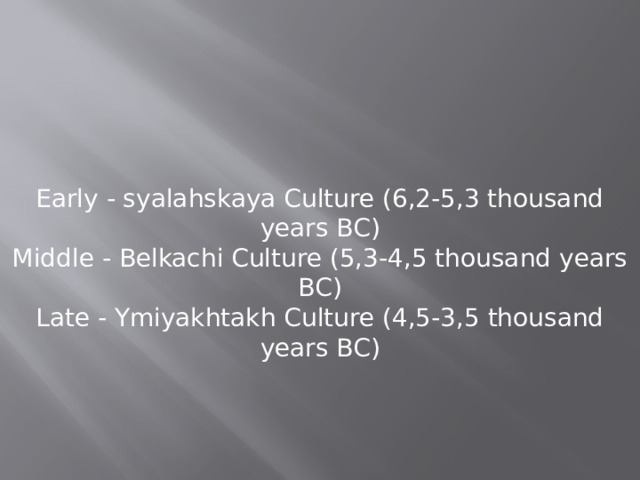
Early - syalahskaya Culture (6,2-5,3 thousand years BC)
Middle - Belkachi Culture (5,3-4,5 thousand years BC)
Late - Ymiyakhtakh Culture (4,5-3,5 thousand years BC)
Since the middle of I millennium BC. e. in Yakutia were the ancestors of the Evens and Evenki. By the XIII century. Tungusic tribes settled in the Middle Lena, Vilyue, Olekma. The arrival of the ancestors of the Yakuts in the Lena region forced them to move to the west and east of the Lena River.
It is assumed that the Turkic-speaking tribes migrated to the territory of modern Yakutia in several waves, the last of which falls on the XIV-XV centuries. Yakuts as a nation formed in the basin of the Middle Lena. It was the final formation of the people on the basis of mixing alien Turkic-speaking tribes with local Paleo-Asiatic genera, as well as newcomers horintsy Mongol and Tungus.
Distribution of cattle introduced significant changes in the economic life of the region. The ancestors of the Yakuts brought in handicraft production region (blacksmithing, jewelry, pottery, etc.), The construction of permanent housing type. By the beginning of the XVII century Yakut clans lived in the basins of the Indigirka and Yana, pushing into the Arctic regions of Yakutia culture of breeding cattle and horse breeding.
Yakutia in the Russian state
In the first quarter of the XVII century Cossack explorers reached the shores of the Lena River. Based Russian winter quarters and forts:. Yakutsk, Zhigansk, Verkhoyansk, Zashiversk, Srednekolymsk etc. become outposts of the Russian advance in the north-east Asia and then to the north-west of America.
In 1632, on the right bank of the Lena was laid Yakut jail, marked the beginning of the future city of Yakutsk. Ostrog laid Petr Beketov. This date is considered the date of entry of Yakutia in the Russian state. In 1638 the county was formed Yakut, later transformed to the Yakut province (1775), and the Yakutsk region (1784) East Siberian governor-general.
In the XVIII century there was a mass Christianization of the indigenous inhabitants of the region. With the activities of the Orthodox clergy associated development of public education and enlightenment of the peoples of Yakutia, the emergence of literature in national languages, the deepening of the processes of interethnic interactions.
A separate chapter in the history of Yakutia is a link. Link started even with the 1640s. Since the XIX century Yakut link for the most part it becomes political. In exile in Yakutia visited Decembrists, members of the Polish uprising of 1863, the Narodniks, the Socialist-Revolutionaries, the Social Democrats.
Yakutia in the Soviet era
April 27, 1922 was formed Yakut Autonomous Soviet Socialist Republic (Yakut ASSR) within the RSFSR.
This is a political decision to give legal and constitutional basis for the formation of statehood in the framework of the creation of a new state - the autonomous republic of the USSR.
Yakutia Soviet period of history associated with large-scale industrial development of its natural resources, which began with the development in the 1920s Aldan gold fields.
In this regard, in 1930 it began the exploitation of the Northern Sea Route, in the mouth of the Lena River was built seaport of Tiksi; shipping and air routes taken out of the transport isolation previously inaccessible areas of the country.
In the 1950s, with the discovery of diamond deposits powerful diamond mining industry began to develop infrastructure in the west of the country. In 1970 - the development of the South Yakut territorial and production complex (see South Yakutia coal basin.). Also in the post-war years - the development of gold mining in Ust-Maya and Oimyakon areas of tin mining in the parliamentary, coal Tomponsky, Verkhnekolymsk and Kobyayskiy areas. Development of oil and gas potential of the Lena-Vilyuiskaya Province, natural gas, gasification of the republic. And much more. At the beginning of 80-ies of the XX century, Yakut ASSR considered industrial-agrarian republic with high prospects of further development of the industry in the country.
There has been also a cultural construction - the development of a national Yakut literature, culture and the cultures of other peoples living in the republic - Russian, Evenki, Evens, Yukaghir, and others.
The Republic of Sakha (Yakutia)
A new stage in the history of Yakutia began September 27, 1990, when the Declaration of State Sovereignty was declared. On this day, the Supreme Council of the Yakut ASSR announced the transformation of autonomy to the Yakut-Sakha Soviet Socialist Republic within the RSFSR.
In October 1991, it was established by the president of the republic. The first president in December 1991 became Mikhail Nikolayev. Republic its name to the Republic of Sakha (Yakutia) was changed in the same year.
In 2009, at the request of the Constitutional Court of the Russian position on the sovereignty of Yakutia were largely excluded from the Constitution of the Republic of Sakha).
Population
The population of the republic, according to the State Statistics Committee of Russia is 959 875 people. (2016). Population density - 0.31 persons / km2 (2016).. It is one of the lowest in the Russian Federation. Urban population - 65.08% (2015).
Everything and the urban population (its share), according to the All-Union and All-Russian census.
People from Siberia 466 492, 478 085 of the Russian people

Symbols of the Republic
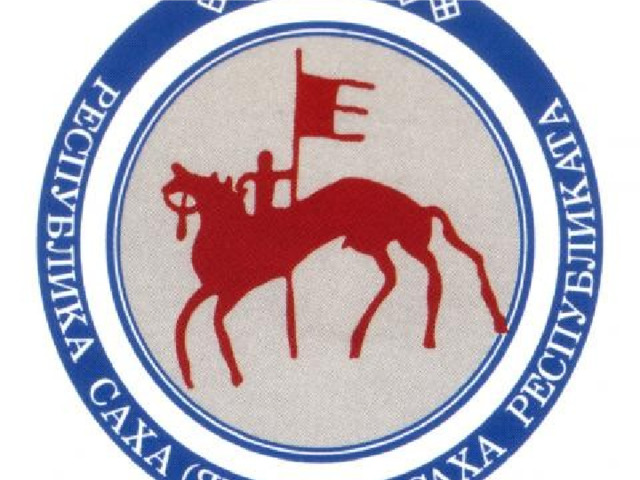
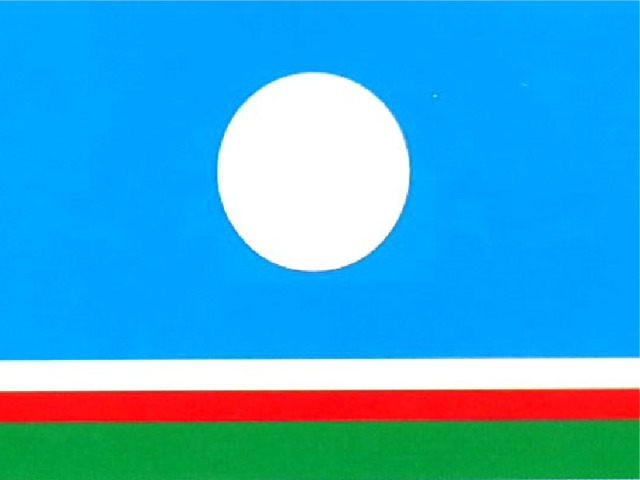

Thank you for attention


Вебинар для учителей

Свидетельство об участии БЕСПЛАТНО!