Россия, город Уфа


СДЕЛАЙТЕ СВОИ УРОКИ ЕЩЁ ЭФФЕКТИВНЕЕ, А ЖИЗНЬ СВОБОДНЕЕ
Благодаря готовым учебным материалам для работы в классе и дистанционно
Скидки до 50 % на комплекты
только до
Готовые ключевые этапы урока всегда будут у вас под рукой
Организационный момент
Проверка знаний
Объяснение материала
Закрепление изученного
Итоги урока
Была в сети 29.05.2026 07:19

Романчук Ирина Анатольевна
учитель
55 лет
 924
924
 70 658
Местоположение
Russian banknotes
Категория:
Английский язык
23.01.2025 10:30
Тема:
Culture Corner 3 p. 53

Просмотр содержимого документа
«Russian banknotes»

Take a brief look at Russian banknotes

The currency of Russia is called “ruble”. It has been used in our country since the 13 th century.
The first paper banknotes of Russia were issued in January 9, 1769
Catherine the Second
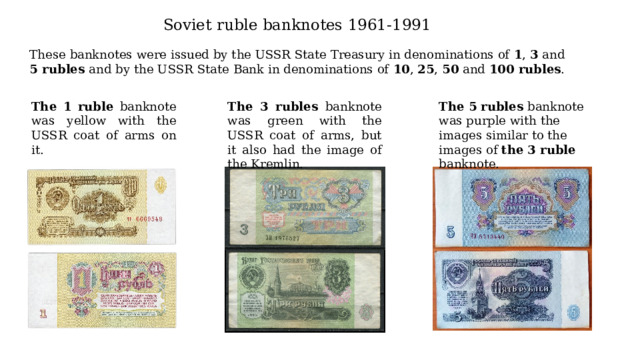
Soviet ruble banknotes 1961-1991
These banknotes were issued by the USSR State Treasury in denominations of 1 , 3 and 5 rubles and by the USSR State Bank in denominations of 10 , 25 , 50 and 100 rubles .
The 1 ruble banknote was yellow with the USSR coat of arms on it.
The 3 rubles banknote was green with the USSR coat of arms, but it also had the image of the Kremlin.
The 5 rubles banknote was purple with the images similar to the images of the 3 ruble banknote.

The 10, 25, 50 and 100 rubles were colourful and featured an image of Lenin’s face.

The front depicts the Kommunalny Bridge across the Yenisey River and Paraskeva Pyatnitsa Chapel in Krasnoyarsk , which is also the city in the background. On the back is a Krasnoyarsk hydroelectric station.
Now in Russia there are banknotes of 5 , 10 , 50 , 100 , 200 , 500 , 1000 , 2000 and 5000 rubles .
The design is dedicated to the city of Veliky Novgorod . On the obverse is the Millennium of Russia with Saint Sophia Cathedral in Novgorod in the background. On the reverse is the fortress wall of the Novgorod Kremlin . The Volkhov River is also seen in the background above the wall. [
The blue 50-ruble note has St. Petersburg on it. On one side you see the sculpture of a girl who symbolizes the Neva River, with the Peter and Paul Cathedral in the background. The Spit of Vasilievsky Island, with the Old St. Petersburg Stock Exchange and the Rostral Column, are pictured on the note’s other side.

On the front side and back of the banknote is the Bolshoi Theater.
On the front side of the banknote is a Monument to the scuttled ships in Sevastopol. On the back is the State Historical and Architectural Museum-Reserve “Tauric Chersoneses”.
On the front side of the banknote is a Monument to Peter the First and a sailboat in the port of Arkhangelsk. On the back is a monastery.

On the front side of the banknote is a Monument to Jaroslav Mudry and the Chapel of Kazan. On the back is a church.
The 5000 rubles banknote is the most valuable. On the front side of the banknote is a Monument to Nikolay Nikolayevich Muravyov-Amursky. On the back is a bridge over the Amur River.
In the front side of the banknote is a Russian bridge. On the back is a spaceport “Vostochny”



Вебинар для учителей

Свидетельство об участии БЕСПЛАТНО!