Россия, Миасс

СДЕЛАЙТЕ СВОИ УРОКИ ЕЩЁ ЭФФЕКТИВНЕЕ, А ЖИЗНЬ СВОБОДНЕЕ
Благодаря готовым учебным материалам для работы в классе и дистанционно
Скидки до 50 % на комплекты
только до
Готовые ключевые этапы урока всегда будут у вас под рукой
Организационный момент
Проверка знаний
Объяснение материала
Закрепление изученного
Итоги урока
Была в сети 19.05.2025 12:02

Медведева Марина Сергеевна
Учитель английского языка первой категории
37 лет
 7 367
7 367
 7 521
7 521 
Местоположение
Специализация
Школьная Олимпиада
Категория:
Английский язык
02.05.2017 10:35

Просмотр содержимого документа
«Школьная Олимпиада»
Муниципальный этап Всероссийской олимпиады школьников
по английскому языку
2016-2017 учебный год
7-8 классы
Время выполнения – 60 минут Максимальный балл – 50
Listening
Time: 10 minutes
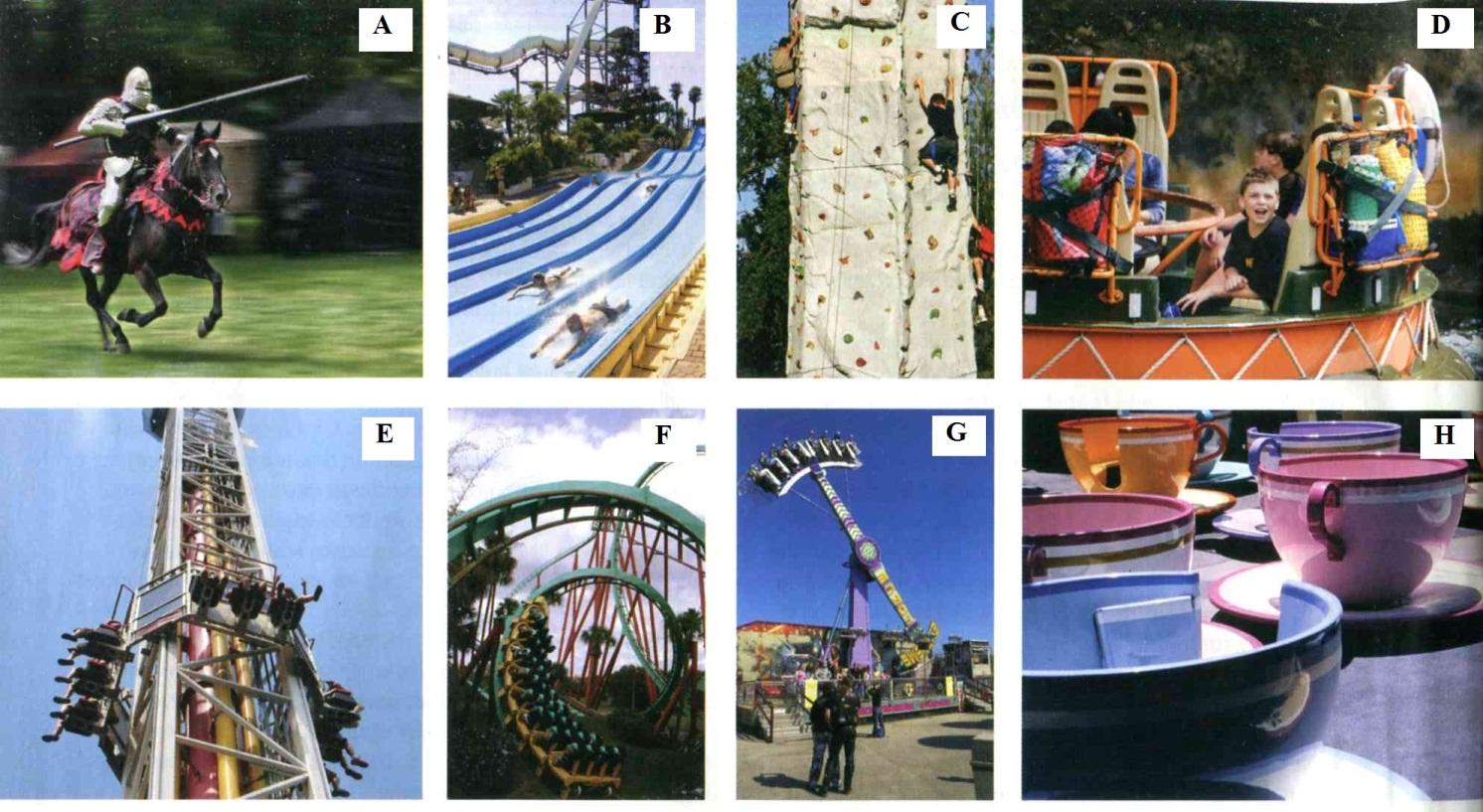
Task 1. You will hear six short extracts with people talking about rides and theme parks. Listen and decide which pictures below (A, B, C, D, E, F, G or H) are most similar to the attractions the speakers are talking about. There are extra pictures which you do not need.
You will hear the extracts two times.
| 1 | 2 | 3 | 4 | 5 | 6 |
|
|
|
|
|
|
|
Transfer your answers to the answer sheet!
Reading
Time: 15 minutes
Task 1. Read the article about British people and foreign languages and decide whether the following ideas are true (1), false (2) or do not appear in the text (3). Mark 1, 2 or 3 in the box.
| 7. | UK students never have to study a foreign language. |
|
| 8. | Most British people only speak English. |
|
| 9. | Edward Jones’ students never try to speak a foreign language. |
|
| 10. | British people don’t travel a lot. |
|
| 11. | Britain could do more business abroad. |
|
| 12. | The Government accepted there was a problem with their policy. |
|
| 13. | Learning languages earlier is definitely more effective. |
|
| 14. | The European Commission strongly supports early teaching. |
|
| 15. | There aren’t many opportunities for older people to learn. |
|
‘Language policy a disaster’ says head teacher
A top head teacher in the UK has called for a “review of language policy” after the number of students taking exams in languages at sixteen fell by 14.4% because foreign languages are now optional after the age of fourteen.
Lack of motivation
Low levels of language learning are nothing new in Britain – over 60% of the population are unable to get by in a foreign language. As Edward Jones, a teacher from Manchester, says, “Many of my students lack motivation and, strangely, foreign travel doesn’t really help. Often, they make an effort to speak French, or whatever, when they go abroad, but then find that local people reply in English and are more fluent than they are. They often feel embarrassed and just speak English after that. They come back to class asking ‘What’s the point?’”
Lost trade
According to a recent report, the point is that Britain is losing millions of euros of trade because of the lack of language skills. Relying on everyone else to speak English is not enough. Officials, however, defend their language policy. “We need to be realistic about what will improve language learning. Telling young people to learn a language at 16 won’t help. It’s better to give children the opportunity to learn a foreign language from the age of 7.”
Change to early teaching question
While there have been similar changes in many countries, studies have questioned if it really is easier for younger children to learn languages. A European Commission report has noted that there is a lack of evidence about the usefulness of early teaching. Although the report is generally in favour, it suggests that the advantages of an early start depend on providing “a good environment for learning and continuity from one year to the next.”
That can be difficult, according to Brian Willis, a language expert. “Many primary teachers have a basic level themselves and can’t teach much. Also, students progress at different speeds – some pick up quickly, some don’t learn anything at all! When they go to secondary school, their teachers have to deal with a wide range of levels. It’s very difficult.” He suggests that making language learning more available to older learners is equally important. “They could provide cheap classes at work or in universities.” Willis says it also helps if learners have more opportunities to hear foreign languages. “Places like Sweden and Holland show a lot of foreign films on TV and they don’t dub foreign TV programmes and films into their own languages.”
Brian Willis speaks eight different languages ‘at various levels’ and runs a company providing ‘language solutions’
People often say they have no talent for languages and so don’t even try. It’s nonsense. Everybody can learn to have basic conversations if they don’t worry about feeling stupid sometimes. All fluent speakers have had experiences when they get things badly wrong, but it’s important to keep practising.
I remember one mistake I made when I was teaching in Argentina. I had done a bit of Spanish before, but not much. In my first class, I was explaining to the students that I was a language learner too, so I knew how they felt. I told them – in Spanish – “Don’t get embarrassed!” The students looked surprised and said, “Embarazada?” “Yes,” I said, “because if you’re embarrassed, you can’t talk.” Several students laughed and we continued the class. I later found out I had used the wrong word and I’d actually said “Don’t get pregnant!” I felt stupid, but it didn’t stop me from talking and learning. I just never made the same mistake again!
Transfer your answers to the answer sheet!
Use of English
Time: 10 minutes
Task 1. Read the sentences below and choose the correct answer (A, B, C or D). There is only one correct answer for each sentence.
16. The actors … the kids with their performance and enthusiasm.
A inspired B inclined C involved D included
17. Most … like travelling.
A of people B of the people C the people D people
18. They … Alex to forget the idea, as it just could not be done and it was not practical.
A talked B said C told D spoke
19. I went to London … clothes.
A for buy B for to buy C to buy D to buying
20. … Gloria last week?
A Have you seen B Did you see C Were you seeing D You saw
Task 2. Read the conversation between Julia and Kevin who met by chance at the station. Put the verbs in the correct form like in the example given.
| Julia: | Hello, Kevin. …… I haven’t seen …… (I/not/see) you for ages. |
| | How are you? |
| Kevin: | I’m fine. How about you? You look well! |
| Julia: | Yes, I’m very well, thanks. So, (21) ………………………… (you/meet) somebody |
| | off the train? |
| Kevin: | No, (22) ………………………… (I/go) to London for a business meeting. |
| Julia: | Oh. (23) ………………………… (you/often/go) away on business? |
| Kevin: | Quite often, yes. And you? Where (24) ………………………… (you/go)? |
| Julia: | Nowhere. (25) ………………………… (I/meet) a friend. Unfortunately, her train |
| | (26) ………………………… (delay) – (27) ……………………….. (I/wait) here for |
| | nearly half an hour. |
| Kevin: | How are your children? |
| Julia: | They’re all fine, thanks. The youngest (28) ………………………… (just/start) school. |
| Kevin: | How is she getting on? (29) ………………………… (she/like) it? |
| Julia: | Oh, yes! She thinks it’s great! And you? Are you working at the moment? |
| | When (30) ………………………… (I/last/speak) to you, you were working |
| | in a travel agency… |
Transfer your answers to the answer sheet!
Writing
Time: 25 minutes
You would like to make life in your hometown better and you have some ideas how to do it.
|
|
| |
|
| ||
|
|
| |
|
| ||
|
| ||
Choose one idea and write a letter to the local authorities. In your letter
mention why you do not quite like something in your hometown
make your proposal using one of the ideas
explain how your hometown will change
Write between 120-150 words.
Writing
Time: 25 minutes
Participant’s ID number
|
|
|
|
|
|
|
10








Вебинар для учителей

Свидетельство об участии БЕСПЛАТНО!