Казахстан, поселок Айтеке би

СДЕЛАЙТЕ СВОИ УРОКИ ЕЩЁ ЭФФЕКТИВНЕЕ, А ЖИЗНЬ СВОБОДНЕЕ
Благодаря готовым учебным материалам для работы в классе и дистанционно
Скидки до 50 % на комплекты
только до
Готовые ключевые этапы урока всегда будут у вас под рукой
Организационный момент
Проверка знаний
Объяснение материала
Закрепление изученного
Итоги урока
Была в сети 10.01.2023 11:16

Қаражан Фариза Талғатбекқызы
Учитель английского языка
31 год
 2 014
2 014
 34 793
Местоположение
Специализация
Special techniques of developing speaking skills of students
Категория:
Английский язык
07.11.2021 21:39

Просмотр содержимого документа
«Special techniques of developing speaking skills of students»
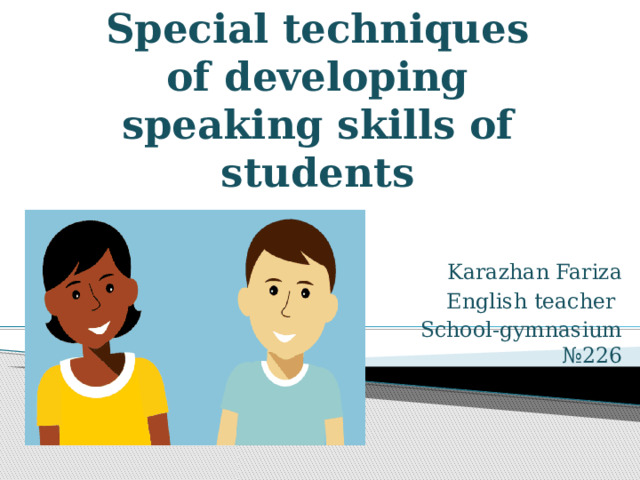
Special techniques of developing speaking skills of students
Karazhan Fariza
English teacher
School-gymnasium №226
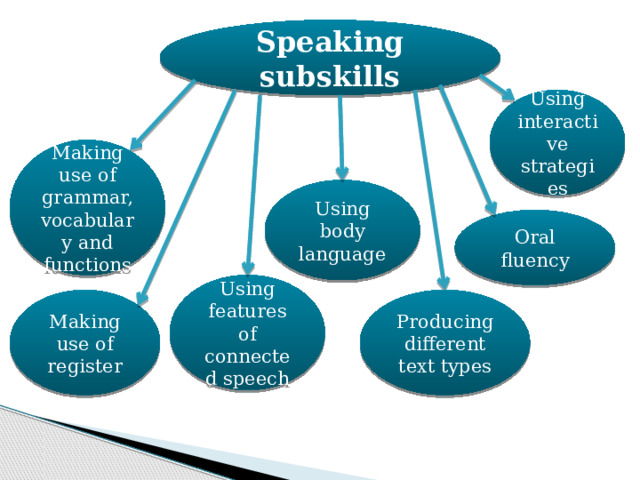
Speaking subskills
Using interactive strategies
Making use of grammar, vocabulary and functions
Using body language
Oral fluency
Using features of connected speech
Making use of register
Producing different text types

Particular aspects of speaking
- Fluency
- Pronunciation
- Register
- Grammatical accuracy
- Body language
- Interactive strategies
- Interactive speaking (conversations, discussions)
- Speaking at length (presentations, giving points of view)
Goals and Techniques for Teaching Speaking
The goal of teaching speaking skills is communicative efficiency. Learners should be able to make themselves understood, using their current proficiency to the fullest. They should try to avoid confusion in the message due to faulty pronunciation, grammar, or vocabulary, and to observe the social and cultural rules that apply in each communication situation.
To help students develop communicative efficiency in speaking, instructors can use a balanced activities approach that combines language input , structured output , and communicative output .
Language input comes in the form of teacher talk, listening activities, reading passages, and the language heard and read outside of class. It gives learners the material they need to begin producing language themselves.
Language input may be content oriented or form oriented .
Content-oriented input focuses on information, whether it is a simple weather report or an extended lecture on an academic topic. Content-oriented input may also include descriptions of learning strategies and examples of their use.
Form-oriented input focuses on ways of using the language: guidance from the teacher or another source on vocabulary, pronunciation, and grammar (linguistic competence); appropriate things to say in specific contexts (discourse competence); expectations for rate of speech, pause length, turn-taking, and other social aspects of language use (sociolinguistic competence); and explicit instruction in phrases to use to ask for clarification and repair miscommunication (strategic competence).

In the presentation part of a lesson, an instructor combines content-oriented and form-oriented input. The amount of input that is actually provided in the target language depends on students’ listening proficiency and also on the situation.
Structured output focuses on correct form. In structured output, students may have options for responses, but all of the options require them to use the specific form or structure that the teacher has just introduced.
Structured output is designed to make learners comfortable producing specific language items recently introduced, sometimes in combination with previously learned items. Instructors often use structured output exercises as a transition between the presentation stage and the practice stage of a lesson plan. Textbook exercises also often make good structured output practice activities.
In communicative output, the learners’ main purpose is to complete a task, such as obtaining information, developing a travel plan, or creating a video. To complete the task, they may use the language that the instructor has just presented, but they also may draw on any other vocabulary, grammar, and communication strategies that they know. In communicative output activities, the criterion of success is whether the learner gets the message across. Accuracy is not a consideration unless the lack of it interferes with the message.
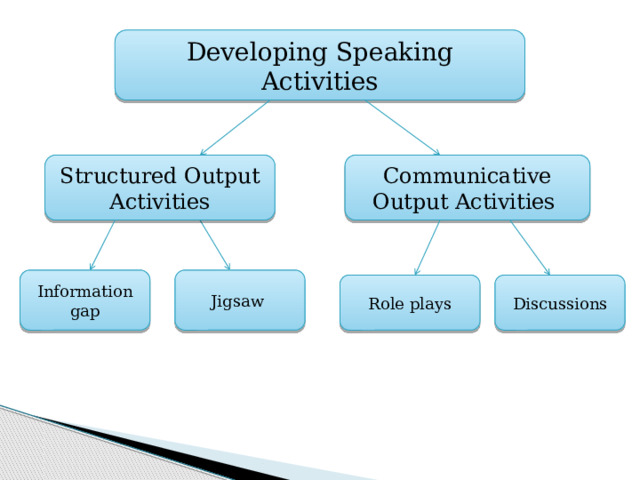
Developing Speaking Activities
Structured Output Activities
Communicative Output Activities
Information gap
Jigsaw
Role plays
Discussions
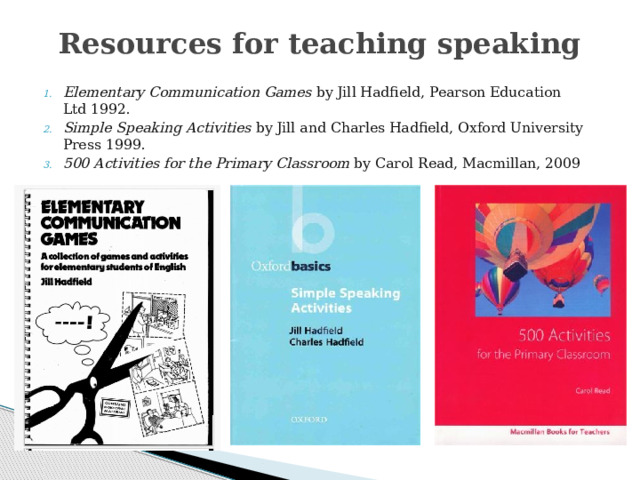
Resources for teaching speaking
- Elementary Communication Games by Jill Hadfield, Pearson Education Ltd 1992.
- Simple Speaking Activities by Jill and Charles Hadfield, Oxford University Press 1999.
- 500 Activities for the Primary Classroom by Carol Read, Macmillan, 2009
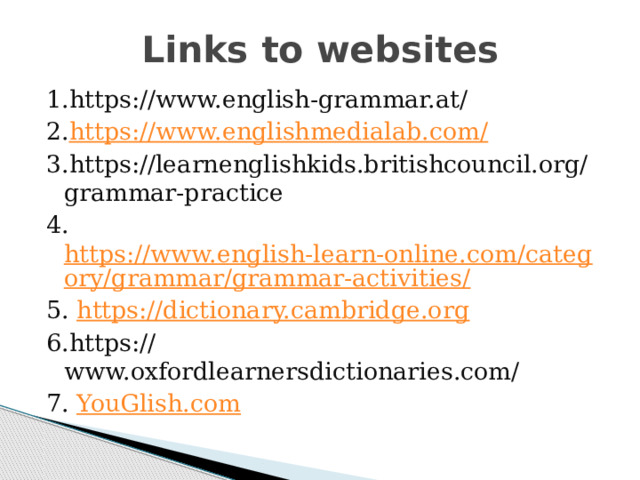
Links to websites
1.https://www.english-grammar.at/
2. https://www.englishmedialab.com/
3.https://learnenglishkids.britishcouncil.org/grammar-practice
4. https://www.english-learn-online.com/category/grammar/grammar-activities/
5. https://dictionary.cambridge.org
6.https://www.oxfordlearnersdictionaries.com/
7. YouGlish.com

Correcting learners
Reformulating
Oral correction
Peer and self-correction
Echo correcting
Finger correction
Gestures and facial expressions
Delayed correction

References:
1. Methodology course for teachers of English. Student’s book and Workbook. 2017
2. “Spoken language: What it is and how to teach it” by Grace Stovall Burkart, in Modules for the professional preparation of teaching assistants in foreign languages (Grace Stovall Burkart, ed.; Washington, DC: Center for Applied Linguistics, 1998)
https://files.eric.ed.gov/fulltext/ED433722.pdf
- https://busyteacher.org/7054-top-10-websites-esl-teacher.html
- https://www.spokenenglishpractice.com/learn-english-speaking-online/
- https://www.myenglishteacher.eu/blog/your-top-10-language-exchange-websites-for-speaking-english-fluently/

Thank you
for your attention!


Вебинар для учителей
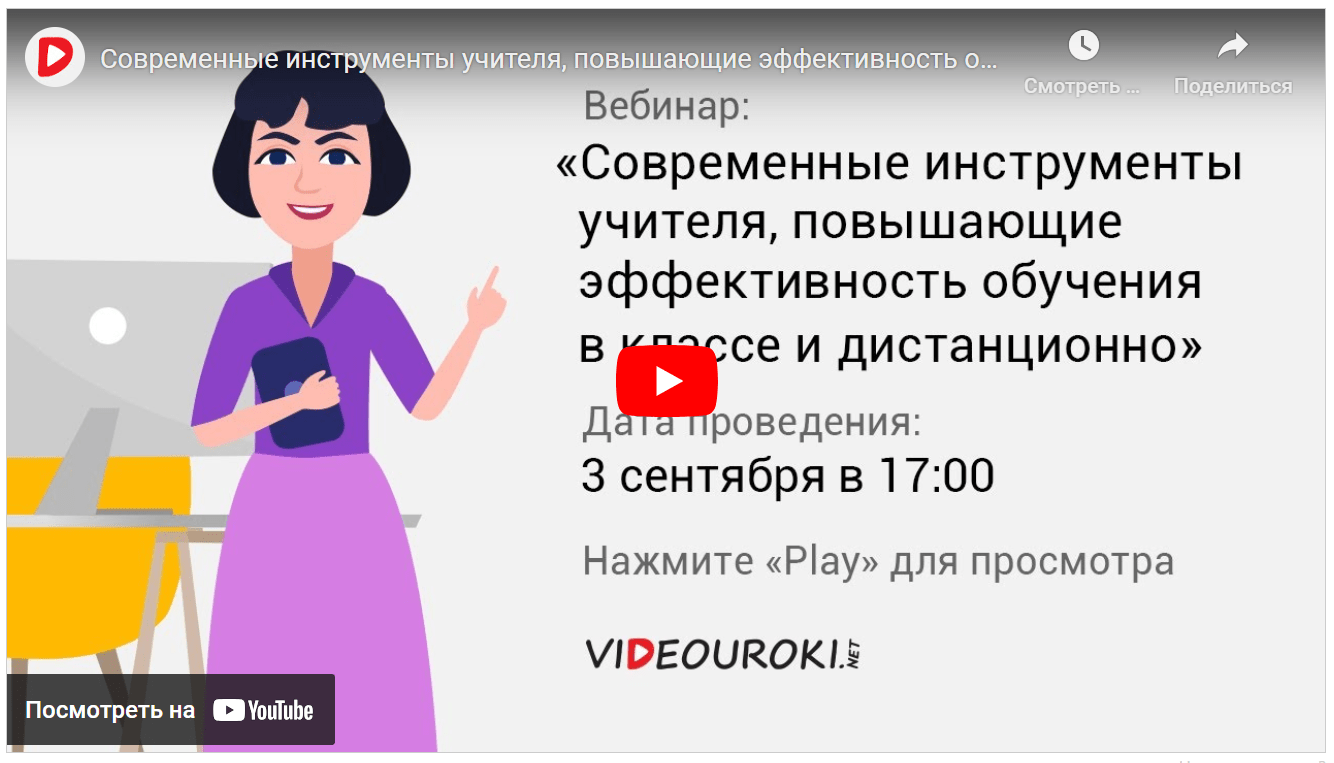
Свидетельство об участии БЕСПЛАТНО!