

Россия, г. Улан-Удэ

СДЕЛАЙТЕ СВОИ УРОКИ ЕЩЁ ЭФФЕКТИВНЕЕ, А ЖИЗНЬ СВОБОДНЕЕ
Благодаря готовым учебным материалам для работы в классе и дистанционно
Скидки до 50 % на комплекты
только до
Готовые ключевые этапы урока всегда будут у вас под рукой
Организационный момент
Проверка знаний
Объяснение материала
Закрепление изученного
Итоги урока
Была в сети 19.05.2026 11:22

Олзоева София Владимировна
учитель английского языка
 1 298
1 298
 53 483
Местоположение
Специализация
Спотлайт 7 модуль 1а
Категория:
Английский язык
04.12.2022 16:32

Просмотр содержимого документа
«Спотлайт 7 модуль 1а»

A city mouse or
a country mouse?
About someone who likes living in the city or in the country.
What are we going to talk about?

Listen to the sounds.
What can you see / smell / hear? How do they make you feel? (stressed? relaxed? free? worried? happy? lonely?)
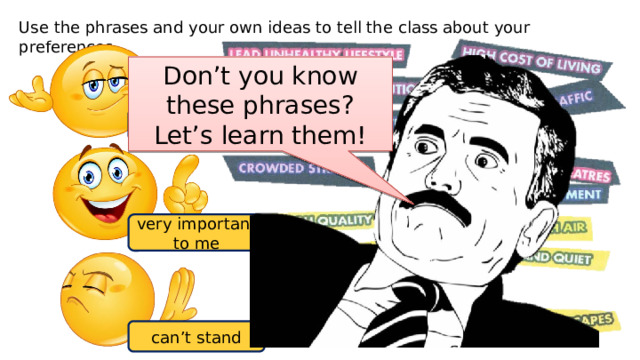
Use the phrases and your own ideas to tell the class about your preferences.
Don’t you know these phrases? Let’s learn them!
don’t mind
very important to me
can’t stand

High quality lifestyle
Lead unhealthy lifestyle
Вести нездоровый образ жизни
Высококачественный образ жизни
What can you see on the pictures?
Свежий воздух
Интенсивное движение
Heavy traffic
Fresh air
Чувство изоляции
Constant noise & pollution
Feeling isolated
Постоянный шум и загрязнения
Peace and quiet
Convenient public transport
Тишина и покой
Удобный общественный транспорт
Shops, cinemas and theatres
Friendly, helpful people
Магазины, кино и театры
Дружелюбные, отзывчивые люди
Beautiful landscapes
Многолюдные улицы
Красивые пейзажи
Crowded streets
Высокая цена проживания
High rate of unemployment
High cost of living
Высокий уровень безработицы
Низкий уровень безработицы
Low rate of unemployment

Use the phrases and your own ideas to tell the class about your preferences.
I don’t mind the peace and quiet of the country, but I can’t stand feeling isolated. I’m a city mouse.
don’t mind
A high quality lifestyle is very important to me. I like fresh air and beautiful landscapes. I think I’m a country mouse.
very important to me
I’m a city mouse. Convenient public transport and crowded streets are very important to me.
can’t stand

Before reading learn new words.
guest
lovely
чудесный
рядом
close at hand
гость
толчея и суета
swap
обмен
hustle and bustle
огромный
farmyard
huge
двор фермы
to milk
оборудование, приспособление
facility
доить
хлев, сарай
homesick
barn
тоскующий по дому
кормление
feeding
скучать
to miss
isolated
родной город
hometown
изолированный, одинокий

Read the title of the unit and the headings on this page. What do you expect to read about in the text on p. 7? Listen, read and check.
Swap
Sarah, 14
The text is about teenage lifestyles. Two teenagers are taking part in a reality show in which they swap families and schools.
Annabel, 14

Read the text and mark the sentences T (true) or F (false). Then explain the words in bold.
Annabel, 14
In Teenage Life Swap:
Sarah, 14
- Annabel doesn’t like staying in bed.
- Sarah can’t sleep at night.
- Sarah’s new school has lots of facilities.
- Annabel travels five miles to reach the school.
false
true
true
false
Read the text aloud, as if for a radio programme.
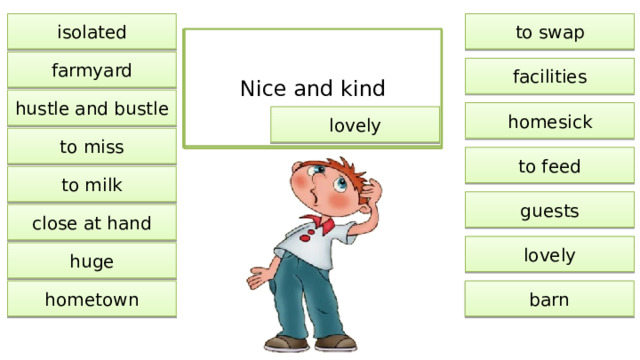
isolated
to swap
Nice and kind
To give food to an animal
Very big
Nearby
An area of land near the farmhouse enclosed by walls or buildings
People who are invites
A building on a farm in which we keep crops or animals
To feel bad because you are away from your home and/or family
Being alone or far from people
To exchange sth for sth else
To get milk from a cow
Buildings, equipment, or services provided at a place.
To feel sad because you don’t have something anymore
The town where somebody comes from and lived/lives in
Movement, activity and noise of a place
farmyard
facilities
hustle and bustle
guests
homesick
lovely
to milk
barn
to feed
close at hand
hustle and bustle
huge
isolated
facilities
hometown
to miss
homesick
farmyard
to swap
to miss
to feed
to milk
guests
close at hand
lovely
huge
hometown
barn
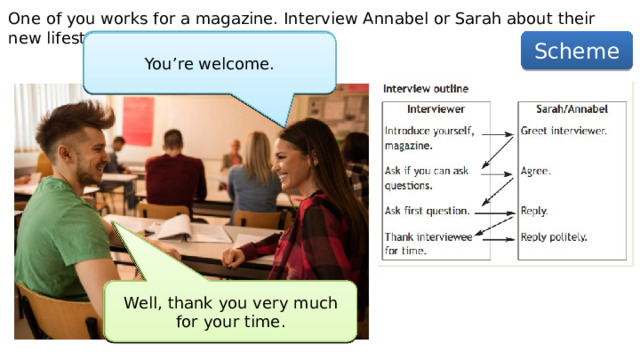
One of you works for a magazine. Interview Annabel or Sarah about their new lifestyle.
Scheme
Hello. Nice to see you.
Of course.
I get up at 5 am.
I leave for school at 7 am.
Yes, I’m learning how to milk cows … etc.
You’re welcome.
What time do you get up?
Hello, my name is Ben Jones from Star Magazine.
Can I ask you a few questions, Annabel?
What time do you go to school?
Are you learning anything at Sarah’s house?
Well, thank you very much for your time.

Present Simple VS
Present Continuous

Present Simple
Key words:
- usually
- often
- always
- every day
- every week
- every month
- every year
- in the morning
- in the afternoon
- in the evening
- at night
- at the weekend
- on Fridays
Постоянные действия и состояния
Mark lives in New Zealand.
Непреложные истины и законы природы
The Moon goes round the Earth.
Привычки и регулярные действия
She always cleans the house at weekends.

Расписания и программы
The train leaves at 6:00 am.
Чувства и эмоции
I love skiing because it’s a fun sport.
Present Simple употребляется также в спортивных комментариях, обзорах, повествованиях
Beckham wins the ball, then he crosses and Owen scores.

Present Continuous
Key words:
- now
- at the moment
- at present
- these days
- nowadays
- still
- today
- tonight
Действия, происходящие в момент речи, в настоящий период времени.
Mum is cooking in the kitchen.
He is looking for a new penfriend in England.
Запланированные действия в будущем.
He is playing tennis this afternoon.
Меняющиеся и развивающиеся ситуации
Mary is getting more and more beautiful.

Такие наречия, как always, для выражения эмоционального состояния (часто раздражения) по поводу повторяющегося действия.
She is always losing her keys.

Stative verbs – глаголы состояния
She sounds quite happy.
Обозначают состояния
Present Continuous
She appears happy.
The food tastes delicious.
Глаголы восприятия
taste
smell
The milk smells strange.
appear
hear
sound
Do you see that bird now?
see
seem

Stative verbs – глаголы состояния
He believes in ghosts.
Обозначают состояния
Present Continuous
I don’t understand you.
Do you remember me?
Глаголы мыслительной деятельности
understand
Please, don’t forget about it.
believe
know
remember
I know it is truth.
forget
realise

Stative verbs – глаголы состояния
I like ice cream.
Обозначают состояния
Present Continuous
I like your new haircut.
I hate Monday mornings.
Глаголы, выражающие чувства и эмоции
want
love
We prefer lemonade.
desire
hate
prefer
He wants a new car.
enjoy
like

Stative verbs – глаголы состояния
They own three cows.
Обозначают состояния
Present Continuous
It belongs to me.
Другие глаголы
include
need
want
have
be
contain
own
fit
belong
cost
wish
matter

Некоторые из этих глаголов могут употребляться в Present Continuous, но с иным значением.
Think
Обдумывать, размышлять
He is thinking about going to France.
Думать, полагать
I think she’s beautiful.

Некоторые из этих глаголов могут употребляться в Present Continuous, но с иным значением.
Хорошо проводить время; принимать душ, обедать
Have
James is having a great time at school.
He is having a shower.
They are having dinner.
Иметь, владеть
She has twelve cats.
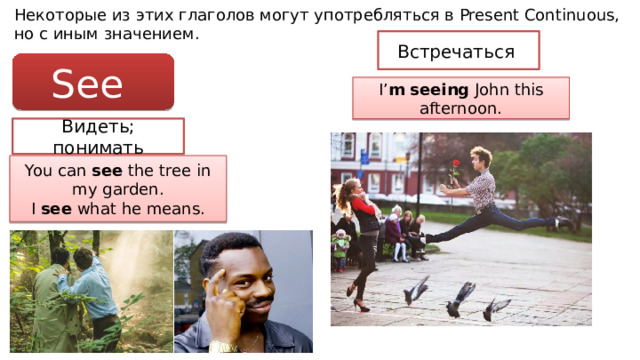
Некоторые из этих глаголов могут употребляться в Present Continuous, но с иным значением.
Встречаться
See
I’ m seeing John this afternoon.
Видеть; понимать
You can see the tree in my garden.
I see what he means.

Некоторые из этих глаголов могут употребляться в Present Continuous, но с иным значением.
Пробовать на вкус
Taste
Ann is tasting the pudding.
Быть … на вкус
This coffee tastes good.

Некоторые из этих глаголов могут употребляться в Present Continuous, но с иным значением.
Выступать, играть, появляться
Appear
She is appearing in a Shakespeare play.
Казаться, производить впечатление
She appears to know the way.

Некоторые из этих глаголов могут употребляться в Present Continuous, но с иным значением.
Нюхать, вдыхать аромат
Smell
She is smelling the flower.
Иметь запах, пахнуть
Her perfume smells sweet.

Некоторые из этих глаголов могут употребляться в Present Continuous, но с иным значением.
Устанавливать
Fit
Tom is fitting a new lock on the bathroom door.
Быть впору, нужного размера
The dress fits her perfectly.

Глаголы look (когда речь идёт о чьей-либо внешности), feel (переживание определенных эмоций) и ache могут использоваться во временах Simple и Continuous без изменения значения .
She feels very stressed.
She is feeling very stressed.

Explain the use of the verbs in bold.
An action happening at the moment of speaking.
Future plans.
Present state and facts.
Routine, habit
Future plans
Future plans.

Find examples in the text above.

Put the verbs in brackets in the Present Simple or the Present Continuous. Give reasons.
A: Why ……………………… (you/be) in such a hurry?
1.
B: I’m worried. My exam ……………………… (start) in ten minutes.
2.
A: I ………………………… (think) of changing school.
B: I ………………………… (not/think) it’s a good idea. You’ll be lonely.
3.
A: Why ……………………… (you/be) angry?
B: My sister ………………………… (always/take) my clothes.
A: Tom ……………………… (look) very stressed.
4.
B: Yes. He ……………………… (study) a lot these days.
A: Why ……………………… (you/leave) now?
5.
B: my train ……………………… (leave) in an hour.

Writing (an e-mail)
Write an e-mail to your English penfriend. Write about:
Where you live
Your daily routine
What you are doing these days/tonight.

Workbook
Match the words to form collocations.
fresh
streets
heavy
air
1. Very few people …………………… a healthy lifestyle in big cities.
lead
2. Our house is next to the train station, which is very …………………….
3. Many young people have to deal with ……………………………… when they finish their studies.
4. Thailand is a country with amazing …………………….
5. I can’t study when there’s ………………………… noise around me.
6. She lives in a(n) ……………………… area in Northern Norway.
traffic
public
convenient
unemployment
transport
crowded
Fill in the correct words.
landscapes
constant
lead
convenient
constant
isolated
landscapes
isolated
unemployment
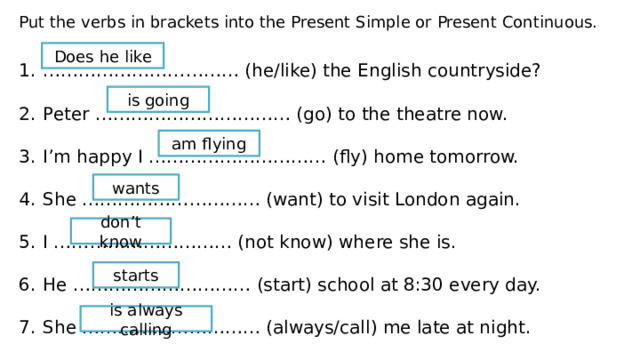
Put the verbs in brackets into the Present Simple or Present Continuous.
- …………………………… (he/like) the English countryside?
- Peter …………………………… (go) to the theatre now.
- I’m happy I ………………………… (fly) home tomorrow.
- She ………………………… (want) to visit London again.
- I ………………………… (not know) where she is.
- He ………………………… (start) school at 8:30 every day.
- She ………………………… (always/call) me late at night.
Does he like
is going
am flying
wants
don’t know
starts
is always calling

Read and choose A, B or C.
1. The Australian Outback is close to the sea.
True
False
Doesn’t say
2. Children in the Australian Outback don’t get an education.
True
False
Doesn’t say
3. The students study online.
Doesn’t say
True
False
4. The students don’t speak to their teachers.
True
False
Doesn’t say
5. School is more fun for children in the Australian Outback.
True
False
Doesn’t say


Вебинар для учителей

Свидетельство об участии БЕСПЛАТНО!



