

© 2020, Ни Юлия Игоревна 311 0


СДЕЛАЙТЕ СВОИ УРОКИ ЕЩЁ ЭФФЕКТИВНЕЕ, А ЖИЗНЬ СВОБОДНЕЕ
Благодаря готовым учебным материалам для работы в классе и дистанционно
Скидки до 50 % на комплекты
только до
Готовые ключевые этапы урока всегда будут у вас под рукой
Организационный момент
Проверка знаний
Объяснение материала
Закрепление изученного
Итоги урока

Была в сети 21.08.2025 20:55

Ни Юлия Игоревна
Студент группы ТП-17-1Р
 6 355
6 355
 9 184
9 184 
Специализация
Structure and content of organizational culture
Категория:
Психологу
21.09.2020 01:31

Просмотр содержимого документа
«Structure and content of organizational culture»
Structure and content of organizational culture
- There are many approaches to the selection of various attributes that characterize and identify a particular culture both at the macro and micro levels.
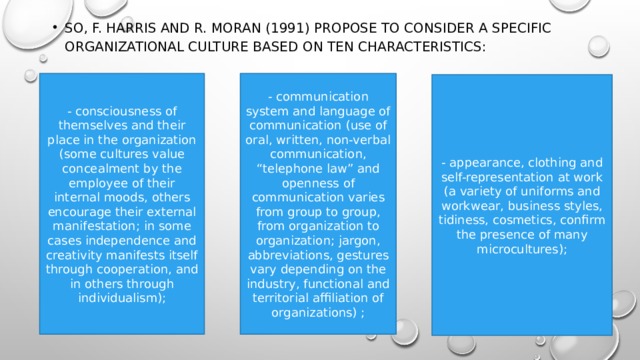
- So, F. Harris and R. Moran (1991) propose to consider a specific organizational culture based on ten characteristics:
- consciousness of themselves and their place in the organization (some cultures value concealment by the employee of their internal moods, others encourage their external manifestation; in some cases independence and creativity manifests itself through cooperation, and in others through individualism);
- communication system and language of communication (use of oral, written, non-verbal communication, “telephone law” and openness of communication varies from group to group, from organization to organization; jargon, abbreviations, gestures vary depending on the industry, functional and territorial affiliation of organizations) ;
- appearance, clothing and self-representation at work (a variety of uniforms and workwear, business styles, tidiness, cosmetics, confirm the presence of many microcultures);
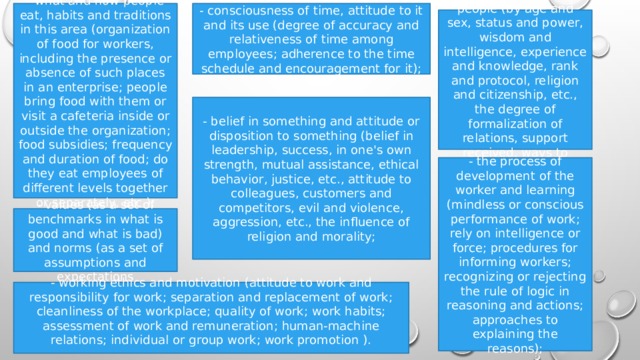
- what and how people eat, habits and traditions in this area (organization of food for workers, including the presence or absence of such places in an enterprise; people bring food with them or visit a cafeteria inside or outside the organization; food subsidies; frequency and duration of food; do they eat employees of different levels together or separately, etc.);
- consciousness of time, attitude to it and its use (degree of accuracy and relativeness of time among employees; adherence to the time schedule and encouragement for it);
- interactions between people (by age and sex, status and power, wisdom and intelligence, experience and knowledge, rank and protocol, religion and citizenship, etc., the degree of formalization of relations, support received, ways to resolve conflicts);
- belief in something and attitude or disposition to something (belief in leadership, success, in one's own strength, mutual assistance, ethical behavior, justice, etc., attitude to colleagues, customers and competitors, evil and violence, aggression, etc., the influence of religion and morality;
- the process of development of the worker and learning (mindless or conscious performance of work; rely on intelligence or force; procedures for informing workers; recognizing or rejecting the rule of logic in reasoning and actions; approaches to explaining the reasons);
- values (as a set of benchmarks in what is good and what is bad) and norms (as a set of assumptions and expectations
- working ethics and motivation (attitude to work and responsibility for work; separation and replacement of work; cleanliness of the workplace; quality of work; work habits; assessment of work and remuneration; human-machine relations; individual or group work; work promotion ).
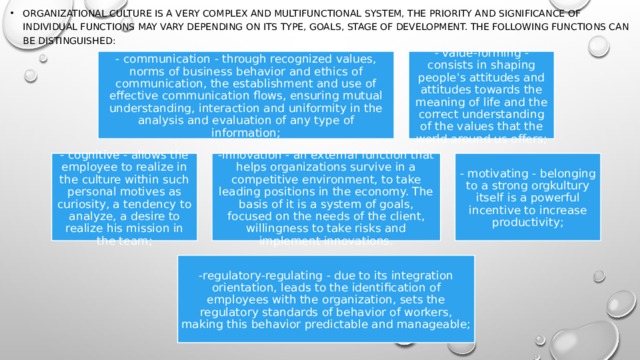
- Organizational culture is a very complex and multifunctional system, the priority and significance of individual functions may vary depending on its type, goals, stage of development. The following functions can be distinguished:
- communication - through recognized values, norms of business behavior and ethics of communication, the establishment and use of effective communication flows, ensuring mutual understanding, interaction and uniformity in the analysis and evaluation of any type of information;
- value-forming - consists in shaping people's attitudes and attitudes towards the meaning of life and the correct understanding of the values that the world around us offers;
- cognitive - allows the employee to realize in the culture within such personal motives as curiosity, a tendency to analyze, a desire to realize his mission in the team;
-innovation - an external function that helps organizations survive in a competitive environment, to take leading positions in the economy. The basis of it is a system of goals, focused on the needs of the client, willingness to take risks and implement innovations.
- motivating - belonging to a strong orgkultury itself is a powerful incentive to increase productivity;
-regulatory-regulating - due to its integration orientation, leads to the identification of employees with the organization, sets the regulatory standards of behavior of workers, making this behavior predictable and manageable;
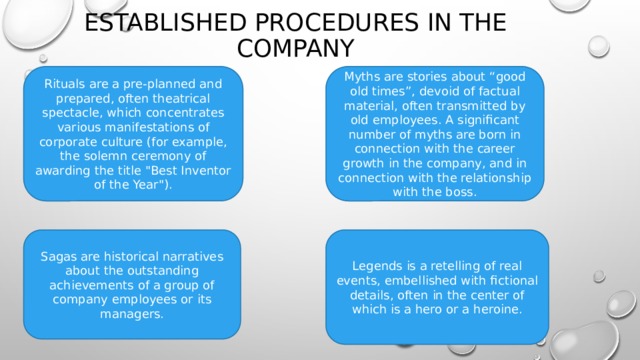
Established procedures in the company
Rituals are a pre-planned and prepared, often theatrical spectacle, which concentrates various manifestations of corporate culture (for example, the solemn ceremony of awarding the title "Best Inventor of the Year").
Myths are stories about “good old times”, devoid of factual material, often transmitted by old employees. A significant number of myths are born in connection with the career growth in the company, and in connection with the relationship with the boss.
Sagas are historical narratives about the outstanding achievements of a group of company employees or its managers.
Legends is a retelling of real events, embellished with fictional details, often in the center of which is a hero or a heroine.
Вебинар для учителей

Свидетельство об участии БЕСПЛАТНО!