кыргызстан, Бишкек


СДЕЛАЙТЕ СВОИ УРОКИ ЕЩЁ ЭФФЕКТИВНЕЕ, А ЖИЗНЬ СВОБОДНЕЕ
Благодаря готовым учебным материалам для работы в классе и дистанционно
Скидки до 50 % на комплекты
только до
Готовые ключевые этапы урока всегда будут у вас под рукой
Организационный момент
Проверка знаний
Объяснение материала
Закрепление изученного
Итоги урока

Была в сети 27.09.2021 12:53

Ботоева Гулкайыр Суюнбековна
учитель английского языка
40 лет
 72
72
 236 776
Местоположение
Специализация
Symbols of canada
Категория:
Английский язык
09.09.2021 07:45

Просмотр содержимого документа
«Symbols of canada»

SYMBOLS OF CANADA: FLAG, COAT OF ARMS, ANTHEM.
FLAG
- On the flag of Canada:
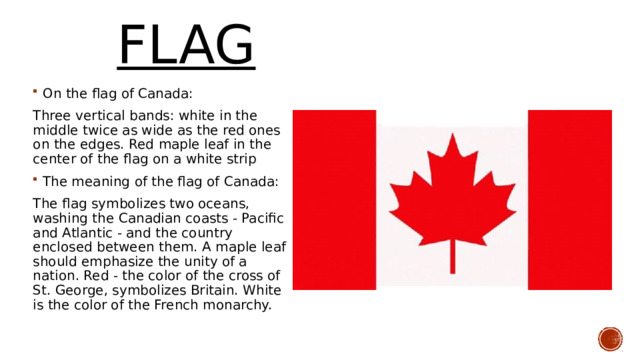
Three vertical bands: white in the middle twice as wide as the red ones on the edges. Red maple leaf in the center of the flag on a white strip
- The meaning of the flag of Canada:
The flag symbolizes two oceans, washing the Canadian coasts - Pacific and Atlantic - and the country enclosed between them. A maple leaf should emphasize the unity of a nation. Red - the color of the cross of St. George, symbolizes Britain. White is the color of the French monarchy.

THE HISTORY OF THE FLAG of Canada
In the first decades of the development of Canada (from the end of the 15th century and until the 1520s), the flag of this territory was the English flag depicting the cross of St. George. Later, when Canada became the possession of the King of France, the flag of the French Orleans dynasty with royal lilies was used.
In the 1620's. Canada again falls under the influence of Britain and uses the flag of Great Britain as a flag. In 1707, the flag of Canada is Red Insign (red sea flag with the British flag in the canton), later renamed the Canadian Red Insign. It served as the "calling card" of Canada and after the formation of the dominion in 1867 - this flag was used by Canadians until the middle of the XX century.
In 1925, a committee was established to develop the national flag. But only in 1964, (when more than 2,600 design options were presented), the new national flag was approved by the Canadian Parliament and approved by Queen Elizabeth II. The first flag raising took place on February 15, 1965.
According to one legend, the maple leaf became the symbol of Canada under the following circumstances. In 1860, the Prince of Wales first visited Canada. In Toronto, the meeting of the high guest was planned. The population of the city was preparing to meet the prince with his national symbols. So, English emigrants brought roses, Scottish - branches of a thistle (the symbol of Scotland). However, for the children of emigrants born in Canada, the symbol was not found, since the only Canadian symbol was a beaver. However, at the end of the 1830s the Baptist Society of St. John in Quebec adopted the maple leaf as a symbol of its Society. He was offered to carry Canadians at a meeting with Prince Wales.
Red and white colors became official colors of Canada after their approval by King George V on November 21, 1921.

THE old flags of Canada
1868 – 1921
1921 - 1957
1957 - 1964
Leicester Peterson’s version
CANADIAN COAt of arms
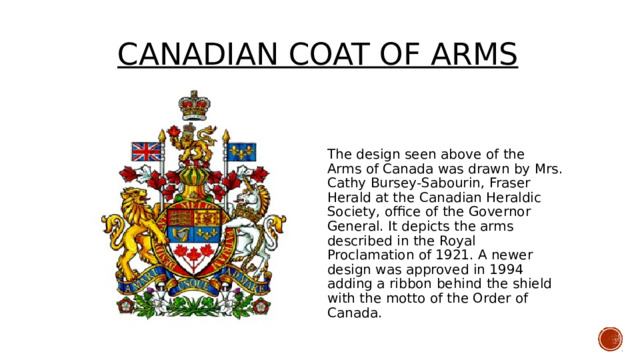
The design seen above of the Arms of Canada was drawn by Mrs. Cathy Bursey-Sabourin, Fraser Herald at the Canadian Heraldic Society, office of the Governor General. It depicts the arms described in the Royal Proclamation of 1921. A newer design was approved in 1994 adding a ribbon behind the shield with the motto of the Order of Canada.
THE SHIELD
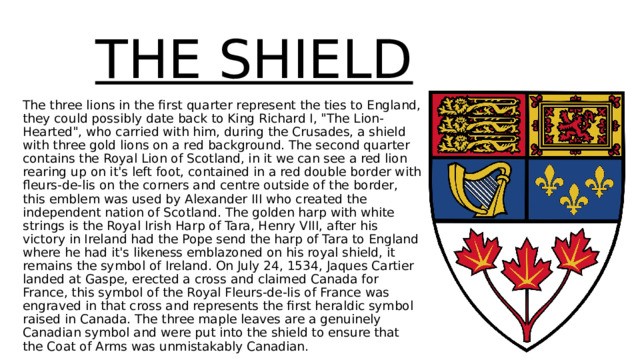
The three lions in the first quarter represent the ties to England, they could possibly date back to King Richard I, "The Lion-Hearted", who carried with him, during the Crusades, a shield with three gold lions on a red background. The second quarter contains the Royal Lion of Scotland, in it we can see a red lion rearing up on it's left foot, contained in a red double border with fleurs-de-lis on the corners and centre outside of the border, this emblem was used by Alexander III who created the independent nation of Scotland. The golden harp with white strings is the Royal Irish Harp of Tara, Henry VIII, after his victory in Ireland had the Pope send the harp of Tara to England where he had it's likeness emblazoned on his royal shield, it remains the symbol of Ireland. On July 24, 1534, Jaques Cartier landed at Gaspe, erected a cross and claimed Canada for France, this symbol of the Royal Fleurs-de-lis of France was engraved in that cross and represents the first heraldic symbol raised in Canada. The three maple leaves are a genuinely Canadian symbol and were put into the shield to ensure that the Coat of Arms was unmistakably Canadian.
THE CREST
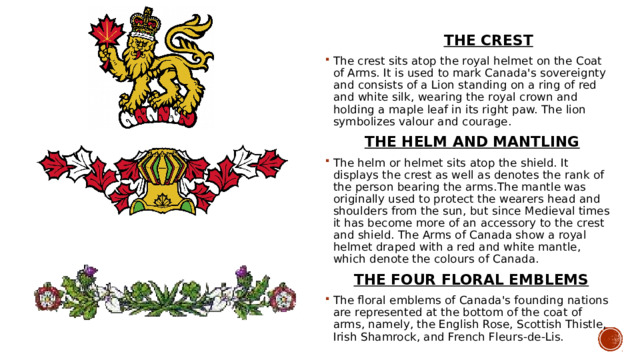
- The crest sits atop the royal helmet on the Coat of Arms. It is used to mark Canada's sovereignty and consists of a Lion standing on a ring of red and white silk, wearing the royal crown and holding a maple leaf in its right paw. The lion symbolizes valour and courage.
THE HELM AND MANTLING
- The helm or helmet sits atop the shield. It displays the crest as well as denotes the rank of the person bearing the arms.The mantle was originally used to protect the wearers head and shoulders from the sun, but since Medieval times it has become more of an accessory to the crest and shield. The Arms of Canada show a royal helmet draped with a red and white mantle, which denote the colours of Canada.
THE FOUR FLORAL EMBLEMS
- The floral emblems of Canada's founding nations are represented at the bottom of the coat of arms, namely, the English Rose, Scottish Thistle, Irish Shamrock, and French Fleurs-de-Lis.
THE Supporters
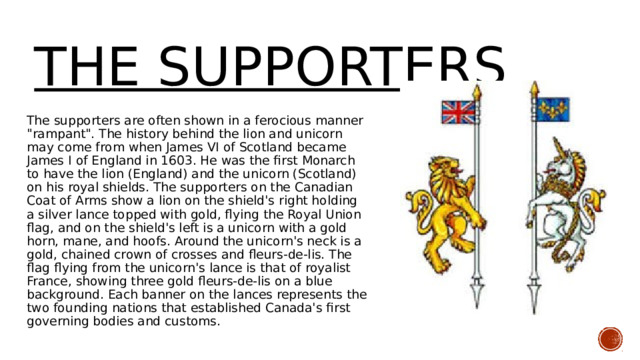
The supporters are often shown in a ferocious manner "rampant". The history behind the lion and unicorn may come from when James VI of Scotland became James I of England in 1603. He was the first Monarch to have the lion (England) and the unicorn (Scotland) on his royal shields. The supporters on the Canadian Coat of Arms show a lion on the shield's right holding a silver lance topped with gold, flying the Royal Union flag, and on the shield's left is a unicorn with a gold horn, mane, and hoofs. Around the unicorn's neck is a gold, chained crown of crosses and fleurs-de-lis. The flag flying from the unicorn's lance is that of royalist France, showing three gold fleurs-de-lis on a blue background. Each banner on the lances represents the two founding nations that established Canada's first governing bodies and customs.
THE MOTTO
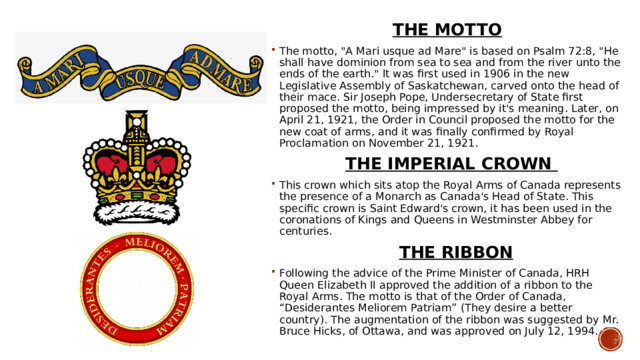
- The motto, "A Mari usque ad Mare" is based on Psalm 72:8, "He shall have dominion from sea to sea and from the river unto the ends of the earth." It was first used in 1906 in the new Legislative Assembly of Saskatchewan, carved onto the head of their mace. Sir Joseph Pope, Undersecretary of State first proposed the motto, being impressed by it's meaning. Later, on April 21, 1921, the Order in Council proposed the motto for the new coat of arms, and it was finally confirmed by Royal Proclamation on November 21, 1921.
THE IMPERIAL CROWN
- This crown which sits atop the Royal Arms of Canada represents the presence of a Monarch as Canada's Head of State. This specific crown is Saint Edward's crown, it has been used in the coronations of Kings and Queens in Westminster Abbey for centuries.
THE RIBBON
- Following the advice of the Prime Minister of Canada, HRH Queen Elizabeth II approved the addition of a ribbon to the Royal Arms. The motto is that of the Order of Canada, “Desiderantes Meliorem Patriam” (They desire a better country). The augmentation of the ribbon was suggested by Mr. Bruce Hicks, of Ottawa, and was approved on July 12, 1994.

anthem: THE OFFIcial English lyrics Of The anthem
O Canada!! Our home and native land!
True patriot love in all of us command.
О, Канада! Наш дом и родная земля!
Сердца твоих потомков движимы любовью к тебе,
With glowing hearts we see thee rise,
The True North strong and free!
С пылающими сердцами мы видим, как ты растёшь
Истинной Северянкой, сильной и свободной! Отовсюду, о, Канада,
From far and wide, O Canada,
We stand on guard for thee.
Мы стоим на страже твоей.
Да сохранит Бог нашу страну славной и свободной!
God keep our land glorious and free!
О, Канада, мы стоим на страже твоей.
O Canada, we stand on guard for thee.
О, Канада, мы стоим на страже твоей.
O Canada, we stand on guard for thee.

The official French anthem with the official English translate
Ô Canada!
Terre de nos aïeux,
O Canada,
land of our ancestors
Ton front est ceint de fleurons glorieux!
О, Канада!
Car ton bras sait porter l’epée,
Земля наших предков-отцов! На тебе яркий пояс прекрасных цветов!
Glorious deeds circle your brow
For your arm knows how to wield the sword
Il sait porter la croix!
Пусть рука, что мечом так владеет
Your arm knows how to carry the cross;
Ton histoire est une epopée Des plus brillants exploits,
И так твердо святой крест несёт,
Your history is an epic of brilliant deeds
Et ta valeur, de foi trempée, Protégera nos foyers et nos droits,
Вся история чья — эпопея, Ярких подвигов, веры оплот. Чьи сокровища, чтя, всё сумеет
Protégera nos foyers et nos droits.
And your valour steeped in faith
Защитить очаги и святыни. Защитим очаги и святыни!
will protect our homes and our rights,
Will protect our homes and our rights.








Вебинар для учителей

Свидетельство об участии БЕСПЛАТНО!