Россия, Новомосковск

СДЕЛАЙТЕ СВОИ УРОКИ ЕЩЁ ЭФФЕКТИВНЕЕ, А ЖИЗНЬ СВОБОДНЕЕ
Благодаря готовым учебным материалам для работы в классе и дистанционно
Скидки до 50 % на комплекты
только до
Готовые ключевые этапы урока всегда будут у вас под рукой
Организационный момент
Проверка знаний
Объяснение материала
Закрепление изученного
Итоги урока
Была в сети 25.10.2023 17:18

Дорошенко Ксения Сергеевна
Учитель английского языка
30 лет
 109
109
 214 050
Местоположение
Специализация
System of Education in Australia
Категория:
Английский язык
27.02.2018 18:53

Просмотр содержимого документа
«System of Education in Australia»
The System of Education in Australia
Education in Australia is primarily the responsibility of the states and territories. Each state or territory government provides funding and regulates the public and private schools within its governing area. The federal government helps fund the public universities, but was not involved in setting curriculum.
Generally, education in Australia follows the three-tier model which includes:
- primary education (primary schools)
- secondary education(secondary schools/high schools)
- tertiary education (universities and/or TAFE colleges).
Education in Australia is compulsory between the ages of five and fifteen to seventeen, depending on the state or territory, and date of birth. The academic year in Australia varies between states and institutions, but generally runs from late January/early February until mid-December for primary and secondary schools, with slight variations in the inter-term holidays and TAFE colleges,
and from late February until mid-November for universities with seasonal holidays and breaks for each educational institute.
Pre-school
Pre-school and pre-prep programmes in Australia is relatively unregulated, and is not compulsory. The first exposure many Australian children have to learn with others outside of traditional parenting is day care or a parent-run playgroup. This sort of activity is not generally considered schooling, as pre-school education is separate from primary school in all states and territories, except Western Australia where pre-school education is taught as part of the primary school system .
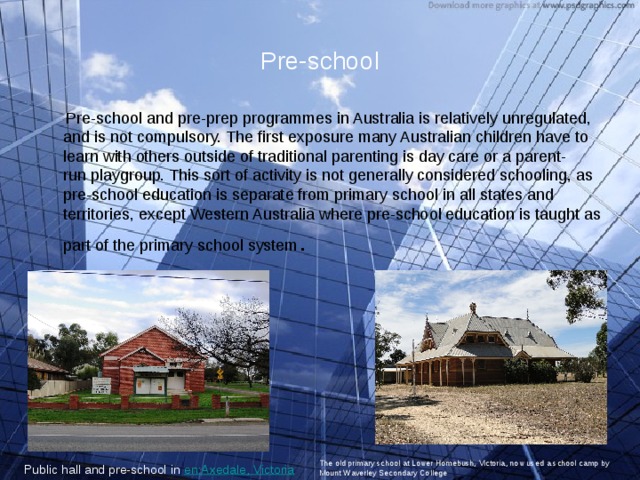
Public hall and pre-school in en:Axedale, Victoria
The old primary school at Lower Homebush, Victoria, now used a school camp by Mount Waverley Secondary College
Schools
School education in Australia is compulsory between certain ages as specified by state or territory legislation. Depending on the state or territory, and date of birth of the child, school is compulsory from the age of five to six to the age of fifteen to seventeen. In recent years, over three quarters of students stay at school until they are seventeen. Government schools educate approximately 65% of Australian students, with approximately 34% in Catholic and independent schools. A small portion of students are legally home-schooled, particularly in rural areas. Government schools (also known as public schools) are free to attend for Australian citizens and permanent residents, while Catholic and independent schools usually charge attendance fees. However in addition to attendance fees; stationery, textbooks, uniforms, school camps and other schooling costs are not covered under government funding. The additional cost for schooling has been estimated to be on average $316 per year per child.
Regardless of whether a school is part of the Government, Catholic or independent systems, they are required to adhere to the same curriculum frameworks of their state or territory. The curriculum framework however provides for some flexibility in the syllabus, so that subjects such as religious education can be taught. Most school students wear uniforms, although there are varying expectations and some Australian schools do not require uniforms.
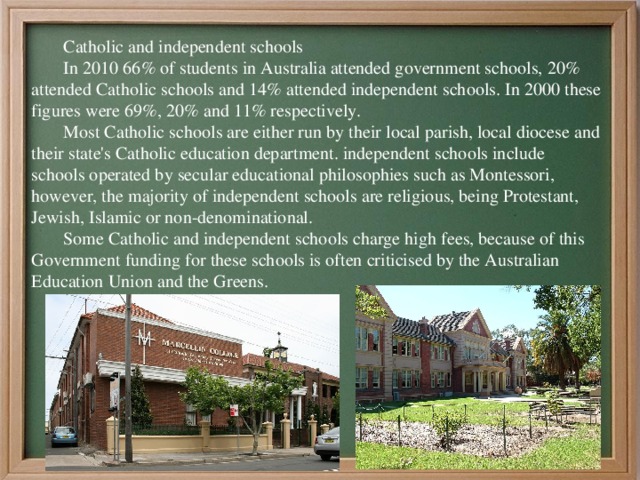
Catholic and independent schools
In 2010 66% of students in Australia attended government schools, 20% attended Catholic schools and 14% attended independent schools. In 2000 these figures were 69%, 20% and 11% respectively.
Most Catholic schools are either run by their local parish, local diocese and their state's Catholic education department. independent schools include schools operated by secular educational philosophies such as Montessori, however, the majority of independent schools are religious, being Protestant, Jewish, Islamic or non-denominational.
Some Catholic and independent schools charge high fees, because of this Government funding for these schools is often criticised by the Australian Education Union and the Greens.
Common ages
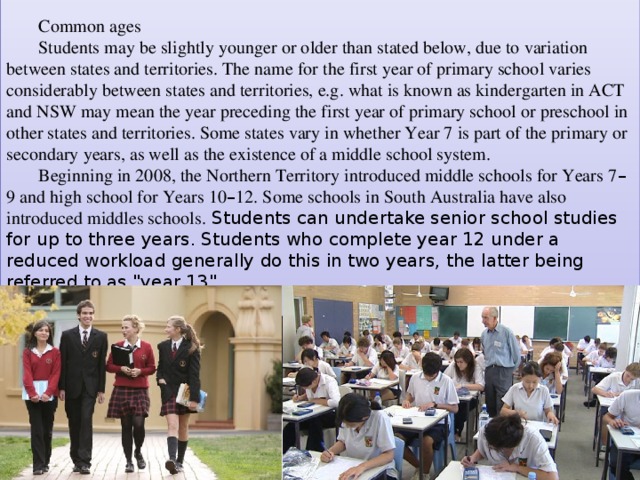
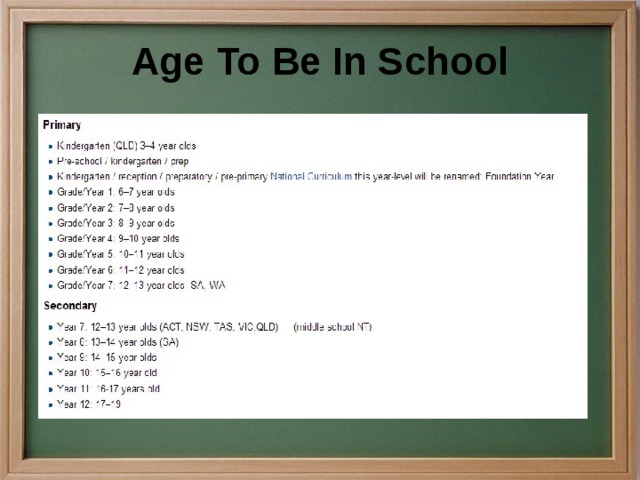
Students may be slightly younger or older than stated below, due to variation between states and territories. The name for the first year of primary school varies considerably between states and territories, e.g. what is known as kindergarten in ACT and NSW may mean the year preceding the first year of primary school or preschool in other states and territories. Some states vary in whether Year 7 is part of the primary or secondary years, as well as the existence of a middle school system.
Beginning in 2008, the Northern Territory introduced middle schools for Years 7 – 9 and high school for Years 10 – 12. Some schools in South Australia have also introduced middles schools. Students can undertake senior school studies for up to three years. Students who complete year 12 under a reduced workload generally do this in two years, the latter being referred to as "year 13".
Age To Be In School
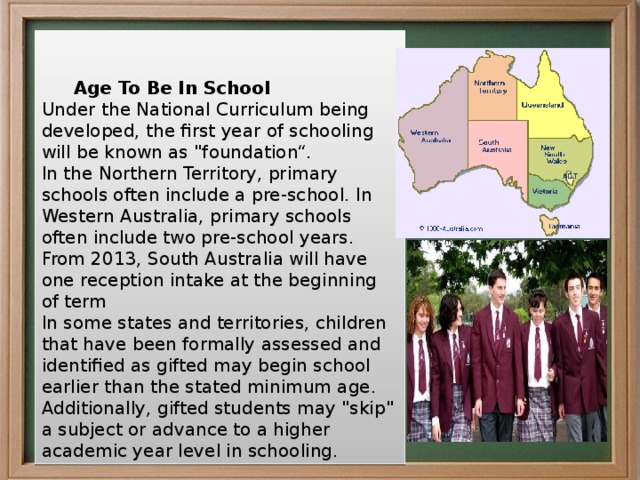
Under the National Curriculum being developed, the first year of schooling will be known as "foundation“.
In the Northern Territory, primary schools often include a pre-school. In Western Australia, primary schools often include two pre-school years.
From 2013, South Australia will have one reception intake at the beginning of term
In some states and territories, children that have been formally assessed and identified as gifted may begin school earlier than the stated minimum age. Additionally, gifted students may "skip" a subject or advance to a higher academic year level in schooling.
Age To Be In School
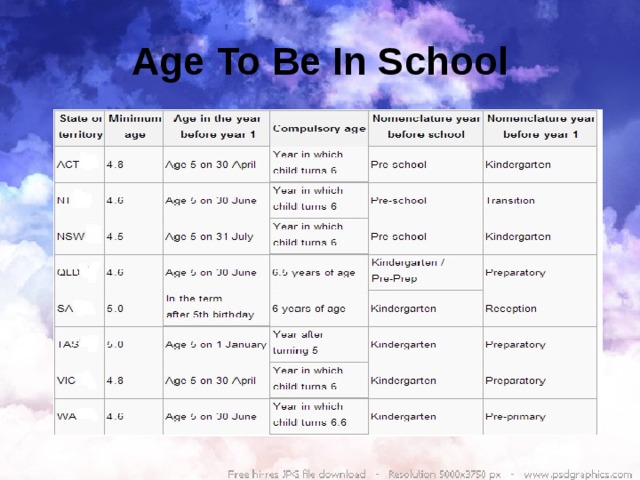
Age To Be In School
![Tertiary education in Australia Tertiary education in Australia is education consists of both government and private institutions. A higher education provider is a body that is established or recognised by or under the law of the Australian Government, a State, the Australian Capital Territory or the Northern Territory.[1] VET providers, both public and private are registered by State and Territory governments. In 2009, the Australian higher education system consisted of: 1)41 universities, of which 37 are public institutions, 2 are private, and 2 are Australian branches of overseas universities; 2)3 other self-accrediting higher education institutions; and 3)non-self-accrediting higher education providers accredited by State and Territory authorities, numbering more than 150 as listed on State and Territory registers. These include several that are registered in more than one State and Territory. The non-self-accrediting higher education providers form a very diverse group of specialised, mainly private, providers that range in size and include theological colleges and other providers that offer courses in areas such as business, information technology, natural therapies, hospitality, health, law and accounting.](https://fsd.multiurok.ru/html/2018/02/27/s_5a957ead6f4f4/img9.jpg)
Tertiary education in Australia
Tertiary education in Australia is education consists of both government and private institutions. A higher education provider is a body that is established or recognised by or under the law of the Australian Government, a State, the Australian Capital Territory or the Northern Territory.[1] VET providers, both public and private are registered by State and Territory governments.
In 2009, the Australian higher education system consisted of:
1)41 universities, of which 37 are public institutions, 2 are private, and 2 are Australian branches of overseas universities;
2)3 other self-accrediting higher education institutions; and
3)non-self-accrediting higher education providers accredited by State and Territory authorities, numbering more than 150 as listed on State and Territory registers. These include several that are registered in more than one State and Territory.
The non-self-accrediting higher education providers form a very diverse group of specialised, mainly private, providers that range in size and include theological colleges and other providers that offer courses in areas such as business, information technology, natural therapies, hospitality, health, law and accounting.

Allocation of responsibilities
Decision-making, regulation and governance for higher education are shared among the Australian Government, the State and Territory Governments and the institutions themselves. Some aspects of higher education are the responsibility of States and Territories. In particular, most universities are established or recognised under State and Territory legislation. States and Territories are also responsible for accrediting non-self-accrediting higher education providers.

Australian Government has the primary responsibility for public funding of higher education.
In Australia, universities are self-accrediting institutions and each university has its own establishment legislation (generally State and Territory legislation) and receive the vast majority of their public funding from the Australian Government, through the Higher Education Support Act 2003.
Many universities in Australia have gained international recognition and have been ranked highly in Academic Ranking of World Universities produced by Shanghai JiaoTong University, and the Times Higher Education World University Rankings. In 2011-2012, 7 Australian universities were ranked amongst the world's top 200

Classification of tertiary qualifications
In Australia, the classification of tertiary qualifications is governed in part by the Australian Qualifications Framework (AQF), which attempts to integrate into a single classification all levels of tertiary education (both vocational and higher education), from trade certificates to higher doctorates. However, as Australian universities largely regulate their own courses, the primary usage of AQF is for vocational education. In recent years there have been some informal moves towards standardization between higher education institutions.

Thank you for attention!
Вебинар для учителей
Свидетельство об участии БЕСПЛАТНО!