







© 2020 438 0


СДЕЛАЙТЕ СВОИ УРОКИ ЕЩЁ ЭФФЕКТИВНЕЕ, А ЖИЗНЬ СВОБОДНЕЕ
Благодаря готовым учебным материалам для работы в классе и дистанционно
Скидки до 50 % на комплекты
только до
Готовые ключевые этапы урока всегда будут у вас под рукой
Организационный момент
Проверка знаний
Объяснение материала
Закрепление изученного
Итоги урока

The bermuda triangle
Категория:
Английский язык
14.01.2020 11:12

Просмотр содержимого документа
«The bermuda triangle»
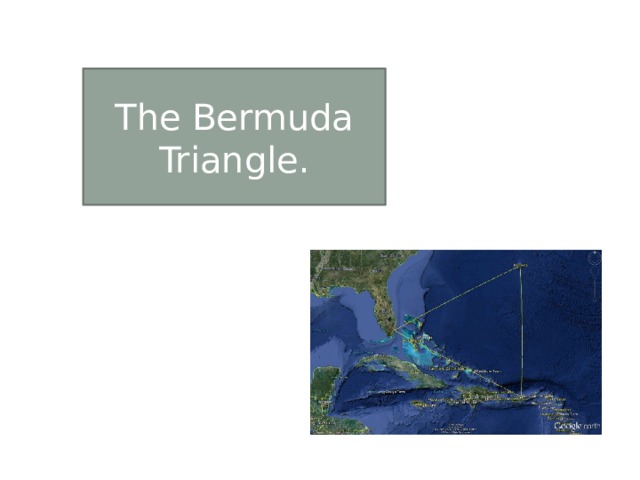
The Bermuda Triangle.
The Bermuda Triangle , also known as the Devil's Triangle or Hurricane Alley, is a loosely defined region in the western part of the North Atlantic Ocean where a number of aircraft and ships are said to have disappeared under mysterious circumstances. Most reputable sources dismiss the idea that there is any mystery.
The vicinity of the Bermuda Triangle is amongst the most heavily traveled shipping lanes in the world, with ships frequently crossing through it for ports in the Americas, Europe and the Caribbean islands. Cruise ships and pleasure craft regularly sail through the region, and commercial and private aircraft routinely fly over it.
- Popular culture has attributed various disappearances to the paranormal or activity by extraterrestrial beings. Documented evidence indicates that a significant percentage of the incidents were spurious, inaccurately reported, or embellished by later authors.
Origins.
The earliest suggestion of unusual disappearances in the Bermuda area appeared in a September 17, 1950, article published in The Miami Herald by Edward Van Winkle Jones. Two years later, Fate magazine published "Sea Mystery at Our Back Door", a short article by George Sand covering the loss of several planes and ships, including the loss of Flight 19, a group of five US Navy Grumman TBM Avenger torpedo bombers on a training mission.
In February 1964, Vincent Gaddis wrote an article called "The Deadly Bermuda Triangle" in the pulp magazine Argosy saying Flight 19 and other disappearances were part of a pattern of strange events in the region.
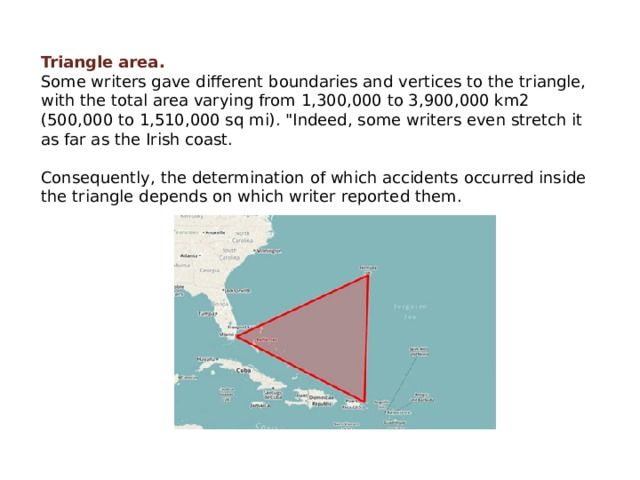
Triangle area.
Some writers gave different boundaries and vertices to the triangle, with the total area varying from 1,300,000 to 3,900,000 km2 (500,000 to 1,510,000 sq mi). "Indeed, some writers even stretch it as far as the Irish coast.
Consequently, the determination of which accidents occurred inside the triangle depends on which writer reported them.
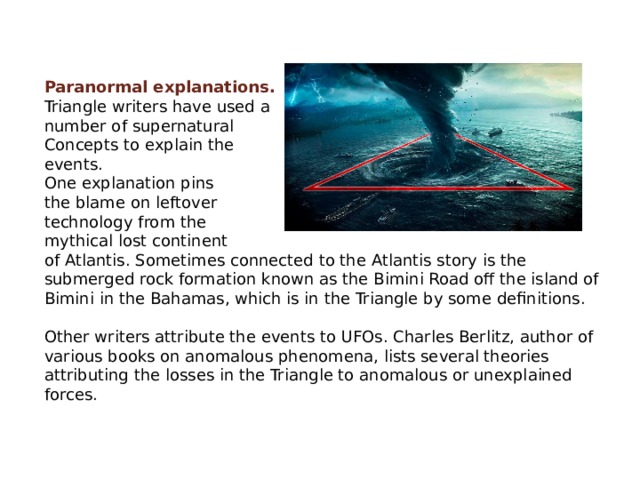
Paranormal explanations.
Triangle writers have used a
number of supernatural
Concepts to explain the
events.
One explanation pins
the blame on leftover
technology from the
mythical lost continent
of Atlantis. Sometimes connected to the Atlantis story is the submerged rock formation known as the Bimini Road off the island of Bimini in the Bahamas, which is in the Triangle by some definitions.
Other writers attribute the events to UFOs. Charles Berlitz, author of various books on anomalous phenomena, lists several theories attributing the losses in the Triangle to anomalous or unexplained forces.
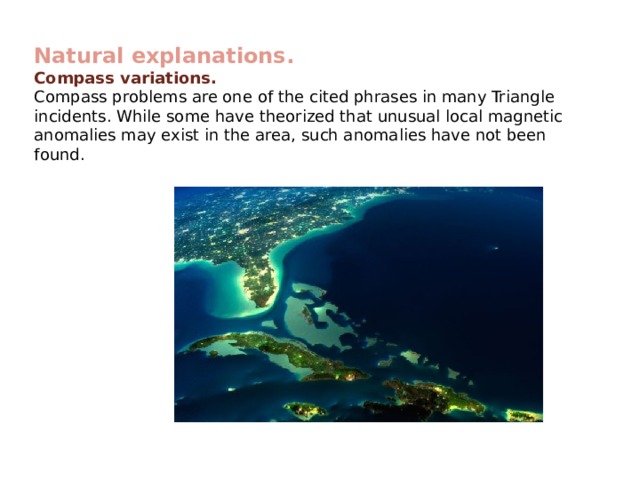
Natural explanations.
Compass variations.
Compass problems are one of the cited phrases in many Triangle incidents. While some have theorized that unusual local magnetic anomalies may exist in the area, such anomalies have not been found.
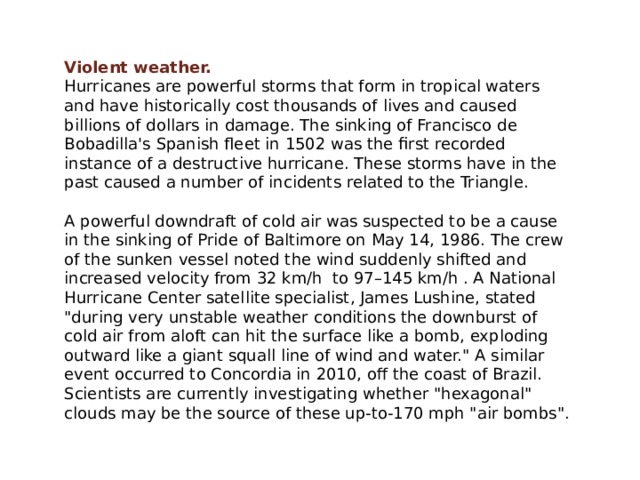
Violent weather.
Hurricanes are powerful storms that form in tropical waters and have historically cost thousands of lives and caused billions of dollars in damage. The sinking of Francisco de Bobadilla's Spanish fleet in 1502 was the first recorded instance of a destructive hurricane. These storms have in the past caused a number of incidents related to the Triangle.
A powerful downdraft of cold air was suspected to be a cause in the sinking of Pride of Baltimore on May 14, 1986. The crew of the sunken vessel noted the wind suddenly shifted and increased velocity from 32 km/h to 97–145 km/h . A National Hurricane Center satellite specialist, James Lushine, stated "during very unstable weather conditions the downburst of cold air from aloft can hit the surface like a bomb, exploding outward like a giant squall line of wind and water." A similar event occurred to Concordia in 2010, off the coast of Brazil. Scientists are currently investigating whether "hexagonal" clouds may be the source of these up-to-170 mph "air bombs".
Main article: USS Cyclops (AC-4).
The incident resulting in the single largest loss of life in the history of the US Navy not related to combat occurred when the collier Cyclops, carrying a full load of manganese ore and with one engine out of action, went missing without a trace with a crew of 309 sometime after March 4, 1918, after departing the island of Barbados. In addition, two of Cyclops's sister ships, Proteus and Nereus were subsequently lost in the North Atlantic during World War II. Both ships were transporting heavy loads of metallic ore similar to that which was loaded on Cyclops during her fatal voyage. In all three cases structural failure due to overloading with a much denser cargo than designed is considered the most likely cause of sinking.

Thank you for attention!
Вебинар для учителей

Свидетельство об участии БЕСПЛАТНО!