 306
306 140 906
© 2019, Semenko Elena Igorevna 693 0


СДЕЛАЙТЕ СВОИ УРОКИ ЕЩЁ ЭФФЕКТИВНЕЕ, А ЖИЗНЬ СВОБОДНЕЕ
Благодаря готовым учебным материалам для работы в классе и дистанционно
Скидки до 50 % на комплекты
только до
Готовые ключевые этапы урока всегда будут у вас под рукой
Организационный момент
Проверка знаний
Объяснение материала
Закрепление изученного
Итоги урока

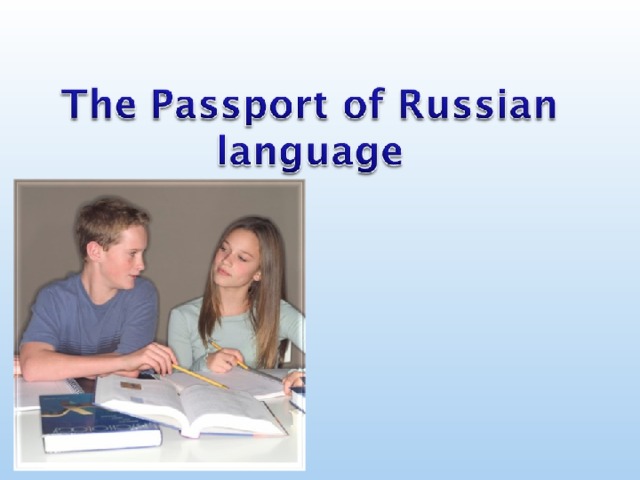
The Passport of Russian language
Категория:
Английский язык
21.05.2019 10:59

Просмотр содержимого документа
«The Passport of Russian language»
Aims of our project:
- To show an importance of the Russian language in the modern world; to prove that Russian is popular and extended.
- To show complete representation about the formation of the Russian language, to learn its history and borrowed words from other languages.
- To show that Russian culture takes the leading place in world culture, in various spheres of world business.
- To involve foreign students to study the Russian language.
Introduction
- Now Russian gets an increasing value in the most various spheres of world business. However among foreigners there are myths that learning this language is difficult. They say, Russian is spoken by few people and Russia is closed and dangerous country with a lot of problems. Therefore we will try to prove schoolboys, students, foreigners that it is necessary to study Russian to learn masterpieces of Russian literature, to join Russian culture and to know about the remarkable country Russia.
Questionnaire
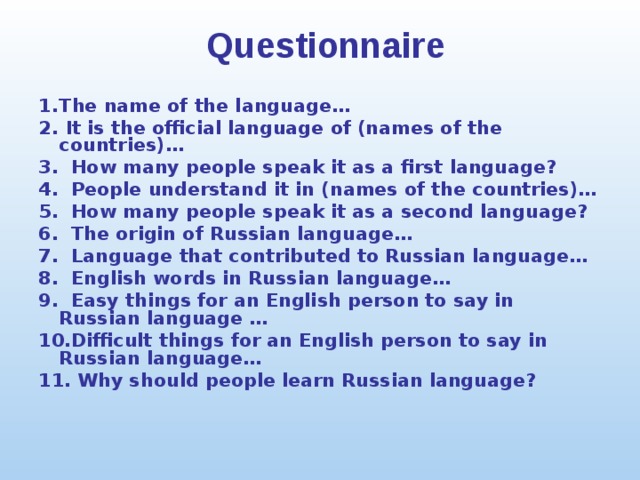
1. The name of the language…
2. It is the official language of (names of the countries)…
3. How many people speak it as a first language?
4. People understand it in (names of the countries)…
5. How many people speak it as a second language?
6. The origin of Russian language…
7. Language that contributed to Russian language…
8. English words in Russian language…
9. Easy things for an English person to say in Russian language …
10.Difficult things for an English person to say in Russian language…
11. Why should people learn Russian language?
The results of questionnaire
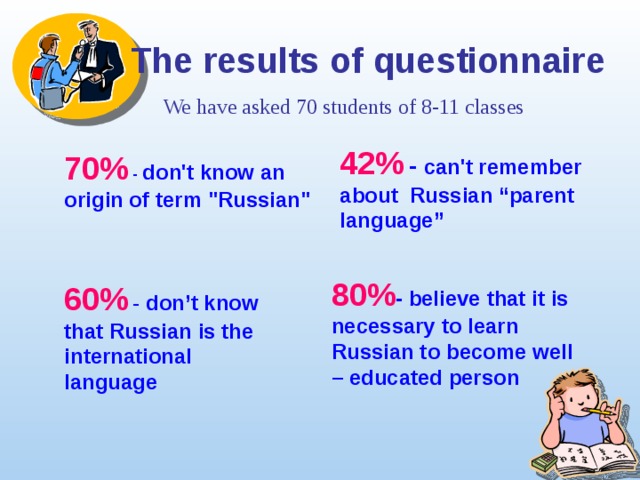
We have asked 70 students of 8-11 classes
42% - can't remember about Russian “parent language”
70% - don't know an origin of term "Russian"
80% - believe that it is necessary to learn Russian to become well – educated person
60% - don’t know that Russian is the international language
Email book
For your information:
- . K.I. Kaufman, M.Yu. Kaufman. Happy English.ru, tutorial for grade 8.
- Illustrated Encyclopedic Dictionary. (Small). Moscow: Scientific publishing house “The Great Russian Encyclopedia”, 2000 - 1038p.
- 3. Kolesov V.V. History of the Russian language in the stories. Moscow: The Enlightenment, 1982 - 191s.
- http://ru.wikipedia.org/wik

Chapter 2. The world’s languages. and the place of Russian among them
Used in countries
Official language
Russian
Israel
Russia
Germany
Kyrgyzstan
Canada
Moldavia
Australia
USA
Kazakhstan
The other republics of the USSR

The official languages of The United Nations
ENGLISH
RUSSIAN
ARABIC
CHINESE
SPANISH
FRENCH
For your information:
1. Иллюстрированный энциклопедический словарь. (Малый). Москва: Научное издательство «Большая Российская энциклопедия», 2000 – 1038 с.
2. http://ru.wikipedia.org/wik

Chapter 3. The origin of the Russian language
Chapter 4. The borrowed words in Russian
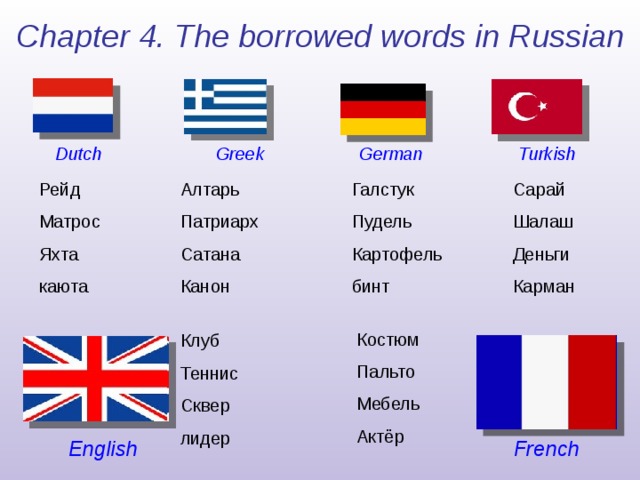
Turkish
German
Greek
Dutch
Рейд
Матрос
Яхта
каюта
Галстук
Пудель
Картофель
бинт
Алтарь
Патриарх
Сатана
Канон
Сарай
Шалаш
Деньги
Карман
Костюм
Пальто
Мебель
Актёр
Клуб
Теннис
Сквер
лидер
English
French
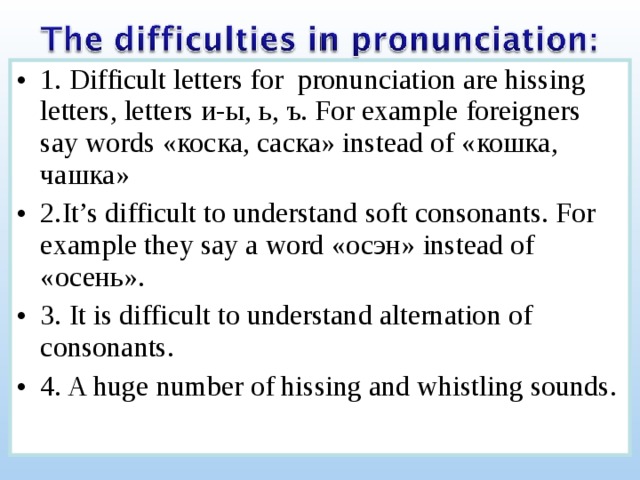
- 1. Difficult letters for pronunciation are hissing letters, letters и-ы, ь, ъ. For example foreigners say words «коска, саска» instead of « кошка, чашка »
- 2.It’s difficult to understand soft consonants. For example they say a word « осэн » instead of « осень» .
- 3. It is difficult to understand alternation of consonants.
- 4. A huge number of hissing and whistling sounds.
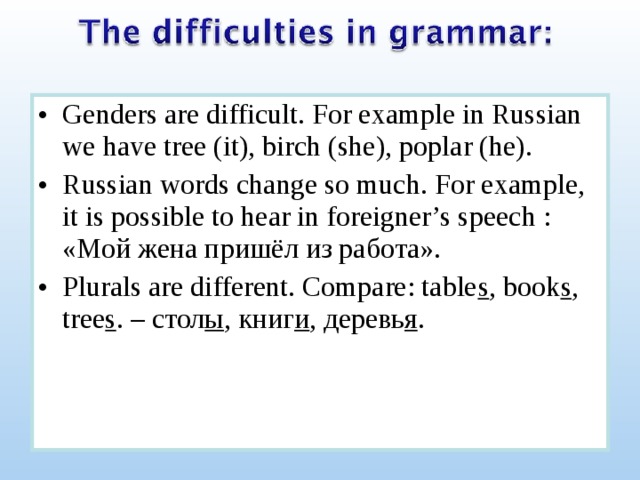
- Genders are difficult. For example in Russian we have tree (it), birch (she), poplar (he).
- Russian words change so much. For example, it is possible to hear in foreigner’s speech : « Мой жена пришёл из работа».
- Plurals are different. Compare: table s , book s , tree s . – стол ы , книг и , деревь я .
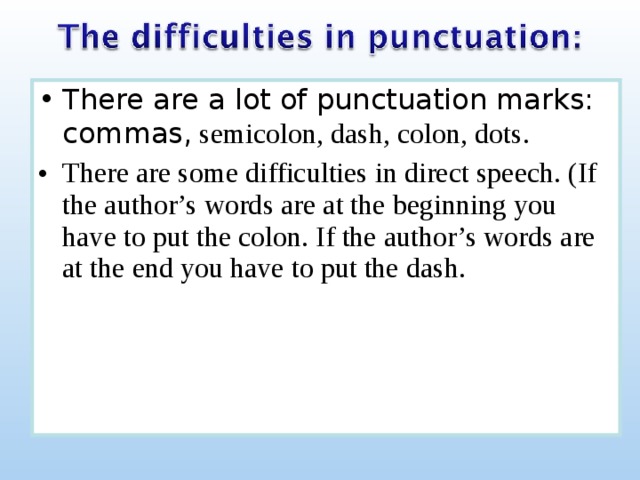
- There are a lot of punctuation marks: commas, semicolon, dash, colon, dots.
- There are some difficulties in direct speech. (If the author’s words are at the beginning you have to put the colon. If the author’s words are at the end you have to put the dash.
![Difference in writing and pronunciation. For example: в о да – [в а да], пра зд ник – [пра з ник], ду б - [ду п] , ж и л – [ж ы л]. The particle «не» is written with words separately or in a one word.](https://fsd.multiurok.ru/html/2019/05/21/s_5ce3af386cfed/img16.jpg)
- Difference in writing and pronunciation. For example: в о да – [в а да], пра зд ник – [пра з ник], ду б - [ду п] , ж и л – [ж ы л].
- The particle «не» is written with words separately or in a one word.
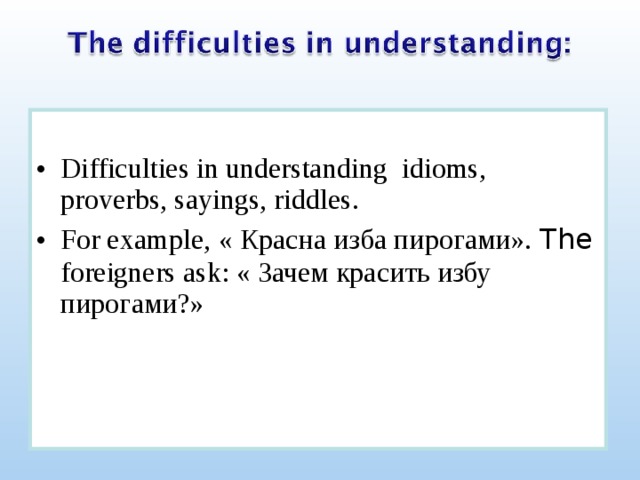
- Difficulties in understanding idioms, proverbs, sayings, riddles.
- For example, « Красна изба пирогами». The foreigners ask: « Зачем красить избу пирогами?»

For your information:
1. Иллюстрированный энциклопедический словарь. (Малый). Москва: Научное издательство «Большая Российская энциклопедия», 2000 – 1038 с.
2. Одинцов В. В., Иванов В. В. Школьный словарь иностранных слов. Москва: Просвещение, 1994 – 272 с.
3. Русский язык: Справочные материалы: Учебное пособие для учащихся/ Баранов М. Т., Костяева Т. А.; Под. ред. Шанского Н. М. – 5-е изд., испр. – Москва: Просвещение, 1998 – 288 с.
4. http://ru.wikipedia.org/wik
Вебинар для учителей

Свидетельство об участии БЕСПЛАТНО!