
Россия, Тула


СДЕЛАЙТЕ СВОИ УРОКИ ЕЩЁ ЭФФЕКТИВНЕЕ, А ЖИЗНЬ СВОБОДНЕЕ
Благодаря готовым учебным материалам для работы в классе и дистанционно
Скидки до 50 % на комплекты
только до
Готовые ключевые этапы урока всегда будут у вас под рукой
Организационный момент
Проверка знаний
Объяснение материала
Закрепление изученного
Итоги урока

Была в сети 18.09.2023 19:13

Дружинина Анастасия Антоновна
Учитель английского языка
30 лет
 878
878
 72 887
Местоположение
Специализация
The poem by Christina Rossetti ‘’Remember me’’
Категория:
Всем учителям
02.12.2018 16:59

Просмотр содержимого документа
«The poem by Christina Rossetti ‘’Remember me’’»
The poem by Christina Rossetti “Remember me’’
Prepared by:
group 221534
Biography of Christina Rossetti
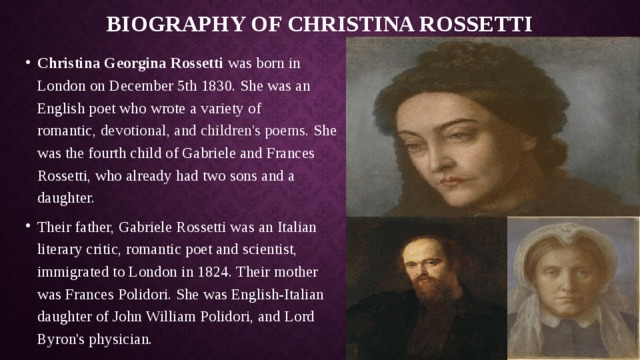
- Christina Georgina Rossetti was born in London on December 5th 1830. She was an English poet who wrote a variety of romantic, devotional, and children's poems. She was the fourth child of Gabriele and Frances Rossetti, who already had two sons and a daughter.
- Their father, Gabriele Rossetti was an Italian literary critic, romantic poet and scientist, immigrated to London in 1824. Their mother was Frances Polidori. She was English-Italian daughter of John William Polidori, and Lord Byron's physician.
Biography of Christina Rossetti
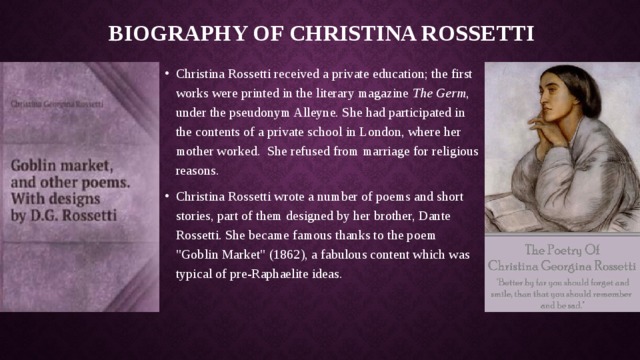
- Christina Rossetti received a private education; the first works were printed in the literary magazine The Germ , under the pseudonym Alleyne. She had participated in the contents of a private school in London, where her mother worked. She refused from marriage for religious reasons.
- Christina Rossetti wrote a number of poems and short stories, part of them designed by her brother, Dante Rossetti. She became famous thanks to the poem "Goblin Market" (1862), a fabulous content which was typical of pre-Raphaelite ideas.
Biography of Christina Rossetti
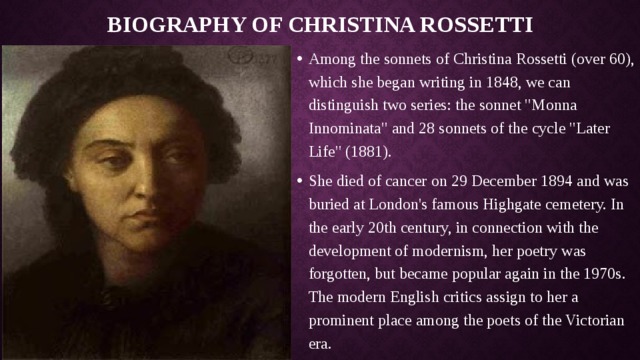
- Among the sonnets of Christina Rossetti (over 60), which she began writing in 1848, we can distinguish two series: the sonnet "Monna Innominata" and 28 sonnets of the cycle "Later Life" (1881).
- She died of cancer on 29 December 1894 and was buried at London's famous Highgate cemetery. In the early 20th century, in connection with the development of modernism, her poetry was forgotten, but became popular again in the 1970s. The modern English critics assign to her a prominent place among the poets of the Victorian era.
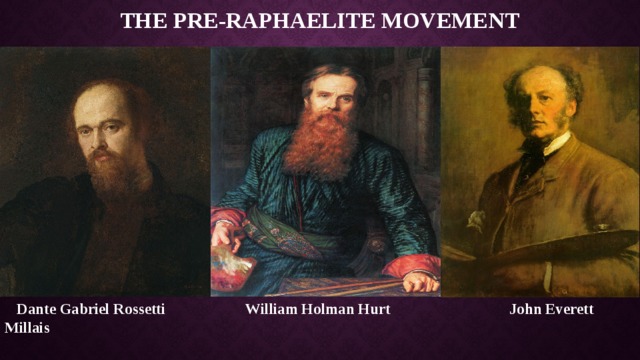
The Pre-Raphaelite Movement
Dante Gabriel Rossetti William Holman Hurt John Everett Millais
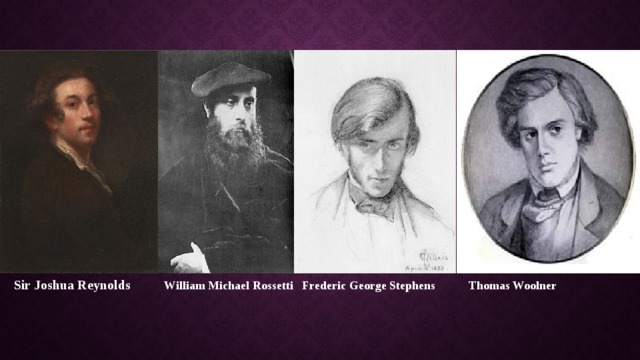
Sir Joshua Reynolds William Michael Rossetti Frederic George Stephens Thomas Woolner

They promoted their ideas by writing and publishing a newspaper called The Germ .
The Germ (1850) was a periodical established by the Pre-Raphaelite Brotherhood to disseminate their ideas. It was not a success, only surviving for four issues between January and April 1850.
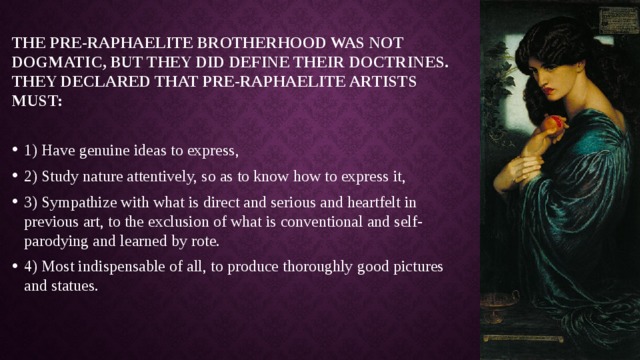
The Pre-Raphaelite Brotherhood was not dogmatic, but they did define their doctrines. They declared that Pre-Raphaelite artists must:
- 1) Have genuine ideas to express,
- 2) Study nature attentively, so as to know how to express it,
- 3) Sympathize with what is direct and serious and heartfelt in previous art, to the exclusion of what is conventional and self-parodying and learned by rote.
- 4) Most indispensable of all, to produce thoroughly good pictures and statues.
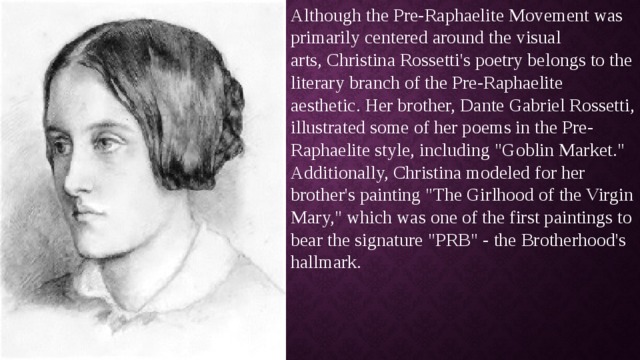
Although the Pre-Raphaelite Movement was primarily centered around the visual arts, Christina Rossetti's poetry belongs to the literary branch of the Pre-Raphaelite aesthetic. Her brother, Dante Gabriel Rossetti, illustrated some of her poems in the Pre-Raphaelite style, including "Goblin Market." Additionally, Christina modeled for her brother's painting "The Girlhood of the Virgin Mary," which was one of the first paintings to bear the signature "PRB" - the Brotherhood's hallmark.
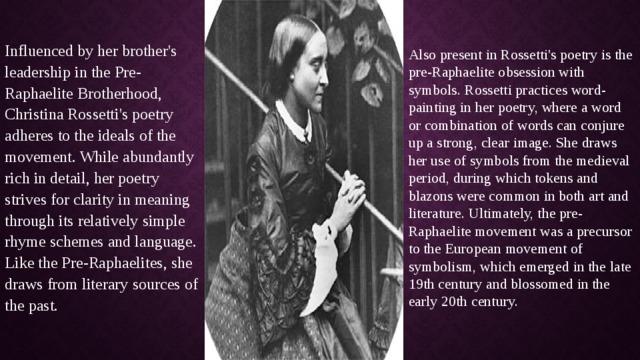
Influenced by her brother's leadership in the Pre-Raphaelite Brotherhood, Christina Rossetti's poetry adheres to the ideals of the movement. While abundantly rich in detail, her poetry strives for clarity in meaning through its relatively simple rhyme schemes and language. Like the Pre-Raphaelites, she draws from literary sources of the past.
Also present in Rossetti's poetry is the pre-Raphaelite obsession with symbols. Rossetti practices word-painting in her poetry, where a word or combination of words can conjure up a strong, clear image. She draws her use of symbols from the medieval period, during which tokens and blazons were common in both art and literature. Ultimately, the pre-Raphaelite movement was a precursor to the European movement of symbolism, which emerged in the late 19th century and blossomed in the early 20th century.
Analysis of “Remember” by Christina Rossetti
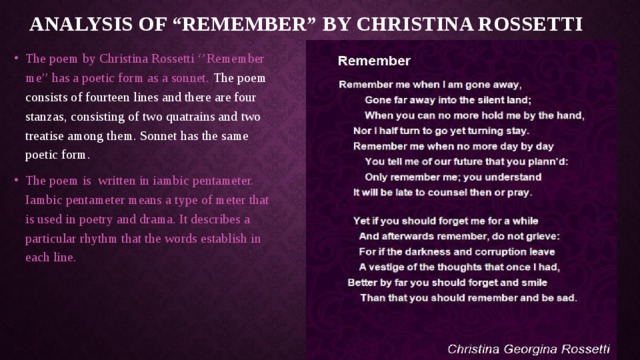
- The poem by Christina Rossetti ‘’Remember me’’ has a poetic form as a sonnet. The poem consists of fourteen lines and there are four stanzas, consisting of two quatrains and two treatise among them. Sonnet has the same poetic form.
- The poem is written in iambic pentameter. Iambic pentameter means a type of meter that is used in poetry and drama. It describes a particular rhythm that the words establish in each line.
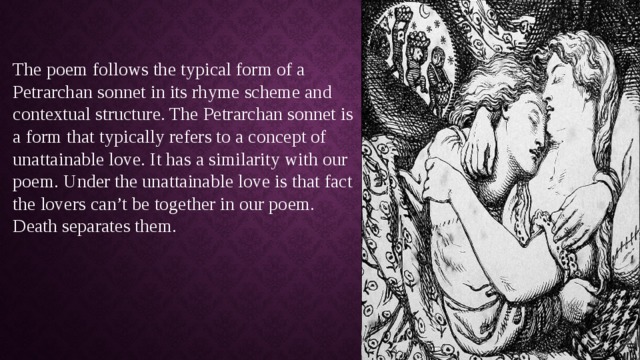
The poem follows the typical form of a Petrarchan sonnet in its rhyme scheme and contextual structure. The Petrarchan sonnet is a form that typically refers to a concept of unattainable love. It has a similarity with our poem. Under the unattainable love is that fact the lovers can’t be together in our poem. Death separates them.
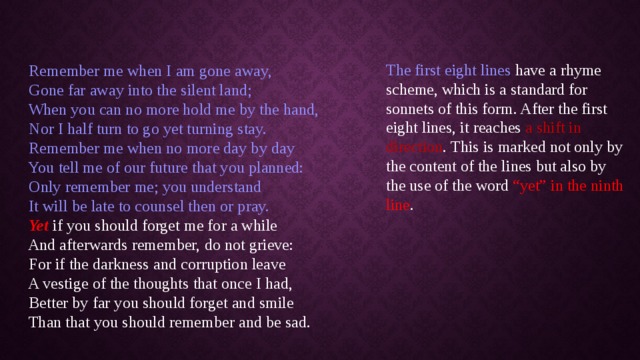
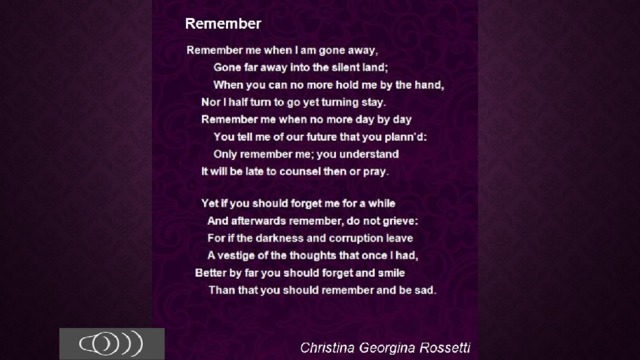
Remember me when I am gone away, Gone far away into the silent land; When you can no more hold me by the hand, Nor I half turn to go yet turning stay. Remember me when no more day by day You tell me of our future that you planned: Only remember me; you understand It will be late to counsel then or pray. Yet if you should forget me for a while And afterwards remember, do not grieve: For if the darkness and corruption leave A vestige of the thoughts that once I had, Better by far you should forget and smile Than that you should remember and be sad.
The first eight lines have a rhyme scheme, which is a standard for sonnets of this form. After the first eight lines, it reaches a shift in direction . This is marked not only by the content of the lines but also by the use of the word “yet” in the ninth line .
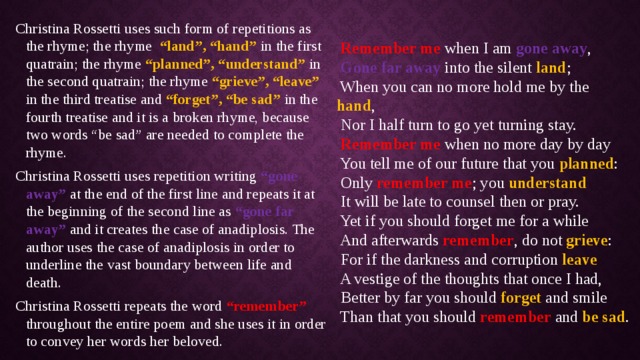
Remember me when I am gone away , Gone far away into the silent land ; When you can no more hold me by the hand , Nor I half turn to go yet turning stay. Remember me when no more day by day You tell me of our future that you planned : Only remember me ; you understand It will be late to counsel then or pray. Yet if you should forget me for a while And afterwards remember , do not grieve : For if the darkness and corruption leave A vestige of the thoughts that once I had, Better by far you should forget and smile Than that you should remember and be sad .
Christina Rossetti uses such form of repetitions as the rhyme; the rhyme “land”, “hand” in the first quatrain; the rhyme “planned”, “understand” in the second quatrain; the rhyme “grieve”, “leave” in the third treatise and “forget”, “be sad” in the fourth treatise and it is a broken rhyme, because two words “be sad” are needed to complete the rhyme.
Christina Rossetti uses repetition writing “gone away” at the end of the first line and repeats it at the beginning of the second line as “gone far away” and it creates the case of anadiplosis. The author uses the case of anadiplosis in order to underline the vast boundary between life and death.
Christina Rossetti repeats the word “remember” throughout the entire poem and she uses it in order to convey her words her beloved.
- The poem by Christina Rossetti ‘’Remember me’’ is accented on the semic repetitions, related to death. There are words and word-phrases linked with the seme ‘’death’’: gone away, silent land, grieve, corruption, darkness.
- The poet here makes use of a euphemism in the very first line of this sonnet when she says, “Remember me when I am gone away.” The euphemism here refers to the poet’s death. The second euphemism can be seen in the eleventh line of this sonnet, when the poet says: “For if the darkness and corruption leave”. In this line, death is viewed as corruption and darkness.
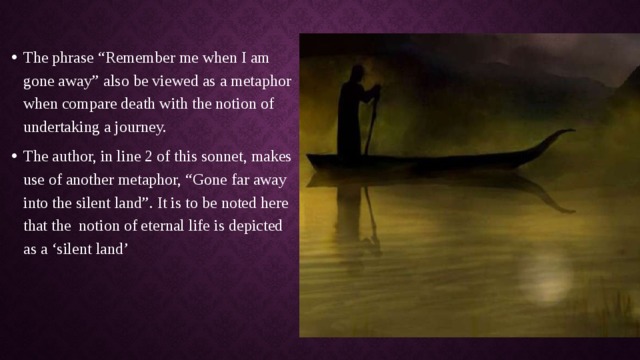
- The phrase “Remember me when I am gone away” also be viewed as a metaphor when compare death with the notion of undertaking a journey.
- The author, in line 2 of this sonnet, makes use of another metaphor, “Gone far away into the silent land”. It is to be noted here that the notion of eternal life is depicted as a ‘silent land’
Theme
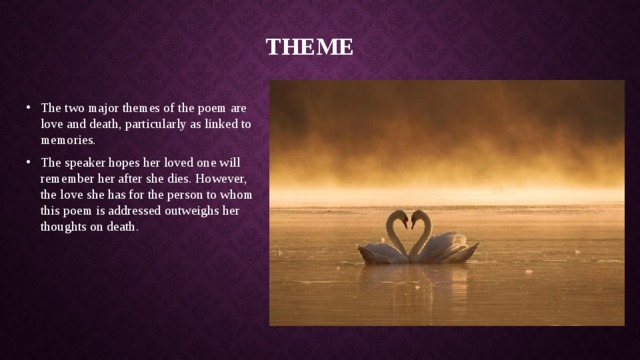
- The two major themes of the poem are love and death, particularly as linked to memories.
- The speaker hopes her loved one will remember her after she dies. However, the love she has for the person to whom this poem is addressed outweighs her thoughts on death.
![The very first quatrain of this sonnet brings to us the subject of the speaker’s death and the painful separation of the two lovers. The poem has been written like a monologue directly addressed to the lover. Besides, the poet also highlights metaphors like “the silent land” to place distance between them. The speaker though knows about the distance between them, and knows that after death there is no chance when he can “hold [her] by the hand” .](https://static.multiurok.ru/multiurok/html/2018/12/02/s_5c03e5583cd80/img19.jpg)
- The very first quatrain of this sonnet brings to us the subject of the speaker’s death and the painful separation of the two lovers. The poem has been written like a monologue directly addressed to the lover.
- Besides, the poet also highlights metaphors like “the silent land” to place distance between them. The speaker though knows about the distance between them, and knows that after death there is no chance when he can “hold [her] by the hand” .
Conclusion
This is a very simple poem with great message that all of us should apply to our lives. It is written in a very simple language. The readers can easily access and identify. It is also a perfectly balanced poem, narrated in the form of the Italian sonnet where she bears a single thought with no unrelated detail.









Вебинар для учителей

Свидетельство об участии БЕСПЛАТНО!