Казахстан, Шымкент

СДЕЛАЙТЕ СВОИ УРОКИ ЕЩЁ ЭФФЕКТИВНЕЕ, А ЖИЗНЬ СВОБОДНЕЕ
Благодаря готовым учебным материалам для работы в классе и дистанционно
Скидки до 50 % на комплекты
только до
Готовые ключевые этапы урока всегда будут у вас под рукой
Организационный момент
Проверка знаний
Объяснение материала
Закрепление изученного
Итоги урока
Была в сети 13.05.2025 16:39
Умурбекова Елена Лукмановна
Учитель английского языка
43 года
 107
107
 216 362
Местоположение
Специализация
Thermodynamics Revision Test
Категория:
Английский язык
10.12.2019 07:47

Просмотр содержимого документа
«Thermodynamics Revision Test»

Choose the correct answer
The random motion of a small particle in a fluid is called?
- Brownian motion
- entropy
- Caloric
- thermodynamics

The total kinetic energy of all the molecules of a substance?
- Temperature
- Entropy
- Heat
- Specific heat
“ Energy can nether be created nor destroyed” is the?
- Law of preservation of energy
- Law of conservation of energy
- Law of entropy
- Law of heat energy

the unit of heat that can raise the temperature of one gram of water by one Celsius degree is the?
- thermal
- joule
- calorie
- kilocalorie
the average kinetic energy of the molecules of a substance?
- Pressure
- Heat
- Temperature
- entropy

The fact that each liquid has its own fixed boiling and freezing temperatures was discovered by using a?
- calorimeter
- thermometer
- Microscope
- barometer

the metric unit for temperature is the?
- calorie
- Degree Fahrenheit
- Degree Celsius
- thermometer
The change in length of a solid for each degree Celsius change in temperature is the coefficient of
- Mass increase
- Entropy change
- Linear expansion
- Heat expansion
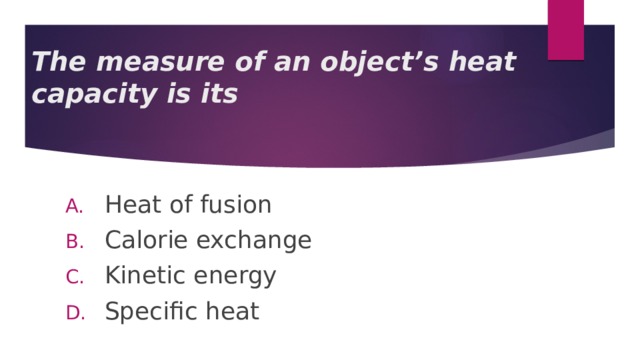
The measure of an object’s heat capacity is its
- Heat of fusion
- Calorie exchange
- Kinetic energy
- Specific heat
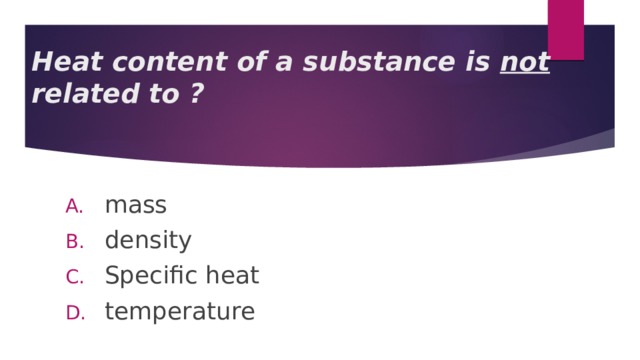
Heat content of a substance is not related to ?
- mass
- density
- Specific heat
- temperature
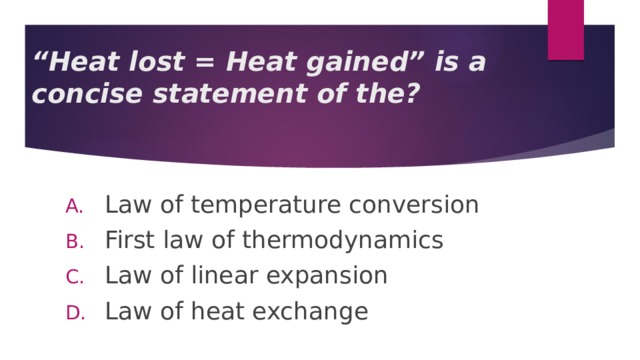
“ Heat lost = Heat gained” is a concise statement of the?
- Law of temperature conversion
- First law of thermodynamics
- Law of linear expansion
- Law of heat exchange
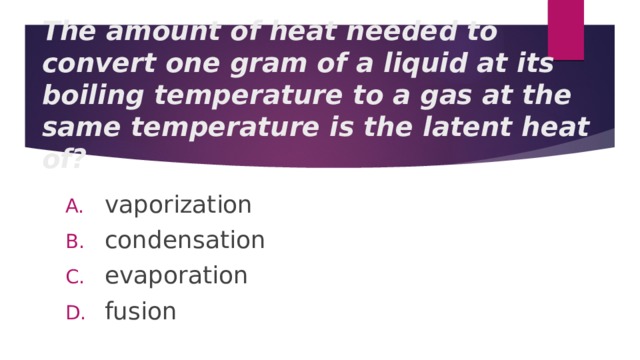
The amount of heat needed to convert one gram of a liquid at its boiling temperature to a gas at the same temperature is the latent heat of?
- vaporization
- condensation
- evaporation
- fusion
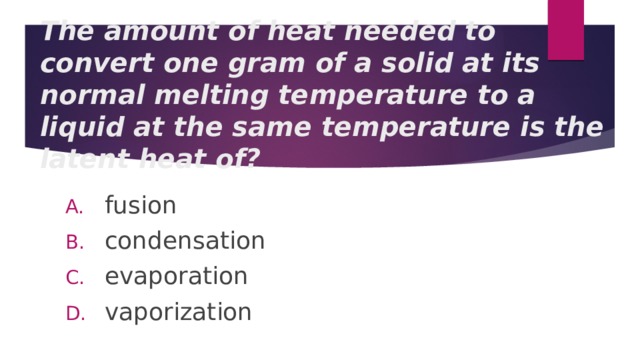
The amount of heat needed to convert one gram of a solid at its normal melting temperature to a liquid at the same temperature is the latent heat of?
- fusion
- condensation
- evaporation
- vaporization
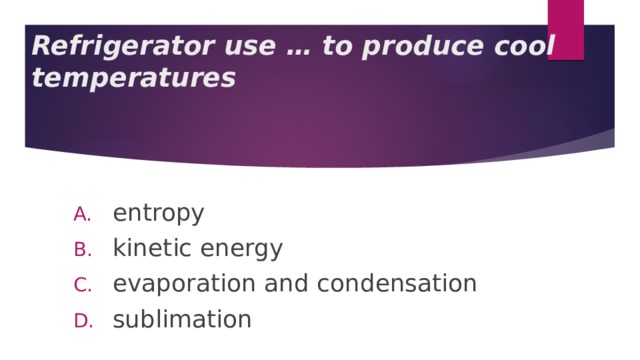
Refrigerator use … to produce cool temperatures
- entropy
- kinetic energy
- evaporation and condensation
- sublimation
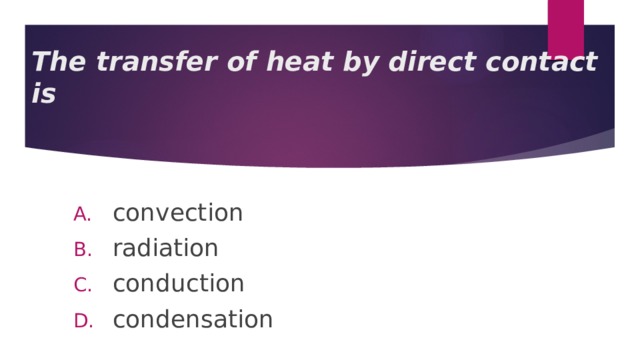
The transfer of heat by direct contact is
- convection
- radiation
- conduction
- condensation
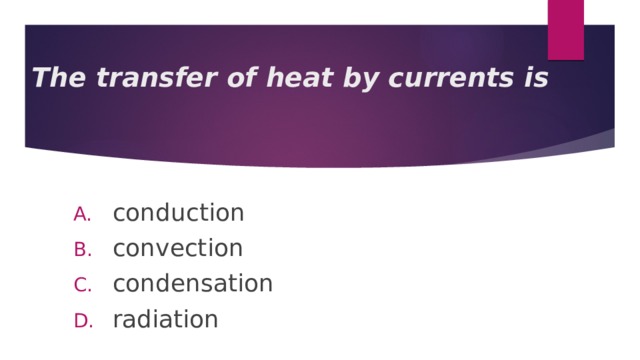
The transfer of heat by currents is
- conduction
- convection
- condensation
- radiation
The transfer of energy by electromagnetic waves is
- condensation
- convection
- radiation
- conduction
Ocean currents are not caused by
- gravity
- Earth’s rotation
- Prevailing winds
- convection
The study of the movement of heat is called
- oceanography
- thermodynamics
- entropy
- convection
“ Disorder can never be entirely eliminated” is stated by the
- First law
- Second law
- Third law
of thermodynamics
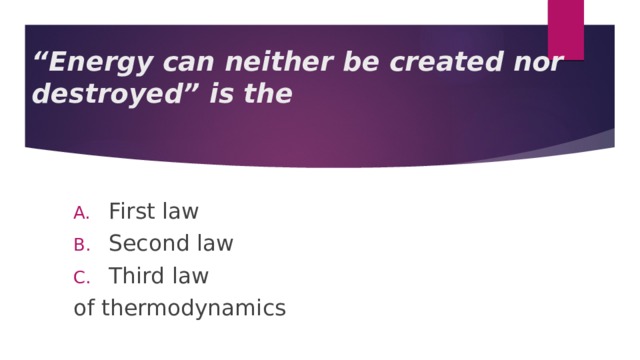
“ Energy can neither be created nor destroyed” is the
- First law
- Second law
- Third law
of thermodynamics
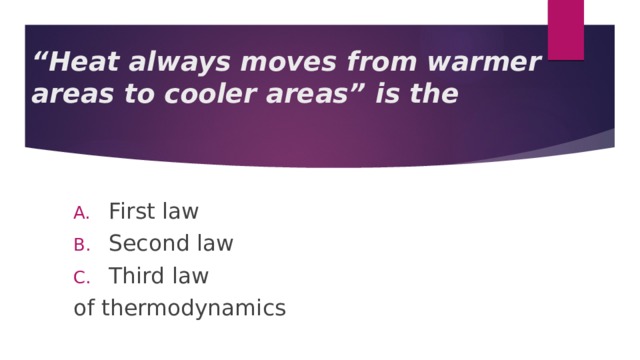
“ Heat always moves from warmer areas to cooler areas” is the
- First law
- Second law
- Third law
of thermodynamics
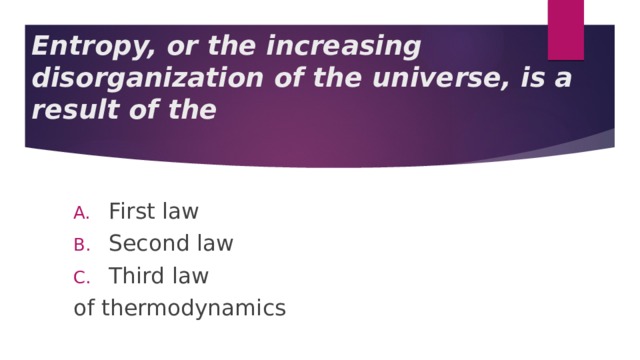
Entropy, or the increasing disorganization of the universe, is a result of the
- First law
- Second law
- Third law
of thermodynamics
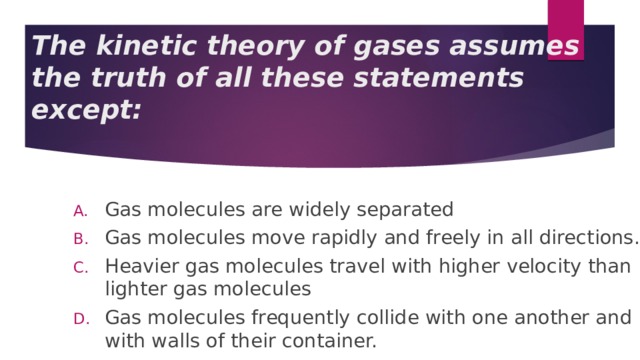
The kinetic theory of gases assumes the truth of all these statements except:
- Gas molecules are widely separated
- Gas molecules move rapidly and freely in all directions.
- Heavier gas molecules travel with higher velocity than lighter gas molecules
- Gas molecules frequently collide with one another and with walls of their container.
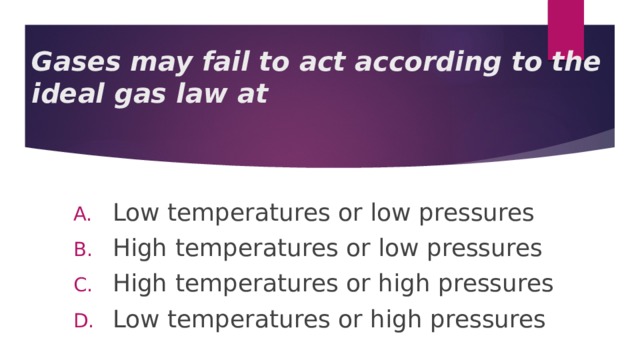
Gases may fail to act according to the ideal gas law at
- Low temperatures or low pressures
- High temperatures or low pressures
- High temperatures or high pressures
- Low temperatures or high pressures


Вебинар для учителей
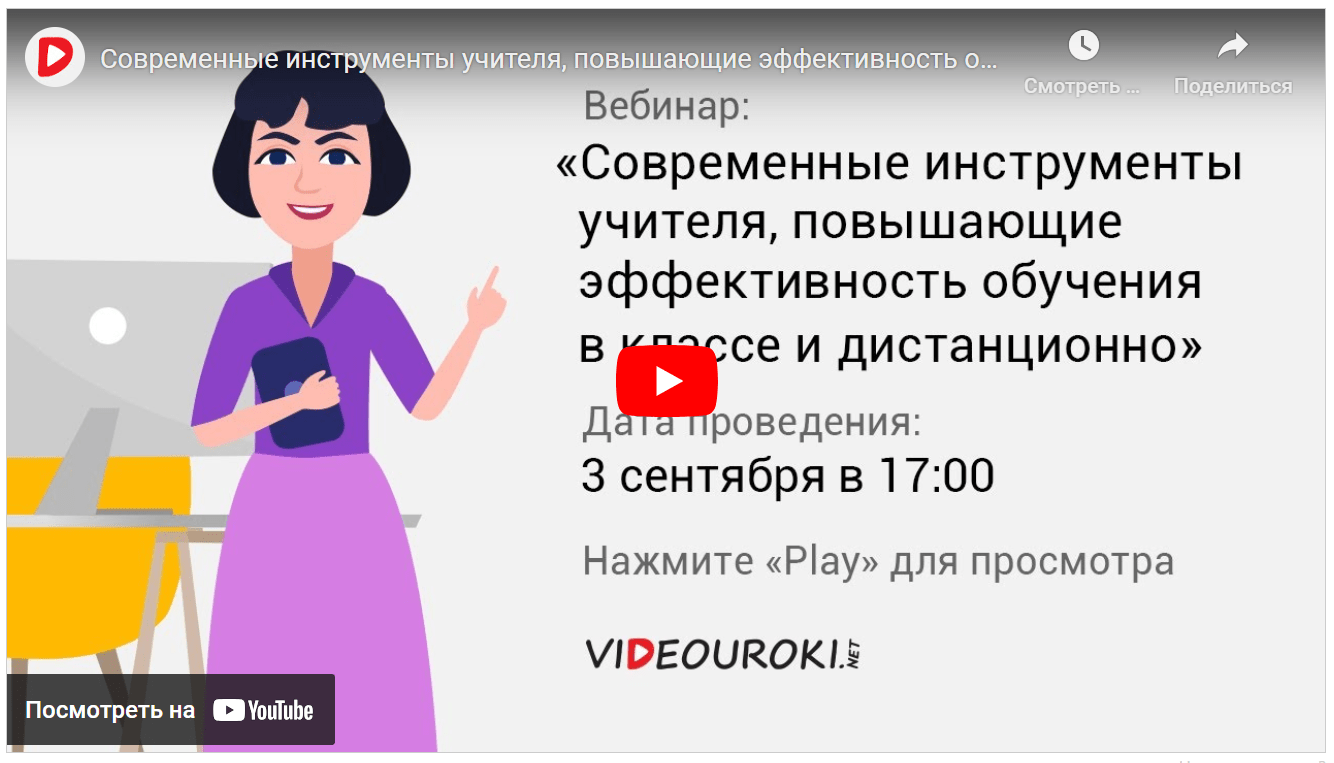
Свидетельство об участии БЕСПЛАТНО!