

Россия, Екатеринбург

СДЕЛАЙТЕ СВОИ УРОКИ ЕЩЁ ЭФФЕКТИВНЕЕ, А ЖИЗНЬ СВОБОДНЕЕ
Благодаря готовым учебным материалам для работы в классе и дистанционно
Скидки до 50 % на комплекты
только до
Готовые ключевые этапы урока всегда будут у вас под рукой
Организационный момент
Проверка знаний
Объяснение материала
Закрепление изученного
Итоги урока
Была в сети 29.05.2026 10:14

Ермакова Елена Олеговна
Учитель Английского языка
 2 762
2 762
 25 490
Местоположение
Types of clauses
Категория:
Английский язык
04.10.2022 02:05

Просмотр содержимого документа
«Types of clauses»
Relative clauses
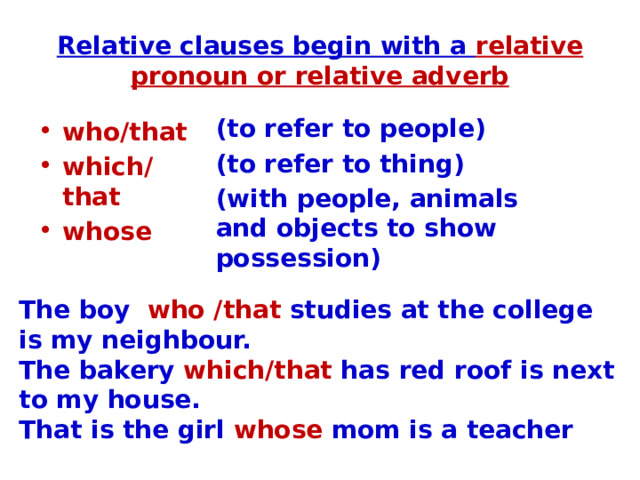
Relative clauses begin with a relative pronoun or relative adverb
(to refer to people)
(to refer to thing)
(with people, animals and objects to show possession)
- who/that
- which/that
- whose
The boy who /that studies at the college is my neighbour.
The bakery which/that has red roof is next to my house.
That is the girl whose mom is a teacher
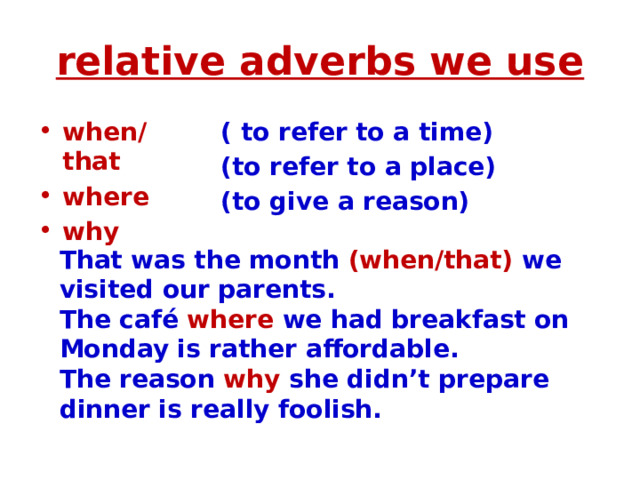
relative adverbs we use
- when/that
- where
- why
( to refer to a time)
(to refer to a place)
(to give a reason)
That was the month (when/that) we visited our parents.
The café where we had breakfast on Monday is rather affordable.
The reason why she didn’t prepare dinner is really foolish.
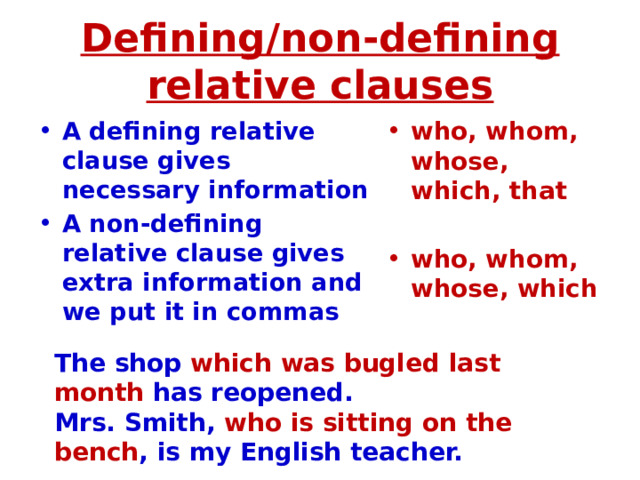
Defining/non-defining relative clauses
- A defining relative clause gives necessary information
- A non-defining relative clause gives extra information and we put it in commas
- who, whom, whose, which, that
- who, whom, whose, which
The shop which was bugled last month has reopened.
Mrs. Smith, who is sitting on the bench , is my English teacher.
Clauses of purpose
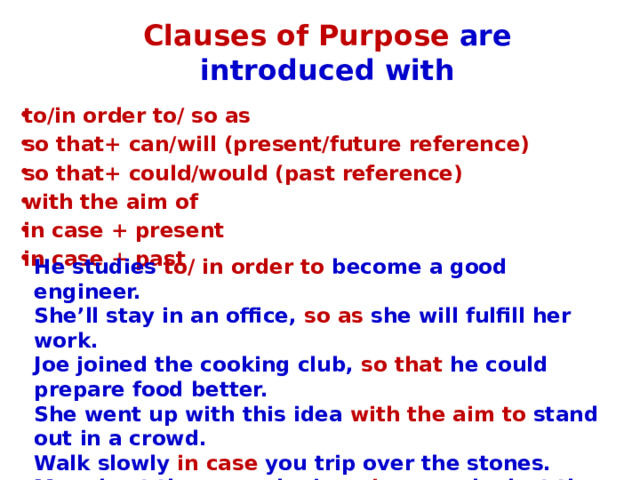
Clauses of Purpose are introduced with
- to/in order to/ so as
- so that+ can/will (present/future reference)
- so that+ could/would (past reference)
- with the aim of
- in case + present
- in case + past
He studies to/ in order to become a good engineer.
She’ll stay in an office, so as she will fulfill her work.
Joe joined the cooking club, so that he could prepare food better.
She went up with this idea with the aim to stand out in a crowd.
Walk slowly in case you trip over the stones.
Mary kept the second mirror in case she lost the first one.
Clauses of Reason
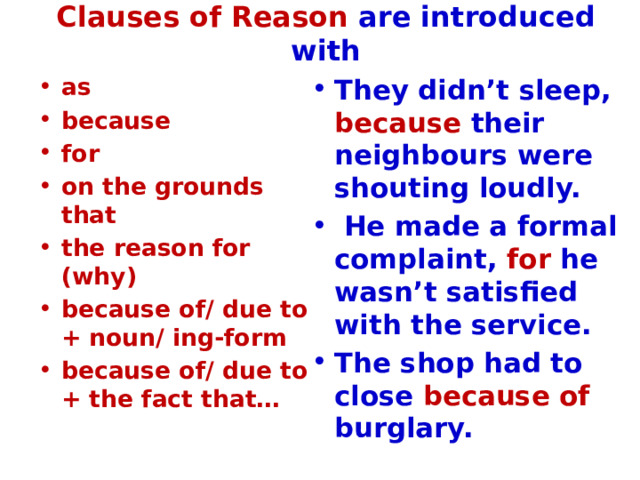
Clauses of Reason are introduced with
- as
- because
- for
- on the grounds that
- the reason for (why)
- because of/ due to + noun/ ing-form
- because of/ due to + the fact that…
- They didn’t sleep, because their neighbours were shouting loudly.
- He made a formal complaint, for he wasn’t satisfied with the service.
- The shop had to close because of burglary.
Clauses of Result
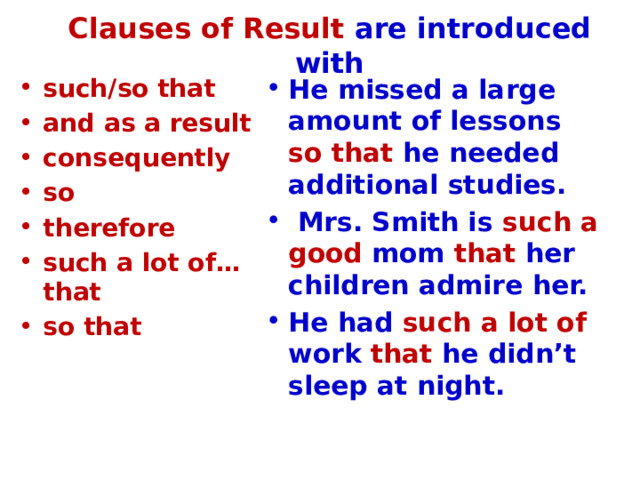
Clauses of Result are introduced with
- such/so that
- and as a result
- consequently
- so
- therefore
- such a lot of… that
- so that
- He missed a large amount of lessons so that he needed additional studies.
- Mrs. Smith is such a good mom that her children admire her.
- He had such a lot of work that he didn’t sleep at night.



Вебинар для учителей

Свидетельство об участии БЕСПЛАТНО!



