СДЕЛАЙТЕ СВОИ УРОКИ ЕЩЁ ЭФФЕКТИВНЕЕ, А ЖИЗНЬ СВОБОДНЕЕ

Благодаря готовым учебным материалам для работы в классе и дистанционно

Скидки до 50 % на комплекты
только до

Готовые ключевые этапы урока всегда будут у вас под рукой

Организационный момент

Проверка знаний

Объяснение материала

Закрепление изученного

Итоги урока
Урок-путешествие

Нажмите, чтобы узнать подробности

Полезный урок для повышения мотивации, интереса к изучамой стране!!!!

Просмотр содержимого документа
«10-5a техкарта»

Ставропольское президентское кадетское училище

Технологическая карта урока

Преподаватель: Соцкая Е.В..

Предмет :английский язык

УМК: О.В.Афанасьева, Д. Дули, И.В. Михеева, Б. Оби, В. Эванс Spotlight 10

Класс: 10

Тип урока: урок формирования лексико-грамматических навыков и речевых умений.

Тема

Beautiful Nepal!

Цель урока

Формирование коммуникативной компетенции

Задачи урока


Когнитивные:

- познакомить с новыми лексическими единицами и актуализировать знание пройденной лексики по теме урока;

- совершенствовать грамматические навыки;

- развивать аудитивные умения;

- способствовать развитию умений ознакомительного и поискового видов чтения;

- способствовать совершенствованию умений выражать свою точку зрения в устной форме речи.

Операциональные:

- обеспечить условия для развития навыков работы с источниками информации;

- способствовать развитию логического мышления;

- способствовать развитию памяти;

- обеспечить ситуацию, способствующую развитию умения переноса усвоенного материала в новую ситуацию.

Аксиологические:

- способствовать повышению мотивации к изучению иностранного языка;

- способствовать овладению необходимыми навыками самостоятельной учебной деятельности.

Формируемые УУД


  • личностные: личностное самоопределение;

  • регулятивные: составление плана и последовательности действий; коррекция — внесение необходимых дополнений и корректив в план и способ действия в случае расхождения эталона, реального действия и его результата;

  • коммуникативные: умение с достаточной полнотой и точностью выражать свои мысли; инициативное сотрудничество в поиске и сборе информации;

  • познавательные: поиск и выделение необходимой информации; осознанное и произвольное построение речевого высказывания в устной и письменной формах; структурирование знаний; построение логической цепи рассуждений.

Основные понятия


Kathmandu, The Himalayas, Bhaktapur, Bisket Jatra, Nepal, Machu Picchu.

View, beggars, barber, breathtaking, trekking excursion, tug-of-war contest, scenery, villagers, contest, temples, pottery, campsites and hotels, experiences.

Межпредметные связи

География, история

Формы работы

Фронтальная, индивидуальная, парная

Ресурсы


основные: УМК

дополнительные: проектор, интерактивная доска, презентация, аудиозапись, видеоролик, раздаточный материал

Основные этапы организации учебной деятельности и их цели


Содержание педагогического взаимодействия


Планируемые результаты


Деятельность учителя

Деятельность воспитанников


  1. 1.Оргмомент

Цель: создание учебного настроя на учебную деятельность.

Принимает рапорт дежурного, приветствует воспитанников.

Дежурный сдает рапорт, сообщает об отсутствующих, заполняет расход личного состава на доске. Кадеты отвечают на приветствие преподавателя.

Создание настроя на учебную деятельность.

2.Введение в тему урока (этап целеполагания и мотивации, постановки проблемного вопроса)

Цель: подведение воспитанников к формулированию темы и постановке задач урока. Составление плана урока.

Предлагает просмотреть на слайд 1, описать картинки и спрогнозировать, о чем будет говориться в этой части модуля. Просит определить главную цель и задачи на урок (слайд 2).


Кадеты описывают картинки на слайде, делают вывод о том, что их объединяет. Предполагают тему занятия, определяют основную цель, задачи.

Совместно с кадетами формулирование темы, задач урока.

3.Основной этап урока:

Цель:

- знакомство с новой лексикой урока;

- актуализация пройденной лексики;

- развитие умений диалогической речи;

- развитие умений ознакомительного и поискового видов чтения;

- развитие умений устной речи;

- совершенствование умений письменной речи.


  1. Предлагает ответить на вопросы о путешествиях и выбрать лично значимые причины путешествия (слайд 3).


  1. Предлагает ответить на вопросы по теме «Путешествия» с опорой на слайде 4 и прокомментировать собственное мнение.


  1. Предлагает догадаться о какой стране пойдет речь с опорой на картинки (слайд 5), просмотреть официальную информацию (слайд 6) и составить краткий рассказ о стране на основе полученной информации.


  1. Предлагает прокомментировать предложенные идеи по теме урока в форме диалога.


  1. Предлагает просмотреть заголовки абзацев и спрогнозировать их содержание.


  1. Предлагает прослушать текст (возможно с опорой), определить верные и неверные высказывания, ответить на вопросы (упр. 2, 3 стр. 82; слайды 8, 9, 10).


  1. Предлагает прослушать отрывок текста и вставить недостающие в тексте слова (слайд 11).


  1. Предлагает найти описательные прилагательные из текста к заданным словам и подобрать к ним антонимы (упр. 4a, стр. 83).


  1. Предлагает дать объяснение выделенным словам из текста и вставить необходимое из них в предложение (упр. 4b, стр. 83).


  1. Предлагает прочитать и перевести лексические единицы текста с целью их закрепления (слайд 15). Затем предлагает пересказать содержание части текста с опорой на слова и вопросы (слайд 16).


  1. Предлагает ознакомиться с дефинициями близких по значению слов (слайд 17, 18), выбрать правильное слово согласно содержанию предложения и составить собственное предложение с другим словом (упр. 6, стр. 83).


  1. Предлагает определить разницу между словами: tour, excursion, trip, voyage, journey (слайд 19) и заполнить пробелы в предложениях (упр. 7, стр. 83).

Высказывают собственное мнение о причинах путешествий.


Отвечают на поставленные вопросы, дают пояснения о собственных предпочтениях, мнении, опыте.


Изучают картинки, делают предположения об изучаемой на уроке стране. Составляют монологическое высказывание с опорой.


В парах составляют диалог, разыгрывают его в классе.


Выполняют задание. Умение делать предположения о возможном содержании текста.


Слушают аудиозапись, определяют верность/неверность утверждений по содержанию текста, корректируют неверные утверждения. Дают развернутые ответы на вопросы.


Слушают аудиозапись и выполняют задание на карточке. Организуют взаимопроверку.


Работают с текстом индивидуально. Затем обсуждают проделанную работу в классе.


Объясняют значение слов на английском языке, выполняют задание.


Выполняют задание. Записывают незнакомые слова и фразы в словарь. Составляют краткий пересказ содержания любой части текста.


Изучают лексическое значение слов и выражений. Записывают их в словарь. Выполняют задание. Составляют предложения.


Изучают особенности лексического значения слов. Вставляют необходимые по смыслу слова в предложения.


Актуализация лексических единиц по теме. Совершенствование языковых навыков и развитие речевых умений.


Развитие умений монологической речи. Умение выражать и аргументировать собственное мнение.


Развитие догадки на основе опоры, умения аргументировать собственную точку зрения. Расширение словарного запаса. Совершенствование навыков говорения на заданную тему.


Развитие умения составления и презентации диалогической речи. Знание разговорных моделей и клише, характерных диалогической речи.


Развитие аналитических и логических способностей, умения прогнозировать на основе опоры.


Развитие аудитивных умений, умений поискового и изучающего видов чтения, отвечать на вопросы аналитического характера. Закрепление пройденной лексики.


Развитие аудитивных умений, умения оценивать результаты собственной и других кадет деятельности.


Знание лексики по теме урока. Расширение лингвистической компетенции воспитанников.


Умения давать общие и контекстуальные значения слов. Знание и применение на практике пройденной лексики.


Расширение словарного запаса и умение использовать его в коммуникативных целях.


Расширение словарного запаса. Умение использовать полученные знания в новой коммуникативной ситуации.


Знание особенностей лексического значения слов. Умение применять их на практике.

4.Заключительный этап

а) Рефлексия

Цель: соотнесение поставленных задач с достигнутыми результатами.

б) Объяснение домашнего задания

Цель: снятие трудностей в выполнении домашнего задания.

в) Оценивание

Цель: аргументирование оценок воспитанников.


Предлагает закончить предложения, которые подразумевают анализ собственных достижений на уроке. Просит обобщить результаты урока.


Предъявляет домашнее задание с комментариями о его выполнении.


Совместно с кадетами формулирует критерии оценок и производит оценивание ответов обучающихся.


Сообщают, что было сделано на уроке, анализируют, достигнуты ли поставленные задачи.


Записывают домашнее задание, выясняют непонятные моменты


Формулируют критерии, оценивают ответы.


Умение проводить анализ собственной деятельности.


Умение прогнозировать и анализировать свою деятельность.


Осуществление регулятивных действий самоконтроля, самооценки в процессе коммуникативной деятельности на иностранном языке.


Просмотр содержимого документа
«раздаточный материал»

Module 5a


Task 7

Tuesday 7th April – The Himalayas


Tuesday 7th April – The Himalayas

We woke up yesterday feeling so 1)_________! Finally the day we would begin our 2-day trekking 2)__________ to the Himalayas had arrived! We took a small plane journey from Kathmandu and then trekked for 3)_______ up and down the rocky mountain trail. It was hot in the bright mountain sun but quite cold wherever there was some 4)________. You can’t imagine how spectacular the scenery was! We finally 5)________ a village called Phakding where we put up our tent and camped outside a teahouse. We tried some local 6)________ , which were delicious, and then got into our sleeping bags. It got cold very quickly once the sun had gone down! I woke the next morning to the most amazing 7)_________ I had ever seen! I took a walk down to the 8) _________ where I ran into two young boys playing. They were really 9)__________. Nepalese villages are very poor, but everyone we met in the mountains 10)__________ happy.


Key to Task 7

Tuesday 7th April – The Himalayas


We woke up yesterday feeling so 1) excited! Finally the day we would begin our 2-day trekking 2) excursion to the Himalayas had arrived! We took a small plane journey from Kathmandu and then trekked for 3) hours up and down the rocky mountain trail. It was hot in the bright mountain sun but quite cold wherever there was some 4) shade. You can’t imagine how spectacular the scenery was! We finally 5) reached a village called Phakding where we put up our tent and camped outside a teahouse. We tried some local 6) dishes, which were delicious, and then got into our sleeping bags. It got cold very quickly once the sun had gone down! I woke the next morning to the most amazing 7) sunrise I had ever seen! I took a walk down to the 8) river where I ran into two young boys playing. They were really 9) friendly. Nepalese villages are very poor, but everyone we met in the mountains 10) seemed happy.


Task 8.


Adjectives and antonyms

Words

Used adjectives

Antonymous adjectives

view


scenery


sunrise


boys


villagers


contest


parade


Bhaktapur temples


pottery


campsite and hotels


experiences


Key to Task 8.


Adjectives and antonyms (Suggested answers)

Words

Used adjectives

Antonymous adjectives

view

absolutely breathtaking

dull, boring

scenery

spectacular

unimpressive

sunrise

amazing

insignificant, ordinary, poor

boys

young

old,

villagers

poor, happy

rich, unhappy

contest

tug-of-war, noisy

quiet, calm

parade

wild

moderate, ineffective

Bhaktapur temples

magnificent, countless

common, unimpressive, small in number,

pottery

beautiful

inelegant, plain, unattractive

campsite and hotels

cheap

expensive, costly

experiences

amazing

minor, insignificant


Просмотр содержимого презентации
«10-5a Travelling Nepal»

Travelling
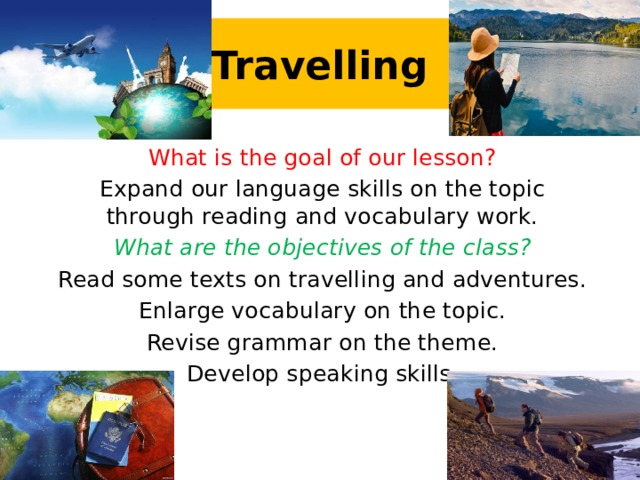
Travelling

Travelling What is the goal of our lesson? Expand our language skills on the topic through reading and vocabulary work. What are the objectives of the class? Read some texts on travelling and adventures. Enlarge vocabulary on the topic. Revise grammar on the theme. Develop speaking skills.

Travelling

What is the goal of our lesson?

Expand our language skills on the topic through reading and vocabulary work.

What are the objectives of the class?

Read some texts on travelling and adventures.

Enlarge vocabulary on the topic.

Revise grammar on the theme.

Develop speaking skills.

Travelling  Task 1. Answer the questions:

Travelling

Task 1. Answer the questions:

  • Do people like travelling? Why(not)?
  • to study the world;
  • to learn about different cultures;
  • to meet new people and make new friends;
  • to visit unusual places;
  • to try different local dishes;
  • to buy souvenirs;
  • to take photos;
  • to master language skills;
  • to have fun;
  • to get new experience;
  • to waste time.
Travelling 2. Where can people travel to? 3. What means of travelling do you prefer? Why? 4. When is it better to travel: winter or summer? 5. What places have you been to? 6. If you had a chance where would you like to go?  Why?

Travelling

2. Where can people travel to?

3. What means of travelling do you prefer? Why?

4. When is it better to travel: winter or summer?

5. What places have you been to?

6. If you had a chance where would you like to go?

Why?

Nepal

Nepal

Nepal: Speaking Task 2. Study the data and tell a few words about the country:

Nepal: Speaking

Task 2. Study the data and tell a few words about the country:

  • Official name: the Federal Democratic Republic of Nepal;
  • Location: south of China, north, east and west of India;
  • Territory: about 147 000 sq. km.;
  • Population: about 30 mln. people;
  • Capital: Kathmandu;
  • Official languages: Nepali and some local languages;
  • Religions: Hindu (81%), Buddhist (9 %), Muslim (5%) and others (5%);
  • Government: Federal Parliamentary Republic;
  • Governor: President.
Nepal: Pre-Reading Task 3. Study the list of the following items and comment on them. Make up a dialogue. walking holidays; staying in a hotel; conveniences; plane journey; camping; heavy rucksacks; cold weather; local inhabitants; festival; guided tour; souvenirs; making notes. You are going to spend holidays with your friend in Nepal. Discuss the possibilities, advantages and worries about going there.

Nepal: Pre-Reading

Task 3. Study the list of the following items and comment on them. Make up a dialogue.

  • walking holidays;
  • staying in a hotel;
  • conveniences;
  • plane journey;
  • camping;
  • heavy rucksacks;
  • cold weather;
  • local inhabitants;
  • festival;
  • guided tour;
  • souvenirs;
  • making notes.

You are going to spend holidays with your friend in Nepal. Discuss the possibilities, advantages and worries about going there.

Nepal: While Reading Task 4. Read the titles of the paragraphs and say what they might be about. Task 5. Study the rest of the text and be ready to say if the statements are true , false or the text doesn’t say about it. Correct the false statements.

Nepal: While Reading

Task 4. Read the titles of the paragraphs and say what they might be about.

Task 5. Study the rest of the text and be ready to say if the statements are true , false or the text doesn’t say about it. Correct the false statements.

Nepal: While Reading The weather wasn’t very good when the travellers arrived in Kathmandu. Kathmandu was clean and quiet. The view from the Himalayas was great. The two young boys asked the travellers for money. Bhaktapur is a modern town. Bisket Jatra takes place once a year. Bisket Jatra lasts a week. Jake and the author went home by plane. The author missed home. The author didn’t sleep at all during the holiday. - True - False - True - Doesn’t say - False - True - Doesn’t say - True - True - False

Nepal: While Reading

  • The weather wasn’t very good when the travellers arrived in Kathmandu.
  • Kathmandu was clean and quiet.
  • The view from the Himalayas was great.
  • The two young boys asked the travellers for money.
  • Bhaktapur is a modern town.
  • Bisket Jatra takes place once a year.
  • Bisket Jatra lasts a week.
  • Jake and the author went home by plane.
  • The author missed home.
  • The author didn’t sleep at all during the holiday.

- True

- False

- True

- Doesn’t say

- False

- True

- Doesn’t say

- True

- True

- False

Nepal: Post-Reading Task 6. Read the text attentively and answer the questions. What was the weather like in Kathmandu? The Himalayas? What means of transport did they use while in Nepal? Where did they stay? What did they do and see in each place? What kind of people are the Nepalese? What did they like about their visit to Bhaktapur:  people? festival? sights? dishes? view? competitions?

Nepal: Post-Reading

Task 6. Read the text attentively and answer the questions.

  • What was the weather like in Kathmandu? The Himalayas?
  • What means of transport did they use while in Nepal?
  • Where did they stay?
  • What did they do and see in each place?
  • What kind of people are the Nepalese?
  • What did they like about their visit to Bhaktapur:

people? festival? sights? dishes? view? competitions?

  • Why did they want to go back home?
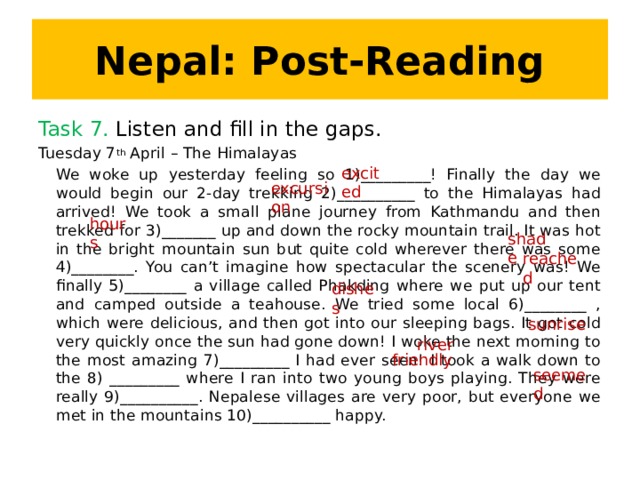
Nepal: Post-Reading Task 7. Listen and fill in the gaps. Tuesday 7 th April – The Himalayas We woke up yesterday feeling so 1)_________! Finally the day we would begin our 2-day trekking 2)__________ to the Himalayas had arrived! We took a small plane journey from Kathmandu and then trekked for 3)_______ up and down the rocky mountain trail. It was hot in the bright mountain sun but quite cold wherever there was some 4)________. You can’t imagine how spectacular the scenery was! We finally 5)________ a village called Phakding where we put up our tent and camped outside a teahouse. We tried some local 6)________ , which were delicious, and then got into our sleeping bags. It got cold very quickly once the sun had gone down! I woke the next morning to the most amazing 7)_________ I had ever seen! I took a walk down to the 8) _________ where I ran into two young boys playing. They were really 9)__________. Nepalese villages are very poor, but everyone we met in the mountains 10)__________ happy. excited excursion hours shade reached dishes sunrise river friendly seemed

Nepal: Post-Reading

Task 7. Listen and fill in the gaps.

Tuesday 7 th April – The Himalayas

We woke up yesterday feeling so 1)_________! Finally the day we would begin our 2-day trekking 2)__________ to the Himalayas had arrived! We took a small plane journey from Kathmandu and then trekked for 3)_______ up and down the rocky mountain trail. It was hot in the bright mountain sun but quite cold wherever there was some 4)________. You can’t imagine how spectacular the scenery was! We finally 5)________ a village called Phakding where we put up our tent and camped outside a teahouse. We tried some local 6)________ , which were delicious, and then got into our sleeping bags. It got cold very quickly once the sun had gone down! I woke the next morning to the most amazing 7)_________ I had ever seen! I took a walk down to the 8) _________ where I ran into two young boys playing. They were really 9)__________. Nepalese villages are very poor, but everyone we met in the mountains 10)__________ happy.

excited

excursion

hours

shade

reached

dishes

sunrise

river

friendly

seemed

Nepal: Post-Reading Task 8. Find the adjectives to describe the following things. Suggest antonyms. Complete the table.

Nepal: Post-Reading

Task 8. Find the adjectives to describe the following things. Suggest antonyms. Complete the table.

  • view
  • scenery
  • sunrise
  • boys
  • villagers
  • contest
  • parade
  • Bhadtakur temples
  • pottery
  • campsites and hotels
  • experiences
Nepal: Post-Reading Task 9. Explain the words in bold and use them in the sentences below. Delayed, beggar, barber, cracked, pavement, escape, peak, in the distance, breathtaking, trekking, shade, scenery, put up, local, ancient, annual, hire, tug-of-war contest, kick off, be based on, candlelit procession, craftsman, handicraft, drum, backpack, nasty viruses, countless, home comforts.

Nepal: Post-Reading

Task 9. Explain the words in bold and use them in the sentences below.

Delayed, beggar, barber, cracked, pavement, escape, peak, in the distance, breathtaking, trekking, shade, scenery, put up, local, ancient, annual, hire, tug-of-war contest, kick off, be based on, candlelit procession, craftsman, handicraft, drum, backpack, nasty viruses, countless, home comforts.

Nepal: Post-Reading delayed She arrived in London after a _________ flight from Lisbon. The _________ dishes were delicious. Have you ever been to the ________ city of Machu Picchu? Notting Hill Carnival is an ________ festival on London. They _________ a guide to show them around. The _________ was crowded with people. local ancient annual hired pavement

Nepal: Post-Reading

delayed

  • She arrived in London after a _________ flight from Lisbon.
  • The _________ dishes were delicious.
  • Have you ever been to the ________ city of Machu Picchu?
  • Notting Hill Carnival is an ________ festival on London.
  • They _________ a guide to show them around.
  • The _________ was crowded with people.

local

ancient

annual

hired

pavement

Nepal: Post-Reading Task 10. Study the words and phrases from the text and translate them into Russian.

Nepal: Post-Reading

Task 10. Study the words and phrases from the text and translate them into Russian.

  • delayed flight
  • street vendor
  • shoeshine boy
  • crack
  • be worth sth/doing sth
  • the view of …
  • in the distance
  • be breathtaking
  • trekking excursion
  • rocky mountain trail
  • spectacular
  • scenery
  • put up a tent
  • try local dishes
  • once = when
  • annual
  • hire a guide
  • tug-of-war contest
  • kick off
  • wild parade
  • be based on
  • candlelit procession
  • go on a guided tour
  • go shopping for souvenirs
  • handicraft
  • countless temples
  • backpacking through Asia
  • look forward to sth/doing sth
  • home comforts
Nepal: Speaking Task 11. Retell the paragraphs of the text using the words and phrases in Task 10 .

Nepal: Speaking

Task 11. Retell the paragraphs of the text using the words and phrases in Task 10 .

  • Which places did the author visit?
  • What did she do/see in each?
  • How did she like the journey?
Vocabulary Work Task 12. Choose the correct word. Explain the difference in their meaning.

Vocabulary Work

Task 12. Choose the correct word. Explain the difference in their meaning.

  • excursion - a short journey arranged so that a group of people can visit a place, especially while they are on holiday;
  • exhibition - a show of paintings, photographs, or other objects that people can go to see;
  • leaflet - a small book or piece of paper advertising something or giving information on a particular subject;
  • brochure - a thin book giving information or advertising something;
  • coast - the area where the land meets the sea;
  • beach - an area of sand or small stones at the edge of the sea or a lake;
  • package – prepaid kind of holiday with a definite route;
  • packed - containing a lot of a particular type of thing;
  • scenery - the natural features of a particular part of a country that you can see, such as mountains, forests, deserts;
  • view - the whole area that you can see from somewhere, especially when it is very beautiful or impressive;
Vocabulary Work

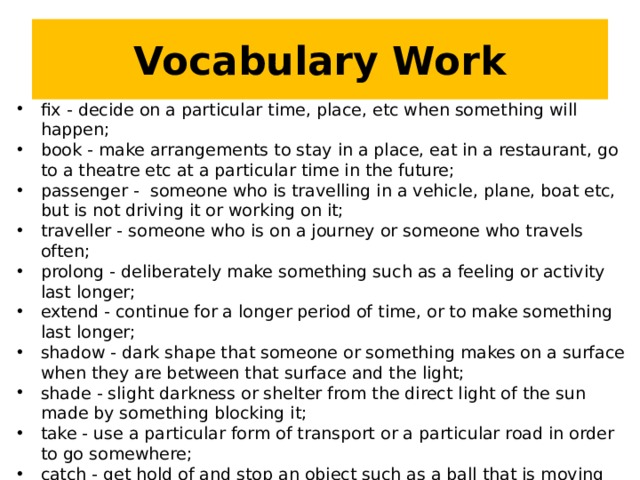
Vocabulary Work

  • fix - decide on a particular time, place, etc when something will happen;
  • book - make arrangements to stay in a place, eat in a restaurant, go to a theatre etc at a particular time in the future;
  • passenger - someone who is travelling in a vehicle, plane, boat etc, but is not driving it or working on it;
  • traveller - someone who is on a journey or someone who travels often;
  • prolong - deliberately make something such as a feeling or activity last longer;
  • extend - continue for a longer period of time, or to make something last longer;
  • shadow - dark shape that someone or something makes on a surface when they are between that surface and the light;
  • shade - slight darkness or shelter from the direct light of the sun made by something blocking it;
  • take - use a particular form of transport or a particular road in order to go somewhere;
  • catch - get hold of and stop an object such as a ball that is moving through the air;
  • rent - pay to live in or use a building that is owned by someone else;
  • hire - employ someone for a short time to do a particular job;
  • setting - the place where something is or where something happens, and the general environment.
Vocabulary Work Task 13. Match the words and their definitions and fill them in the sentences:  describes travelling from one place to another over a considerable distance. tour  is often travelling to a place and coming back the same day and so it is not usually long. excursion trip  describes travelling from one place after another over a period of days/weeks and visiting various towns/cities and in the end coming back to where you started voyage journey  is a very long trip, usually at sea or in space.  is usually short journey made for pleasure; an outing tour They went on a coach ___________ of Spain. Let’s go on a day ___________ to the seaside. The holiday company organises a weekly ____________ to the mountains. The Titanic sank on its maiden ______________ . The car ______________ was boring, tiring and hot. trip excursion voyage journey

Vocabulary Work

Task 13. Match the words and their definitions and fill them in the sentences:

  • describes travelling from one place to another over a considerable distance.

tour

  • is often travelling to a place and coming back the same day and so it is not usually long.

excursion

trip

  • describes travelling from one place after another over a period of days/weeks and visiting various towns/cities and in the end coming back to where you started

voyage

journey

  • is a very long trip, usually at sea or in space.
  • is usually short journey made for pleasure; an outing

tour

  • They went on a coach ___________ of Spain.
  • Let’s go on a day ___________ to the seaside.
  • The holiday company organises a weekly ____________ to the mountains.
  • The Titanic sank on its maiden ______________ .
  • The car ______________ was boring, tiring and hot.

trip

excursion

voyage

journey

Reflexion

Reflexion

Hometask

Hometask

  • Learn the words and expressions (pp. 82-83) by heart.
  • Retell the text “Beautiful Nepal” using as many words and expressions as possible.