


Россия, г. Оренбург

СДЕЛАЙТЕ СВОИ УРОКИ ЕЩЁ ЭФФЕКТИВНЕЕ, А ЖИЗНЬ СВОБОДНЕЕ
Благодаря готовым учебным материалам для работы в классе и дистанционно
Скидки до 50 % на комплекты
только до
Готовые ключевые этапы урока всегда будут у вас под рукой
Организационный момент
Проверка знаний
Объяснение материала
Закрепление изученного
Итоги урока
Была в сети 20.07.2026 20:59

Ильина Оксана Владимировна
Учитель английского языка
 1 331
1 331
 52 499
Местоположение
Специализация
Условные предложения
Категория:
Английский язык
15.05.2026 21:48

Просмотр содержимого документа
«Условные предложения»

If предложения – условные предложения

В английском языке существует 4 основных типа предложений if, которые часто называют условными предложениями. Эти предложения состоят из двух частей (придаточных предложений):
1) часть if (предложение if);
2) другая часть, где вы можете использовать такие слова, как can, will, возможно, might, could и would (основное предложение).

4 основных типа предложений if
- Zero conditional (нулевое условное)
- First conditional (первое условное)
- Second conditional (второе условное)
- Third conditional (третье условное)
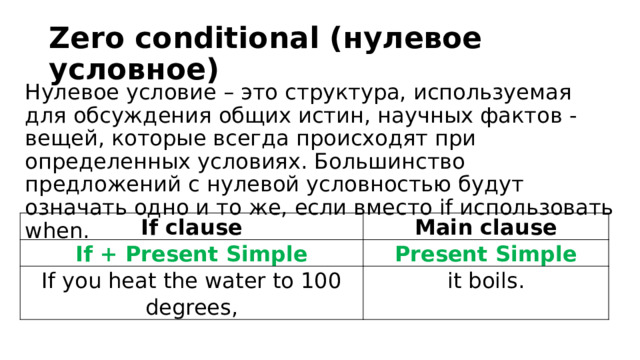
Zero conditional (нулевое условное)
Нулевое условие – это структура, используемая для обсуждения общих истин, научных фактов - вещей, которые всегда происходят при определенных условиях. Большинство предложений с нулевой условностью будут означать одно и то же, если вместо if использовать when.
If clause
If + Present Simple
Main clause
If you heat the water to 100 degrees,
Present Simple
it boils.

– Make zero conditional sentences.
1) Jane/eat/too much chocolate / she / get / sick.
2) You/not/eat/you/die.
3) You/heat/ice/it/melts.

Keys:
1 – If Jane eats too much chocolate, she gets sick.
2 – If you don’t eat, you die.
3 – If you heat ice, it melts.

First conditional (первое условное)
Первое условие - это структура, используемая для обсуждения возможностей в настоящем или будущем. Используется для обсуждения вещей, которые могут произойти.
If clause
If + Present Simple
Main clause
If you study hard,
Future Simple, can, may
you will pass the test.

– Make first conditional sentences. Put the verbs in brackets into the correct tense.
1) If you … (not study), you … (fail) the test.
2) I … (lend) you my umbrella if you … (need) it.
3) If I … (be late), I … (call) you.

Keys:
1 – If you don’t study, you will fail the test.
2 – I will lend you my umbrella if you need it.
3 – If I am late, I will call you.

Second conditional (второе условное)
Второе условное обозначение - это структура, используемая для описания нереальных ситуаций в настоящем или будущем, вещей, которые не происходят или не будут происходить в будущем.
If clause
If + Past Simple would,
Main clause
If I had a million dollars,
could, might
I would buy a big house.

– Write second conditional sentences. Put the verbs in brackets into the correct tense.
- If you … (leave) your job, you … (travel) around the world.
2) If you … (be) nicer to him, he … (lend) you the money.
3) It … (be) nice if the rain … (stop)!

Keys:
1 – If you left your job, you could travel around the world.
2 – If you were nicer to him, he might lend you the money.
3 – It would be nice if the rain stopped!

Third conditional (третье условное)
Третье условное выражение - это конструкция, используемая для описания нереальных ситуаций в прошлом. Третье условное выражение используется для описания событий, которые НЕ происходили в прошлом. Он часто используется для выражения критики или сожаления о прошлом.
If clause
If + Past Perfect
Main clause
If I had studied harder,
would/could/might have + Past Participle
I would have passed the exam.

– Write third conditional sentences. Put the verbs in brackets into the correct form.
- He crashed his car because he fell asleep while driving. If he … (fall) asleep while driving, he … (crash) his car.
2) I lost my job because I was late for work. I … (loose) my job if I … (be) late for work.
3) We couldn’t go to the concert, because we didn’t have enough money. If we … (have) enough money, we … (go) to the concert.

Keys:
1 – If he hadn’t fallen asleep while driving, he wouldn’t have crashed his car.
2 – I wouldn’t have lost my job if I hadn’t been late for work.
3 – If we had had enough money, we could have gone to the concert.

Homework: правило "условные предложения", с. 126 №3








Вебинар для учителей

Свидетельство об участии БЕСПЛАТНО!



