


Россия, Ейск


СДЕЛАЙТЕ СВОИ УРОКИ ЕЩЁ ЭФФЕКТИВНЕЕ, А ЖИЗНЬ СВОБОДНЕЕ
Благодаря готовым учебным материалам для работы в классе и дистанционно
Скидки до 50 % на комплекты
только до
Готовые ключевые этапы урока всегда будут у вас под рукой
Организационный момент
Проверка знаний
Объяснение материала
Закрепление изученного
Итоги урока

Была в сети 14.06.2026 15:52

Толок Дарья Дмитриевна
Преподаватель Английского языка
 1 489
1 489
 47 440
Местоположение
Специализация
Uterine fibroids
Категория:
Английский язык
09.06.2026 23:16

Просмотр содержимого документа
«Uterine fibroids»

Uterine fibroids

Presentation content
- What is uterine fibroid?
- Types of uterine fibroids
- Risk factors
- Clinical presentation of the disease
- Diagnosis of Uterine Myoma
- Treatment of Uterine Fibroids
- Uterine Fibroids Prevention
- World Health Organization statistics

What is uterine fibroid?
- Uterine fibroids are benign, hormone-dependent tumor. They are one of the most common benign tumors of the female reproductive system

- Uterine fibroids are a fairly common condition, with a prevalence rate reaching 70-80%, but in most cases, they are asymptomatic.
- Only 30-40% of cases show noticeable symptoms
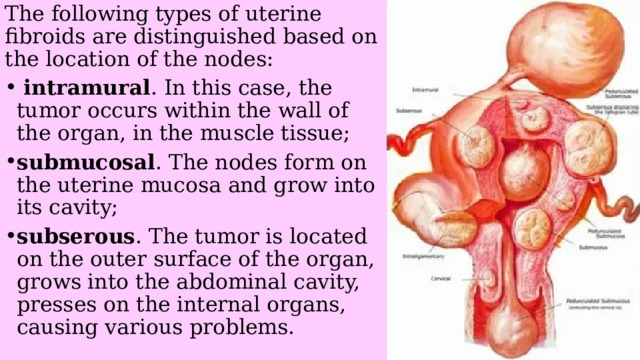
The following types of uterine fibroids are distinguished based on the location of the nodes:
- intramural . In this case, the tumor occurs within the wall of the organ, in the muscle tissue;
- submucosal . The nodes form on the uterine mucosa and grow into its cavity;
- subserous . The tumor is located on the outer surface of the organ, grows into the abdominal cavity, presses on the internal organs, causing various problems.

Risk factors include:
- immune system dysfunction;
- hormonal imbalances;
- hereditary predisposition;
- reproductive age from 25 to 35 years;
- late first pregnancy;
- menopause;
- use of combined oral contraceptives;
- excess weight
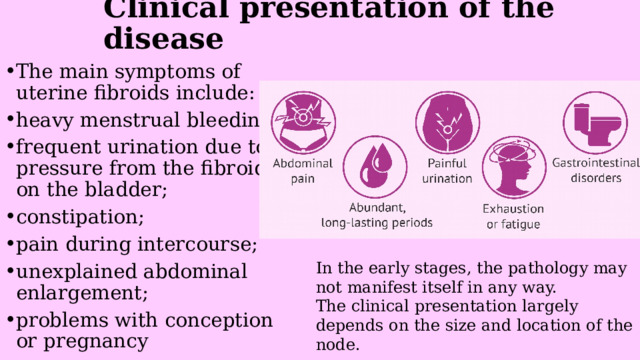
Clinical presentation of the disease
- The main symptoms of uterine fibroids include:
- heavy menstrual bleeding;
- frequent urination due to pressure from the fibroid on the bladder;
- constipation;
- pain during intercourse;
- unexplained abdominal enlargement;
- problems with conception or pregnancy
In the early stages, the pathology may not manifest itself in any way.
The clinical presentation largely depends on the size and location of the node.

Diagnosis of Uterine Myoma
- Pelvic Ultrasound. Allows determination of the number, location, and size of fibroids. On ultrasound, fibroids appear as a round, homogeneous mass; the uterus is often enlarged and its contours are deformed.
- Pelvic MRI. Prescribed if ultrasound does not allow a full assessment of the size and position of the tumor, such as with a very large uterus.

- Hysteroscopy. An endoscopic method for visually assessing the uterine cavity. Used for submucosal fibroids, as well as for the removal of polyps and fibroid nodes growing into the uterine cavity.
- Hysterosalpingography (HSG). An X-ray examination of the uterus and fallopian tubes using contrast agents.
- Laparoscopy . Allows examination of the uterus with a special instrument through small punctures in the abdominal wall.

Treatment of Uterine Fibroids
- The choice of treatment depends on the location and size of the tumor, the clinical presentation of the disease, the patient's condition and age, and her reproductive plans.
- Conservative treatment is used if the fibroid is small (up to 12 weeks old), does not cause significant symptoms, and grows slowly. Its goal is to slow the growth of fibroids, eliminate symptoms, and preserve the uterus.
Treatment may include:
- hormonal medications
- non-hormonal drugs for mild symptoms
- antiprogestogens

- Surgical treatment is recommended for active fibroid growth, large tumors, severe symptoms, and complications.
Methods:
- Myomectomy – removal of fibroids while preserving the uterus and the possibility of pregnancy. It can be performed laparoscopically or hysteroscopically.
- Hysterectomy – complete removal of the uterus. Recommended for women who are not planning to become pregnant.
- Uterine artery embolization – partial blockage of the blood vessels supplying the uterus, which leads to disruption of the fibroid's blood supply and its necrosis.
- FUS ablation – a non-invasive technique that uses focused ultrasound waves to reduce the size of fibroids.

Uterine Fibroids Prevention
- regularly visiting a gynecologist (at least 1-2 times a year), even in the absence of symptoms;
- an annual pelvic ultrasound;
- maintain a healthy lifestyle: eat a balanced diet, control your weight, engage in moderate physical activity, and avoid stress;
- avoid abortion;
- promptly treat gynecological diseases and inflammatory processes in the pelvic organs;
- monitor your hormonal levels and, if necessary, take measures to normalize them;

- Uterine fibroids are a common benign condition that significantly impacts women's health and healthcare systems worldwide. According to the World Health Organization (WHO), uterine fibroids are diagnosed in 30–35% of women of reproductive age, and up to 45% in older women. They are one of the most common benign tumors of the female reproductive system.

Thank you for your attention








Вебинар для учителей

Свидетельство об участии БЕСПЛАТНО!



