
 956
956 69 209






© 2016, lenck 754 2

СДЕЛАЙТЕ СВОИ УРОКИ ЕЩЁ ЭФФЕКТИВНЕЕ, А ЖИЗНЬ СВОБОДНЕЕ
Благодаря готовым учебным материалам для работы в классе и дистанционно
Скидки до 50 % на комплекты
только до
Готовые ключевые этапы урока всегда будут у вас под рукой
Организационный момент
Проверка знаний
Объяснение материала
Закрепление изученного
Итоги урока
Welcome To London
Категория:
Английский язык
11.05.2016 09:52

Просмотр содержимого документа
«Welcome To London»

Welcome To London
Lazareva T.V. LENSK. SECONDARY SCHOOL № 1

Trafalgar Square
- Trafalgar Square is a public space and tourist attraction in central London, England, United Kingdom. At its centre is Nelson's Column, which is guarded by four lion statues at its base. There are a number of statues and sculptures in the square, with one plinth displaying changing pieces of contemporary art. The square is also used for political demonstrations and community gatherings, such as the celebration of New Year's Eve.
- The name commemorates the Battle of Trafalgar (1805), a British naval victory of the Napoleonic Wars over France. The original name was to have been "King William the Fourth's Square", but George Ledwell Taylor suggested the name "Trafalgar Square".
- In the 1820s the George IV engage the architect John Nash to redevelop the area. Nash cleared the square as part of his Charing Cross Improvement Scheme. The present architecture of the square is due to Sir Charles Barry and was completed in 1845
- Trafalgar Square is owned by the Queen in Right of the Crown, and managed by the Greater London Authority, while Westminster City Council owns the roads around the square, including the pedestrianised area of the North Terrace.
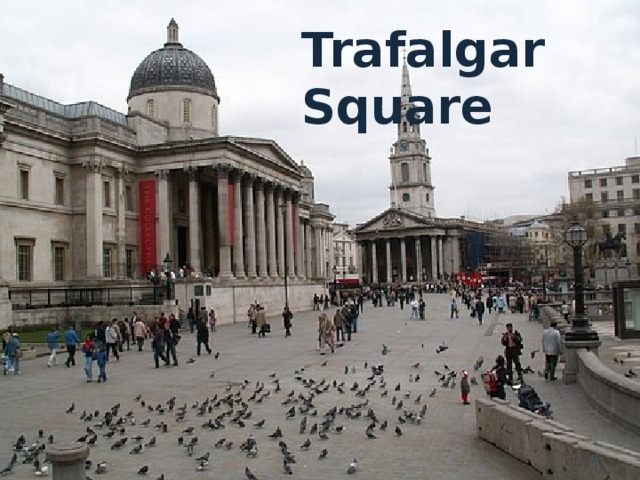
Trafalgar Square

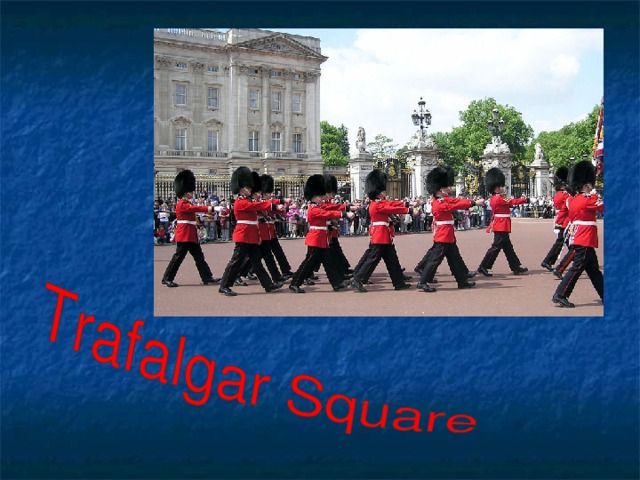


Big Ben
- Big Ben is the nickname for the great bell of the clock at the north end of the Palace of Westminster in London, and is generally extended to refer to the clock or the clock tower as well. It is the largest four-faced chiming clock and the third-tallest free-standing clock tower in the world. It celebrated its 150th anniversary on 31 May 2009, during which celebratory events took place. The erecting of the tower was completed on 10 April 1858. The clock tower has become one of the most prominent symbols of both London and England, often in the establishing shot of films set in the city .

The Tower

The Tower


- Her Majesty's Royal Palace and Fortress , more commonly known as the Tower of London , is a historic castle on the north bank of the River Thames in central London, England. It lies within the London Borough of Tower Hamlets, separated from the eastern edge of the City of London by the open space known as Tower Hill. It was founded towards the end of 1066 as part of the Norman Conquest of England. The White Tower, which gives the entire castle its name, was built by William the Conqueror in 1078, and was a resented symbol of oppression, inflicted upon London by the new ruling elite. The castle was used as a prison since at least 1100, although that was not its primary purpose. A grand palace early in its history, it served as a royal residence. As a whole, the Tower is a complex of several buildings set within two concentric rings of defensive walls and a moat. There were several phases of expansion, mainly under Kings Richard the Lionheart, Henry III, and Edward I in the 12th and 13th centuries. The general layout established by the late 13th century remains despite later activity on the site

- Tower Bridge (built 1886-1894) is a combined bascule and suspension bridge in London, England, over the River Thames. It is close to the Tower of London, from which it takes its name . It has become an iconic symbol of London.
- The bridge consists of two towers tied together at the upper level by means of two horizontal walkways, designed to withstand the horizontal forces exerted by the suspended sections of the bridge on the landward sides of the towers. The vertical component of the forces in the suspended sections and the vertical reactions of the two walkways are carried by the two robust towers. The bascule pivots and operating machinery are housed in the base of each tower. The bridge's present colour scheme dates from 1977, when it was painted red, white and blue for the Queen's Silver Jubilee. Originally it was painted a chocolate brown colour.
- Tower Bridge is sometimes mistakenly referred to as London Bridge, which is the next bridge upstream.
- The nearest London Underground station is Tower Hill on the Circle and District Lines, and the nearest Docklands Light Railway station is Tower Gateway.
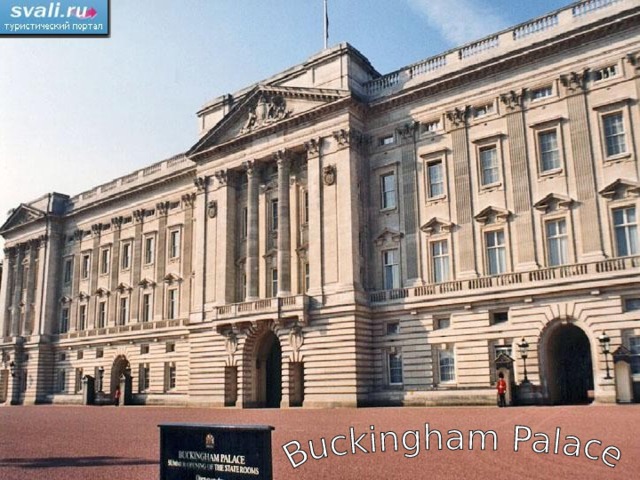


The Gates Of Buckingham Palace

- Buckingham Palace , in London, is the principal residence and office of the British monarch. Located in the City of Westminster, the palace is a setting for state occasions and royal hospitality. It has been a focus for the British people at times of national rejoicing and crisis.
- Originally known as Buckingham House , the building which forms the core of today's palace was a large townhouse built for the Duke of Buckingham in 1705 on a site which had been in private ownership for at least 150 years. It was subsequently acquired by George III in 1761 as a private residence for Queen Charlotte, and known as "The Queen's House". During the 19th century it was enlarged, principally by architects John Nash and Edward Blore, forming three wings around a central courtyard. Buckingham Palace finally became the official royal palace of the British monarch on the accession of Queen Victoria in 1837. The last major structural additions were made in the late 19th and early 20th centuries, including the East front which contains the well-known balcony on which the Royal Family traditionally congregate to greet crowds outside. However, the palace chapel was destroyed by a German bomb in World War II; the Queen's Gallery was built on the site and opened to the public in 1962 to exhibit works of art from the Royal Collection.
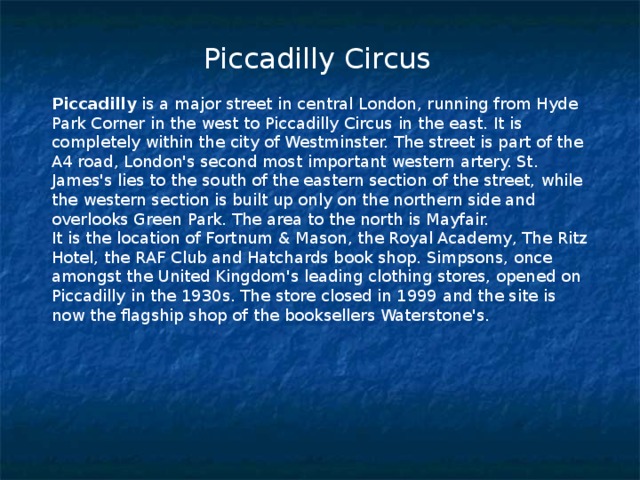
Piccadilly Circus
Piccadilly is a major street in central London, running from Hyde Park Corner in the west to Piccadilly Circus in the east. It is completely within the city of Westminster. The street is part of the A4 road, London's second most important western artery. St. James's lies to the south of the eastern section of the street, while the western section is built up only on the northern side and overlooks Green Park. The area to the north is Mayfair.
It is the location of Fortnum & Mason, the Royal Academy, The Ritz Hotel, the RAF Club and Hatchards book shop. Simpsons, once amongst the United Kingdom's leading clothing stores, opened on Piccadilly in the 1930s. The store closed in 1999 and the site is now the flagship shop of the booksellers Waterstone's.
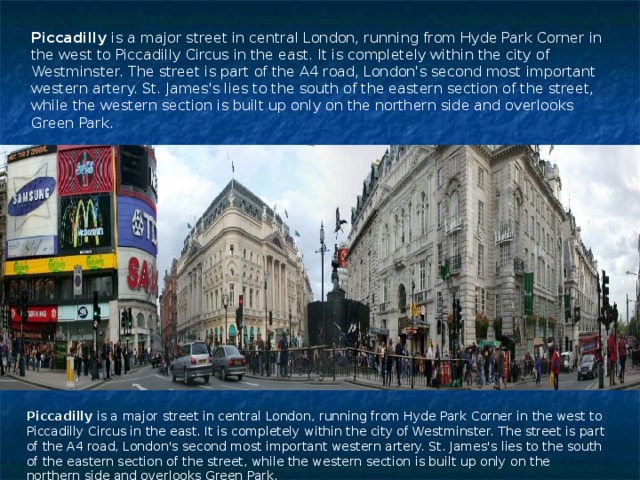
Piccadilly is a major street in central London, running from Hyde Park Corner in the west to Piccadilly Circus in the east. It is completely within the city of Westminster. The street is part of the A4 road, London's second most important western artery. St. James's lies to the south of the eastern section of the street, while the western section is built up only on the northern side and overlooks Green Park.
Piccadilly is a major street in central London, running from Hyde Park Corner in the west to Piccadilly Circus in the east. It is completely within the city of Westminster. The street is part of the A4 road, London's second most important western artery. St. James's lies to the south of the eastern section of the street, while the western section is built up only on the northern side and overlooks Green Park.

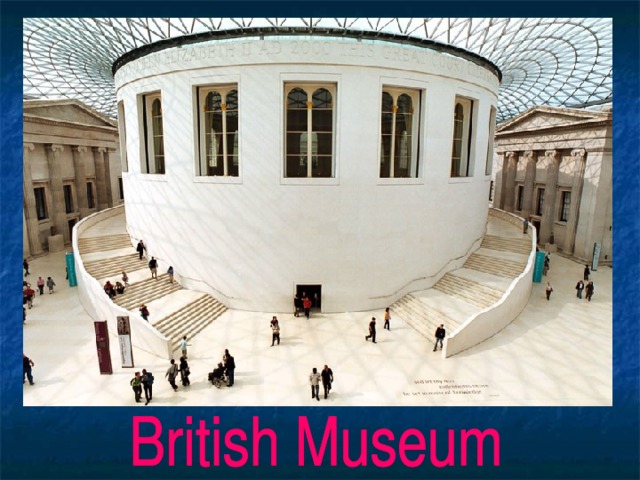

- The British Museum is a museum of human history and culture in London. Its collections, which number more than seven million objects , are amongst the largest and most comprehensive in the world and originate from all continents, illustrating and documenting the story of human culture from its beginnings to the present.
- The British Museum was established in 1753, largely based on the collections of the physician and scientist Sir Hans Sloane. The museum first opened to the public on 15 January 1759 in Montagu House in Bloomsbury, on the site of the current museum building. Its expansion over the following two and a half centuries was largely a result of an expanding British colonial footprint and has resulted in the creation of several branch institutions, the first being the British Museum (Natural History) in South Kensington in 1887. Some objects in the collection, most notably the Elgin Marbles from the Parthenon, are the objects of intense controversy and of calls for restitution to their countries of origin.
- Until 1997, when the British Library (previously centred on the Round Reading Room) moved to a new site, the British Museum was unique in that it housed both a national museum of antiquities and a national library in the same building. The museum is a non-departmental public body sponsored by the Department for Culture, Media and Sport, and as with all other national museums in the United Kingdom it charges no admission fee.Since 2002 the director of the museum has been Neil MacGregor.


- St Paul's Cathedral , London, is a Church of England cathedral and seat of the Bishop of London. Its dedication to Paul the Apostle dates back to the original church on this site, founded in AD 604. St Paul's sits at the top of Ludgate Hill, the highest point in the City of London, and is the mother church of the Diocese of London. The present church dating from the late 17th century was built to an English Baroque design of Sir Christopher Wren, as part of a major rebuilding program which took place in the city after the Great Fire of London, and was completed within his lifetime.
- The cathedral is one of the most famous and most recognisable sights of London, with its dome, framed by the spires of Wren's City churches, dominating the skyline for 300 years. At 365 feet (111m) high, it was the tallest building in London from 1710 to 1962, and its dome is also among the highest in the world. In terms of area, St Paul's is the second largest church building in the United Kingdom after Liverpool Cathedral.
- St Paul's Cathedral occupies a significant place in the national identity of the English population. [ It is the central subject of much promotional material, as well as postcard images of the dome standing tall, surrounded by the smoke and fire of the Blitz. Important services held at St Paul's include the funerals of Lord Nelson, the Duke of Wellington and Sir Winston Churchill; Jubilee celebrations for Queen Victoria; peace services marking the end of the First and Second World Wars; the marriage of Charles, Prince of Wales, and Lady Diana Spencer, the launch of the Festival of Britain and the thanksgiving services for both the Golden Jubilee and 80th Birthday of Queen Elizabeth II. St Paul's Cathedral is a busy working church, with hourly prayer and daily services.

The Main Gates Of Hyde Park
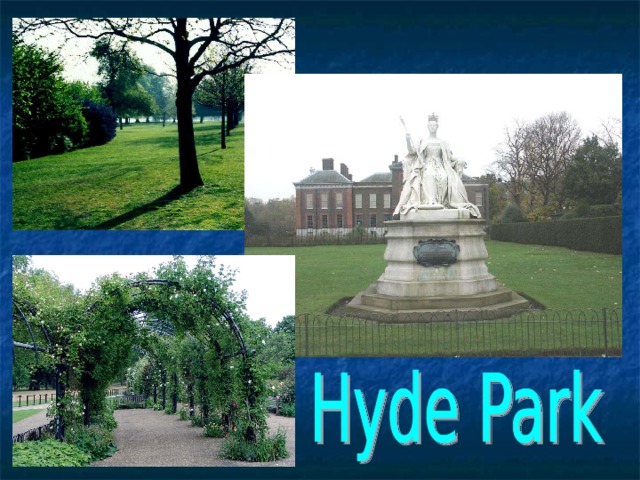

- Hyde Park is one of the largest parks in central London, United Kingdom, and one of the Royal Parks of London, famous for its Speakers' Corner.
- The park is divided in two by the Serpentine. The park is contiguous with Kensington Gardens; although often still assumed to be part of Hyde Park, Kensington Gardens has been technically separate since 1728, when Queen Caroline made a division between the two. Hyde Park covers 142 hectares (350 acres) and Kensington Gardens covers 111 hectares (275 acres), giving an overall area of 253 hectares (625 acres), making the combined area larger than the Principality of Monaco (196 ha/484 acres), though smaller than New York City's Central Park (341 ha/843 acres). To the southeast, outside of the park, is Hyde Park Corner. Although, during daylight, the two parks merge seamlessly into each other, Kensington Gardens closes at dusk but Hyde Park remains open throughout the year from 5 am until midnight.
Вебинар для учителей

Свидетельство об участии БЕСПЛАТНО!