Казахстан,

СДЕЛАЙТЕ СВОИ УРОКИ ЕЩЁ ЭФФЕКТИВНЕЕ, А ЖИЗНЬ СВОБОДНЕЕ
Благодаря готовым учебным материалам для работы в классе и дистанционно
Скидки до 50 % на комплекты
только до
Готовые ключевые этапы урока всегда будут у вас под рукой
Организационный момент
Проверка знаний
Объяснение материала
Закрепление изученного
Итоги урока
Была в сети 07.06.2019 16:59

Алмаганбетова Маржан Бахыткызы
Учитель Английского языка
 670
670
 88 726
Местоположение
Специализация
Welcome to my Kazakhstan!
Категория:
Английский язык
12.02.2019 20:08

Просмотр содержимого документа
«Welcome to my Kazakhstan!»
| Long term plan. Module 4 : The world around us Step 3:In Kazakhstan Lesson: Welcome to my Kazakhstan! | School “Asikata” | ||||
| Date:20.12.16 | Teacher’s name: Almaganbetova M | ||||
| Class: 1 ``A``, ``B``, ``G``
| Number of present: | Absent: | |||
| Learning objective(s) that this lesson is contributing to: | 1.L4 recognize basic intonation distinguishing questions from statements 1.S1 make basic personal statements and simple statements about objects 1.S3 pronounce basic words and expressions intelligible 1.R1 recognize initial letters in names and places 1.UE11 use there is / are to make short statements | ||||
| Lesson objectives: | All learners will be able to:know the capital of Kazakhstan and its flag`s colour Most learners will be able to:know the names of Kazakhstan cities and structures ``There is/There are``, ``Where are you from?`` Some learners will be able to: make up sentences using the structures and new words | ||||
| Language objectives: | Learners can:name the capital of Kazakhstan, the national language of Kazakhstan and visual remember the flag of Kazakhstan | ||||
| Key words and phrases: Flag, Kazakh, There is/there are, Where are you from? | |||||
| Useful classroom language for dialogue/writing: There is a Baiterek in Kazakhstan…I`m from Kazakhstan | |||||
| Discussion points: Where are you from? | |||||
| Can you say why? ….. | |||||
| Writing prompts: Flag, Kazakh, capital, There is/there are, Where are you from? | |||||
| Previous learning | The Seasons | ||||
| Plan | |||||
| Planned timing
| Planned activities (replace the notes below with your planned activities) | Resources | |||
| Start (Beginning of the lesson)
|
Greeting: Teacher greets learners; learners respond to greeting and take their places. Dividing into subgroups: Teacher divides learners into subgroups using colorful circles, squares, triangles and rectangular figures. Warming up: “Telephone game” Teacher whispers a sentence to the first learner in a line. Learners must then repeat the sentence to the next learner in line and on down the line. The last learner in line will say out loud the sentence as he/she heard it. The first learner in line will either agree or disagree with the sentence. Revising the previous lesson: The seasons How do you think what theme we have for today? Teacher asks the learners to identify today’s theme using interactive slides. Teacher introduces lesson objectives to the learners. |
Pictures | |||
| Middle (of the lesson)
|
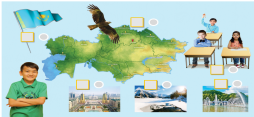
Teacher shows the map of Kazakhstan and explains difference of word between capital and city. Then asks question. What is the capital of Kazakhstan? Name the cities of Kazakhstan? What colour of our flag? Then asks question. Where are you from? I`m from Kazakhstan/Chimkent.
Dialogues T-P;
Let`s sing a song about ``My flag`` My flag is blue. My flag is bright. I like it very much The yellow sun. The blue, blue sky. And the eagle is flying high Chorus Kazakhstan is my country. Kazakhstan is my life I live happy here with my friends.
| Notebook Pictures and map
CD player | |||
| End (of the lesson)
| Reflection Self-assessment: Traffic lights Ask students to look at lesson objectives they set at the beginning of the lesson and think and say what they did well in the lesson and what needs improvement. | Traffic lights cards | |||
| Additional information: | |||||
| Differentiation - how do you plan to give more support? How do you plan to challenge the more able learners? | Assessment - how are you planning to check learners’ learning? | Cross – curricular links health and safety check ICT links Values links | |||
|
| Formative assessment | Art, music | |||
| Reflection
Were the lesson objectives / learning objectives realistic? What did the learners learn today? What was the learning atmosphere like? Did my planned differentiation work well? Did I stick to timings? What changes did I make from my plan and why? | Use the space below to reflect on your lesson. Answer the most relevant questions from the books on the left about your lesson.
| ||||
| Summary evaluation What two things went really well (consider both teaching and learning)? 1. Activity song 2. The Structure ``where are you from?`` What two things would have improved the lessons (consider both teachings and learning)?
What have learned from his lesson about this lesson about the class or individuals that will inform my next lesson? | |||||
| Lesson: Weather
| School:``Kausar`` | ||
| Date: 15.06.16 | Teachers` name:Ospanova A,
| ||
| Class: 3 A
| Number of present: 12 | Absent: | |
| Learning objective(s) that this lesson is contributing to: | 2.L1recognise short basic instructions for a limited range of classroom routines spoken slowly and distinctly. 2.L3 recognise with support common names and names of places recognise the spoken form of a limited range of everyday and classroom words.
| ||
| Lesson objectives: | All learners will be able to: learn a few new words related to the topic ``weather``. | ||
| Most learners will be able to: be able to express preferences in weather and ask question ``How is the weather today?`` and answer for it. | |||
| Some learners will be able to: describe the weather and make up sentences using the structures and new words | |||
| Language objectives: | Learners can:name the weather phenomenon and describing the weather capital of Kazakhstan, the national language of Kazakhstan and visual remember the flag of Kazakhstan | ||
| Key words and phrases: Rainy, windy, snowy, sunny, cloudy, stormy | |||
| Useful classroom language for dialogue/writing: How is the weather today? It`s … . | |||
| Discussion points: What is the weather like today? | |||
| Can you say why? …..
| |||
| Writing prompts: Rainy, windy, snowy, sunny, cloudy, stormy ,What is the weather like today? It`s … .
| |||
| Previous learning | Hot and cold | ||
| Plan | |||
| Planned timing
| Planned activities (replace the notes below with your planned activities) | Resources | |
| Start (Beginning of the lesson)
|
Spring is green,
Guess the sounds according the weather phenomenon |
Notebook, speaker | |
| Middle (of the lesson)
|
Rainy, windy, snowy, sunny, cloudy, stormy
Read and guess the season -It`s cold and snowy. Children like skating and playing snowballs. What season is it?
-Sometimes it`s warm. Sometimes it`s cold. It`s often rainy. People take umbrellas. What season is it?
-It`s hot and sunny. Children don`t go to school. They have holidays. People swim in the rivers and have picnics. What season is it?
-It`s warm and sunny. There are many new flowers. The sky is blue. Nauryz and Victory Day are in this season. What season is it?
-My favourite season is _________ because it`s very beautiful season. I like painting yellow and red trees. What season do I like?
-My favourite season is __________ because I go to my grandparents` house and we go to the river to swim. What season do I like?
“How is the weather today?”
How is the weather today?2 Clap, clap, clap It`s raining, it`s raining I am wet today! How is the weather today?2 Clap, clap, clap It`s sunny, it`s sunny I am hot today! How is the weather today?2 Clap, clap, clap It`s snowing, it`s snowing I am cold today! How is the weather today?2 Clap, clap, clap It`s windy, it`s windy My hair is mess today! How is the weather today?2 Clap, clap, clap It`s stormy, it`s stormy I am scared today! | Notebook Slides Work sheets
CD player and worksheets speaker | |
| End (of the lesson)
|
T: It`s cloudy. Ps: Have to show cards with weather phenomenon pictures according the teacher’s order. | Cards with weather phenomenon pictures | |
| Long-term plan unit: Unit 1 My Family | School:``Kausar`` | ||
| Date: 02.09.16 | Teacher’s name:Ospanova A | ||
| Class: 1 A, B, G | Number of present: | Absent: | |
| The theme of the lesson: Let`s start! | |||
| Learning objective(s) that this lesson is contributing to: | 1.L3 recognise with support common names and names of places; recognise the spoken form of a limited range of everyday and classroom words 1.S1 make basic personal statements about people, objects and classroom routines 1.S3 pronounce familiar words and expressions intelligibly 1.UE6 use demonstrative pronouns this, these to indicate things | ||
| Lesson objectives: | All learners will be able to:say hello and goodbye | ||
| Most learners will be able to:sing the ``Hello`` song | |||
| Some learners will be able to: make up sentences using the structures and new words and to learn by heart new song | |||
| Language objectives: | Learners can:to say hello and goodbye, then to sing all together | ||
| Key words and phrases: Hello, Goodbye, I`m… , He is… , She is… | |||
| Useful classroom language for dialogue/writing: I am Saule. He is Marat. | |||
| Discussion points: What`s your name? | |||
| Can you say why? ….. | |||
| Writing prompts: Name, my, I, he, she, hello, goodbye | |||
| Previous learning | Recognize letters Understand and follow instructions Pronounce all words on the topic intelligibly | ||
| Plan | |||
| Planned timing
| Planned activities (replace the notes below with your planned activities) | Resources | |
| Beginning 5 minutes Video | Teacher greets students; students respond to greeting and take their places. Warming up Teacher asks students “How are you?” to find out their mood at the beginning of the lesson; students choose one of the smiles they see on the slide and answer the question - Teacher introduces lesson objectives to the students. - Students watch a video and follow the instructions to make circles of different sizes: Make a circle big, big, big Small, small, small…
| Slide 3
Video 1 | |
| Middle (of the lesson) 20 minutes
|
- go around the class, monitor and assist if necessary - in 12 mins collect the papers for further assessment; give students praising stickers for their work.
Dialogues T-P;
| Notebook Pictures and map
CD player | |
| End (of the lesson) 10 minutes
|
| Pictures
Stikers | |
| Additional information: | ||
| Differentiation - how do you plan to give more support? How do you plan to challenge the more able learners? | Assessment - how are you planning to check learners’ learning? | Cross – curricular links health and safety check ICT links Values links |
|
| Formative assessment | Art, music |
| Reflection
Were the lesson objectives / learning objectives realistic?
What did the learners learn today?
What was the learning atmosphere like?
Did my planned differentiation work well?
Did I stick to timings? What changes did I make from my plan and why? | Use the space below to reflect on your lesson. Answer the most relevant questions from the books on the left about your lesson.
Yes, they were
They learn the names of Kazakhstan cities and they can structures ``There is/There are``, ``Where are you from?``
Very well
Yes, they did
| |
| Summary evaluation What two things went really well (consider both teaching and learning)? 1. Activity song 2. The Structure ``where are you from?`` What two things would have improved the lessons (consider both teachings and learning)?
What have learned from his lesson about this lesson about the class or individuals that will inform my next lesson? | ||
| Long-term plan unit: Unit 1 ‘’My family’’. | School: Gymnasium ``Kausar`` | |||||||
| Date: 05.09.16 | Teacher’s name: OspanovaAisara | |||||||
| Grade: 1 | Number present: | Absent: | ||||||
| Theme of the lesson: Greetings. Aa-Bb | ||||||||
| Learning objectives that this lesson is contributing to
| 1.L3 recognise with support simple greetings recognise the spoken form of a limited range of basic and everyday classroom words 1.S1 make basic personal statements and simple statements about objects 1.S6 exchange simple greetings and say please, sorry and thank you 1.UE6 use demonstrative pronouns this, these to indicate things | |||||||
| Lesson objectives: |
| |||||||
| Successcriteria
| Learners have met the learning objective{R1} if they can: Recognize letters in names of weather conditions Spell the words correctly | |||||||
| Value links: | Lifelong learning | |||||||
| Cross-curricular links: | World cognition | |||||||
| ICT skills: | Using videos& pictures, working with URLs | |||||||
| Previouslearning | Let`s start! | |||||||
| PLAN | ||||||||
| Planned timings | Planned activities | Resources | ||||||
| Beginning 5 minutes
Middle 20 minutes
Next 5 minutes | Teacher greets students; students respond to greeting and take their places. Warming up Teacher asks students “Hello” to find out their mood at the beginning of the lesson; children choose one of the smiles they see on the slide and repeat ‘’Hello””
My Family. Let’s start.Hello Goodbye.{5} Whole class activity -give pupils a couple of minutes to revise Hello and Goodbye ! -Colour the words Hello and Goodbye. -Talk with your friend. -Sing the Hello song! Formative Assessment: - hand out worksheets for matching activity - set a time limit of 5 minutes; monitor students’ progress -Match the words to their pictures Hello and Goodbye ! I’m …. Dynamic break{W} {2} Double double this this Double double that that…… Lets play a game. -Take a ball and make a circle with children ,throw up it to someone of the pupils ,during it they have to remember today’s new words.
|
| ||||||
|
Picture dictionaries | ||||||||
| Less 5 minutes | Reflection Ask students to look at lesson objectives they set at the beginning of the lesson and think and say what they did well in the lesson and what needs improvement. Good bye song Students sing a good-bye song and dance | PPP slide 2 https://www.youtube.c om/watch?v=Xcws7U WWDEs | ||||||
| Additionalinformation
| ||||||||
| Differentiation – how do you plan to give more support? How do you plan to challenge the more able learners?
| Assessment – how are you planning to check learners’ learning?
| Health and safety check ICT links
| ||||||
| Less able students – greater support by means of prompts, visuals or writing difficult words on the blackboard More able students – independent work on definite tasks with little/no support | throughobservation
|
Work with the SMART board not more than 10 minutes Use water based markers Ensure proper ventilation Checksockets’ safety
| ||||||
| Reflection Were the lesson objectives/learning objectives realistic? What did the learners learn today? What was the learning atmosphere like? Did my planned differentiation work well? Did I stick to timings? What changes did I make from my plan and why? |
| |||||||
| Summary evaluation What two things went really well (consider both teaching and learning)? 1: 2: What two things would have improved the lesson (consider both teaching and learning)? 1: 2: What have I learned from this lesson about the class or individuals that will inform my next lesson? | ||||||||
|
| ||||||||
|
| ||||||||
| Long-term plan unit: Unit 1 ‘’My family’’. | School: Gymnasium ``Kausar`` | |||||||
| Date: 09.09.16 | Teacher’s name: OspanovaAisara | |||||||
| Grade: 1 | Number present: | Absent: | ||||||
| Theme of the lesson: About myself. Cc-Dd | ||||||||
| Learning objectives that this lesson is contributing to
| 1.L3 recognize with support common names and names of places; recognize the spoken form of a limited range of everyday and classroom words 1.S1 make basic personal statements about people, objects and classroom routines 1.S3 pronounce familiar words and expressions intelligibly 1.S6 make introductions and requests in basic interactions with others 1.UE6 use demonstrative pronouns this, these that, those to indicate things | |||||||
| Lesson objectives: |
| |||||||
| Successcriteria
| Learners have met the learning objective{R1} if they can: Recognize letters in names of weather conditions Spell the words correctly | |||||||
| Value links: | Lifelong learning | |||||||
| Cross-curricular links: | World cognition | |||||||
| ICT skills: | Using videos& pictures, working with URLs | |||||||
| Previouslearning | Greetings. Aa-Bb | |||||||
| PLAN | ||||||||
| Planned timings | Planned activities | Resources | ||||||
| Beginning 5 minutes
Middle 20 minutes
Next 5 minutes | Teacher greets students; students respond to greeting and take their places. Warming up ``Memory game`` Teacherexplain the condition. If I clap once, you will say ``Good morning``, If I clap two times you shouldn`t say, only shake each other’s hands. If I clap three timesyou should say Goodbye. My Family. About myself{5} Whole class activity -give pupils a couple of minutes to revise Hello and Goodbye ! -Colour the words Hello and Goodbye. - showing slides and video according the theme -Talk with your friend. -Sing the ``Family``song! This is my mummy And this is my daddy Mummy and daddy this is my family This is my brother And this is my sister Brother and sister this is my family Formative Assessment: - hand out worksheets for matching activity - set a time limit of 5 minutes; monitor students’ progress -Match the words to their pictures Dynamic break: Double double this this Double double that that…… Lets play a game. -Take a ball and make a circle with children ,throw up it to someone of the pupils ,during it they have to remember today’s new words.
|
| ||||||
|
Picture dictionaries, Video | ||||||||
| Less 5 minutes | Reflection Ask students to look at lesson objectives they set at the beginning of the lesson and think and say what they did well in the lesson and what needs improvement. Good bye song Students sing a good-bye song and dance | PPP slide 2 https://www.youtube.c om/watch?v=Xcws7U WWDEs | ||||||
| Additionalinformation
| ||||||||
| Differentiation – how do you plan to give more support? How do you plan to challenge the more able learners?
| Assessment – how are you planning to check learners’ learning?
| Health and safety check ICT links
| ||||||
| Less able students – greater support by means of prompts, visuals or writing difficult words on the blackboard More able students – independent work on definite tasks with little/no support | throughobservation
|
Work with the SMART board not more than 10 minutes Use water based markers Ensure proper ventilation Checksockets’ safety
| ||||||
| Reflection Were the lesson objectives/learning objectives realistic? What did the learners learn today? What was the learning atmosphere like? Did my planned differentiation work well? Did I stick to timings? What changes did I make from my plan and why? |
| |||||||
| Summary evaluation What two things went really well (consider both teaching and learning)? 1: 2: What two things would have improved the lesson (consider both teaching and learning)? 1: 2: What have I learned from this lesson about the class or individuals that will inform my next lesson? | ||||||||
|
| ||||||||
| Long-term plan unit: Unit 1 ‘’My family’’. | School: Gymnasium ``Kausar`` | |||||||
| Date: 14.09.16 | Teacher’s name: OspanovaAisara | |||||||
| Grade: 1A,B,G | Number present: | Absent: | ||||||
| Theme of the lesson: My Family. Ee - Ff | ||||||||
| Learning objectives that this lesson is contributing to
| 1.L1 recognise short instructions for basic classroom routines spoken slowly and distinctly 1.L3 recognize with support common names and names of places; recognize the spoken form of a limited range of everyday and classroom words 1.S3 pronounce familiar words and expressions intelligibly 1.UE2 use cardinal numbers 1 – 10 to count | |||||||
| Lesson objectives: | All learners will be able to: know the members of family Most learners will be able to: know the names of family learn by heart the song according the theme. Some learners will be able to: act out episode according the theme from DVD | |||||||
| Language objectives: | Learners can:name the members of family, to sing a song according the theme and visual remember initial letters E and F Key words and phrases: Daddy, mummy, sister, brother, stop, get ready, go, this is my … Useful classroom language for dialogue/writing: Who is this? This is my mummy and this is my daddy Discussion points: Who is this? Can you say why? …..because through this question we can identify blood ties Writing prompts: Daddy, mummy, brother, sister, family | |||||||
| Previouslearning | About myself. Cc-D d | |||||||
| PLAN | ||||||||
| Planned timings | Planned activities | Resources | ||||||
| Beginning 5 minutes
Middle 20 minutes
Next 5 minutes | Teacher greets students; students respond to greeting and take their places. Warming up ``Memory game`` Teacher explain the condition. If I clap once, you will say ``Good morning``, If I clap twice you shouldn`t say, only shake each other’s hands. If I clap three times you should say Goodbye. And now let`s review our last song ``This is my mummy!`` with TPR activities - showing slides and video according the theme -Acting out episode according the theme on page 8 pupil`s book. - working with activity books To introduce new letters and make more examples corresponding them. Traffic light game: If I show ``red`` circle, you should say ``stop``. If I show ``yellow`` circle, you should say ``get ready. If I show ``green`` circle, you should say ``go``. Dynamic break: Double, double this this Double, double that that…… Lets play a game ``spider`s web`` The first pupil take thick thread and throw up it to someone of the pupils ,during it they have to remember today’s new words. After every throwing they should say new words which they are remember. At last they will find spider`s web.
|
| ||||||
|
Picture dictionaries, Video, Alphabet poster | ||||||||
| Less 5 minutes | Reflection Ask students to look at lesson objectives they set at the beginning of the lesson and think and say what they did well in the lesson and what needs improvement. Good bye song Students sing a good-bye song and dance | PPP slide 2 https://www.youtube.c om/watch?v=Xcws7U WWDEs | ||||||
| Additionalinformation
| ||||||||
| Differentiation – how do you plan to give more support? How do you plan to challenge the more able learners?
| Assessment – how are you planning to check learners’ learning?
| Health and safety check ICT links
| ||||||
| Less able students – greater support by means of prompts, visuals or writing difficult words on the blackboard More able students – independent work on definite tasks with little/no support | throughobservation
|
Work with the SMART board not more than 10 minutes Use water based markers Ensure proper ventilation Checksockets’ safety
| ||||||
| Reflection Were the lesson objectives/learning objectives realistic? What did the learners learn today? What was the learning atmosphere like? Did my planned differentiation work well? Did I stick to timings? What changes did I make from my plan and why? |
| |||||||
| Summary evaluation What two things went really well (consider both teaching and learning)? 1: 2: What two things would have improved the lesson (consider both teaching and learning)? 1: 2: What have I learned from this lesson about the class or individuals that will inform my next lesson? | ||||||||
Вебинар для учителей

Свидетельство об участии БЕСПЛАТНО!