

Узбекистан, Ташкент


СДЕЛАЙТЕ СВОИ УРОКИ ЕЩЁ ЭФФЕКТИВНЕЕ, А ЖИЗНЬ СВОБОДНЕЕ
Благодаря готовым учебным материалам для работы в классе и дистанционно
Скидки до 50 % на комплекты
только до
Готовые ключевые этапы урока всегда будут у вас под рукой
Организационный момент
Проверка знаний
Объяснение материала
Закрепление изученного
Итоги урока

Была в сети 10.06.2018 16:43

Косимова Дилором Валижоновна
учитель английского языка
48 лет
 693
693
 86 608
Местоположение
"Where are you going"
Категория:
Английский язык
09.06.2018 21:18

Просмотр содержимого документа
«"Where are you going"»

Tashkent city
Yashnobod district
school 226
Lesson plan on the theme
“ Where are you going ?” in class 4
by an English teacher
Kosimova Dilorom Valijonovna
Odami ersang demagil odami ,
Onikim yo’q xalq g’amidin g’ami .
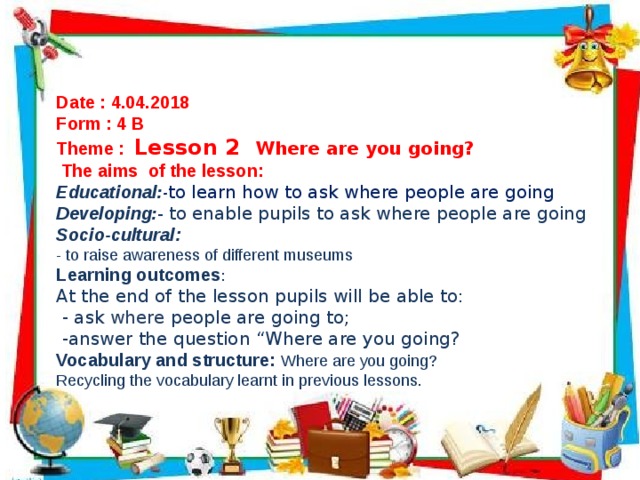
Date : 4.04.2018
Form : 4 B
Theme : Lesson 2 Where are you going?
The aims of the lesson:
Educational : - to learn how to ask where people are going
Developing : - to enable pupils to ask where people are going
Socio-cultural:
- to raise awareness of different museums
Learning outcomes :
At the end of the lesson pupils will be able to:
- ask where people are going to;
-answer the question “Where are you going?
Vocabulary and structure: Where are you going?
Recycling the vocabulary learnt in previous lessons.
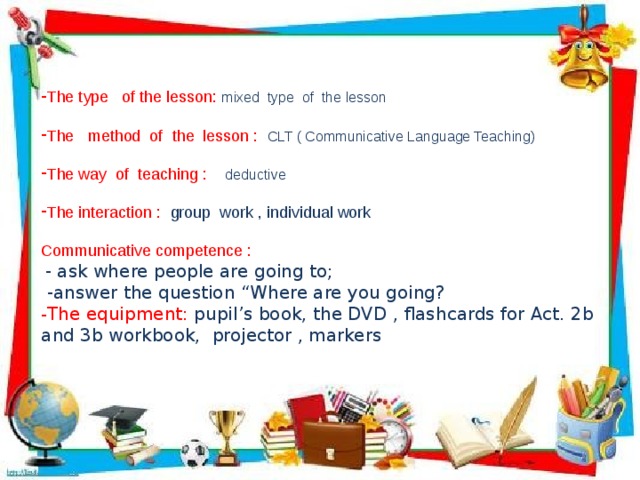
- The type of the lesson: mixed type of the lesson
- The method of the lesson : CLT ( Communicative Language Teaching)
- The way of teaching : deductive
- The interaction : group work , individual work
Communicative competence :
- ask where people are going to;
-answer the question “Where are you going?
- The equipment: pupil’s book, the DVD , flashcards for Act. 2b and 3b workbook, projector , markers
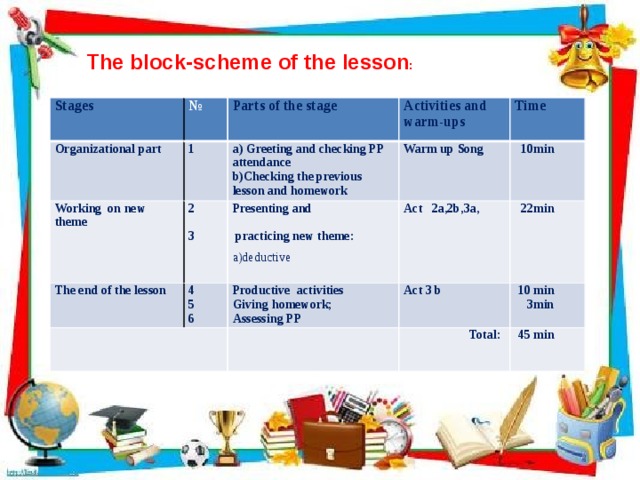
The block-scheme of the lesson :
Stages
№
Organizational part
Parts of the stage
1
Working on new theme
2
a) Greeting and checking PP attendance
The end of the lesson
Activities and warm-ups
b)Checking the previous lesson and homework
Warm up Song
Time
Presenting and
4
Productive activities
5
Act 2a,2b,3a,
3
10min
Act 3 b
Giving homework;
6
practicing new theme:
22min
a)deductive
Assessing PP
10 min
Total:
3min
45 min
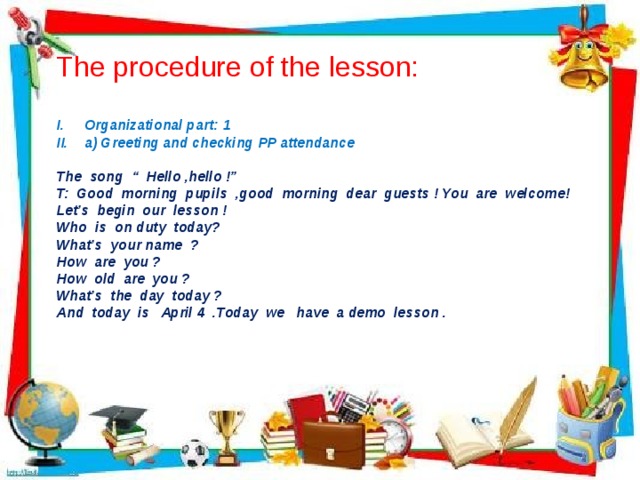
The procedure of the lesson:
- Organizational part: 1
- a) Greeting and checking PP attendance
The song “ Hello ,hello !”
T: Good morning pupils ,good morning dear guests ! You are welcome!
Let’s begin our lesson !
Who is on duty today?
What’s your name ?
How are you ?
How old are you ?
What’s the day today ?
And today is April 4 .Today we have a demo lesson .
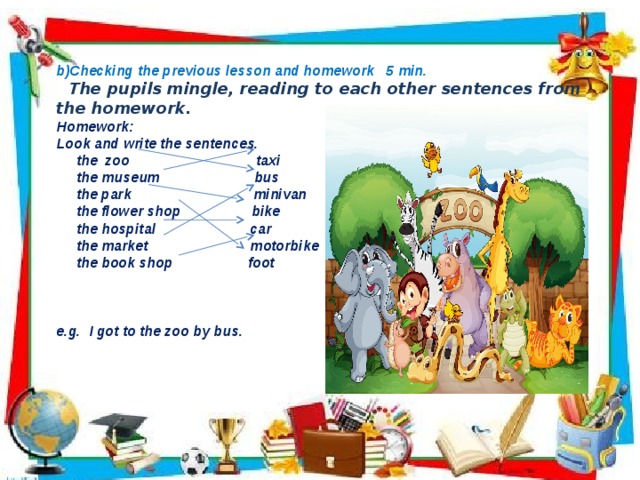
b)Checking the previous lesson and homework 5 min.
The pupils mingle, reading to each other sentences from the homework.
Homework:
Look and write the sentences.
the zoo taxi
the museum bus
the park minivan
the flower shop bike
the hospital car
the market motorbike
the book shop foot
e.g. I got to the zoo by bus.
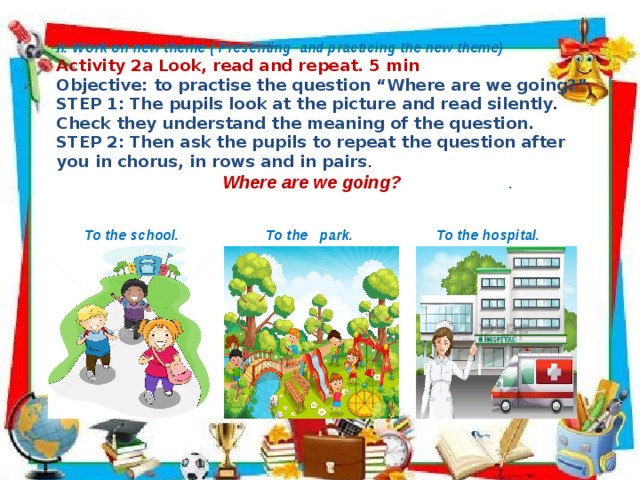
II. Work on new theme ( Presenting and practicing the new theme)
Activity 2a Look, read and repeat. 5 min
Objective: to practise the question “Where are we going?”
STEP 1: The pupils look at the picture and read silently.
Check they understand the meaning of the question.
STEP 2: Then ask the pupils to repeat the question after you in chorus, in rows and in pairs .
Where are we going? .
To the school. To the park. To the hospital.
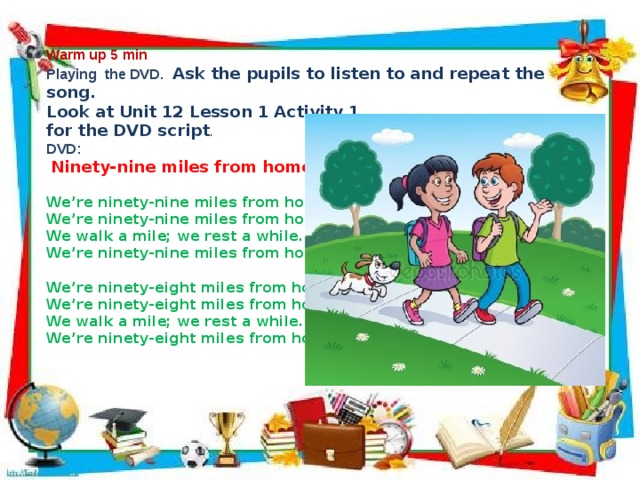
Warm up 5 min
Playing the DVD. Ask the pupils to listen to and repeat the song.
Look at Unit 12 Lesson 1 Activity 1
for the DVD script .
DVD:
Ninety-nine miles from home
We’re ninety-nine miles from home.
We’re ninety-nine miles from home.
We walk a mile; we rest a while.
We’re ninety-nine miles from home.
We’re ninety-eight miles from home.
We’re ninety-eight miles from home.
We walk a mile; we rest a while.
We’re ninety-eight miles from home.
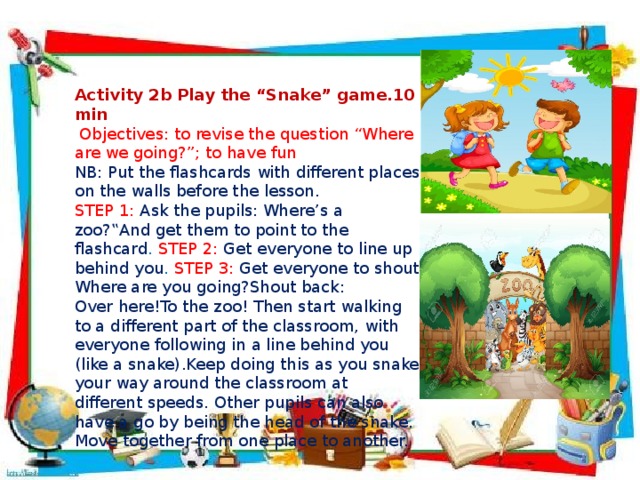
Activity 2b Play the “Snake” game.10 min
Objectives: to revise the question “Where are we going?”; to have fun
NB: Put the flashcards with different places on the walls before the lesson.
STEP 1: Ask the pupils: Where’s a zoo?‟And get them to point to the flashcard . STEP 2: Get everyone to line up behind you . STEP 3: Get everyone to shout Where are you going?Shout back:
Over here!To the zoo! Then start walking to a different part of the classroom, with everyone following in a line behind you (like a snake).Keep doing this as you snake your way around the classroom at different speeds. Other pupils can also have a go by being the head of the snake. Move together from one place to another.
Lang
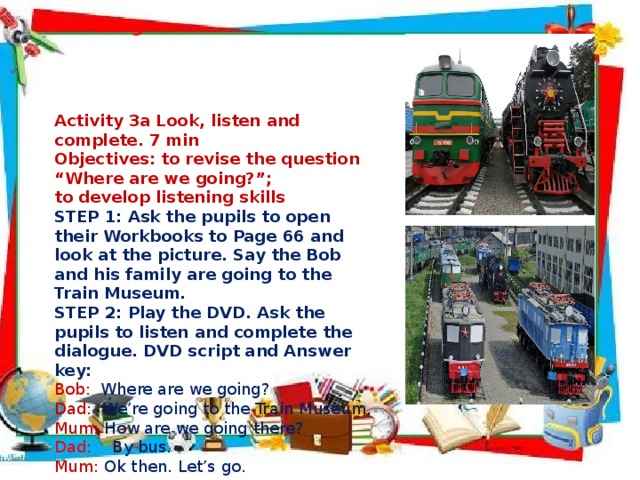
Activity 3a Look, listen and complete. 7 min
Objectives: to revise the question “Where are we going?”;
to develop listening skills
STEP 1: Ask the pupils to open their Workbooks to Page 66 and look at the picture. Say the Bob and his family are going to the Train Museum.
STEP 2: Play the DVD. Ask the pupils to listen and complete the dialogue. DVD script and Answer key:
Bob: Where are we going?
Dad: We’re going to the Train Museum.
Mum: How are we going there?
Dad: By bus.
Mum: Ok then. Let’s go.
Activity 3b Play “I’m going to...”.10min
Objective: to consolidate the question “Where are we going?” and the structure “I’m going to ...”
STEP 1: Prepare two sets of place flashcards for this game, which practices the key structures “Where are you going?”and “I‟m going to…” STEP 2: Get everyone to close their eyes as you place each flashcard from the first set around the room (e.g. place the zoo card in the corner, the park card under a desk, etc.).
STEP 3: Then, tell everyone to open their eyes. Give a card (e.g. zoo) from the second set to a pupil. Have the following conversation (model):
Teacher: Where are you going?
Pupil: To the zoo. (I’m going to the zoo.)
Teacher: How are you going there?"
Pupil: By bus.
Teacher: Ok then. Goodbye.
Pupil: Goodbye.
Lang
STEP 4: The pupil must then search for the zoo flashcard. When s/he finds it, s/he can return to you for another card. As the first pupil is searching, give another card (e.g. the school) to another pupil and have the same conversation. Eventually, you will have pupils searching all over the place and returning for another card. It can be a bit noisy but great fun.
Extension: The pupil searches for the card acting out the transport (e.g. steering the wheel of a car, etc.). Each time the student searches s/he must use a new means of transport.
Lang
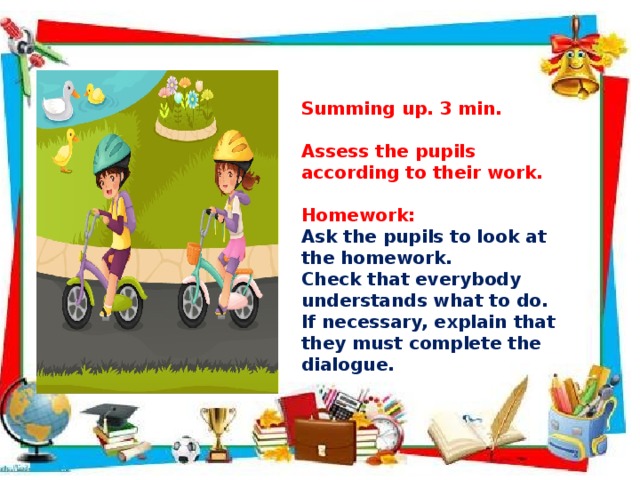
Summing up. 3 min.
Assess the pupils according to their work.
Homework:
Ask the pupils to look at the homework.
Check that everybody understands what to do. If necessary, explain that they must complete the dialogue.



Вебинар для учителей

Свидетельство об участии БЕСПЛАТНО!



