Россия, Саратов

СДЕЛАЙТЕ СВОИ УРОКИ ЕЩЁ ЭФФЕКТИВНЕЕ, А ЖИЗНЬ СВОБОДНЕЕ
Благодаря готовым учебным материалам для работы в классе и дистанционно
Скидки до 50 % на комплекты
только до
Готовые ключевые этапы урока всегда будут у вас под рукой
Организационный момент
Проверка знаний
Объяснение материала
Закрепление изученного
Итоги урока
Была в сети 09.06.2026 11:44

Рогоза Надежда Александровна
учитель английского языка
 2 049
2 049
 34 861
Местоположение
Презентация на тему: "Which vs. That, Who vs. Which and Who vs. Whom. What are the Differences?"
Категория:
Английский язык
18.06.2019 00:45

Просмотр содержимого документа
«Презентация на тему: "Which vs. That, Who vs. Which and Who vs. Whom. What are the Differences?"»

Which vs. That, Who vs. Which and Who vs. Whom. What are the Differences?

- If you aren’t sure when to use which vs. that in your writing, don’t feel bad. They are one of the most common questions I get from readers, wondering when it is correct to use which word.
- Which and that are both complicated words in English with many different uses inside a sentence. And while they both can be used in other constructions, the confusion between the two usually centers on their uses as relative pronouns.


That and Which as Pronouns
- A brief, important note on using which or that as pronouns: be careful when using them to refer to people. Many style guides specify writers to solely use who when referring human beings and/or animals with a name. For example,
- The woman who opened the door for you is my mom. (CORRECT)
- The woman that opened the door for you is my mom. (WRONG)
- Which and that are used, instead, for inanimate objects or animals without a name. For example,
- The bat that I threw hit the bleachers.
- I am sick of the dog that keeps barking.
- This rule is followed the the AP Stylebook but not the Chicago Manual of Style. It’s not clear that it’s absolutely necessary, but if you are writing a paper or any piece of formal writing, it’s probably best to observer the rule.
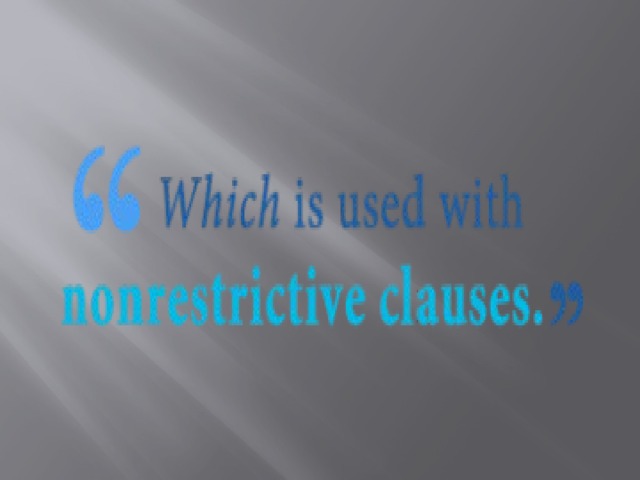

- Type1: Kathy works for a company that makes furniture.
- In this sentence, the relative clause tells you what kind of a company the speaker means. It is a restrictive clause. We do not use commas with these clauses.
- Type 2: “James told me about his new job, which he’s enjoying very much.”
- “ We stayed at the Park Hotel, which a friend of ours recommended.”
- In these sentences, the relative clauses do not tell you which things the speaker means. We already know which things are meant; James’s job and the Park Hotel.

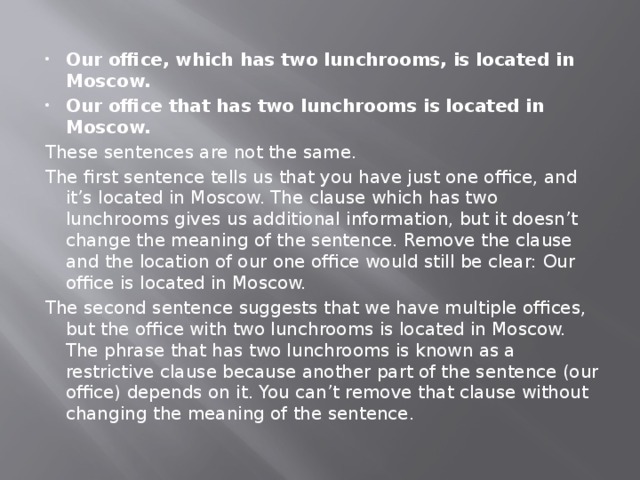
- Our office, which has two lunchrooms, is located in Moscow.
- Our office that has two lunchrooms is located in Moscow.
These sentences are not the same.
The first sentence tells us that you have just one office, and it’s located in Moscow. The clause which has two lunchrooms gives us additional information, but it doesn’t change the meaning of the sentence. Remove the clause and the location of our one office would still be clear: Our office is located in Moscow.
The second sentence suggests that we have multiple offices, but the office with two lunchrooms is located in Moscow. The phrase that has two lunchrooms is known as a restrictive clause because another part of the sentence (our office) depends on it. You can’t remove that clause without changing the meaning of the sentence.

- The time machine, which looked like a telephone booth, concerned Bill and Ted.
- The time machine that looked like a telephone booth concerned Bill and Ted.
In the first sentence (thanks to the use of which), the time machine concerned Bill and Ted. It also happened to look like a telephone booth. In the second sentence (that uses the restrictive clause), Bill and Ted are concerned with the time machine that looks like a telephone booth. They aren’t concerned with the one that looks like a garden shed or the one that looks like a DeLorean (Marty McFly may have reservations about that one).

Using «Who» and«Which»
- Who : Who is normally used to refer to human beings, either male or female. In other words, who refers to people.
- Which : The word which is used to refer to other living beings such as animals, insects, plants and objects in general. In other words, which refers to things

• The man who swam the channel.
- The clause who swam the channel is linked to The man. As The man is a person, the clause starts with the relative pronoun who. That could also have been used, but it runs the risk of annoying readers
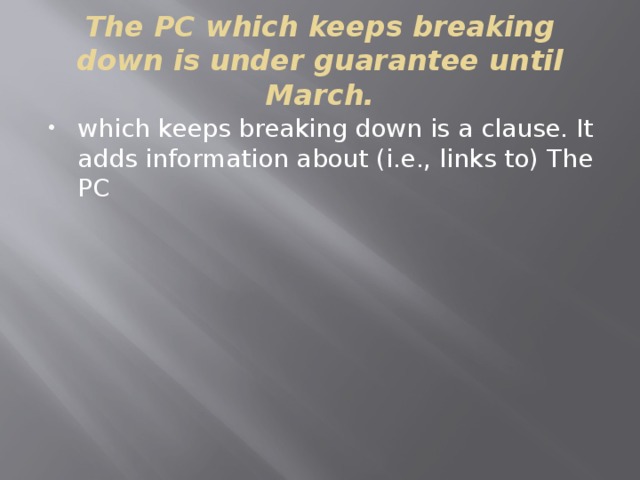
The PC which keeps breaking down is under guarantee until March.
- which keeps breaking down is a clause. It adds information about (i.e., links to) The PC

• The vicar which was on BBC1 last night used to be our local vicar.
- A vicar is a person. Therefore, who should be used and not which

• Please accept my resignation. I don't want to belong to any club that will accept me as a member .
- A club is a thing. Therefore, which will accept me as a member would have been okay. Remember, that can sometimes replace which

WHEN DO YOU PUT A COMMA BEFORE WHICH AND WHO?
- When who or which introduces a restrictive phrase or clause (i.e., additional information that is required to identify the word it is linked to), then the who or the which can be replaced by that. If the who or which introduces information that is not essential to identify the word it is linked to (called the antecedent), then the who or the which will be offset with commas and it cannot be replaced with that.

BEWARE OF AMBIGUITY
- Manx cats, which live on the Isle of Man, have a longer life expectancy than normal domestic cats.
- Manx cats which live on the Isle of Man have a longer life expectancy than normal domestic cats.
- The first example means that all Manx cats have a longer life expectancy than normal cats. (The clause is simply additional information telling the reader where Manx cats live.)
- The second example means that only Manx cats living on the Isle of Man have a longer life expectancy (i.e., Manx cats that live elsewhere do not).

Вебинар для учителей
Свидетельство об участии БЕСПЛАТНО!