
Россия, Астрахань

СДЕЛАЙТЕ СВОИ УРОКИ ЕЩЁ ЭФФЕКТИВНЕЕ, А ЖИЗНЬ СВОБОДНЕЕ
Благодаря готовым учебным материалам для работы в классе и дистанционно
Скидки до 50 % на комплекты
только до
Готовые ключевые этапы урока всегда будут у вас под рукой
Организационный момент
Проверка знаний
Объяснение материала
Закрепление изученного
Итоги урока
Была в сети 05.06.2025 20:22

Бойченко-Башилина Юлия Михайловна
Студент- преподаватель начальных классов
22 года
 2 300
2 300
 30 461
Местоположение
Специализация
Education in Canada. Преподаватель английского языка: Попова Юлия Алексеевна
Категория:
Английский язык
28.12.2022 17:02

Просмотр содержимого документа
«Education in Canada. Преподаватель английского языка: Попова Юлия Алексеевна»
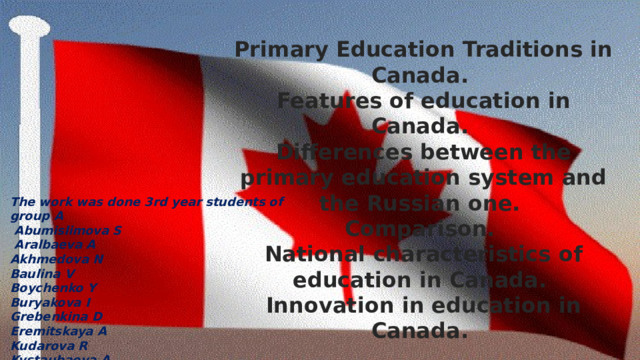
Primary Education Traditions in Canada.
Features of education in Canada.
Differences between the primary education system and the Russian one.
Comparison.
National characteristics of education in Canada.
Innovation in education in Canada.
The work was done 3rd year students of group A
Abumislimova S
Aralbaeva A
Akhmedova N
Baulina V
Boychenko Y
Buryakova I
Grebenkina D
Eremitskaya A
Kudarova R
Kystaubaeva A
Primary Education Traditions in Canada.
Primary education in Canada is built in the likeness of the American one. In elementary schools, education lasts from the first to the fifth grades. Education in primary-level public schools is free and compulsory. Children are required to study in schools until the age of 15. Primary education in Canada is provided in English or French. Additional language classes are provided for immigrants. Canadian school is fun. A rare week goes by without some special event. Either a public holiday, then a large-scale school holiday (for example, a school anniversary or a performance / concert that the whole school staged), or even just a Pajama Day. On this day, everyone, both students and teachers, come to school in pajamas, favorite slippers and with pillows-blankets-toys in an embrace. There is a Hat Day, and the Day of a Favorite Book Character.
Children study in mixed-type classes, where both boys and girls study together. The teachers of the school receive a university education and have a license to teach. Most schools in Canada are state-run, but there are also private boarding schools with international fame. Private schools in Canada are distinguished by large territories, highly qualified teachers and excellent equipment. The training program contains general education lessons, sports, as well as music and art classes. Every morning begins with the Canadian national anthem (everyone is standing, but you can sing along) and a school radio program. A very large part of the educational process is devoted to the art of presentation. The quality of the project and the ability to talk about it in front of the class are evaluated. At the same time, you can use any expressive means. But the beginning of the school year, by the way, does not apply to holidays. Studies in Canada begin on the first Monday of September, after Labor Day, and there are no special outfits or bouquets for teachers. They finish their studies, by the way, much later here - usually in the last week of June
Features of education in Canada.
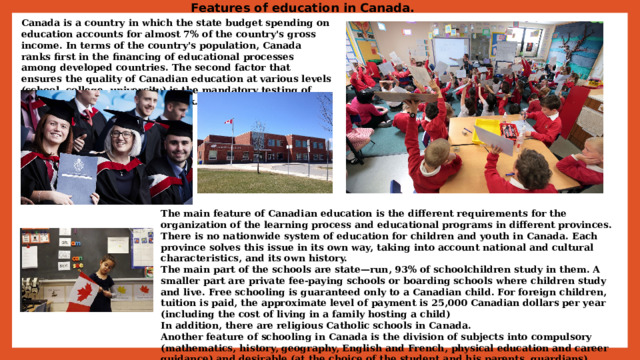
Canada is a country in which the state budget spending on education accounts for almost 7% of the country's gross income. In terms of the country's population, Canada ranks first in the financing of educational processes among developed countries. The second factor that ensures the quality of Canadian education at various levels (school, college, university) is the mandatory testing of teachers upon admission to work.
The main feature of Canadian education is the different requirements for the organization of the learning process and educational programs in different provinces. There is no nationwide system of education for children and youth in Canada. Each province solves this issue in its own way, taking into account national and cultural characteristics, and its own history. The main part of the schools are state—run, 93% of schoolchildren study in them. A smaller part are private fee-paying schools or boarding schools where children study and live. Free schooling is guaranteed only to a Canadian child. For foreign children, tuition is paid, the approximate level of payment is 25,000 Canadian dollars per year (including the cost of living in a family hosting a child) In addition, there are religious Catholic schools in Canada. Another feature of schooling in Canada is the division of subjects into compulsory (mathematics, history, geography, English and French, physical education and career guidance) and desirable (at the choice of the student and his parents, guardians).
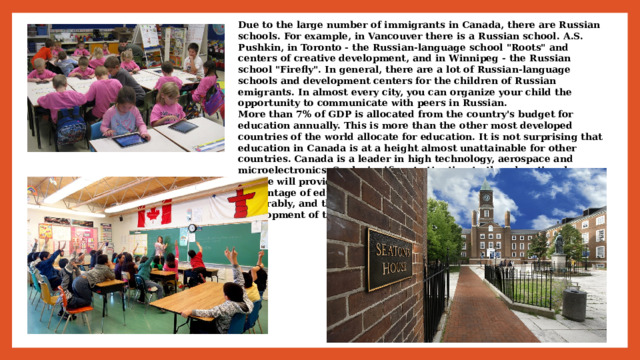
Due to the large number of immigrants in Canada, there are Russian schools. For example, in Vancouver there is a Russian school. A.S. Pushkin, in Toronto - the Russian-language school "Roots" and centers of creative development, and in Winnipeg - the Russian school "Firefly". In general, there are a lot of Russian-language schools and development centers for the children of Russian emigrants. In almost every city, you can organize your child the opportunity to communicate with peers in Russian. More than 7% of GDP is allocated from the country's budget for education annually. This is more than the other most developed countries of the world allocate for education. It is not surprising that education in Canada is at a height almost unattainable for other countries. Canada is a leader in high technology, aerospace and microelectronics. Such significant attention to the educational sphere will provide the country with constant prosperity, as the percentage of education of the Canadian population is growing inexorably, and the educated population is the key to the constant development of the country.
Differences between the primary education system and the Russian one. Comparison.
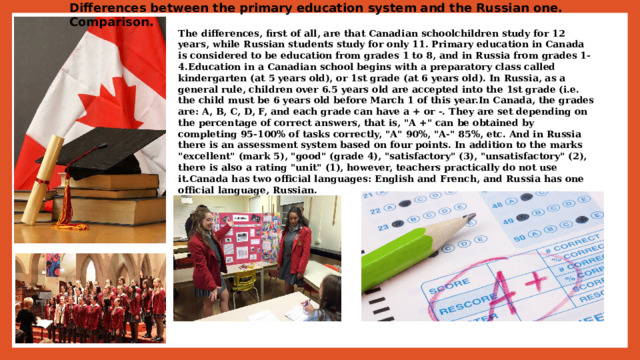
The differences, first of all, are that Canadian schoolchildren study for 12 years, while Russian students study for only 11. Primary education in Canada is considered to be education from grades 1 to 8, and in Russia from grades 1-4.Education in a Canadian school begins with a preparatory class called kindergarten (at 5 years old), or 1st grade (at 6 years old). In Russia, as a general rule, children over 6.5 years old are accepted into the 1st grade (i.e. the child must be 6 years old before March 1 of this year.In Canada, the grades are: A, B, C, D, F, and each grade can have a + or -. They are set depending on the percentage of correct answers, that is, "A +" can be obtained by completing 95-100% of tasks correctly, "A" 90%, "A-" 85%, etc. And in Russia there is an assessment system based on four points. In addition to the marks "excellent" (mark 5), "good" (grade 4), "satisfactory" (3), "unsatisfactory" (2), there is also a rating "unit" (1), however, teachers practically do not use it.Canada has two official languages: English and French, and Russia has one official language, Russian.
National characteristics of education in Canada.
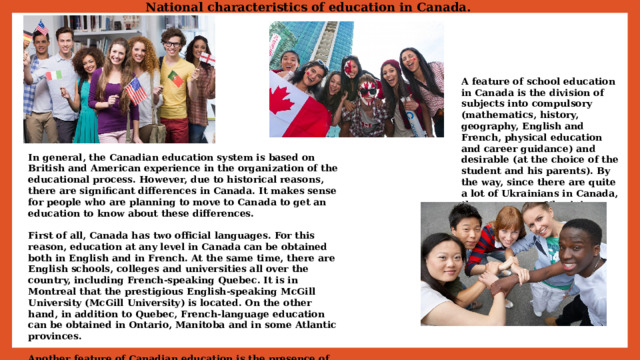
A feature of school education in Canada is the division of subjects into compulsory (mathematics, history, geography, English and French, physical education and career guidance) and desirable (at the choice of the student and his parents). By the way, since there are quite a lot of Ukrainians in Canada, there are many Ukrainian and bilingual English-Ukrainian schools here.
In general, the Canadian education system is based on British and American experience in the organization of the educational process. However, due to historical reasons, there are significant differences in Canada. It makes sense for people who are planning to move to Canada to get an education to know about these differences.
First of all, Canada has two official languages. For this reason, education at any level in Canada can be obtained both in English and in French. At the same time, there are English schools, colleges and universities all over the country, including French-speaking Quebec. It is in Montreal that the prestigious English-speaking McGill University (McGill University) is located. On the other hand, in addition to Quebec, French-language education can be obtained in Ontario, Manitoba and in some Atlantic provinces.
Another feature of Canadian education is the presence of different systems in different provinces. Canada has 10 provinces and 3 territories administered
Innovation in education in Canada.
Over the past decade, new tools have been added to computers, calculators and printers at school: tablets, interactive whiteboards and a 3D printer (volume printing). The educational process in Canada adapts quickly enough to new technological realities. For example, the presence of a printed essay (essay) or a report with photographs is one of the main requirements in middle and high school. In a Canadian school, children begin to learn to write with printed letters, and capital letters appear only in the 3rd grade. At the moment, in Canada, teaching capital letters in some schools has been completely canceled, and in the near future this will happen to all English schools.
Where in Canada do students have access to devices. This:
- Home computer, family or individual; it is important to check the history and put a good filter on the computer. Do not allow the child to work on the computer in his room to avoid various temptations;
- * School Computer Center;
- * Computer and programs provided by the school (for a fee);
- * Public free computers in city libraries for those who do not have access to computers at home.
- * Specialized centers/Internet cafes, etc.
Report cards, daily academic performance and student attendance, homework assignments are gradually being transferred from paper space to virtual space. For example, at school, on a special parent portal, you can see in real time the location of the child and even tardiness for lessons (tardiness), homework assignments and samples of exams and tests are posted there.
The system of grades/credits for admission to universities is also computerized. All students at the Canadian school have an individual personal number. From grade 9 to grade 12, all grades are entered into a single electronic system and based on them, students in grade 12 enter universities and continue their further education. Parents regularly receive emails about school events, meetings, important events, etc. Forms and documents in many schools are also sent in electronic format. Schools are switching to electronic recording of students for the next academic year. The necessary documents are either scanned during the registration process, or sent by mail, or delivered to the school.

Вебинар для учителей

Свидетельство об участии БЕСПЛАТНО!