© 2026, Бардакова Валерия Александровна 72 0

СДЕЛАЙТЕ СВОИ УРОКИ ЕЩЁ ЭФФЕКТИВНЕЕ, А ЖИЗНЬ СВОБОДНЕЕ
Благодаря готовым учебным материалам для работы в классе и дистанционно
Скидки до 50 % на комплекты
только до
Готовые ключевые этапы урока всегда будут у вас под рукой
Организационный момент
Проверка знаний
Объяснение материала
Закрепление изученного
Итоги урока
Был в сети 24.02.2026 15:16

Бардакова Валерия Александровна
Учитель
 17
17
 292 265
Специализация
Элективный курс "Культура Великобритании"
Категория:
Английский язык
13.01.2026 18:12

Просмотр содержимого документа
«Элективный курс "Культура Великобритании"»
UNIT 1
Language as a means of communication
Step 1
The History of the English Language
Pre-Reading, While-Reading:
Key vocabulary:
distinct – отличный от;
evolve – эволюционировать;
derive – происходить, получать:
conquer – завоевывать.
Pronounce the following names of languages and continents:
German, Dutch, Europe, Latin, Greek, Australia, Asia
Read the title and ask a few questions related to this topic.
While-Reading:
Find out if there are answers to your questions in the text below.
Most people know that the English language is spoken by millions of people around the world. However, few people are aware of the history of the English language.
Today, English is one language, but in some ways it's a mixture of many different languages. The English language is most closely related to a group of languages called the Germanic languages. This group also includes languages such as German and Dutch. About 1500 years ago, these languages were not yet distinct from each other. Some of the people of Germany and the Netherlands then moved to England.
Those people were called the Anglo Saxons and their language then evolved into English. Most of the basic words of the English language are derived from these very old Anglo-Saxon languages. For example, words for the parts of the body, for numbers and for animals are mostly Anglo-Saxon words.
Some new words were brought to England over 1000 years ago by people who came from the Scandinavian countries of Northern Europe. Many words that begin with the letters SK, such as skin and skill, are Scandinavian words.
A major change happened in the English language after the year 1066. In that year, England was conquered by a king from the northern part of France. He and his followers spoke French, so French became an important language in England. During the next few 100 years, the English language absorbed a very large number of French words. In fact, today's English dictionaries contain more words of French origin than of Anglo-Saxon origin. Part of the reason why the English language has so many words is that it often has 2 words for each idea, one word of Anglo-Saxon origin, and one word of French origin.
Many more words entered the English language a few 100 years ago when science and technology became more widespread. Most scientific and technical words are derived from words of the ancient languages of Latin and Greek. Because there are so many of these scientific and technical words in the English language today, the influence of Latin and Greek has been quite large.
Other languages have also contributed many words to the English language. Some words have come from the Celtic languages spoken in Ireland, Scotland and Wales. Many words have been added to the English language by immigrants who came to North America from various countries of Europe. Also, many more words have been adopted from the native languages of North America, Australia and the Pacific, and from the languages of the peoples of Africa and Asia. All of these words have made English a very interesting language.
After Reading
Imagine that one of you is a historian and the other is a person who is interested in history. Make up a dialogue and act it out.
Step 2
The Role of English in the World
Pre-Reading:
What do you think about the role of English in the world? Answer the question.
While Reading:
Read the text and try to guess what the underlined words mean.
English is the native language for more than 300 million people on our earth. But nowadays it is widely used not only in those countries where it is a first language. A lot of countries (such as China, Russia, Thailand and many others) have recognized the importance of this language recently as an international means of communication. English is taught in all schools and colleges there. In Russia itself English is gathering pace as a popular second language.
There are also some countries (such as India, Singapore, Pakistan, the Philippines and some African countries) where English is an official second language and it is often used in mass media, courts, parliaments and universities.
Today English is used almost everywhere. It is the language of banking and industry, computers and trade, technology and science. English as an international language helps people of different nationalities from around the world discuss politics or arrange business meetings. For example, German and Italian businessmen can choose English as their mutual language of communication.
More and more people from non-English speaking countries start learning the language and using it in their daily life, business and travelling. Tourism development has contributed much to English becoming the universal means of communication. However some linguists hold the opinion that the globalization of English as an international language can be quite harmful for the language itself because foreign speakers greatly influence its grammar, pronunciation and vocabulary.
After Reading
Match the words to their synonyms:
To recognize; A. to pick up the pace;
To gather pace; B. to know;
To arrange; C. to give;
To contribute D. organize.
Name 3 things why English is important. Share them with your partner.
Step 3
British English - American English
Is there a difference in grammar in British and American English? Let's read the article and find out.
In terms of grammar, British and American English are very similar with just minor differences. These are often visible in the choice of verb or verb form in two varieties. American English also has a tendency to replace complex tenses with simple ones where possible, for example, present perfect with past simple as in: “Have you phoned her yet?” (Brit.) vs. “Did you phone her yet?” (Amer.). Adverbs such as yet/ever/already/just are commonly used in the past simple in American English and not the present perfect. Take a look at some further examples (Brit vs Amer):
He’s eaten too much. vs. He ate too much. (now he’s feeling sick)
Have you ever been to France? vs. Did you ever go to France?
I haven’t read this book yet. vs. I didn’t read this book yet. (can I borrow it?)
As another example, Americans are much more likely to be technically correct in the agreement of collective noun and verb form than Britons.(2) So in standard AE it would be: The team is playing well this season whereas in BE it is common and acceptable to say the team is playing well. Similar differences can be seen in the use of words like government, committee etc.: The government is... (AE), the government is... (BE). (4)
Sometimes Americans favour “do” where Brits would use “have (+ got)”. Take a look at the following examples (Brit vs. Amer):
Have you got a problem? vs. Do you have a problem?
Have you got children? vs. Do you have children?
Have you got time to… vs. Do you have time to…
After Reading
The following sentences are typically AE. What would the typical British say?
Do you have any siblings?
It is important that she be told.
The jury has not yet reached its decision.
Go fetch your book.
He dove into the water.
You must come visit me real soon.
Would you like to try to speak American English? Talk with your partner using American grammar rules.
Unit 2
Family and Home
Step 1
Eating Habits in Britain
Pre-Reading
Look at the pictures and guess what the words mean.
Baked potato, 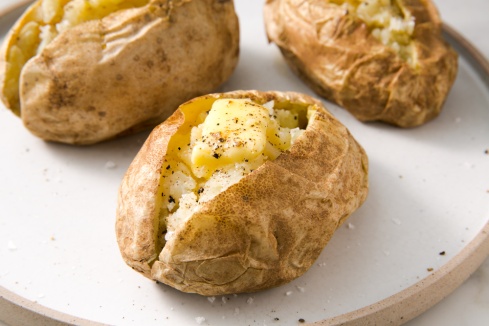
beans on toast, 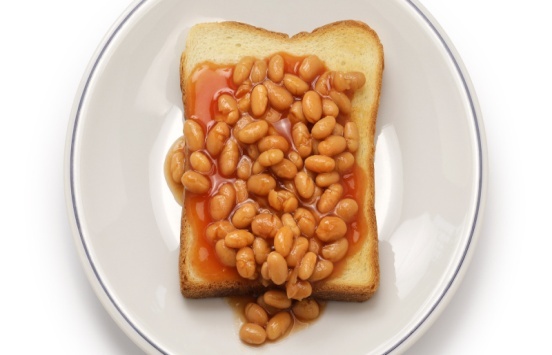
crisps, 
biscuits, 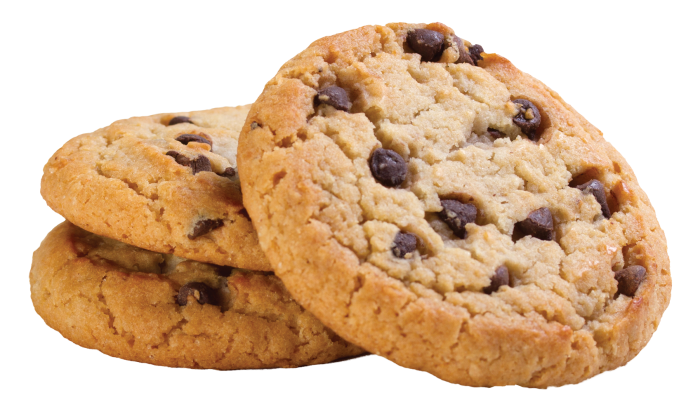
two courses, 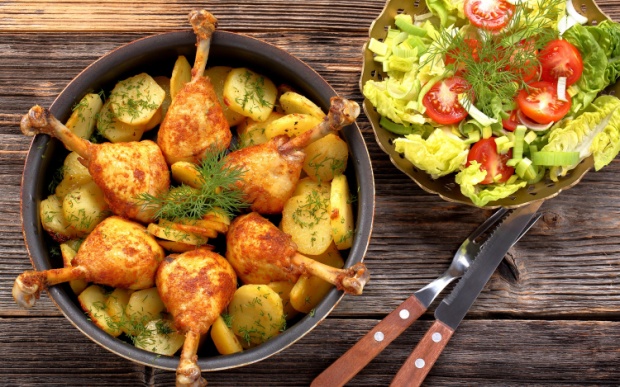
convenience food, 
take-away food, 
slimming food, 
fibre, 
scones, 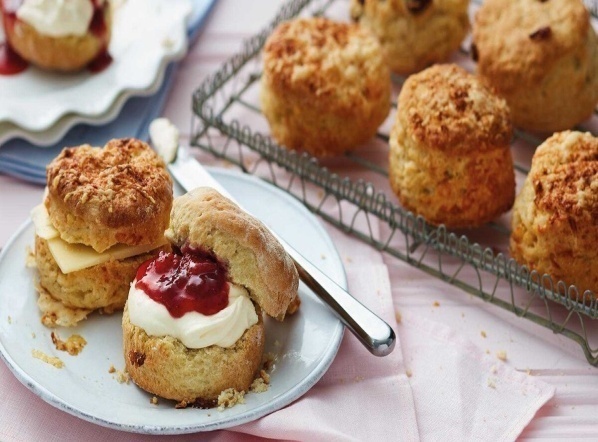
vinegar. 
Answer the questions: What do you eat for breakfast? Do you eat crisps or biscuits as a snack? How often do you buy convenience food? Have you ever tried to eat only slimming food? What does fibre mean? Can you cook scones by yourselves?
Let’s read the text and find out what eating habits British people have.
While-Reading
Fill the gaps with the words above.
The traditional British breakfast is a cooked meal of bacon, eggs and sausages, preceded by cereal or fruit and followed by toast. Nowadays, this large meal is served mainly in hotels and is very popular with foreign visitors. Britons may eat this big breakfast at weekends or on special occasions but they prefer a smaller, healthier meal to start a normal day. Lunch is a light meal and is eaten at school or work at about 1 p.m. Lunch takes 30-40 minutes. Popular lunches are: a salad or a sandwich; a 1_______; 2_______.
Snacks are very popular in Britain, and many people often eat snacks between meals. Schools may also sell snacks, such as 3_______, chocolate, sweets and 4_______.
Dinner is usually the main meal of the day and consists of two _______ - meat or fish and vegetables followed by a dessert or pudding. 5________ and frozen foods are especially popular. Convenience meals are already cooked - all you have to do is to heat them up in the microwave.
British 6_______ is fish and chips eaten with salt and 7________. Some fish and chips still wrap your meal in newspaper, others use special bags to keep it warm. Some give you a plastic fork. Most towns and cities now offer a wide range of take-away meals, from American-stily hamburgers to Turkish kebabs. Many families prefer to eat take-away food for dinner instead of cooking.
The British are famous for their love of sweet things, and afternoon tea with sandwiches, 8________, jam and several different kinds of coke was once a traditional custom. Like the English cooked breakfast, it is now more often found in teashops and hotels than in private homes, and you can buy special guidebooks to tell you where the best afternoon teas are served. Most working people do not have teas as an afternoon "meal", but they do have a sport break in the middle of the afternoon for a cup of tea. Tea is often drunk with lunch and dinner.
Since the 1970s eating habits in Britain have undergone a change. People started to eat less fat and more 9_______. Fat is believed to be one of the major causes of obesity and heart disease. Forty per cent of adults in Britain are overweight. High fibre foods and low fat foods can now be found in all shops and supermarkets.
The British have also started to count calories. They try to take in fewer calories and to follow a calorie-controlled diet. One of the fastest-growing sectors of the food market in Britain is 10________.
After Reading
Are these habits similar to Russian ones? Compare them.
Step 2
English homes (Дома англичан)
Pre-Reading
What kind of houses do you know? Where do you live?
Learn new vocabulary:
are largely concentrated – в основном, расположены
block of flats – многоквартирный дом
modern apartments – современные апартаменты
conservative – консервативный
value – ценить; ценность
marvelous view – чудесный вид
stone – каменный
brick – кирпичный
row – ряд
terraced houses – таунхаусы
semi-detached houses – двухквартирные дома
detached house – отдельный дом
property – имущество
jointly – совместно
mortgage – ипотека
wages – зарплата
Let’s find out where English people live.
About 51 million people live in England and most of them (84%) are largely concentrated in London. Like in any other capital city there are a lot of blocks of flats with modern flats and a lot of people prefer living there. But people who are more conservative and value the traditions of their country live in the countryside.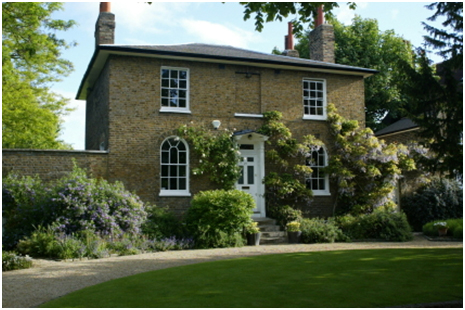
The houses in the countryside are usually more expensive than the flats in big cities. I think it is normal because when you live in the country, you pay not just for the house but for the marvelous views, fresh air and a possibility to spend your free time in a garden (gardening is one of the most favourite hobbies among the British). English houses often have two floors and an attic. There is a kitchen, a dining-room and a living on the ground floor. Almost in every house there is a fire-place in the living-room, which is the most favourite place for all the family in the evenings or on holidays. There are bedrooms and several bathrooms on the first floor. There is always a room for guests. There is usually a study on the attic.
Usually houses in England are built from stones or bricks (from the local area), which are different in colour. And sometimes it seems that Britain is a country of multicoloured houses. In England there are many types of houses. People can live in a flat as it was told above. In most towns all over England there are streets of houses joined together in long rows. Such houses are called terraced houses. Two houses joined together are called semi-detached houses. If the houses are not joined to any other buildings they are called detached houses. The most popular types of houses among British people are semi-detached and detached houses.
Though more and more people tend to buy a house in the countryside, it has become a great problem for the English to buy a house because the prices on the property are increasing much faster than the wages. But it is always possible to take a mortgage in a bank, call upon rich relatives or buy a house jointly with friends.
While Reading
Are the sentences true or false:
1. About 51 million people live in England and most of them (84%) are largely concentrated in London.
2. The houses in the countryside aren’t usually more expensive than the flats in big cities.
3. Houses in England are usually built from wood.
4. Two houses joined together are called terraced houses.
5. The most popular types of houses among British people are semi-detached and detached houses.
6. There are different types of houses in England.
After Reading
Answer the questions in pairs:
1. Where do most of English people prefer to live?
2. Why are the houses in the country more expensive than the flats in big cities?
3. What types of houses do you know in England?
4. What are the most popular types of houses among English people?
5. Is it easy or difficult nowadays to buy a house? Why?
6. How can you buy a house?
Step 3
A Typical British Family
Pre-Reading
Read these sayings and say Russian equivalents to them. Do you agree with them?:
“There is no place like home”, “The Englishman's home is his castle”.
What do you remember about grammar construction “used to”? Give some examples from your life using this construction.
Say a few words about typical Russian family. Do you think it differs from British one? Let’s find out it in the text.
The English are a nation of stay-at-home. “There is no place like home,” they say. And when the man is not working he is at home in the company of his wife. "The Englishman's home is his castle” is a saying known all over the world. And it is true.
A "typical" British family used to consist of mother, father and two children, but in recent years there have been many changes in family life. Some of these have been caused by new laws and others are the result of changes in society. For example, since the law made it easier to get a divorce (развестись), the number of divorces (разводы) has increased. In fact, one marriage in every three now ends in divorce. This means that there are a lot of one-parent (неполные) families. Society is now more tolerant than it used to be of unmarried (неженатые, незамужние) people, unmarried couples and single (одинокие) parents. Another change has been caused by the fact that people are living longer nowadays, and many old people live alone following the death of their partners. As a result of these changes in the pattern of people's lives, there are many households which consist of only one person or one person and children. You might think that marriage and the family are not so popular as they once were. However, the majority of divorced people marry again, and they sometimes take responsibility (берут ответственность) for a second family.
Members of a family - grandparents, aunts, uncles, cousins - keep in touch, but they see less of each other than they used to. This is because people often move away from their home town to work, and so the family becomes scattered (разбросана). Christmas is the traditional season for reunions (воссоединения). Although the family group is smaller nowadays than it used to be, relatives often travel many miles in order to spend the holiday together. In general, each generation is keen to become independent of parents in establishing its own family unit (создание собственной семейной ячейки), and this fact can lead to social as well as geographical differences within the larger, family group.
Relationships within the family are different now. Parents treat their children more as equals (равные) than they used to, and children have more freedom to make their own decisions. The father is more involved with bringing up children, often because the mother goes out to work. Increased leisure facilities (возможности для отдыха) and more money mean that there are greater opportunities outside the home. Although the family holiday is still an important part of family life (usually taken in August, and often abroad) many children have holidays away from their parents, often with a school party or other organized group.
Who looks after the older generation (старшее поколение)? There are about 10 million old-age pensioners in Britain, of whom about 750,000 cannot live entirely (полностью) independently. The government gives financial help in the form of a pension but in the future it will be more and more difficult for the nation economy to support the increasing number of elderly. At the present time, more than half of all old people are looked after at home. Many others live in Old Peoples' Homes, which may be private or state owned.
After Reading:
Write down underlined words and make up your own sentences with them;
Retell the text using underlined words.
Unit 3
British Character And Lifestyle
Step 1
British Character
Pre-Reading
Learn new vocabulary “Traits of Character”
Polite – вежливый;
well-mannered – воспитанный;
reserved – сдержанный;
unemotional – неэмоциональный;
with a sense of humour – с чувством юмора;
conservative – консервативный;
practical – практичный;
realistic – реалистичный;
prudent – бережливый
Have you got some traits of character from the list above? What are you like? Say 3 main qualities of your character.
Let’s find out what Englishmen are like.
The British are said to be polite and well-mannered people. Polite words or phrases such as «Please», «Thank you» and «Excuse me» are used very often in Britain.
The British are said to be reserved. They don't like displaying their emotions even in dangerous and tragic situations. But they are not unemotional. They control their emotions because they are taught that it is best not to show their feelings. The English hardly ever lie, but they don't tell you the truth either. English people take everything with a sense of humour. You can easily offend (обидеть) them if you tell them they have no sense of humour.
Englishmen tend to be rather conservative, they love familiar things. They are proud of their traditions and carefully keep them up. Britain has more living symbols of its past than many other countries. Traditional uniforms are still preserved in Great Britain.
The English are practical and realistic, prudent and careful about almost everything. Everything is orderly: the lawns and the trees are neatly trimmed. Every Englishman is said to be a countryman at heart. The English countryside is many things to many people. It means peace and quiet, beauty, good health and no crime. Most Englishmen love gardens. Gardening is one of the most popular hobbies among Englishmen. They usually prefer a house with a garden to an apartment in a modern block of flats. The British people are considered to be the world's greatest tea drinkers. They drink it at meals and between meals. The English tea is usually strong and with milk. The British love animals very much. Millions of families have "bird-tables" in their gardens. Nearly half of the households in Britain keep at least one pet. The English take good care of their pets. They are pet lovers.
After Reading
Answer the questions:
1. Are the British polite? Why?
2. Are the British reserved or communicative? Why?
3. Why are British people said to be conservative?
4. What are traditional British dishes? What do the British like to drink?
5. Do the British keep everything in order? How can you prove that?
6. Do the British like their countryside?
7. What is their attitude towards animals?
8. Can you describe the British using 3 adjectives?
9. What is your personal attitude towards the British?
10. How different or alike do you think the Russians and the British are?
Step 2
National Stereotypes
Pre-Reading:
What stereotypes about Russian people do you know? Do you know something about English people? Let’s find out it in the text.
While Reading:
Underline or write down stereotypes as you notice. Try to understand the words in bold.
There are certain stereotypes of national character which are well known in Britain. For instance, the Irish are supposed to be great talkers, the Scots have a reputation for being careful with money, the Welsh are renowned for their singing abilities, and the English are considered to be reserved. These characteristics are, of course, only caricatures and are not reliable description of individual people from these countries.
British people give a relatively high value to the everyday personal contacts. Some writers on Britain have talked about the British desire "to belong", and it is certainly true that the pub, or the working man's club, or the numerous other clubs devoted to various sports and pastimes play a very important part in many people's lives. Many people make their social contacts through work and, partly as a result of it, the profession is also an important aspect of their sense of identity. British people try to appear as if they belong to as high class as possible, though nobody wants to be thought of as «snobbish».
The British have few living traditions and are too individualistic to have the same everyday habits as each other. They are rather proud of being different. However, this does not mean that they like change. They don't. They may not behave in traditional ways, but they like symbols of tradition and stability. The British are rather conservative and their conservatism can combine with their individualism. Why should they change just to be like everyone else?
Indeed, as far as they are concerned, not being like everyone else is a good reason not to change. Their driving on the left-hand side of the road is a good example to this.
Systems of measurement are another example. The British government has been trying for many years to get British people to use the same scales that are used nearly everywhere else in the world. But everybody in Britain still shops in pounds and ounces.
The modern British are not really chauvinistic. Open hostility to people from other countries is very rare. If there is any chauvinism at all, it expresses itself through ignorance (невежество). Most British people know remarkably little about Europe and who lives there.
It is probably true that the British, especially the English, are more reserved than the people of many other countries. They find it comparatively difficult to indicate friendship by open displays of affection. For example, it is not the convention to kiss when meeting a friend. Instead, friendship is symbolized by behaving as casually as possible.
The British are comparatively uninterested in clothes. They spend a lower proportion of their income on clothing than people in most European countries do. Many people buy second-hand clothes and are not at all embarrassed to admit this. A male bank employee, for example, is expected to wear a suit with a tie at work. But on Sundays the British like to "dress down". They can't wait to take off their respectable working clothes. In fact, the British are probably more tolerant of "strange" clothing than people in most other countries.
The English people are great pet lovers. Practically every family has a dog or a cat, or both. They have special dog shops selling food, clothes and other things for dogs. There are dog hairdressing saloons. Millions of families have "bird-tables" in their gardens. Perhaps, this overall concern for animals is part of the British love for nature.
The British are always talking about the weather. Unlike many others, this stereotype is actually true to life. But constant remarks about the weather at chance meetings are not the result of polite conventions. They are the result of the fact that, on the one hand, to ask personal questions would be rude while, at the same time, silence would also be rude. The weather is a very convenient topic to "fill the gap".
After Reading
Discuss what the words in bold mean. In what context were these words used?
In pairs compare British stereotypes with Russian ones.
Step 3
Leisure in Britain
Pre-Reading
Make three predictions about how British spend free time.
While Reading
Choose the correct words for filling the gaps.
1.
A.make
B.do
C.play
D.go
2.
A.many
B.more
C.much
D.most
3.
A.record
B.scan
C.print
D.power
4.
A.with
B.for
C.on
D.about
5.
A.what
B.why
C.when
D.while
6.
A.available
B.probable
C.abundant
D.exclusive
7.
A.drag
B.bring
C.carry
D.take
8.
A.strength
B.exercise
C.athletics
D.presentation
9.
A.voyage
B.journey
C.visit
D.road
10.
A.ages
B.numbers
C.years
D.groups
The British spend their free time in different ways. People generally use it to relax, but many people also (1)_____ voluntary work, especially for charities.
People spend a lot of their free time at home, where the (2) _____ popular leisure activity is watching television, the average viewing time being 25 hours a week. People often (3)______ programs on video so that they can watch later, and video recorders are also used (4)______ watching videos hired from a video rental shop.
Reading is another a favourite pastime. The British spend a lot of time reading newspapers and magazines.
In the summer gardening is popular, and in winter it is often replaced by “do-it-yourself”, (5)______ people spend their time improving or repairing their homes. Many people have pets to look after; taking the dog for a daily walk is a regular routine.
The extra leisure time (6) _____ at weekends means that some leisure activities, many of them to do with sport, normally (7)______ place only then. Traditional spectator sports include football, cricket, horse racing, motor racing and motor cycle racing. Popular forms of (8)______ are swimming, tennis, ice-skating or roller skating, cycling, climbing, and hill or country walking.
Families often have a “day out” at the weekend, especially in summer, with a (9)______ to a local event such as a festival, fair or show. Young people especially go to clubs and discos, while people of all (10) _____ go to the theatre, the cinema, art exhibitions and concerts.
After Reading
Write an e-mail to your English friend about leisure in Russia.
Step 4
British Holidays and Traditions
Pre-Reading
What do these words mean?
interesting traditions,
most public holidays,
New Year's Day,
Easter Monday,
the most important holiday of the year,
colorful socks at the end of their beds,
traditional day for those who are in love,
dress up in costumes of witches and ghosts.
Read the text and do exercises after it.
Great Britain is an old country and it has a lot of holidays and interesting traditions. Holidays in the country are historic and public. Most public holidays are called bank holidays because banks, companies and most shops do not work on these days. Such holidays include New Year's Day, Easter Monday and others.
At Easter, the British give each other chocolate eggs, which they eat on Easter Sunday.
Christmas is on the 25-th of December. Families spend this day together. For many people this is the most important holiday of the year. Family members wrap up their presents and put them under the Christmas tree. Children hang colorful socks at the end of their beds for presents. They believe that Father Frost puts presents inside the socks.
New Year's Day is not as important in Britain as it is in Russia. People usually make promises to themselves such as to give up smoking, to change their lifestyle and others.
St. Valentine's Day is celebrated on the 14th of February. This is the traditional day for those who are in love. Young people give flowers and greeting cards to their Valentines and celebrate this day together.
Halloween is a holiday loved by all children. It takes place on the 31th of October. There are a lot of parties and people dress up in costumes of witches and ghosts and make lanterns of pumpkins with a candle inside. People also play different games and have fun. Children usually go from one house to another with empty baskets or bags, knock on doors and say: Trick or treat. People should give them something, or they will play a trick on them.
Among historic holidays, Guy Fawkes Night can be mentioned. In the 15-th century, a group of people with Guy Fawkes as their leader decided to blow up the Houses of Parliament. They did not manage to do this and Guy Fawkes was caught and hanged. Since then the British celebrate this day burning a doll made of straw and dressed in old clothes on a bonfire. Children dress in old clothes and beg in the street saying: A penny for the Guy.
There are a lot of customs in Great Britain. One of the most famous is gardening. Most of the English keep small gardens full of flowers behind their houses or around them. In spring, there are a lot of flower-shows and vegetable-shows with prizes for the best exhibitions.
In Northern Ireland there is a holiday called St. Patrick's Day. It is celebrated on the 17-th of March. On this day people wear green clothes and drink Irish beer. There are carnivals and barbeques all over the country.
After Reading
1. Answer the questions:
- What can you say about British Holidays and Traditions?
- What British Holidays and Traditions do you know?
- What can you say about Christmas?
- What can you say about New Year's Day?
- What can you say about St. Valentine's Day?
- What can you say about Halloween?
2. Make up a story about one holiday or tradition in Great Britain, using information from the text and a favourite holiday in Russia. Present them to the class.
1.____________________________________________________________________________________________________________________________________________________________________________________________________________________________________________________________________________________________________________________________________________________________________________________________________________________________________________________________________________________________________________________________________________________________________________________________________________________________________________________________________________________________________________________________________________________________________________________________________________________
2._______________________________________________________________________________________________________________________________________________________________________________________________________________________________________________________________________________________________________________________________________________________________________________________________________________________________________________________________________________________________________________________________________________
3. Draw and sign a holiday card.
For example:
My dear girlfriend Ann, I congratulate you with this wonderful holiday St. Valentine's Day!!! I wish you good luck, health and, of course, love!!! Be happy.
Yours Nick.
_________________________________________________________________
____________________________________________________________________________________________________________________________________
________________________________________________________________
Unit 4
Environment in Great Britain
Step 1
Climate, Weather, Wildlife.
The climate in the UK is generally mild because of the Gulf Stream and it is usually described as cool, humid and changeable.
The weather is so changeable indeed that the English often say that they have no climate but only weather. The English also say that they have three kinds of weather: when it rains in the morning, when it rains in the afternoon or when it rains all day long. The weather is never too hot or too cold. Winters are very mild. Sometimes it snows and snow melts quickly and the English seldom have “white Christmas”. In fact in the South of England grass remains green all the year round.
This humid mild climate is good for plants. The trees and flowers begin to blossom early in spring.
Some of them have become symbols in the UK. You may know that poppy is the symbol of peace, the red rose is the national emblem of England, the thistle is the national emblem of Scotland. The daffodils and the leek are the emblems of Wales and the shamrock is the emblem of Ireland. The UK used to be a land of big forests, mainly oaks, elms and beeches in England, while Scotland had mainly pines and birches. But nowadays a lot of these territories are cultivated.
The animal life of the UK is much like that of Europe, to which it was once joined. Many animals are now protected by law. About 50 land animals are found in the UK: foxes, hares, rabbits, and deer among them.
Some 230 kinds of birds live in the UK. The most numerous are blackbirds, sparrows and starlings. Robin is the national bird of the UK.
But wildlife in Britain is in great danger, because of pollution. Many British rivers have become “biologically” dead. There is no fish in them and wildlife around them is not growing the way it should.
mild - мягкий
humid - влажный
remain - оставаться
poppy - мак
thistle - чертополох
daffodil - нарцис
leek - лук-порей
shamrock - клевер
elm - вяз
I. Find English equivalents in the text.
из-за
таять
символ мира
скворец
воробей
II. Complete the sentences.
Sometimes it rains so heavily_______________________.
Sometimes it snows and snow_______________________.
The trees and flowers_____________________________.
The daffodils and the leek__________________________.
But wildlife in Britain is____________________________.
III. Make the right choice:
1. The emblem of England is
a) leek
b) poppy
c) rose
2. The emblem of Ireland is_____________________________.
a) daffodil
b) rose
c) shamrock
3. The emblem of Scotland is____________________________.
a) rose
b) thistle
c) poppy
4. The emblems of Wales are_________________________.
a) poppy and leek
b) leek and rose
c) leek and daffodil
5. The symbol of peace is_______________________________.
a) birch
b) poppy
c) rose
Step 2
The problem of environmental protection in Great Britain
Exercise 1. Translate the words :
1. rapid - быстрый
2. accompany - сопровождать
3. consumption - поглощения
4. reduction in sulphur dioxide emissions - сокращение выбросов диоксида серы
5. combustion [kəm'bʌsʧ(ə)n] - сгорания
6. petrol stations - бензоколонки
7. carbon monoxide, hydrocarbon and nitrogen oxide - монооксид углерода, углеводороды и оксид азота
8. work out - разрабатывать
9. the elimination of chlorofluorocarbons - уничтожение, устранение хлорофлюороуглерода
10. ozone layer - озоновый слой
11. conservation area - охранная зона
Exercise 2. Read the text and answer the questions.
We are living in the time of rapid (1) scientific and technological progress, which is accompanied (2) by an increasing consumption (3) of the world’s natural resources. Such vital sources of life as air, water, minerals as well as fauna and flora are being wasted and destroyed.
The protection of nature has become of international importance. Great Britain stresses the need for improvement of environmental protection too. Integrated pollution control restricts emissions to air, land and water from the most harmful process. Responsibility for pollution control rests with local and central government. Great Britain has adopted a phased programme of reductions in sulphur dioxide emissions (4) from existing large combustion (5) plants of up to 60 per cent by 2003. Over 95 per cent of petrol stations (6) in Britain stock unleaded petrol. Strict controls have reduced carbon monoxide, hydrocarbon and nitrogen oxide (7) emissions.
The Government worked out (8) the rules for the use of the Earth’s atmosphere. Total emissions of smoke in the atmosphere have fallen by over 85 per cent since 1960. Sulphur dioxide emissions have fallen by about 40 per cent since 1970.
The Government is committed to the elimination of chlorofluorocarbons (9) which damage the ozone layer (10). They also contribute to the green-house effect, which leads to global warming and a rise in sea levels.
There are nearly 500,000 protected buildings and 7,000 conservation areas (11) of architectural or historical interest in Great Britain.
The Government attaches great importance to the protection of national parks (they cover 9 per cent of the total land area of England and Wales). Great care is taken of three regional parks and forty national scenic areas, which cover 13 per cent of Scotland. The territorial waters of most nations are already being spoiled, but the National Rivers Authority of Great Britain protects its inland waters in England and Wales. In Scotland the river purification authorities are responsible for water pollution control.
Under such strict regime the mineral and other resources of the oceans and seas would become reserves not only for use by this generation but the following generations as well.
1. What programme has Great Britain adopted?
2. What did the Government work out for the use of the Earth’s atmosphere?
3. Which factors lead to global warming and a rise in sea levels?
4. How many protected buildings and conservation areas are there in Great Britain?
5. Why does the Government of Great Britain attach great importance to the protection of national parks and purification of the territorial waters?
Вебинар для учителей
Свидетельство об участии БЕСПЛАТНО!