Россия, санкт-петербург

СДЕЛАЙТЕ СВОИ УРОКИ ЕЩЁ ЭФФЕКТИВНЕЕ, А ЖИЗНЬ СВОБОДНЕЕ
Благодаря готовым учебным материалам для работы в классе и дистанционно
Скидки до 50 % на комплекты
только до
Готовые ключевые этапы урока всегда будут у вас под рукой
Организационный момент
Проверка знаний
Объяснение материала
Закрепление изученного
Итоги урока
Была в сети 13.04.2026 10:47

Савчиц Марина Анатольевна
English teacher and instructor
47 лет
 477
477
 109 745
Местоположение
Специализация
Money and Hobbies talk. OGE speaking and using grammar in context.
Категория:
Английский язык
11.02.2026 10:57

Просмотр содержимого документа
«Money and Hobbies talk. OGE speaking and using grammar in context.»
with answers
![Speaking. Part 1. Read the words written in transcription, find them in the text and underline them. effect [ɪˈfekt] сущ affect [ˈæfekt] гл](https://fsd.multiurok.ru/html/2026/02/11/s_698c35232bf90/img1.jpg)
Speaking. Part 1. Read the words written in transcription, find them in the text and underline them.
effect
[ɪˈfekt]
сущ
affect
[ˈæfekt]
гл
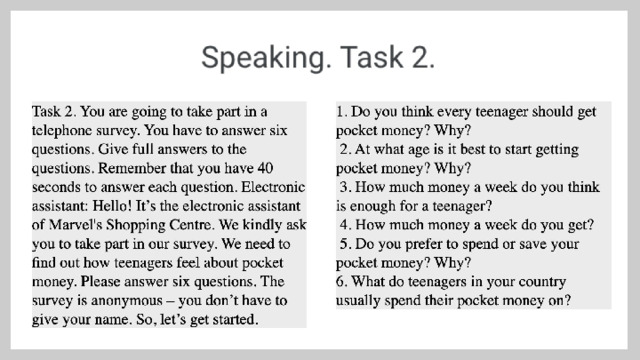
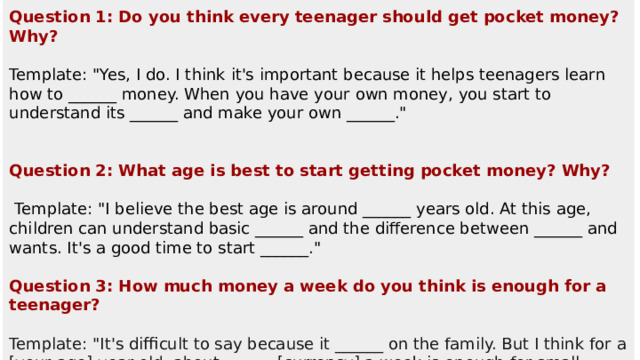
Question 1: Do you think every teenager should get pocket money? Why?
Template: "Yes, I do. I think it's important because it helps teenagers learn how to ______ money. When you have your own money, you start to understand its ______ and make your own ______."
Question 2: What age is best to start getting pocket money? Why?
Template: "I believe the best age is around ______ years old. At this age, children can understand basic ______ and the difference between ______ and wants. It's a good time to start ______."
Question 3: How much money a week do you think is enough for a teenager?
Template: "It's difficult to say because it ______ on the family. But I think for a [your age]-year-old, about ______ [currency] a week is enough for small ______, like ______ or ______."
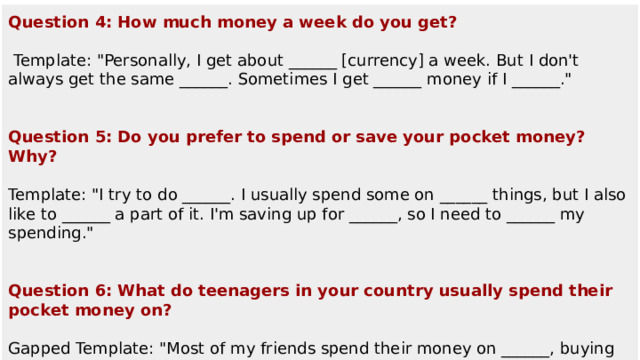
Question 4: How much money a week do you get?
Template: "Personally, I get about ______ [currency] a week. But I don't always get the same ______. Sometimes I get ______ money if I ______."
Question 5: Do you prefer to spend or save your pocket money? Why?
Template: "I try to do ______. I usually spend some on ______ things, but I also like to ______ a part of it. I'm saving up for ______, so I need to ______ my spending."
Question 6: What do teenagers in your country usually spend their pocket money on?
Gapped Template: "Most of my friends spend their money on ______, buying ______, or downloading ______. ______ and ______ are also very popular, especially with ______."
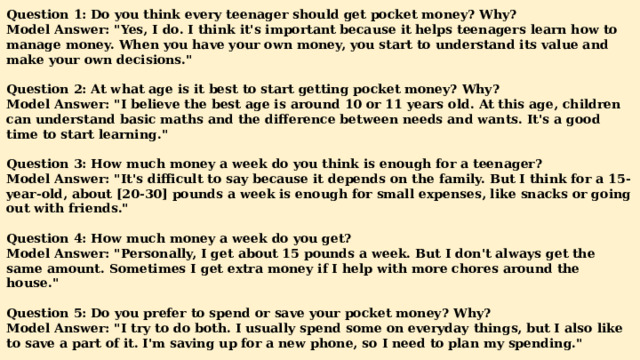
Question 1: Do you think every teenager should get pocket money? Why?
Model Answer: "Yes, I do. I think it's important because it helps teenagers learn how to manage money. When you have your own money, you start to understand its value and make your own decisions."
Question 2: At what age is it best to start getting pocket money? Why?
Model Answer: "I believe the best age is around 10 or 11 years old. At this age, children can understand basic maths and the difference between needs and wants. It's a good time to start learning."
Question 3: How much money a week do you think is enough for a teenager?
Model Answer: "It's difficult to say because it depends on the family. But I think for a 15-year-old, about [20-30] pounds a week is enough for small expenses, like snacks or going out with friends."
Question 4: How much money a week do you get?
Model Answer: "Personally, I get about 15 pounds a week. But I don't always get the same amount. Sometimes I get extra money if I help with more chores around the house."
Question 5: Do you prefer to spend or save your pocket money? Why?
Model Answer: "I try to do both. I usually spend some on everyday things, but I also like to save a part of it. I'm saving up for a new phone, so I need to plan my spending."
Question 6: What do teenagers in your country usually spend their pocket money on?
Model Answer: "Most of my friends spend their money on going to cafes, buying snacks, or downloading music and games. Clothes and accessories are also very popular, especially with girls."
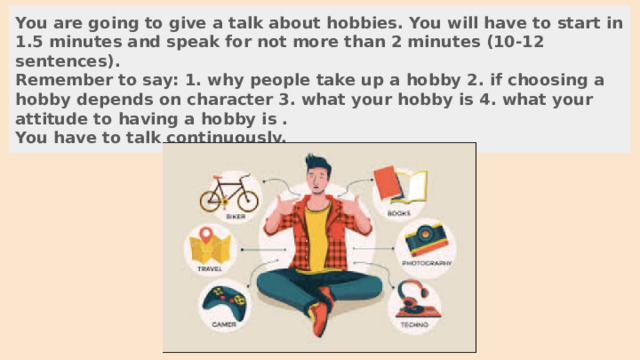
You are going to give a talk about hobbies. You will have to start in 1.5 minutes and speak for not more than 2 minutes (10-12 sentences).
Remember to say: 1. why people take up a hobby 2. if choosing a hobby depends on character 3. what your hobby is 4. what your attitude to having a hobby is .
You have to talk continuously.
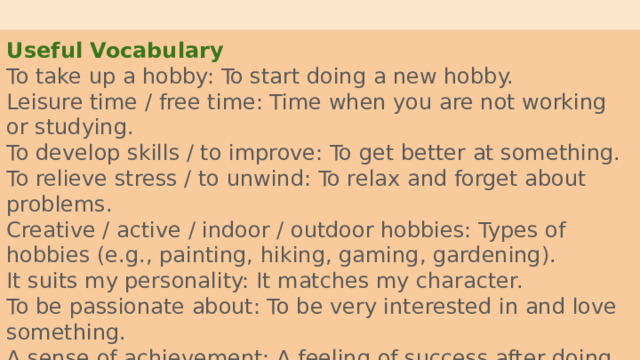
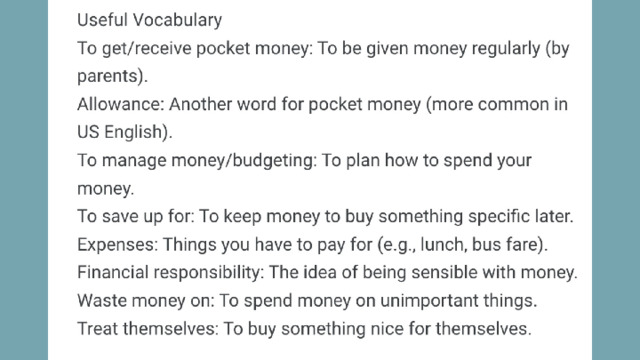
Useful Vocabulary
To take up a hobby: To start doing a new hobby.
Leisure time / free time: Time when you are not working or studying.
To develop skills / to improve: To get better at something.
To relieve stress / to unwind: To relax and forget about problems.
Creative / active / indoor / outdoor hobbies: Types of hobbies (e.g., painting, hiking, gaming, gardening).
It suits my personality: It matches my character.
To be passionate about: To be very interested in and love something.
A sense of achievement: A feeling of success after doing something well.
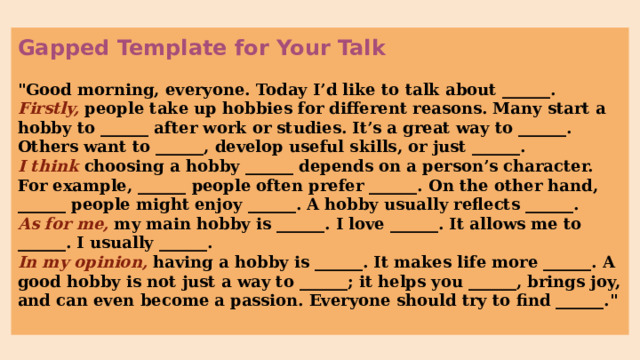
Gapped Template for Your Talk
"Good morning, everyone. Today I’d like to talk about ______.
Firstly, people take up hobbies for different reasons. Many start a hobby to ______ after work or studies. It’s a great way to ______. Others want to ______, develop useful skills, or just ______.
I think choosing a hobby ______ depends on a person’s character. For example, ______ people often prefer ______. On the other hand, ______ people might enjoy ______. A hobby usually reflects ______.
As for me, my main hobby is ______. I love ______. It allows me to ______. I usually ______.
In my opinion, having a hobby is ______. It makes life more ______. A good hobby is not just a way to ______; it helps you ______, brings joy, and can even become a passion. Everyone should try to find ______."
Possible Answer:
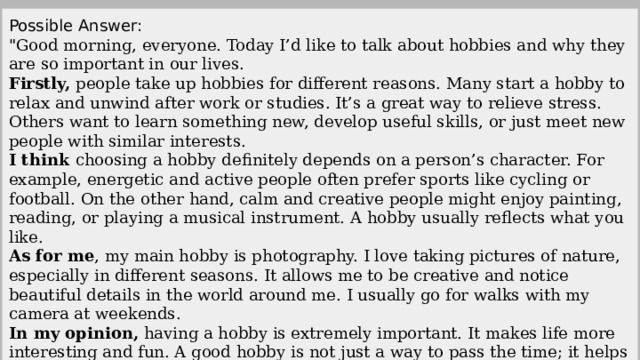
"Good morning, everyone. Today I’d like to talk about hobbies and why they are so important in our lives.
Firstly, people take up hobbies for different reasons. Many start a hobby to relax and unwind after work or studies. It’s a great way to relieve stress. Others want to learn something new, develop useful skills, or just meet new people with similar interests.
I think choosing a hobby definitely depends on a person’s character. For example, energetic and active people often prefer sports like cycling or football. On the other hand, calm and creative people might enjoy painting, reading, or playing a musical instrument. A hobby usually reflects what you like.
As for me , my main hobby is photography. I love taking pictures of nature, especially in different seasons. It allows me to be creative and notice beautiful details in the world around me. I usually go for walks with my camera at weekends.
In my opinion, having a hobby is extremely important. It makes life more interesting and fun. A good hobby is not just a way to pass the time; it helps you grow as a person, brings joy, and can even become a passion. Everyone should try to find an activity they truly enjoy."
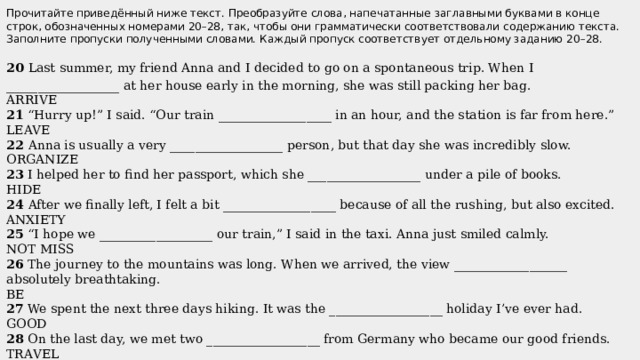
Прочитайте приведённый ниже текст. Преобразуйте слова, напечатанные заглавными буквами в конце строк, обозначенных номерами 20–28, так, чтобы они грамматически соответствовали содержанию текста. Заполните пропуски полученными словами. Каждый пропуск соответствует отдельному заданию 20–28.
20 Last summer, my friend Anna and I decided to go on a spontaneous trip. When I __________________ at her house early in the morning, she was still packing her bag.
ARRIVE
21 “Hurry up!” I said. “Our train __________________ in an hour, and the station is far from here.”
LEAVE
22 Anna is usually a very __________________ person, but that day she was incredibly slow.
ORGANIZE
23 I helped her to find her passport, which she __________________ under a pile of books.
HIDE
24 After we finally left, I felt a bit __________________ because of all the rushing, but also excited.
ANXIETY
25 “I hope we __________________ our train,” I said in the taxi. Anna just smiled calmly.
NOT MISS
26 The journey to the mountains was long. When we arrived, the view __________________ absolutely breathtaking.
BE
27 We spent the next three days hiking. It was the __________________ holiday I’ve ever had.
GOOD
28 On the last day, we met two __________________ from Germany who became our good friends.
TRAVEL
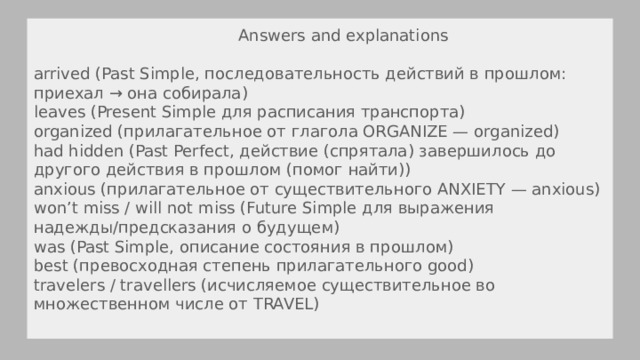
Answers and explanations
arrived (Past Simple, последовательность действий в прошлом: приехал → она собирала)
leaves (Present Simple для расписания транспорта)
organized (прилагательное от глагола ORGANIZE — organized)
had hidden (Past Perfect, действие (спрятала) завершилось до другого действия в прошлом (помог найти))
anxious (прилагательное от существительного ANXIETY — anxious)
won’t miss / will not miss (Future Simple для выражения надежды/предсказания о будущем)
was (Past Simple, описание состояния в прошлом)
best (превосходная степень прилагательного good)
travelers / travellers (исчисляемое существительное во множественном числе от TRAVEL)
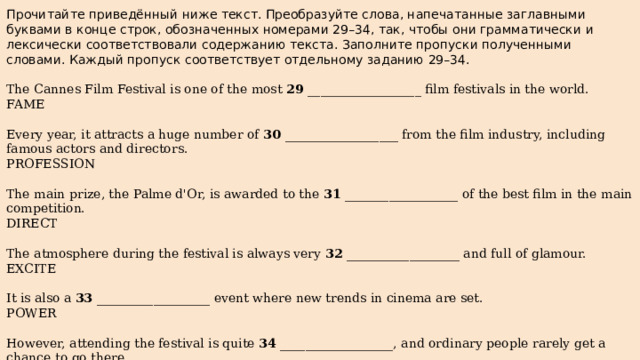
Прочитайте приведённый ниже текст. Преобразуйте слова, напечатанные заглавными буквами в конце строк, обозначенных номерами 29–34, так, чтобы они грамматически и лексически соответствовали содержанию текста. Заполните пропуски полученными словами. Каждый пропуск соответствует отдельному заданию 29–34.
The Cannes Film Festival is one of the most 29 __________________ film festivals in the world.
FAME
Every year, it attracts a huge number of 30 __________________ from the film industry, including famous actors and directors.
PROFESSION
The main prize, the Palme d'Or, is awarded to the 31 __________________ of the best film in the main competition.
DIRECT
The atmosphere during the festival is always very 32 __________________ and full of glamour.
EXCITE
It is also a 33 __________________ event where new trends in cinema are set.
POWER
However, attending the festival is quite 34 __________________, and ordinary people rarely get a chance to go there.
EXPENSE
Answers and Explanations
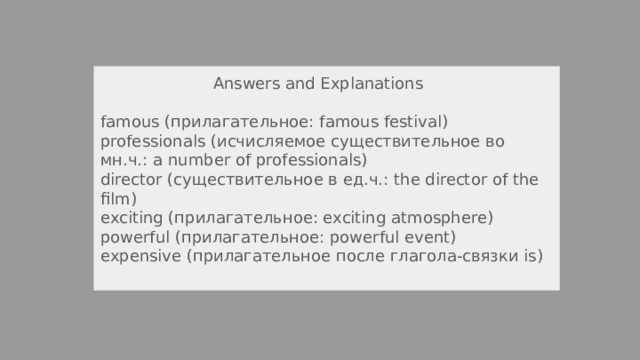
famous (прилагательное: famous festival)
professionals (исчисляемое существительное во мн.ч.: a number of professionals)
director (существительное в ед.ч.: the director of the film)
exciting (прилагательное: exciting atmosphere)
powerful (прилагательное: powerful event)
expensive (прилагательное после глагола-связки is)
Possible Answer:
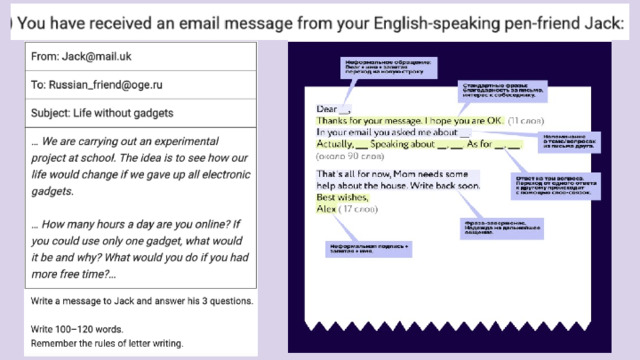
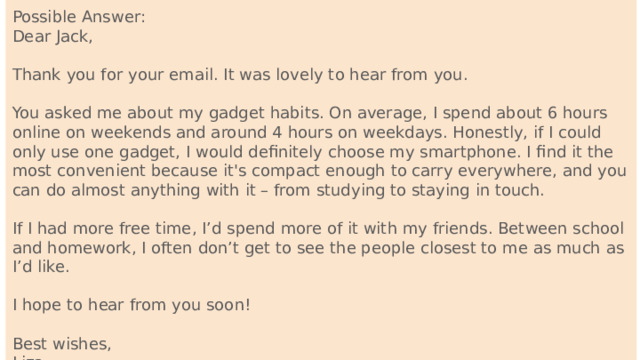
Dear Jack,
Thank you for your email. It was lovely to hear from you.
You asked me about my gadget habits. On average, I spend about 6 hours online on weekends and around 4 hours on weekdays. Honestly, if I could only use one gadget, I would definitely choose my smartphone. I find it the most convenient because it's compact enough to carry everywhere, and you can do almost anything with it – from studying to staying in touch.
If I had more free time, I’d spend more of it with my friends. Between school and homework, I often don’t get to see the people closest to me as much as I’d like.
I hope to hear from you soon!
Best wishes,
Liza
122 words

Вебинар для учителей

Свидетельство об участии БЕСПЛАТНО!