Россия, Симферополь

СДЕЛАЙТЕ СВОИ УРОКИ ЕЩЁ ЭФФЕКТИВНЕЕ, А ЖИЗНЬ СВОБОДНЕЕ
Благодаря готовым учебным материалам для работы в классе и дистанционно
Скидки до 50 % на комплекты
только до
Готовые ключевые этапы урока всегда будут у вас под рукой
Организационный момент
Проверка знаний
Объяснение материала
Закрепление изученного
Итоги урока

Была в сети 29.04.2026 14:55

Драгальчук Марина Васильевна
учитель английского языка
41 год
 719
719
 84 227
Местоположение
Специализация
Презентация для изучения Present Simple
Категория:
Английский язык
03.07.2024 14:40

Просмотр содержимого документа
«Презентация для изучения Present Simple»

Present Simple
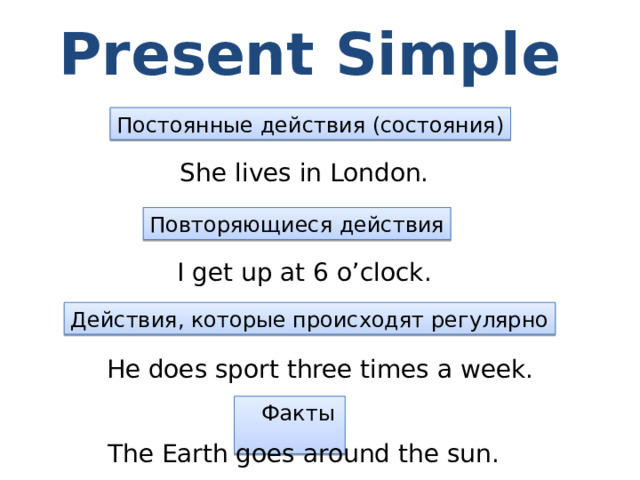
Present Simple
Постоянные действия (состояния)
She lives in London.
Повторяющиеся действия
I get up at 6 o’clock.
Действия, которые происходят регулярно
He does sport three times a week.
Факты
The Earth goes around the sun.
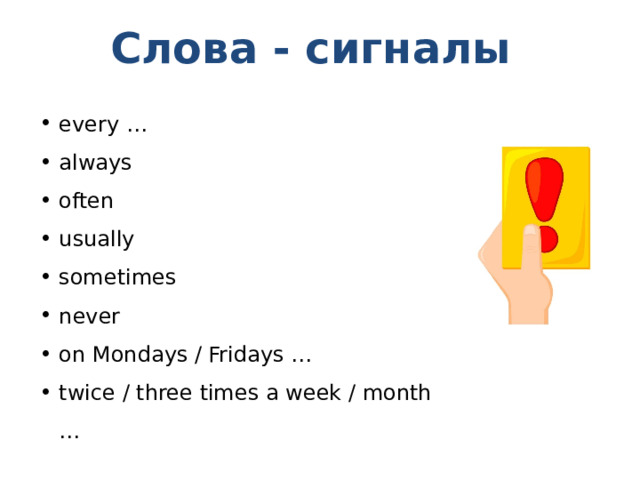
Слова - сигналы
- every …
- always
- often
- usually
- sometimes
- never
- on Mondays / Fridays …
- twice / three times a week / month …

По-английски «глагол» - verb. Обозначаем буквой V ( V erb)
V
V
I
you
he
she
it
we
they
V s/es
V
V
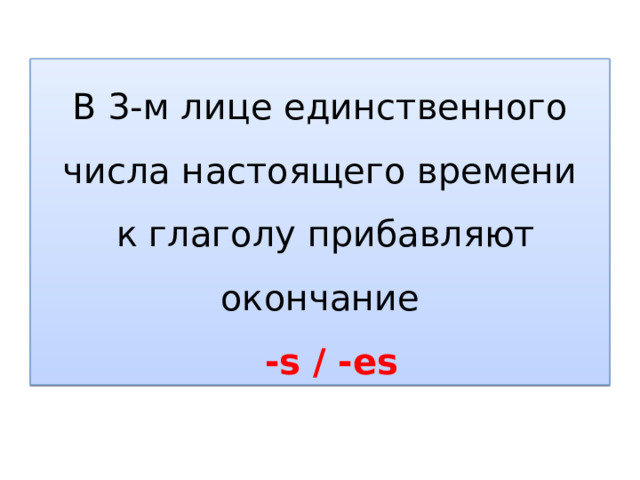
В 3-м лице единственного числа настоящего времени
к глаголу прибавляют окончание
-s / -es

+
I
like
You
like
He
like s
She
like s
It
like s
We
like
They
like

-
I
don’t like
You
don’t like
He
doesn’t likes
She
doesn’t likes
It
doesn’t likes
We
don’t like
They
don’t like
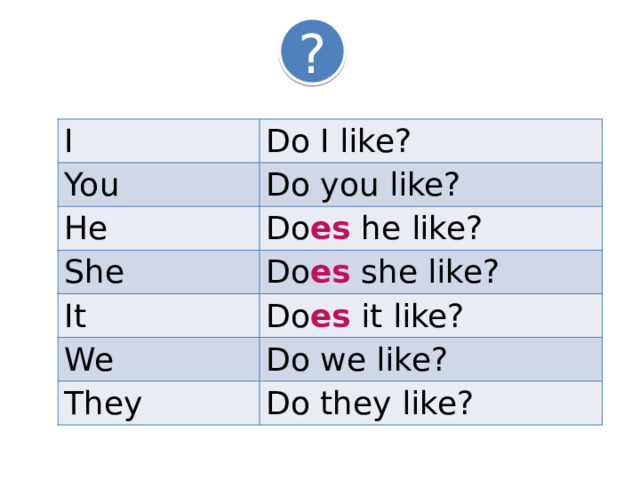
?
I
Do I like?
You
Do you like?
He
Do es he like?
She
Do es she like?
It
Do es it like?
We
Do we like?
They
Do they like?
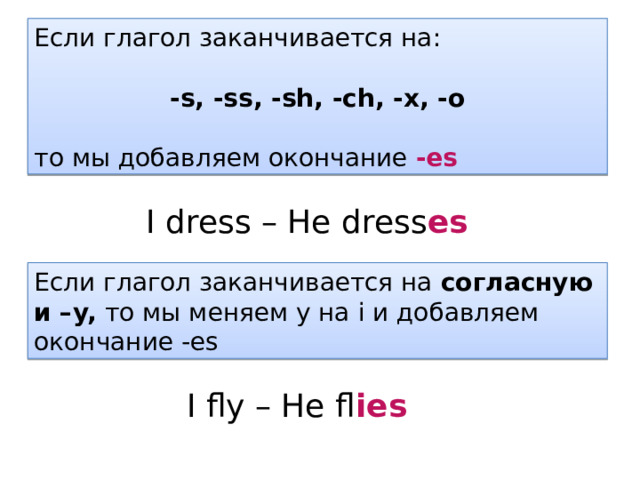
Если глагол заканчивается на:
-s, -ss, -sh, -ch, -x, -o
то мы добавляем окончание -es
I dress – He dress es
Если глагол заканчивается на согласную и –y, то мы меняем y на i и добавляем окончание -es
I fly – He fl ies
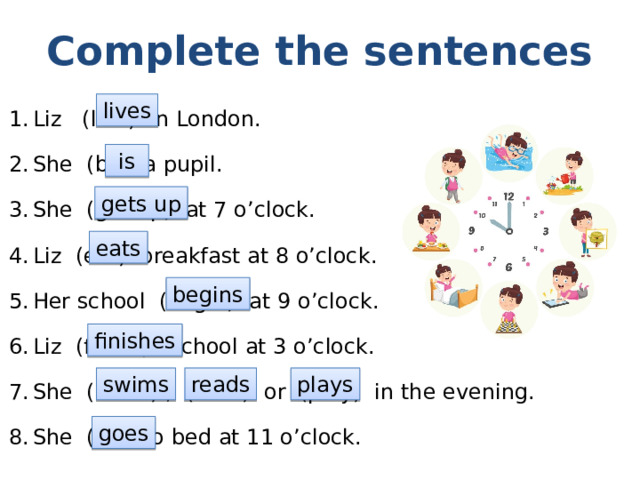
Complete the sentences
- Liz (live) in London.
- She (be) a pupil.
- She (get up) at 7 o’clock.
- Liz (eat) breakfast at 8 o’clock.
- Her school (begin) at 9 o’clock.
- Liz (finish) school at 3 o’clock.
- She (swim) , (read) or (play) in the evening.
- She (go) to bed at 11 o’clock.
lives
is
gets up
eats
begins
finishes
swims
reads
plays
goes

Put the verbs into the Present Simple negative form.
- They (start) school at 10 o’clock.
- He (like) fish.
- Pam (have) lunch in the afternoon.
- Peter (watch) TV in the evening.
- They (live) in Moscow.
- I (ride) my bike to school.
- Lizzy (play) piano.
- We (like) to read English books.
don’t start
doesn’t like
doesn’t have
doesn’t watch
don’t live
don’t ride
doesn’t play
don’t like
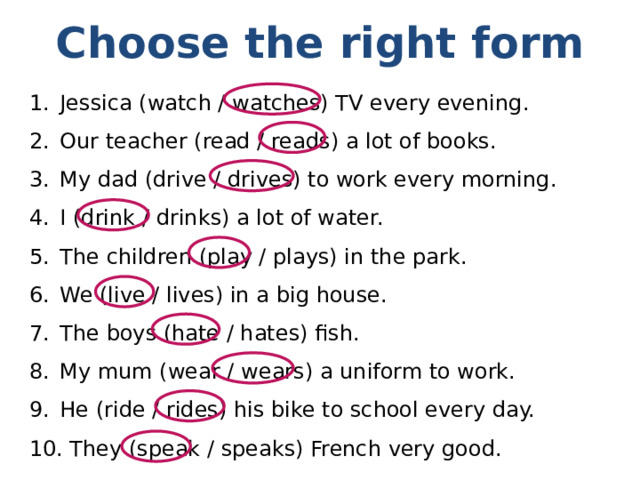
Choose the right form
- Jessica (watch / watches) TV every evening.
- Our teacher (read / reads) a lot of books.
- My dad (drive / drives) to work every morning.
- I (drink / drinks) a lot of water.
- The children (play / plays) in the park.
- We (live / lives) in a big house.
- The boys (hate / hates) fish.
- My mum (wear / wears) a uniform to work.
- He (ride / rides) his bike to school every day.
- They (speak / speaks) French very good.
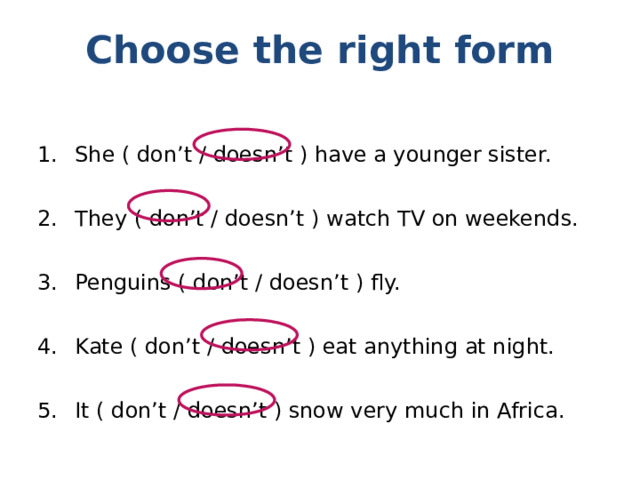
Choose the right form
- She ( don’t / doesn’t ) have a younger sister.
- They ( don’t / doesn’t ) watch TV on weekends.
- Penguins ( don’t / doesn’t ) fly.
- Kate ( don’t / doesn’t ) eat anything at night.
- It ( don’t / doesn’t ) snow very much in Africa.

Correct the underlined words
- Chloe eats not vegetables.
- The bus come every ten minutes.
- They not have pets in their house.
- Tracy doesn’t has music class on Fridays.
- Jason always try his best.
- Rabbits doesn’t eat meat.
doesn’t eat
comes
don’t have
doesn’t have
tries
don’t eat

Correct the mistakes
My friend Cathy have a horse. Its name is Wind. It are a beautiful animal with big eyes and a long tail. It is very friendly.
Wind eat apples and grass but it don’t eat meat. Horses don’t like meat.
Cathy ride her horse every day after school. She loves her horse very much. It is not easy to look after a horse but Cathy enjoy it.
has
is
eats
doesn’t
rides
enjoys
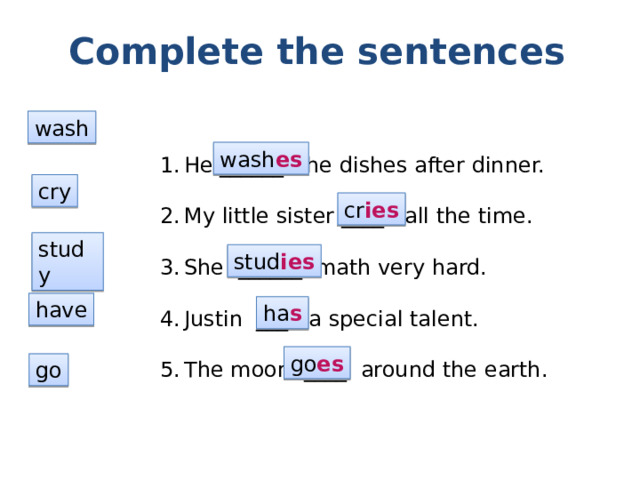
Complete the sentences
wash
- He ______ the dishes after dinner.
- My little sister ____ all the time.
- She ______ math very hard.
- Justin ___ a special talent.
- The moon ____ around the earth.
wash es
cry
cr ies
study
stud ies
have
ha s
go es
go
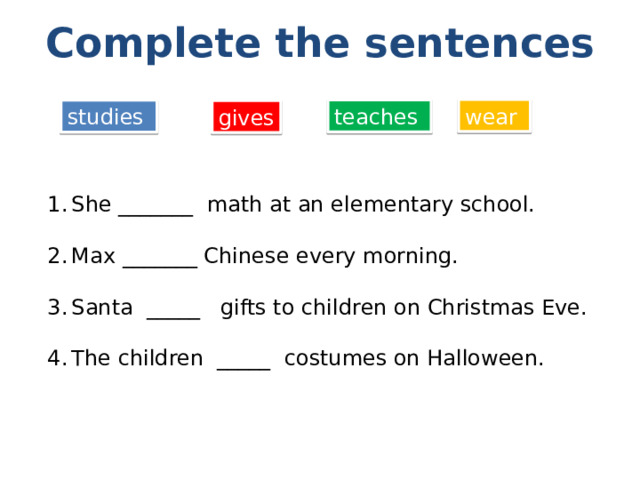
Complete the sentences
wear
teaches
studies
gives
- She _______ math at an elementary school.
- Max _______ Chinese every morning.
- Santa _____ gifts to children on Christmas Eve.
- The children _____ costumes on Halloween.

Ask questions about Sara
Does Sara work ?
- live in London
- go to school
- like listening to music
- play basketball
- travel abroad every summer
- make breakfast in the morning
- drive a car
- have a brother

Краткий ответ на вопросы
Do you like apples?
- No, I don’t .
- Yes, I do .
Does he like apples?
- Yes, he does .
- No, he doesn’t .
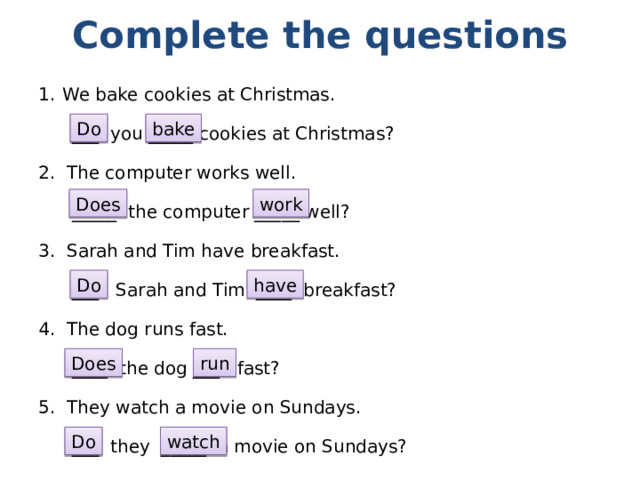
Complete the questions
- We bake cookies at Christmas.
___ you _____ cookies at Christmas?
2. The computer works well.
_____ the computer _____ well?
3. Sarah and Tim have breakfast.
___ Sarah and Tim ____ breakfast?
4. The dog runs fast.
____ the dog ___ fast?
5. They watch a movie on Sundays.
___ they _____ a movie on Sundays?
Do
bake
Does
work
Do
have
Does
run
Do
watch

Ask and answer questions!
go to school
Chloe
ride a bike
Andy
like ice cream
Liz and Ben
You
Does Chloe go to school?
Yes, she does.
Does Chloe ride a bike?
No, she doesn’t.
Does Chloe like ice cream?
Yes, she does.
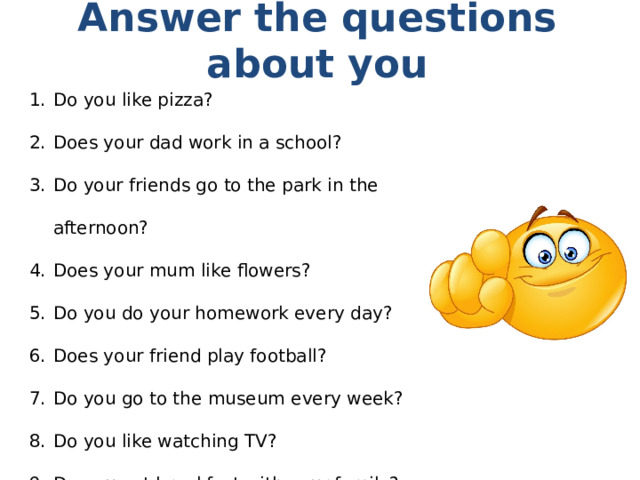
Answer the questions about you
- Do you like pizza?
- Does your dad work in a school?
- Do your friends go to the park in the afternoon?
- Does your mum like flowers?
- Do you do your homework every day?
- Does your friend play football?
- Do you go to the museum every week?
- Do you like watching TV?
- Do you eat breakfast with your family?
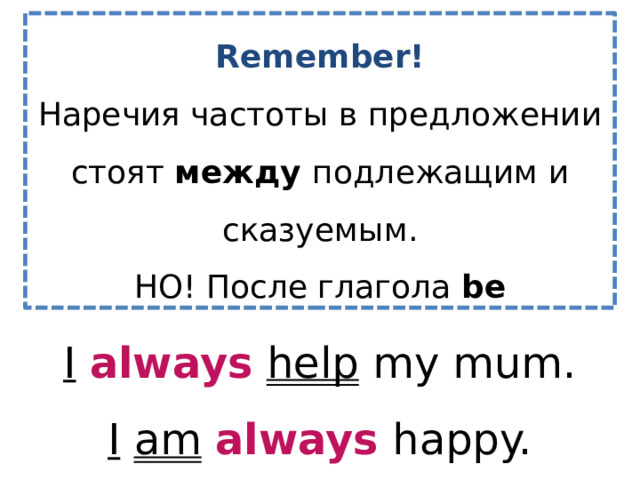
Remember!
Наречия частоты в предложении стоят между подлежащим и сказуемым.
НО! После глагола be
I always help my mum.
I am always happy.

Put the adverbs in the correct place.
- I drink water in the morning. (always)
- Kate goes to bed late. (never)
- My mum watches TV. (sometimes)
- I am tired. (often)
- John doesn’t get up early. (usually)
- They are late for school. (never)
- Ben eats in a restaurant. (sometimes)

Choose the right form
1. Jessica ______ like French films .
don’t
doesn’t
2. ___ you always do your homework?
Do
Does
3. My friends ______ TV every evening.
watches
watch
4. My friend _____ volleyball very well.
plays
play
5. We usually ___ out on Saturdays.
eat
eats

Present Simple or Present progressive?

Choose the right form
- Look! He (leaves / is leaving) the house.
- I (write / am writing) a test at the moment.
- She usually (walks / is walking) to school. But look! Today she (goes / is going) by bike.
- Every Sunday we (go / are going) to see my grandparents.
- He often (goes / is going) to the cinema.
- We (play / are playing) Monopoly at the moment.
- I (don’t do / am not doing) anything at the moment.

Complete the sentences
- This (be) Caroline.
- Caroline (have) long blond hair.
- She usually (wear) jeans, but now she (wear) a skirt.
- Caroline (like) sports.
- She (play) handball every Monday and Thursday.
- Caroline (talk) to her friend at the moment.
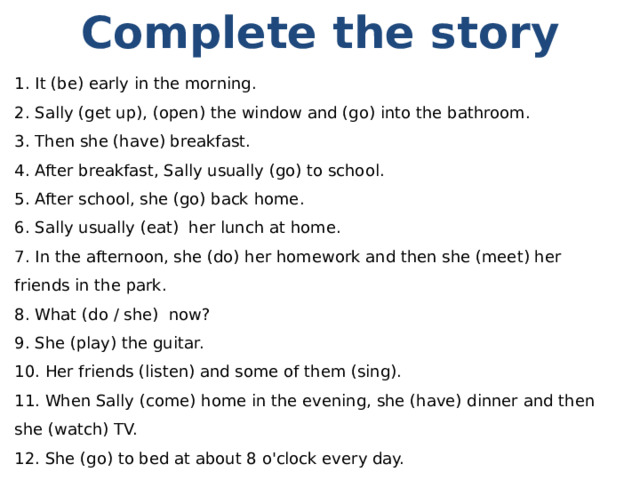
Complete the story
- It (be) early in the morning.
- Sally (get up), (open) the window and (go) into the bathroom.
- Then she (have) breakfast.
- After breakfast, Sally usually (go) to school.
- After school, she (go) back home.
- Sally usually (eat) her lunch at home.
- In the afternoon, she (do) her homework and then she (meet) her friends in the park.
- What (do / she) now?
- She (play) the guitar.
- Her friends (listen) and some of them (sing).
- When Sally (come) home in the evening, she (have) dinner and then she (watch) TV.
- She (go) to bed at about 8 o'clock every day.







Вебинар для учителей

Свидетельство об участии БЕСПЛАТНО!