Беларусь, Минск

СДЕЛАЙТЕ СВОИ УРОКИ ЕЩЁ ЭФФЕКТИВНЕЕ, А ЖИЗНЬ СВОБОДНЕЕ
Благодаря готовым учебным материалам для работы в классе и дистанционно
Скидки до 50 % на комплекты
только до
Готовые ключевые этапы урока всегда будут у вас под рукой
Организационный момент
Проверка знаний
Объяснение материала
Закрепление изученного
Итоги урока
Была в сети 28.04.2026 09:38

Абакунчик Юлия Сергеевна
учитель английского языка
39 лет
 6 522
6 522
 8 868
8 868 
Местоположение
Специализация
Презентация по теме "Frequency Adverbs: Easy Guide" ("Наречия частоты: Простое руководство").
Категория:
Английский язык
22.12.2025 09:31

Просмотр содержимого документа
«Презентация по теме "Frequency Adverbs: Easy Guide" ("Наречия частоты: Простое руководство").»

Frequency Adverbs: Easy Guide
Let's learn about frequency adverbs! We'll start with the basics. We'll explain the main adverbs and then show you where to put them in sentences.
Frequency adverbs like always, often, sometimes, rarely, and never tell us how often something happens.
Think of them like a scale from 100% (always) to 0% (never). Learning these words will help you sound more natural when you speak English.
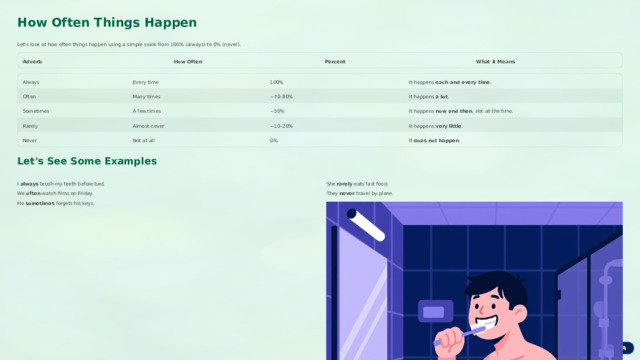
How Often Things Happen
Let's look at how often things happen using a simple scale from 100% (always) to 0% (never).
Adverb
How Often
Percent
What it Means
It happens each and every time .
Always
100%
Every time
Often
Many times
~70–80%
It happens a lot .
It happens now and then , not all the time.
A few times
~50%
Sometimes
Rarely
Almost never
~10–20%
It happens very little .
It does not happen .
0%
Not at all
Never
Let's See Some Examples
I always brush my teeth before bed.
She rarely eats fast food.
We often watch films on Friday.
They never travel by plane.
He sometimes forgets his keys.
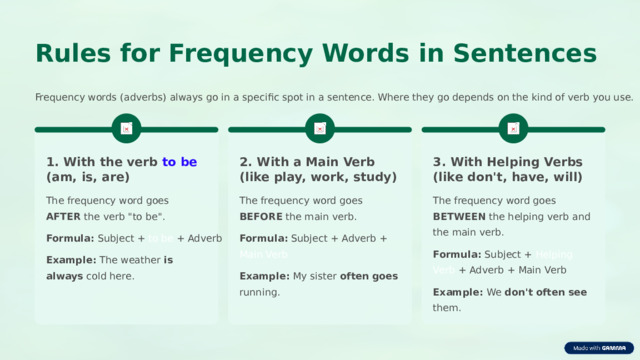
Rules for Frequency Words in Sentences
Frequency words (adverbs) always go in a specific spot in a sentence. Where they go depends on the kind of verb you use.
3. With Helping Verbs (like don't, have, will)
1. With the verb to be (am, is, are)
2. With a Main Verb (like play, work, study)
The frequency word goes AFTER the verb "to be".
The frequency word goes BEFORE the main verb.
The frequency word goes BETWEEN the helping verb and the main verb.
Formula: Subject + to be + Adverb
Formula: Subject + Adverb + Main Verb
Formula: Subject + Helping Verb + Adverb + Main Verb
Example: The weather is always cold here.
Example: My sister often goes running.
Example: We don't often see them.
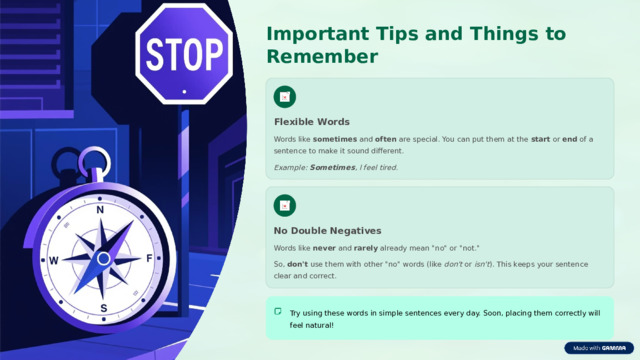
Important Tips and Things to Remember
Flexible Words
Words like sometimes and often are special. You can put them at the start or end of a sentence to make it sound different.
Example: Sometimes , I feel tired.
No Double Negatives
Words like never and rarely already mean "no" or "not."
So, don't use them with other "no" words (like don't or isn't ). This keeps your sentence clear and correct.
Try using these words in simple sentences every day. Soon, placing them correctly will feel natural!

Вебинар для учителей

Свидетельство об участии БЕСПЛАТНО!