Россия, Махачкала

СДЕЛАЙТЕ СВОИ УРОКИ ЕЩЁ ЭФФЕКТИВНЕЕ, А ЖИЗНЬ СВОБОДНЕЕ
Благодаря готовым учебным материалам для работы в классе и дистанционно
Скидки до 50 % на комплекты
только до
Готовые ключевые этапы урока всегда будут у вас под рукой
Организационный момент
Проверка знаний
Объяснение материала
Закрепление изученного
Итоги урока
Была в сети 18.12.2025 20:03

Магомедова Сабина Магомедовна
учитель английского языка
33 года
 41
41
 259 403
Местоположение
Scotish myths and legends
Категория:
Английский язык
23.11.2025 11:48

Просмотр содержимого документа
«Scotish myths and legends»
Municipal Project Works Contest “Horizons”
PROJECT WORK
“Scottish myths and legends”
Done by Aisha Medjidova,
Form 10 of School №2
Supervised by Magomedova Sabina Magomedovna
Makhachkala 2024
Contents
I. Introduction ……………………………………………………………3
II. Main part
Chapter 1.
1.1. Secrets of Scottish castles………………………..5
1.2. Mystical places of Scotland……………………7
1.3. Interesting fact about Scotland…………………12
Chapter 2. Practical results of research…………………12
III. Conclusion………………………………………………………14
IV. The list of the literature and the Internet resources …………………………16
Introduction
Romantic and mysterious Scotland, a land of stunning landscapes, is located in the north of the island of Great Britain. It "captured" a third of the country's territory and three archipelagos - the Hebrides, Orkney and Shetland Islands. The first written records of Scotland appeared during the Roman conquest of the British Isles. Officially, the history of Scotland dates back to 843, when the kingdom of the Scots and Picts was headed by monarch Kenneth MacAlpine.
A trip to Scotland causes a storm of emotions. It amazes with the majesty of its untouched nature: emerald hills and mountains, endless valleys and rocky islands. Scotland is famous for its ancient castles that keep priceless works of art, endless beaches, golf courses, and excellent cuisine. More than 2 million people come here every year to admire this detached and slightly gloomy beauty. The Scots themselves still feel their individuality, have a special system of values, their own history, culture and traditions that differ from the English. Studying the history of this amazing country in more detail, it can be noted that Scotland is not only a country as an administrative entity, but it also hides a lot of mysteries and secrets that go back centuries.
Mystical buildings and cultural monuments of Scotland are one of the main treasures of the state in the British Isles. They reflect the soul of the people who created them, tell about life and death, love and hate, happiness and sorrow. They personify the centuries-old history of Great Britain as a whole, the largest European power. Castles and buildings that have stood the test of time; castles and buildings scorched by battles and stained with blood; finally, castles and buildings that embodied the dream of beauty and freedom - all this is the best page in the book of the country's history. Mystical buildings, the famous Loch Ness lake with its legend are often associated with magical rituals, evil spirits and religion. All this gives a sense of mystery, and a topic that includes riddles and secrets that have not yet been revealed is much more interesting for research than a topic that contains a certain theory and irrefutable facts.
We chose this topic "Scottish myths and legends ", because we believe that paranormal phenomena have always been the subject of the most heated debates of both scientists and ordinary people. And for the latter, various visions or even information about them are phenomena that instill horror, fear of ignorance, but at the same time, no one has ever refused the opportunity to see something mysterious and exciting for themselves.
The castles of Scotland are known throughout the world for their age and architectural power, they are closely connected with the destinies of outstanding personalities of different eras. A close acquaintance with these diverse cultural monuments allows us to follow the history of the country, the development of medieval construction technologies and the change in the main functions of cultural monuments of Scotland over the centuries.
Relevance of the topic. The mysteries of Scotland have attracted the attention of thousands of people for many centuries. In our time, when most cultural monuments have been destroyed, and those that remain are gradually deteriorating, there is a need to preserve the buildings as a cultural heritage. We must understand the role of cultural monuments in history and their purpose for the present.
The novelty of this study is that the problem of the mystical secrets of Great Britain has not received due coverage in the linguistic and regional studies literature; there is a lack of specific scientific data on the features of the emergence and history of the mysterious cultural monuments of the state on the British Isles.
The purpose of this work is to discover unknown Scotland, mystical Scotland.
Based on the purpose, the following tasks were identified:
1. To get acquainted with the history of Scottish castles, where ghosts are said to be found. To give a brief description of these castles
2. To study the most famous legends of Scotland
3. To conduct a survey among the students of our school about the significance of this topic
4. To design a poster: "Tourist route through the country of mysteries and legends"
The subject of the study is the diversity of mystical castles, myths and legends of Scotland.
The object of the study is the most mysterious castles, mysterious places.
Practical significance.
Such work forms an interest in the history of the country of the studied language, develops cognitive and creative activity. Independent activity contributes to a comprehensive acquaintance with the topic under study, expanding knowledge on this issue. Skills in working with literature develop critical thinking, the ability to analyze phenomena on a scientific basis, and this is a component of any research work.
These studies can be used in English lessons. In our work, we used such methods as: studying and analyzing literature, comparison, questionnaires, surveys, systematization and generalization of the information received.
II. Main part
1.1 Secrets of Scottish castles
The Scots love ghosts more than anything, which is not surprising. After all, there are so many ancient castles and ruins in the country that ghosts can thrive here. The Scots claim that a real medieval castle without ghosts is not a castle at all by British standards.
Haunted castles can be seen everywhere in Scotland, and one of the most famous haunts of ghosts is Edinburgh Castle. According to legends and traditions of Scotland, there is an underground quarter under Edinburgh, where terminally ill people were brought during the plague in the 17th century. A huge number of people died here, and their souls still wander around the castle and the city, unable to find a home.
The ghosts of Scotland do not end there. Another haunted castle is Glamis Castle, which is home to two poltergeists: the Grey Lady and Earl Beardie. And maybe more, who knows? As eyewitnesses admit, when you enter the family chapel, deep in your soul there is sadness and grief, and sometimes you can hear terrible, "grave" sounds. This is the spirit of the Gray Lady who came to pray. As is known from history, the Gray Lady is the ghost of Janet Douglas, who after the death of her influential husband was accused of witchcraft and publicly burned at the stake. Everyone knew that the woman was innocent, so today her soul cannot find a refuge.
The second ghost of Glamis Castle is Earl Beardy, who was cursed for a terrible sin. He played cards for money on Sunday, when it was strictly forbidden. Now the unfortunate Earl Beardy is condemned to play cards with the devil himself until Judgment Day, since he broke the rules and succumbed to temptation on a holy day.
This magnificent 800-year-old castle was once a Royal residence and played host to Robert the Bruce and King Charles I. The sumptuous interior was created by Lord Leith who bought Fyvie in 1889. He amassed a collection of arms and armour as well as impressive artworks including works by Raeburn and Gainsborough. Fyvie is home to the ghost of Lilias Drummond, known as “The Green Lady”. Legend has it that a previous owner of the castle, Alexander Seton, starved her to death in revenge for not providing him with a son and heir.
The night that he remarried, she made an appearance outside the newlyweds bedchamber lamenting their nuptials and creating a hullabaloo.
In the morning it was discovered that she had scratched her name into the castle wall, which can still be viewed to this day.
The largest house in the Northern Highlands boasts no less than 189 rooms. The apartments on the upper floors are haunted by Margaret, who was the daughter of the castle’s owner, the 14th Earl of Sutherland.
Margret had fallen in love with Jamie, a groom in the castle stables. Her father disapproved of the relationship, and while he sought someone more suitable, the Earl had her imprisoned the castle attic.
The lovers planned to elope, and a maid agreed to bring Margaret a rope so she could escape from her makeshift prison.
With her Jamie waiting below on his horse, Margaret climbed out of the window. As she was about to start her descent, her father entered the room. Margaret realised then that she and Jamie could never be together and let go of the rope.
The ghost of Margaret haunts Dunrobin Castle to this day, crying out in pain for her lost love.
1.2. Mystical places of Scotland
Loch Ness Monster
One of Scotland’s most famous unsolved mysteries is that of the Loch Ness Monster (or ‘Nessie’ as it has affectionately come to be known).
The large dinosaur-like creature is reputed to inhabit Loch Ness in the Scottish Highlands. ‘Nessie’ has a long neck and one or more humps protruding from the water. The first recorded sighting of the monster was nearly 1,500 years ago when a giant beast is said to have leaped out of a lake near Inverness and eaten a local farmer. Since then, the myth of the Loch Ness Monster has magnified.
In 1934, a London doctor snapped a photograph that seemed to show a dinosaur-looking creature emerging from the water. Dozens of sightings have since been claimed, many of which have turned out to be hoaxes. In 2009, a newspaper reader claims to have spotted ‘Nessie’ whilst browsing Google Earth’s satellite photos of Loch Ness.
Regardless of the truth, the suggestion of the monster’s existence makes Loch Ness one of Scotland’s most popular tourist attractions with thousands visiting its shores each year with the hope of catching a rare glimpse of the famous monster.
In 2003, the BBC sponsored a search of the loch using 600 sonar beams and satellite tracking. No animal of substantial size was found and, despite their reported hopes, the scientists admitted this “proved” the Loch Ness Monster was a myth.
Kelpies
The mythical kelpie is the Scots name given to a supernatural water horse that was said to haunt Scotland's lochs and lonely rivers. It has usually been described as appearing as a horse but is able to adopt human form. However, some accounts state that the Kelpie retains its hooves when appearing as a human, leading to its association with the Christian idea of Satan. Robert Burns alludes to this idea in his 1786 poem “Address to the Deil.”
The kelpie would appear to its victims as a lost dark grey or white pony but could be identified by its constantly dripping mane. It would entice people to ride on its back, before taking them down to a watery grave.
One specific story talks of a Kelpie captured by the Laird of Morphie. The Laird harnessed the strength of the horse-form Kelpie by using a halter stamped with the sign of a cross. The captor forced the kelpie to carry heavy stones to build his castle and when the work was complete, the laird released the kelpie who was understandably unhappy in its treatment. The kelpie cursed the Laird of Morphie, a reason popularly believed to explain the extinction of the Laird family.
Selkies
Selkies were mythical creatures that could transform themselves from seal to human form and back again. The legend of the selkie apparently originated on the Orkney and Shetland Islands where selch or selk(ie) is the Scots word for seal. Tales once abounded of a man who found a beautiful female selkie sunbathing on a beach, stole her skin and forced her to become his wife and bear his children. The selkie woman was often seen gazing lovingly at the ocean. Years later, the selkie found her skin and later escaped back to seal form and to the sea, leaving her own children behind, never to return.
Some versions of the legend say that the selkie revisits her children on land once a year, others say that the children would witness a large seal approach them and say hello.
A Shetland version of the tale about the selkie compelled to become a human wife was published in 1822. In this edition, the selkie already had a husband of her own kind in the ocean before she was forced to stay on land. Some stories from Shetland have selkies luring islanders into the sea at midsummer, the lovelorn humans never returning to dry land.
The Nine Maidens of Dundee
A farmer lived with his nine, beautiful daughters on a farm known as Pitempton. After a busy day of work, the farmer sent his eldest daughter to gather water from a nearby well. When she failed to return, he sent his second-oldest daughter, and so on and so on.
When all had failed to return, he went to investigate, only to find the slain bodies of his nine lovely daughters strewn across the ground by the well. Coiled around their battered bodies, basking in the blood of the innocent victims, the farmer was aghast to see a huge serpent-like dragon.
Fearing he was about to become the tenth kill of the evening, the farmer fled to call his neighbors, who returned, armed with weapons, to slay the beast.
Perhaps sensing that it was no match for the baying mob, the dragon attempted to make its escape, but a young man named Martin caught up with it. Using only a wooden club, he beat the dragon, eventually slaying it as the crowd yelled “strike, Martin”.
The place where the dragon was defeated was named “Strike-Martin” and was subsequently named Strathmartine – a name which lives on in the name of a school and a street in Dundee. Martin's Stone stands alone in a field one mile north of the village of Bridgefoot (previously known as Kirkton of Strathmartine), itself now on the northern fringes of Dundee.Walk down the city’s High Street, and you’ll come face to face with a statue of the dragon.
The Ghost Piper of Clanyard Bay
The unmistakable blast of the bagpipes is a common sound in Scotland, particularly in our cities and at festivals and celebrations. But what happens when the piper himself vanishes into thin air? There are several stories of phantom pipers throughout Scottish history and folklore.
In days gone by, a dark network of tunnels was said to extend from the Cove of Grennan to the cliffs of Clanyard Bay, near Stranraer.
Locals believed that fairies lived in these tunnels and caves, and no one dared to go inside and disturb them until one day, a piper boldly entered the caves. He played his pipes loudly, accompanied by his faithful brown dog.
The music droned on for hours, slowly fading away until it couldn’t be heard. Suddenly, the dog ran out of the cave terrified and howling, without any of its hair! The piper was never seen again.
Although the caves are now long gone, on summer nights, passers-by have heard the distant sound of bagpipes coming from deep under the ground.
Perhaps it’s the wind whistling through the old underground caves, maybe it’s just a trick of the mind, or maybe…just maybe, it’s the spirit of the piper, playing his Scottish melodies forevermore.
The Gorbals Vampire
Back in the 1950s, the Gorbals area of Glasgow was being terrorised.
Stories had been circulating in the Gorbals about missing children, believed killed, the culprit was said to be a seven-foot vampire, with iron teeth lurking in the Southern Necropolis. The adults wouldn’t believe the kids, so the kids decided to deal with this monster once and for all – by themselves. In 1954, hundreds of young kids from the Gorbals area of Glasgow swarmed into mass panic stemmed from the legend of “Jenny wi’ the Iron Teeth”, a murderous ghost said to haunt Glasgow Green. There was also an American comic book at that time entitled: “The Vampire with the Iron Teeth”.After the story appeared in the local press, it gained worldwide coverage. An unlikely alliance of Christians, communists and the National Union of Teachers blamed imported American horror comic books for the mass hysteria.The campaign ultimately reached Parliament, resulting in the 1955 Children and Young Persons (Harmful Publications) Act which still stands today.A stage play, and a graphic novel have told the story of the Gorbals Vampire, and a large mural of the beast guards a local
Robert the Bruce and the Spider
Robert the Bruce is well known in Scotland and across the world due to the part he played in the wars of Scottish independence and films such as Outlaw King. He was born in 1274 at Lochmaben castle where he was Knight and Overlord of Annandale. In 1306 he was crowned King of Scotland and subsequently tried to free Scotland from the English enemy. After being defeated in battle in 1306 by the Earl of Pembroke at Methven, Robert the Bruce went into hiding, supposedly in the Western Isles. He resided in a cave for three months, at the lowest point of his life and struggling to come up with a plan about what to do next, contemplating leaving the country never to return. However, while Robert the Bruce was waiting, legend has it that he watched a spider building a web in the entrance to the cave. The typically stormy Scottish weather, not one to disappoint, made the spider’s task difficult as droplet after droplet destroyed the creature's intricate work. Finally, against all odds, the spider succeeded with his web.Robert the Bruce was inspired by the spider’s efforts, so decided to get up and face another fight. He is said to have told his men: “If at first you don’t succeed, try try and try again,” which is a phrase used still to this day.
1.3. Interesting fact about Scotland
Why is the unicorn Scotland's National Animal?
With Scotland being famed for its love for and long history of myths and legends, it is no surprise that a fabled creature such as the unicorn is Scotland’s national animal. Unicorns have been linked to Scotland for centuries. In Celtic mythology the unicorn was a symbol of purity and innocence, as well as masculinity and power. Tales of dominance and chivalry associated with the unicorn may be why it was chosen as Scotland’s national animal. While the animal is mythological, the ideals it represents are what make it a perfect fit as the national animal for Scotland, and because like this proud beast – Scots would fight to remain unconquered. The unicorn was first used on the Scottish royal coat of arms by William I in the 12th century. In the 15th century, when King James III was in power, gold coins even appeared with the unicorn on them. When Scotland and England unified under the reign of James VI of Scotland in 1603, the Scottish Royal Arms had two unicorns supporting a shield. When James VI became James I of England and Ireland, he replaced the unicorn on the left of the shield with the national animal of England, the lion, to show that the countries were indeed united.
Did you know that Scotland has a National Unicorn Day? It's on the 9 April every year!
Practical results of the study.
Working on the project "Scottish myths and legends ", we analyzed a lot of literature and Internet resources. Having analyzed and systematized all the collected material, we came to the conclusion that Scotland is indeed a very mystical and mysterious country, hiding a lot of unexplored and unidentified.
Having admired the very beautiful and architectural monuments of different eras, more and more tourists want to touch some mystery, secret or, in extreme cases, some mystical and otherworldly phenomenon in their travels. The world leader in the number of ancient and not so secrets is undoubtedly Scotland. Many castles have not only a centuries-old history, but also a ghost or several ghosts. Scientists have put forward a hypothesis that such an "abundance" of ghosts, spirits and ghosts is associated with the island location of the country and the maritime climate. Without paying much attention to scientific theories, castle owners are happy to welcome guests to their estates. And if you think that Scotland's mystical attractions are located somewhere in the outback and you'll have to look for them, you're wrong!
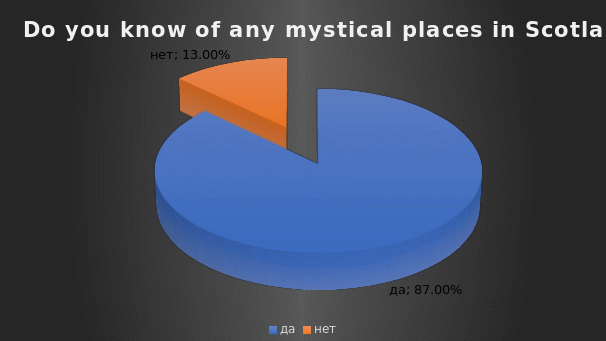
In order to prove Scotland's leadership in the number of mystical mysteries and secrets, we conducted a survey among students of our school classes. The following results were obtained:
1. Do you know of any mystical places in Scotland?
Yes -87%
No- 13%
1. Do you know the names of Scottish castles?
Yes– 80%
No – 20%
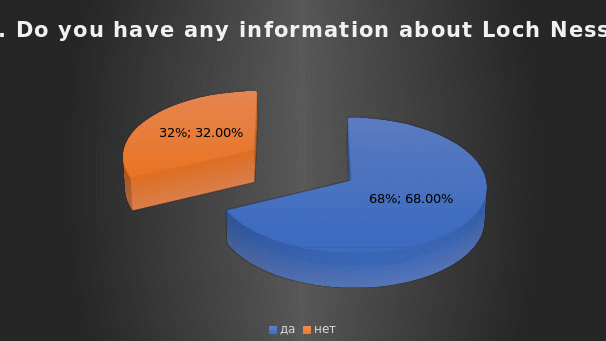
.Do you have any information about Loch Ness?
YES– 68%
NO– 32%
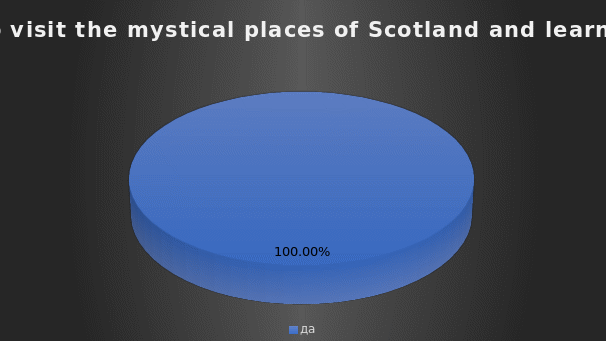
Would you like to visit the mystical places of Scotland and learn more about them?
YES– 100%
Conclusion.
This work only briefly outlines the most popular legends about ghosts and secrets of mystical Scotland. It is very difficult to list everything that can be seen here, so we stopped only at a few mysterious places in Scotland. We studied: the history of the mysterious Loch Ness, Edinburgh Castle, Glamis Castle and others.
During the study, we found out that the stories of all these places are mystical, which are full of secrets and mysteries of the past. They attract millions of tourists every year. Visitors come here from different parts of the world, in order to admire not only the natural beauty of this country, but also to plunge into the era of the past and feel the spirit of the Middle Ages. One thing is obvious, Scotland holds many secrets and unsolved mysteries.
The purpose of our work was to find information about the mysterious places of Scotland and conduct a survey to study the knowledge of 6th grade students on a given topic - successfully completed.
We have selected and systematized theoretical and illustrative material about the mysterious places of Scotland. We have come up with questions to study the existing knowledge of students on this topic and conducted an analysis of the students' knowledge. The survey showed an average level of students' knowledge about Scotland, but we hope that our project will interest and raise the level of knowledge about this country and its mysterious places among the students of our school.It will be possible to highlight this topic among the students of the school and introduce them to the history of Scotland and its mysterious places with the help of a presentation and the product of the project - the poster "Tourist route through the country of mysteries and legends".
In our project, on the one hand, evidence of the existence of ghosts was presented, and on the other - for those who do not believe in the presence of otherworldly forces - these facts were presented as phenomena inherent in the human psyche. And when reading the historical explanation of the presence of certain visions and ghosts in the castles of Scotland, everyone can choose for themselves - whether they believe in ghosts or not. Thus, information about castles and the mysterious Loch Ness helps to broaden the horizons and knowledge of people interested in the history, geography and culture of Scotland, and also attracts people who have never been interested in this. Which confirms the hypothesis of our study. We can say that the goal of the work has been achieved.
The practical significance of the work is that it convincingly proves the existence of secrets and mysteries of mystical Scotland.
The list of the literature and the Internet resources:
Fadeyeva, N.I. (2015). Scottish Myths and Legends.
Korneva, V.P. (2016). The Secrets of Scottish Legends.
Lapina, E.Yu. (2019). Mythology and Folklore of Scotland.
Ross R. David (2010) "Scottish Mythology: A Guide to the Folklore of Scotland"
BBC - Scotland's Myths and Legends
BBC Scotland - Этот ресурс предлагает статьи и видео о различных мифах и легендах Шотландии.
Scottish Folklore and Mythology
Folklore Society - Этот сайт содержит статьи и исследования, посвященные шотландскому фольклору и мифологии.
Celtic Mythology
Celtic Myth Podshow - Подкаст, посвященный кельтской мифологии, включая шотландские мифы.
Mythopedia
Mythopedia - Веб-сайт, посвященный мифам и легендам со всего мира, включая статьи о шотландской мифологии.
Scotland's Stories
Scotland's Stories - Портал, предоставляющий доступ к различным историям и мифам о Шотландии.
Scottish Mythology - Wikipedia
Wikipedia - Статья о шотландской мифологии с обзором основных тем и персонажей.
Project Gutenberg
Project Gutenberg - Содержит множество старинных текстов и сборников сказок, в том числе шотландских.
9




Вебинар для учителей
Свидетельство об участии БЕСПЛАТНО!