Россия, Ярославль

СДЕЛАЙТЕ СВОИ УРОКИ ЕЩЁ ЭФФЕКТИВНЕЕ, А ЖИЗНЬ СВОБОДНЕЕ
Благодаря готовым учебным материалам для работы в классе и дистанционно
Скидки до 50 % на комплекты
только до
Готовые ключевые этапы урока всегда будут у вас под рукой
Организационный момент
Проверка знаний
Объяснение материала
Закрепление изученного
Итоги урока

Была в сети 14.04.2026 22:46

Забелина Ольга Юрьевна
Учитель английского языка
52 года
 2 292
2 292
 30 404
Местоположение
Специализация
Sightseeing Tour Around Yaroslavl
Категория:
Английский язык
04.04.2026 20:56

Просмотр содержимого документа
«Sightseeing Tour Around Yaroslavl»
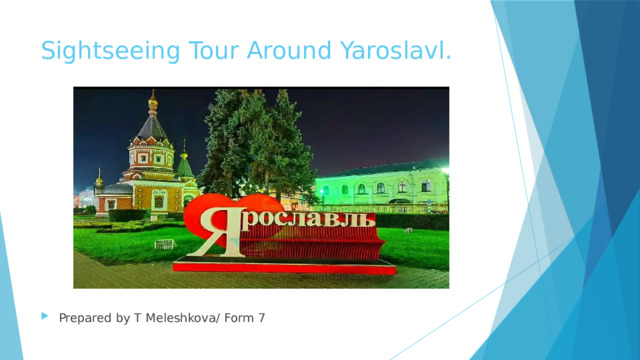
Sightseeing Tour Around Yaroslavl.
- Prepared by T Meleshkova/ Form 7
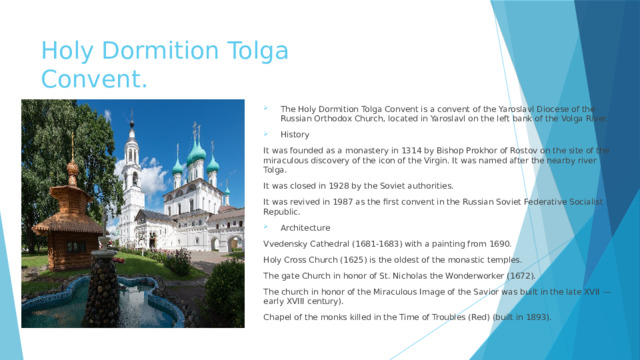
Holy Dormition Tolga Convent.
- The Holy Dormition Tolga Convent is a convent of the Yaroslavl Diocese of the Russian Orthodox Church, located in Yaroslavl on the left bank of the Volga River.
- History
It was founded as a monastery in 1314 by Bishop Prokhor of Rostov on the site of the miraculous discovery of the icon of the Virgin. It was named after the nearby river Tolga.
It was closed in 1928 by the Soviet authorities.
It was revived in 1987 as the first convent in the Russian Soviet Federative Socialist Republic.
- Architecture
Vvedensky Cathedral (1681-1683) with a painting from 1690.
Holy Cross Church (1625) is the oldest of the monastic temples.
The gate Church in honor of St. Nicholas the Wonderworker (1672).
The church in honor of the Miraculous Image of the Savior was built in the late XVII — early XVIII century).
Chapel of the monks killed in the Time of Troubles (Red) (built in 1893).
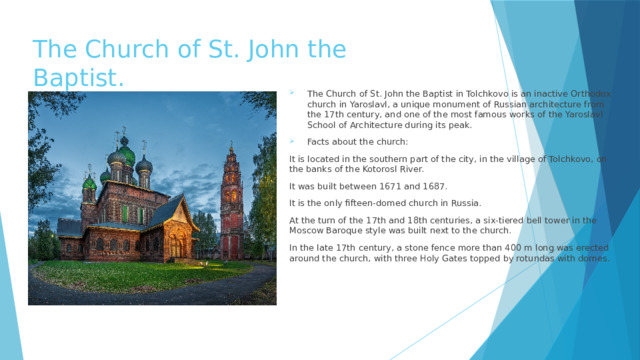
The Church of St. John the Baptist.
- The Church of St. John the Baptist in Tolchkovo is an inactive Orthodox church in Yaroslavl, a unique monument of Russian architecture from the 17th century, and one of the most famous works of the Yaroslavl School of Architecture during its peak.
- Facts about the church:
It is located in the southern part of the city, in the village of Tolchkovo, on the banks of the Kotorosl River.
It was built between 1671 and 1687.
It is the only fifteen-domed church in Russia.
At the turn of the 17th and 18th centuries, a six-tiered bell tower in the Moscow Baroque style was built next to the church.
In the late 17th century, a stone fence more than 400 m long was erected around the church, with three Holy Gates topped by rotundas with domes.
Rubleny Gorod.
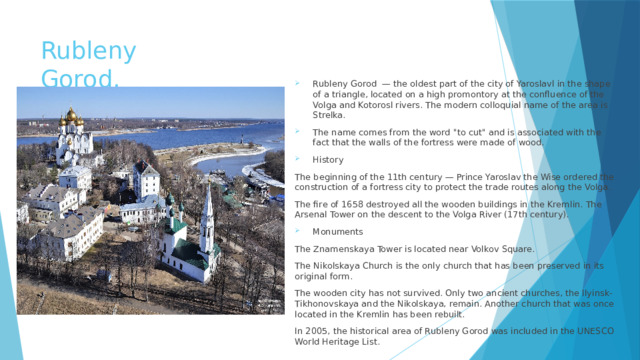
- Rubleny Gorod — the oldest part of the city of Yaroslavl in the shape of a triangle, located on a high promontory at the confluence of the Volga and Kotorosl rivers. The modern colloquial name of the area is Strelka.
- The name comes from the word "to cut" and is associated with the fact that the walls of the fortress were made of wood.
- History
The beginning of the 11th century — Prince Yaroslav the Wise ordered the construction of a fortress city to protect the trade routes along the Volga.
The fire of 1658 destroyed all the wooden buildings in the Kremlin. The Arsenal Tower on the descent to the Volga River (17th century).
- Monuments
The Znamenskaya Tower is located near Volkov Square.
The Nikolskaya Church is the only church that has been preserved in its original form.
The wooden city has not survived. Only two ancient churches, the Ilyinsk-Tikhonovskaya and the Nikolskaya, remain. Another church that was once located in the Kremlin has been rebuilt.
In 2005, the historical area of Rubleny Gorod was included in the UNESCO World Heritage List.
Theatre for Young Spectators
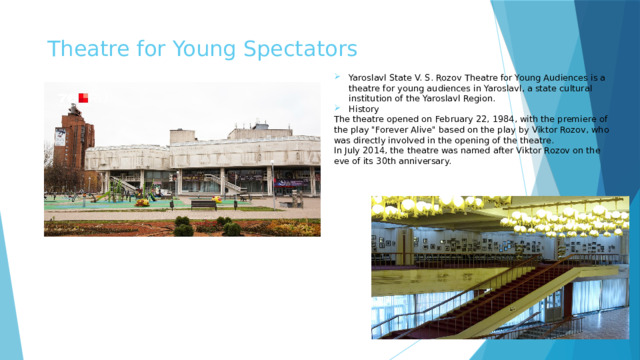
- Yaroslavl State V. S. Rozov Theatre for Young Audiences is a theatre for young audiences in Yaroslavl, a state cultural institution of the Yaroslavl Region.
- History
The theatre opened on February 22, 1984, with the premiere of the play "Forever Alive" based on the play by Viktor Rozov, who was directly involved in the opening of the theatre.
In July 2014, the theatre was named after Viktor Rozov on the eve of its 30th anniversary.
The Museum of Military Glory.
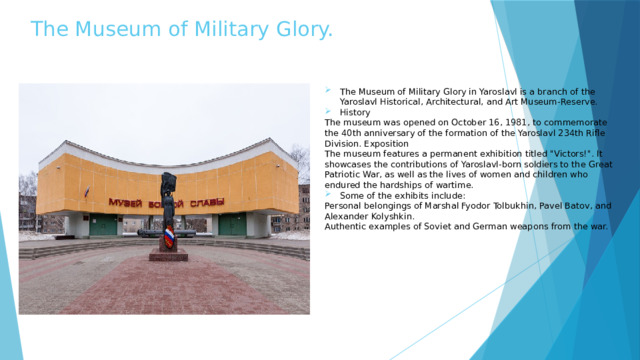
- The Museum of Military Glory in Yaroslavl is a branch of the Yaroslavl Historical, Architectural, and Art Museum-Reserve.
- History
The museum was opened on October 16, 1981, to commemorate the 40th anniversary of the formation of the Yaroslavl 234th Rifle Division. Exposition
The museum features a permanent exhibition titled "Victors!". It showcases the contributions of Yaroslavl-born soldiers to the Great Patriotic War, as well as the lives of women and children who endured the hardships of wartime.
- Some of the exhibits include:
Personal belongings of Marshal Fyodor Tolbukhin, Pavel Batov, and Alexander Kolyshkin.
Authentic examples of Soviet and German weapons from the war.







Вебинар для учителей

Свидетельство об участии БЕСПЛАТНО!