Россия, Каспийск


СДЕЛАЙТЕ СВОИ УРОКИ ЕЩЁ ЭФФЕКТИВНЕЕ, А ЖИЗНЬ СВОБОДНЕЕ
Благодаря готовым учебным материалам для работы в классе и дистанционно
Скидки до 50 % на комплекты
только до
Готовые ключевые этапы урока всегда будут у вас под рукой
Организационный момент
Проверка знаний
Объяснение материала
Закрепление изученного
Итоги урока

Была в сети 06.04.2026 20:12

Туллиева Аминат Юсуповна
учитель английского языка
39 лет
 743
743
 82 062
Местоположение
Специализация
В мире английской литературы
Категория:
Английский язык
30.01.2019 16:23

Просмотр содержимого документа
«В мире английской литературы»
Муниципальное бюджетное общеобразовательное учреждение
«средняя общеобразовательная школа №6» им. Омарова М.О.
Внеклассное мероприятие по английскому языку
среди учащихся 6-9 классов
«In the world of English Literature»
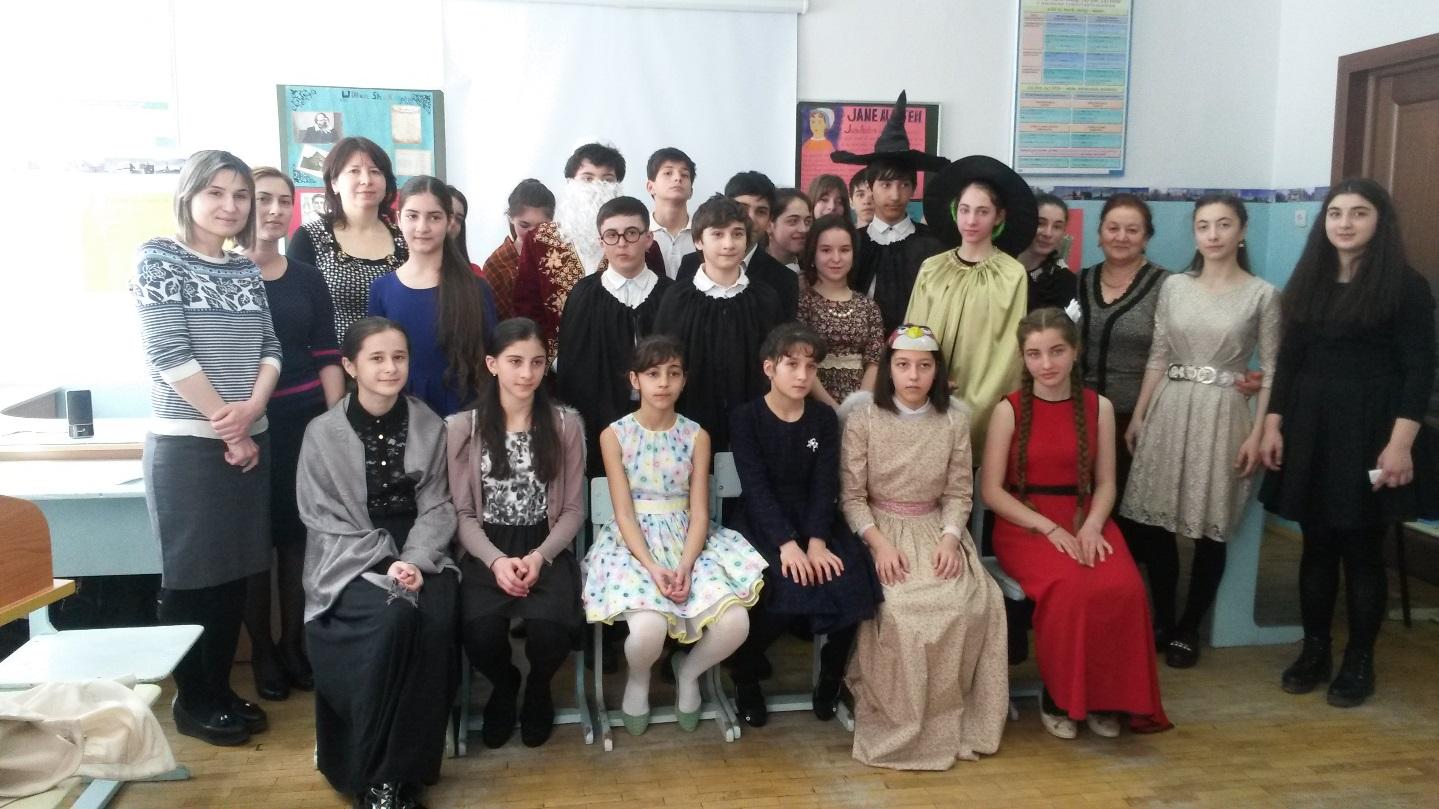
Учителя: Загирова
Угланбиги
Бинямудиновна
высшая к/к
Туллиева
Амина
Юсуповна
I к/к
Каспийск 2016
Цели и задачи:
образовательные:
закрепление умений адекватного восприятия иноязычной речи на слух;
развитие навыков устной речи на английском языке;
расширение кругозора и словарного запаса.
развивающие: развитие творческих способностей учащихся, выразительность, эмоциональность, декламацию;
развитие правильного произношения, интонации;
развитие учебных умений учащихся (умение работать с литературой).
развитие коммуникативной компетенции, включая умение взаимодействовать с окружающими.
воспитательные: воспитание нравственных качеств, способности сопереживания, сочувствия, уважительного отношения к культуре другого народа;
воспитание чувства прекрасного, чувства ответственности за порученное дело;
развитие эстетических представлений и актёрских способностей у детей;
содействие вовлечению учащихся в диалог культур, через умение находить аналогию и проводить параллели со знакомой им русской литературой.
Оборудование:
Стенгазеты с рассказами и иллюстрациями о жизни английских поэтов и писателей
Презентация «In the world of English Literature», слайды которой используются для иллюстрации информации в течение всего вечера
Видеозаписи о жизни и творчестве Г. Лонгфелло, Р. Бернса
Аудиозаписи лютневой музыки и песни «Вечерний звон» в исполнении нескольких певцов
Костюмы и реквизит актёров, играющих их роли;
Музыкальное сопровождение по выбору учителя;
Ход мероприятия
Good morning, dear guests and young talents. We gathered today to plunge into the world of adventures,
fantasy and in the world of verbal creativity. “Literature is the most powerful weapon that we can use to change the world” Henry James
William Shakespeare, (1564 – 1616) the great poet and dramatist, was born on April 23rd, 1564. In his childhood, William went to the Stratford Grammar School. When he was 19, he married Anne Hathaway, the daughter of a well-to-do farmer. They had three children – one boy and two girls. A few years later after his marriage, about the year 1587, Shakespeare left his native town for London. As he rose in popularity, he wrote plays for the famous Globe Theatre and acted in them. His career as a dramatist lasted for nearly twenty-one years. In 1597 Shakespeare bought a house in Stratford and returned to Stratford to spend the last years of his life in his native town. Shakespeare died on April 23rd, 1616. He was buried at the Holy Trinity Church in Stratford-on-Avon.
Shakespeare’s sonnets occupy a unique place in his literary legacy. There are three main characters in his sonnets: the Young Man, the Dark Lady and the Rival Poet. The main theme of most of Shakespeare’s sonnets is love and friendship.
Shakespeare wrote 37 plays: 17 comedies, 10 historical plays and 7 books of poems. But only 18 of them were published in his lifetime. Most famous of his plays are Othello, King Lear, Hamlet, and Romeo and Juliet.
“Hamlet” is a great philosophical tragedy. It is the story of a man who loved good and hated evil who loved truth and hated lies. The character of Hamlet is one of the most difficult in world literature. This role was played by the best actors of all times and peoples.
To be, or not to be: that is the question:
Whether 'tis nobler in the mind to suffer
The slings and arrows of outrageous fortune,
Or to take arms against a sea of troubles,
And by opposing end them? To die: to sleep;
No more; and by a sleep to say we end
The heartache and the thousand natural shocks
That flesh is heir to, 'tis a consummation
Devoutly to be wish'd. To die, to sleep;
To sleep: perchance to dream: ay, there's the rub;
For in that sleep of death what dreams may come
When we have shuffled off this mortal coil,
Must give us pause: there's the respect
That makes calamity of so long life;
For who would bear the whips and scorns of time,
The oppressor's wrong, the proud man's contumely,
The pangs of despised love, the law's delay,
The insolence of office and the spurns
That patient merit of the unworthy takes
To be, or not to be: that is the question
H. Longfellow (1807-1882). Видеофильм о Генри Лонгфелло
Twilight
The twilight is sad and cloudy,
The wind blows wild and free,
And like the wings of sea-birds
Flash the white caps of sea.
But in the fisherman`s cottage
There shines a ruddier light,
And a little face at the window
Peers out into the night.
Close, close it is pressed to the window,
And if those childish eyes
Were looking into the darkness,
To see some form arise.
Charlotte Bronte (1816—1855) an English novelist of the 19th century, was a contemporary (современник) of Dickens, Thackeray3. She was the daughter of a poor clergyman. There were six children in the family, five girls and one boy. Their mother died when Charlotte was a very small child. The girls were sent to a charity school. The children lived at that school in cold gloomy rooms, and were always hungry. Charlotte's sisters, Mary and Elisabeth died of tuberculosis. The novel "Jane Eyre" is partly an autobiography where the author describes the beginning of her life.
The main character of the novel is Jane Eyre, an orphan girl who had lost her parents when she was a child. She lived in the family of her uncle, her mother's brother, Mr. Reed, who had died some years before. His wife, Mrs. Reed, had promised to her husband to look after Jane as one of her own children.
Jane was not happy in this family. Mrs. Reed had three children, two girls and a boy, who made the life of the poor girl very hard. They beat the child, called her names and when she wanted to defend herself, they punished her and shut her in a dark room. One day she decided to send her to charity - school. The book is worth reading.
|
(выходит с книгой читает текст) Отрывок из романа Ш. Бронте «Джейн Эйр» |
Three days passed. Then very early in the morning, I left the house and never went back again. A new life began for me at Lowood School for poor girls.
A woman met me at Lowood school, carried my things and we walked to a big house. We went into the house. A teacher came and took me into a long room with a lot of large tables round it. Girls of nine to twenty years old sat on benches round the tables. They all had brown dresses on. It was dark and cold in the room.
For supper we had a piece of bread and some water. After that we marched to the bedroom. It was a large room with many beds. Two girls slept in each bed. In ten minutes the teacher took away the light.
The night passed quickly. In the morning it was very cold in the room. We washed our faces in water with ice in it. Then we marched to the cold school-room where lessons began. The girls read the Bible, and did exercises in their exercise-books. This lasted for an hour. Then we marched to another room for breakfast. After breakfast there was reading, writing, history and geography. Before dinner we went into the cold, windy garden for an hour.
For dinner we had some bad meat and potatoes. I ate what I could. Then we marched back to the school-room and had our lessons till five o'clock.
The next day began as before, but we could not wash. The water in the wash-room was ice.
During January, February and March there was much snow in the garden. We had no boots and could not walk far. The rooms were very cold. The food was bad and in spring many of the pupils were ill with typhus, hi May Lowood school was a hospital. Forty-five girls out of eighty were ill. We had no lessons. Many pupils went home and died there. Some girls died in the school.
Beatrix Potter ( 1866 – 1943)Beatrix Potter was a writer, illustrator. Beatrix was born in Kensington, London. Her father, Robert was a distinguished lawyer, and her mother the daughter of a wealthy merchant. Her parents were also artistic and this artistic talent was passed on to Beatrix.
She spent much of her early life in her own company; she rarely saw her brother Ewan. Having little social contact with children of her own age, Beatrix began to be drawn into her own world of creating her own stories, based on animals. Her stories combine her love for both animals and English countryside.
Potter wrote 23 books: The Tale of Peter Rabbit (1902), The Tale of Two Bad Mice (1904), The Tale of Mr. Jeremy Fisher (1906) and so on. Today we want to show you one of her fairytales. It is called –The hen and the rose.
The Hen and the Rose
Author: There was a beautiful rose in a beautiful garden. Every morning she looked at the sun and smiled. But one morning the ugly worm crawled to Rose and began to eat its leaves.
(Пока автор произносит эти слова, появляется Солнце, Роза улыбается ему, Солнце уходит, затем появляется червяк.)
The Worm: What a nice Rose! What tasty leaves!
Author: When the sun came out he was surprised to see that his friend looked sad.
(Появляется солнце.)
The Sun: Dear, Rose, why do you look so sad?
Rose: Oh dear! I am so unhappy because an ugly worm is eating my leaves and will not go away.
The Worm: Yummy! Yummy!
The Sun: I will not shine until Rose is happy.
(Солнце прячется за облако.)
The Wind (появляясь): Father Sun, why are you not shining today?
The Sun: Rose is so unhappy. An ugly worm is eating her leaves and he will not go away. I will not shine until Rose is happy.
Author: And the Wind stopped blowing. A Bird was surprised when the wind stopped blowing.
(Прилетает птичка.)
The Bird: Mr. Wind, why have you stopped blowing?
The Wind: Rose is so unhappy. An ugly worm is eating her leaves. So Father Sun will not shine and I will not blow until Rose is happy.
The Bird: I also love Rose. I will not sing again until Rose is happy.
Author: The Bird met a Hen.
(Выходит курочка.)
The Hen: Why do you look so sad? Why aren’t you singing?
The Bird: Rose is so unhappy. An ugly worm is eating her leaves so Father Sun will not shine, Mr. Wind will not blow and I will not sing again until Rose is happy.
The Hen: Really! Please tell me how this will help Rose? If you want to help Rose you must do something for her. Come with me.
(Птичка и курочка подходят к розе. Курочка находит червяка и съедает его.)
The Hen: See how I have helped Rose and at the same time had a delicious breakfast.
Rose (оживая и улыбаясь): Thank you.
The Sun is shining brightly,
The Rose is smiling smartly,
The singing birds are flying over
Growing greeny trees.
And they are friends forever,
They spend all time together,
They help each other every day
And never put in trouble.
Thomas Moore ( 1779-1852 )
Almost everyone in our country knows the romance, 'Those Evening Ве1ls' ('Вечерний звон'), which was written to the Bells of St. Petersburg, but not many of you know, that its words originally belong to Thomas Moore .
Thomas Moore was born of catholic parents in Dublin. Having completed his studies of law in London, he held the post of Admiralty Registrar at Bermuda for some time and then made a tour of the United States and Canada. In 1811 he met Byron and became his life-long friend.
Thomas Moore holds a place in English literature as a song writer and a satirist. Moore's love for national Irish music and songs, his devotion to the cause of Irish independence on the one hand, and his oriental affinities on the other are characteristic of the Romantic movement.
Thomas Moore wrote the worldwide-known poem “Those Evening Bells” in a village Mayfield. “Those Evening Bells” were inspired by the sound of the bells of Ashbourne Church just across the river.
Ivan Ivanovich Kozlov, a Russian poet, translated Moore’s poem “Those Evening Bells”. Then Stanislav Monushko and Alexander Grechaninov composed music to this poem and it became a very popular Russian song. Let’s listen to it.
“Those Evening Bells”
Those evening bells! Those evening bells!
How many a tale their music tells,
Of youth, and home, and those sweet time,
When last I heard their soothing chime.
Those joyous hours are passed away;
And many a heart, that then was gay,
Within the tomb now darkly dwells,
And hears no more those evening bells.
And so’t will be when I am gone;
That tuneful peal will still ring on,
While other bards shall walk these dells,
And sing your praise, sweet evening bells.
Sir Arthur Ignatius Conan Doyle was a Scottish physician writer, most noted for his stories about the detective Sherlock Holmes, which are considered a major innovation in the field of crime fiction, and for the adventures of Professor Challenger. Sherlock Holmes stories have been translated into more than fifty languages. His other works include science fiction stories, historical novels, plays, romances, poetry, and non-fiction. By 1920 Doyle was one of the most highly paid writers in the world.
Conan Doyle was born on May 22, 1859, in Edinburgh, Scotland. At the age of nine Arthur was sent to study at Jesuit boarding school. It was during those difficult years that Arthur realized he had a talent for storytelling. Later he used his friends and teachers from Stony Hurst College as models for his characters in the Holmes stories. In March 1886, Conan Doyle started writing the novel which catapulted him to fame. The novel A Study in Scarlet which introduced us to the immortal Sherlock Holmes and Dr. Watson was published in 1887. Holmes’s address at Mrs. Hudson’s house, 221B Baker Street, London, is the most famous London street in literature.
There were a number of serious historical novels, poems and plays, based upon which Conan Doyle expected to be recognized as a serious author.
Arthur Conan Doyle died on 7, July1930, surrounded by his family.
Robert Burns (1759 – 1796) Видеофильм о Р. Бернсе
Auld lang syne
Should auld acquaintance be forgot
And never brought to mind
Should auld acquaintance be forgot
And auld lang syne
For auld lang syne, my dear
For auld lang syne
We’ll take a cup of kindness yet
For auld lang syne
We two have run about the slopes
And picked the daises fine
We’ll take a cup of kindness yet
For auld lang syne
For auld lang syne, my dear
For auld lang syne
We’ll take a cup of kindness yet
For auld lang syne
Should auld acquaintance be forgot
And never brought to mind
Should auld acquaintance be forgot
And auld lang syne
For auld lang syne, my dear
For auld lang syne
We’ll take a cup of kindness yet
For auld lang syne
Joanne Rowling (31.07.1965) One of the most successful modern English writers is J.K. Rowling. She is known all over the world. The writer was born on July 31st, 1965. She started writing fictional stories rather early, at the age of nine. Her first listener was her younger sister Dianne. Joanne’s childhood wasn’t easy. Her mother was often ill and she had to take care of herself and her sister. School years were also difficult. In 1982, she failed the exams to Oxford. Nevertheless, she managed to enter the Exeter University. In 1986, she moved to London and started working as a secretary at the research department. The intention to write a fiction about a magical school came to her unexpectedly.
Every morning and evening, she had free time to write the novel, in the afternoons she was teaching. Then she moved to Edinburgh with her daughter. Here she received a grant to finish the novel about “Harry Potter and the Philosopher’s Stone”.
All in all, she wrote seven books about Harry Potter. J. Rowling's Harry Potter novels begin when the orphaned British 10-year-old discovers he has a magical heritage and enters Hogwarts School to learn how to be a wizard.. Her fantasy books about Harry Potter brought her world recognition and popularity. They became the best-selling books in the history of literature.
Harry Potter
Harry: Well! We are at Hogwarts at last. And… today we must be sorted into our houses. As I know… in Puffendor there are the most diligent students.
Ron: I’ve heard… in Ravenclaw study the cleverest ones.
Hermione: Cunning students are sorted to Slytherin
Harry: But Gryffindor is for the bravest students!
Professor McGonagall: We are ready for you now. Follow me.
Hermione: The ceiling isn’t real. It’s bewitched to look like the night sky. I read about it in Hogwarts, A History.
Professor McGonagall: Will you wait along here, please? Now before we begin… Professor Dumbledor would like to say a few words.
Professor Dumbledor: I have a few start-of-term notices. I wish to announce. The first years, please, note…that the Dark Forest is strictly forbidden for all students. Also our caretaker, Mr. Filch, has also asked me to remind you … that the third floor corridor is out of bounds... to everyone who does not wish to die a most painful death. Thank you.
Professor McGonagall: When I call you name, you will come forth. I shall place the Sorting Hat on your head…and you will be sorted into your houses. Hermione Granger!
Hermione: Oh, no. Okay, relax.
Ron: Well, that mental one, I am telling you.
Sorting Hat: Aaaa…. Right then. Right. Okay, Gryffindor!
Professor McGonagall: Ronald Weasley!
Sorting Hat: Ha! Another Weasley! I know just what to do with you. Gryffindor!
Professor McGonagall: Harry Potter!
Sorting Hat: Hmmm! Difficult, very difficult! Plenty of courage, I see. Not a bad mind, either. There is talent, oh yes. And a thirst to prove yourself. But where to put you?
Harry: Not Slytherin! Not Slytherin!
Sorting Hat: Not Slytherin? Eh? Are you sure? You could be great, you know. It’s all here, in your head. And Slytherin will help you on the way to greatness, no doubt about that. No? Well, if you are sure …
Harry: Please
Sorting Hat: Better … be … Gryffindor!
Professor McGonagall: Attention please!
Professor Dumbledor: Let the feast begin
George Gordon Byron (1788 – 1824), the great romantic poet, was born in London, in 1788 in an old aristocratic family. At 17, Byron entered Cambridge University and there his literary career began. In 1807 he published his first collection of poems “Hours of Idleness”. In 1808 Byron graduated from the University and in 1809 he left England for a long journey. He visited Portugal, Spain, Albania, Greece and Turkey. Byron described his travels in a long poem “Childe Harold’s Pilgrimage”. In the Greek town of Missolongi Byron fell ill with typhus and died in April 18th, 1824. He was only 36 years old. His friends brought Byron’s body to England and he was buried in Newstead, his native place. Only in 1969 the authorities finally allowed his remains to be buried in the Poets’ Corner in Westminster Abbey.
I’d like to tell you about the poem “Childe Harold’s Pilgrimage”. It is a story about travel, history and politics. Childe Harold is a young aristocrat, who is not happy in his country. He goes travelling and hopes to find happiness among people far from civilization.
When the poem first appeared in print, many people believed that Byron’s own character was presented in the person of Childe Harold but the author denied it. He justly considered himself to be an active fighter for freedom, while Harold was merely a passive onlooker.
Childe Harold leaves his country for Portugal and Spain; when his ship is far from the shores of England, he says Good Night to his Motherland.
Good Night.
Adieu! Adieu! My native shore
Fades o’er the waters blue;
The night-winds sigh, the breakers roar,
And shrieks the wild sea-mew.
Yon sun that sets upon the sea
We follow in his flight.
Farewell awhile to him and thee,
My native Land – Good Night!
A few short hours and he will rise
To give the morrow birth;
And I shall hail the main and skies,
But not my mother earth.
Deserted is my own good hall,
Its hearth is desolate;
Wild weeds are growing on the wall,
My dog howls at the gate.
Jane Austen (1775-1817) was an English novelist whose works of romantic fiction earned her a place as one of the most widely read writers in English literature. Her realism ,biting irony and satirical commentary as well as he acclaimed plots have gained her historical importance among scholars and critics.
From 1811 until 1816, with the publication of Sense and Sensibility (1811),Pride and Prejudice (1813), Mansfield Park (1814) and Emma (1815), she achieved success as a published writer. Her plots, though fundamentally comic, highlight the dependence of women on marriage to secure social standing and economic security. Her works, though usually popular, were first published anonymously and brought her little personal fame and only a few positive reviews during her lifetime. The publication in 1869 of her nephew's A Memoir of Jane Austen introduced her to a wider public, and by the 1940s she had become widely accepted in academia as a great English writer.
DARCY: Is this your reply?
LIZZIE: Yes, sir.
DARCY: Are you laughing at me?
LIZZIE: No!
DARCY: Are you rejecting me?
LIZZIE: I'm sure that the feelings which, as you’ve told me, have hindered your regard, will help you in overcoming it.
DARCY: Might I ask why, with so little endeavour at civility, I am thus repulsed?
LIZZIE: I might as well enquire why, with so evident a design of insulting me, you chose to tell me that you liked me against your better judgment...
DARCY: I watched them most carefully, and realized his attachment was much deeper than hers.
LIZZIE: That's because she's shy!
DARCY: Bingley too is modest, and was persuaded that she didn't feel strongly for him.
LIZZIE: Because you suggested it!
DARCY: I did it for his own good.
LIZZIE: My sister hardly shows her true feelings tome!
I suppose you suspect that his fortune had same bearing on the matter?
DARCY: No! I wouldn't do your sister the dishonour. Though it was suggested
LIZZIE: What was?
DARCY: It was made perfectly clear that. an advantageous marriage. . .
LIZZIE: Did my sister give that impression?
DARCY: No!
DARCY: There was, however, I have to admit... the matter of your family.
LIZZIE: Our want of connection?
Mr. Bingley didn’t vex himself about that!
DARCY: No, it was more than that.
LIZZIE: How, sir?
DARCY: It was the lack of propriety shown by your mother, your three younger sisters - even, on occasion, your father. Forgive me.
DARCY: You and your sister - I must exclude from this...
LIZZIE: And what about Mr. Wickham?
DARCY: Mr. Wickham?
LIZZIE: What excuse can you give for your behaviour to him?
DARCY: You take an eager interest in that gentleman's concerns!
LIZZIE: He told me of his misfortunes.
DARCY: Oh yes, his misfortunes have been very great indeed!
LIZZIE: You have ruined his chances, and yet treat him with sarcasm?
DARCY: So this is your opinion of me! Thank you for explaining so fully. Perhaps these offences might have been overlooked, if your pride had not been hurt -
LIZZIE: My pride?
DARCY: - by my honesty in admitting scruples about our relationship.
Could you expect me to rejoice in the inferiority of your circumstances?
LIZZIE: And those are the words of a gentleman?
From the first moment I met you, your arrogance and conceit, your selfish disdain of the feelings of others, made me realize that you were the last man in the world I could ever be prevailed upon to marry.
It is often said that the beauty of literature is the beauty of language. And today we tried to show it through the
greatest and most wonderful works of outstanding writers and poets. We hope you have known much interesting and enjoyed the time spent with us. Thank you for coming and participating








Вебинар для учителей

Свидетельство об участии БЕСПЛАТНО!