Россия, Ярославль

СДЕЛАЙТЕ СВОИ УРОКИ ЕЩЁ ЭФФЕКТИВНЕЕ, А ЖИЗНЬ СВОБОДНЕЕ
Благодаря готовым учебным материалам для работы в классе и дистанционно
Скидки до 50 % на комплекты
только до
Готовые ключевые этапы урока всегда будут у вас под рукой
Организационный момент
Проверка знаний
Объяснение материала
Закрепление изученного
Итоги урока
Была в сети 23.05.2026 11:43

Серова Ирина Юрьевна
учитель английского языка
 4 589
4 589
 13 877
Местоположение
Специализация
Зачем изучать иностранные языки (Learning foreign languages)
Категория:
Английский язык
20.02.2026 14:08

Просмотр содержимого документа
«Зачем изучать иностранные языки (Learning foreign languages)»
Learning foreign languages
"Those who know nothing of foreign languages know nothing of their own«, - Johann Wolfgang von Goethe

Language
English
Number of speakers, both native and second-language (mln)
Number of native speakers (mln)
1520
Chinese (Mandarin)
380
Hindi
Percentage of the share of web content featured in this language (%)
1140
Spanish
52.1
941
609
Arabic
345
1.3
560
French
486
422
321
Bengali
313
5.5
189
Portuguese
0.6
273
Russian
4.3
230
264
Urdu
236
255
Indonesian
3.1
148
232
German
199
70
4.3
43
Japanese
134
Swahili
76
125
Marathi
100
122
5.8
Telugu
20
2.7
99
99
96
Vietnamese
Turkish
96
95
Italian
90
85
84
Tamil
90
Javanese
67
86
Tagalog (Filipino)
84
75
Korean
82
83
82
Persian (Farsi)
28
77
Thai
80
Polish
1.0
70
69
61
50
0.7
39
0.3
- 7) Bengali
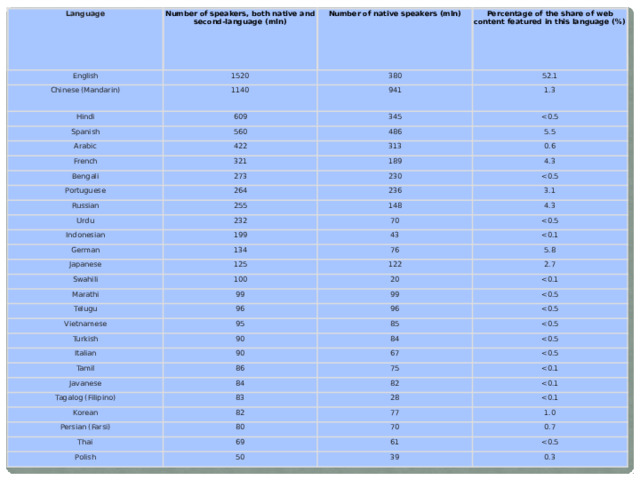
- Bengali is the official language of Bangladesh and the second most spoken language in India, with a total of 273 million speakers, including 230 million native speakers. Despite its large speaker base, Bengali — like Hindi — has a very limited online presence, accounting for less than 0.5% of web content.
- 8) Portuguese
- Portuguese ranks as the 8th most spoken language in the world, with around 264 million speakers in total — 236 million of whom are native speakers. It’s also the third most spoken native language in Europe, following Russian and German. Although it’s widely used in Brazil, Portugal, and parts of Africa, Portuguese maintains a modest digital footprint, making up just 3.1% of global online content.
- 9) Russian
- Despite being the largest country in the world, Russia’s language isn’t among the very top in terms of global speakers. Russian is spoken by around 255 million people, with about 148 million native speakers, placing it 9th globally and 7th by native speaker count. It remains widely used across several post-Soviet states, including Kazakhstan, Georgia, and Uzbekistan, due to historical connections. Online, however, Russian holds a strong position — it's the fourth most used language on the internet, accounting for 4.3% of global content.
- 10) Urdu
- Urdu is spoken by nearly 232 million people worldwide, though less than a third are native speakers. It is primarily used in Pakistan, where it functions as both the national language and a common means of communication. Like Hindi and Bengali, however, Urdu has a very limited presence online — accounting for less than 0.5% of web content.
- …
- 12) German
- German is spoken by around 134 million people in 2025, with about 76 million native speakers. It is the most widely spoken native language in the European Union and is an official language in Germany, Austria, Switzerland, and parts of Belgium and Luxembourg. German is also widely learned as a second language in Europe. It is the fifth most used language online, accounting for 5.8% of web content.
- 13) Japanese
- Japanese is spoken by about 125 million people, the vast majority of whom live in Japan and speak it natively. Despite being geographically concentrated, Japanese is widely studied abroad due to the global popularity of anime, technology, and culture. Japanese is the ninth most used language online, representing 2.7% of global web content.
- 1) English
- As of 2024, approximately 1.52 billion people around the world speak English. Interestingly, only about 25% are native speakers, while the majority have learned it as a second language. English is used in 186 countries, making it the most globally widespread language. It also dominates the digital space, with 52.1% of all websites featuring content in English.
- 2) Chinese (Mandarin)
- Mandarin Chinese ranks as the second most spoken language worldwide, with around 1.14 billion speakers in total, including 941 million native speakers. Although it has the largest number of native speakers — nearly two and a half times more than English — its presence as a second language is relatively limited. Chinese is spoken in 83 countries, yet as of January 2024, only 1.3% of websites featured content in the language.
- 3) Hindi
- While India officially recognizes 22 languages, Hindi stands out as the most widely spoken, used by 52.83% of the population. In comparison, Bengali and Marathi — the second and third most spoken languages — together make up just 18.02%. With 345 million native speakers and a total of 609 million speakers, Hindi is the third most spoken language globally. However, like Mandarin, Hindi's reach is largely regional, mainly within Asia, and its online presence remains minimal, accounting for less than 0.5% of web content.
- 4) Spanish
- In 2024, Spanish is spoken by approximately 560 million people, the vast majority of whom are native speakers — fewer than one in seven learned it as a second language. Interestingly, Spanish has around 100 million more native speakers than English. It holds official or national status in 21 countries, primarily across Latin America, and ranks as the second most used language on the internet. Spanish also features around 11 dialects, with "Spanglish" being a widely recognized hybrid of Spanish and English.
- 5) Arabic
- Similar to Chinese and Spanish, Arabic encompasses a diverse array of dialects, stretching from Morocco to Oman. Globally, it’s spoken by around 422 million people, including 313 million native speakers. Despite its large speaker base, Arabic has a limited digital footprint — only 0.6% of online content is in Arabic.
- 6) French
- As of June 2022, French was spoken by 321 million people worldwide, with non-native speakers making up 41% of that number. It holds official status in 32 countries, and roughly two-thirds of all French speakers are based in Africa. Online, French ranks as the sixth most used language, representing 4.3% of web content.
- A language is a system of communication that a particular community or nation uses and consists of words, grammar, and syntax.
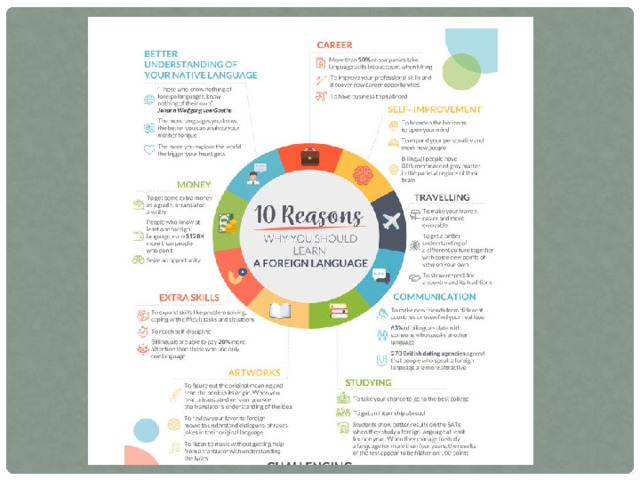
- Languages are the primary tool for communication. They allow us to convey ideas, emotions, thoughts, and understanding between people.
- In a modern world borders are being erased and the need for learning a second language is less a convenience and more a necessity.
- With the increasing interconnectedness of people and cultures, the ability to communicate in multiple languages has become increasingly important.
- When we are able to communicate in different languages, we can better appreciate and respect diverse cultures, traditions, and perspectives.
- Language learning promotes personal growth.
- The more languages you know, the better you can express yourself.
- …
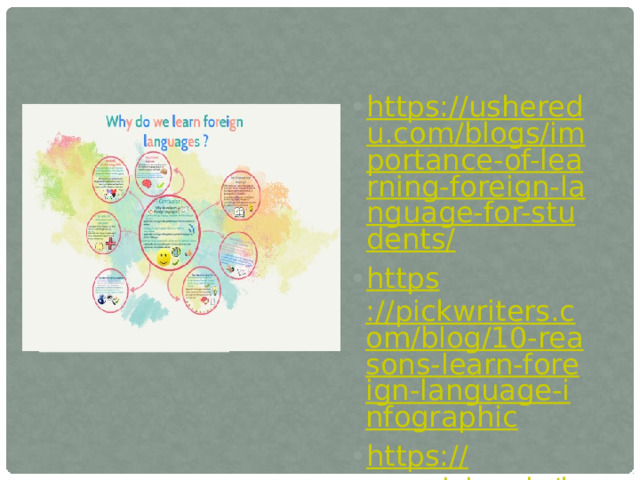
- https://usheredu.com/blogs/importance-of-learning-foreign-language-for-students/
- https ://pickwriters.com/blog/10-reasons-learn-foreign-language-infographic
- https:// www.icls.edu/blog/27-most-spoken-languages-in-the-world-in-2025



Вебинар для учителей
Свидетельство об участии БЕСПЛАТНО!