Россия, Минеральные Воды

СДЕЛАЙТЕ СВОИ УРОКИ ЕЩЁ ЭФФЕКТИВНЕЕ, А ЖИЗНЬ СВОБОДНЕЕ
Благодаря готовым учебным материалам для работы в классе и дистанционно
Скидки до 50 % на комплекты
только до
Готовые ключевые этапы урока всегда будут у вас под рукой
Организационный момент
Проверка знаний
Объяснение материала
Закрепление изученного
Итоги урока
Была в сети 28.05.2018 10:52

Жеранова Анна Григорьевна
учитель иностранного языка
 305
305
 141 303
Местоположение
Специализация
Аборигены Австралии
Категория:
Английский язык
30.05.2017 19:46

Просмотр содержимого документа
«Аборигены Австралии»
Презентацию подготовила
Согова Диана, ученица 10 класса
МОУ СОШ № 12 Курского муниципального района Ставропольского края
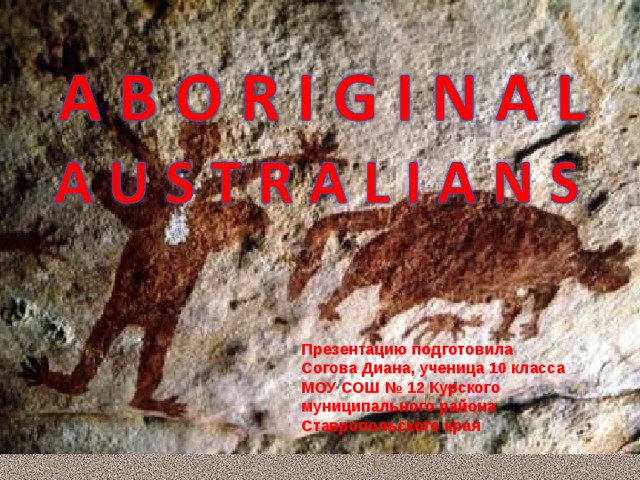
Aboriginal Australians
or Aborigines,
are original inhabitants
of Australia
and their descendants.
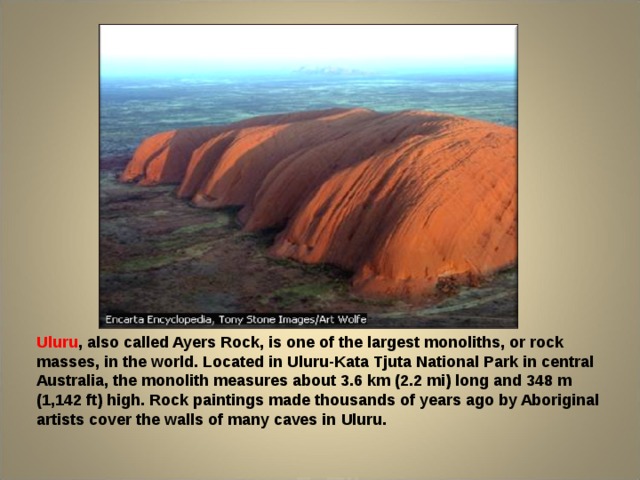
Uluru , also called Ayers Rock, is one of the largest monoliths, or rock masses, in the world. Located in Uluru-Kata Tjuta National Park in central Australia, the monolith measures about 3.6 km (2.2 mi) long and 348 m (1,142 ft) high. Rock paintings made thousands of years ago by Aboriginal artists cover the walls of many caves in Uluru.
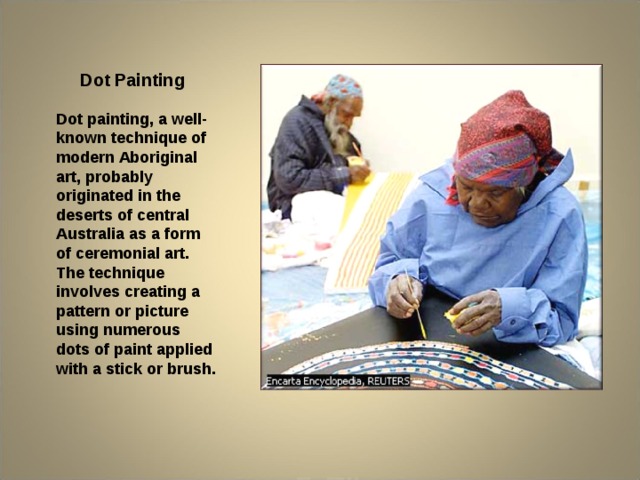
Dot Painting
Dot painting, a well-known technique of modern Aboriginal art, probably originated in the deserts of central Australia as a form of ceremonial art. The technique involves creating a pattern or picture using numerous dots of paint applied with a stick or brush.
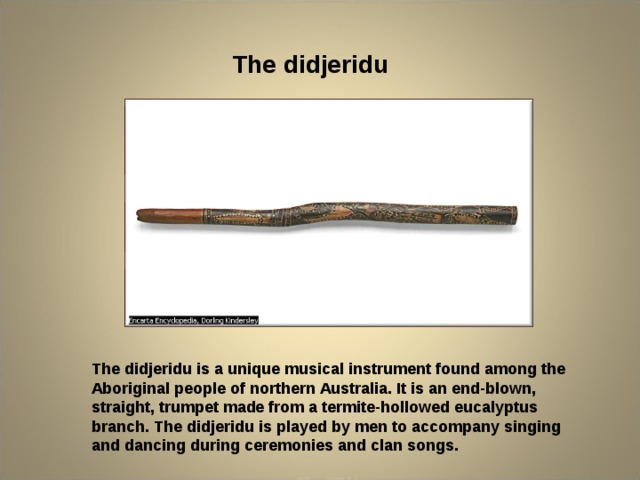
The didjeridu
The didjeridu is a unique musical instrument found among the Aboriginal people of northern Australia. It is an end-blown, straight, trumpet made from a termite-hollowed eucalyptus branch. The didjeridu is played by men to accompany singing and dancing during ceremonies and clan songs.
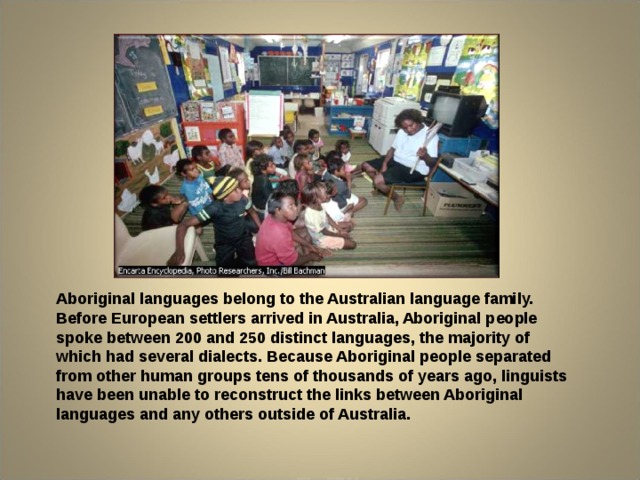
Aboriginal languages belong to the Australian language family.
Before European settlers arrived in Australia, Aboriginal people spoke between 200 and 250 distinct languages, the majority of which had several dialects. Because Aboriginal people separated from other human groups tens of thousands of years ago, linguists have been unable to reconstruct the links between Aboriginal languages and any others outside of Australia.
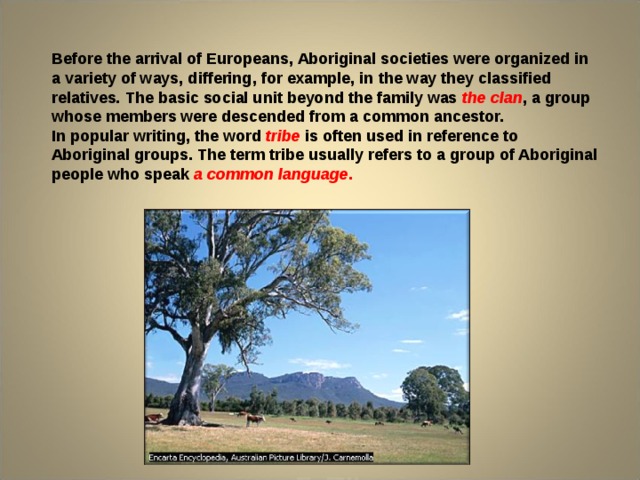
Before the arrival of Europeans, Aboriginal societies were organized in a variety of ways, differing, for example, in the way they classified relatives. The basic social unit beyond the family was the clan , a group whose members were descended from a common ancestor.
In popular writing, the word tribe is often used in reference to Aboriginal groups. The term tribe usually refers to a group of Aboriginal people who speak a common language .
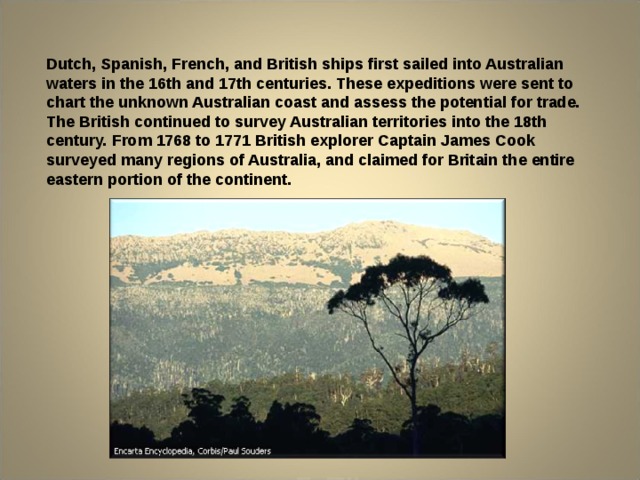
Dutch, Spanish, French, and British ships first sailed into Australian waters in the 16th and 17th centuries. These expeditions were sent to chart the unknown Australian coast and assess the potential for trade. The British continued to survey Australian territories into the 18th century. From 1768 to 1771 British explorer Captain James Cook surveyed many regions of Australia, and claimed for Britain the entire eastern portion of the continent.
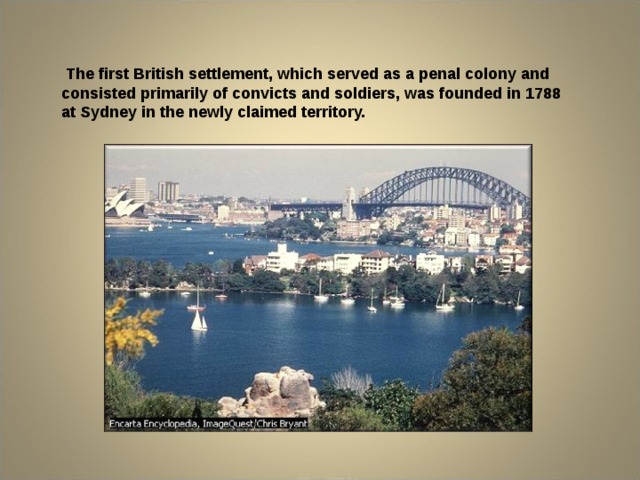
The first British settlement, which served as a penal colony and consisted primarily of convicts and soldiers, was founded in 1788 at Sydney in the newly claimed territory.
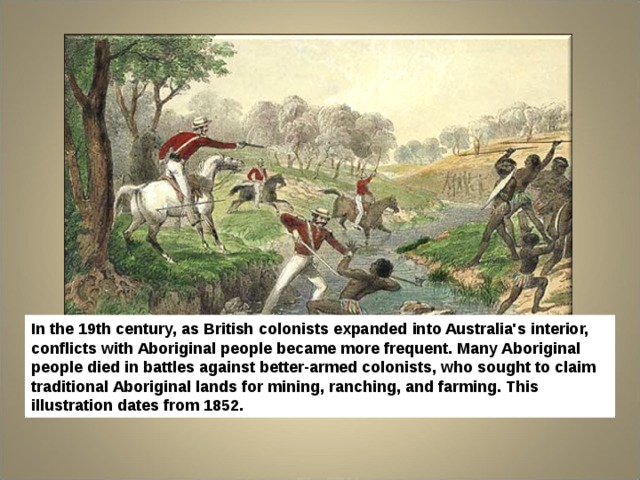
In the 19th century, as British colonists expanded into Australia's interior, conflicts with Aboriginal people became more frequent. Many Aboriginal people died in battles against better-armed colonists, who sought to claim traditional Aboriginal lands for mining, ranching, and farming. This illustration dates from 1852.
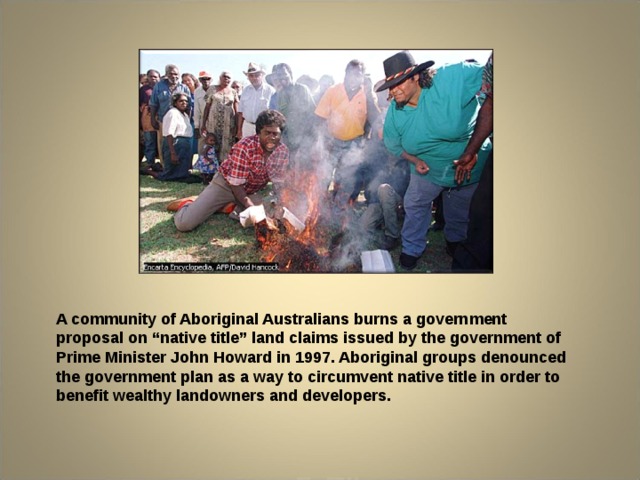
A community of Aboriginal Australians burns a government proposal on “native title” land claims issued by the government of Prime Minister John Howard in 1997. Aboriginal groups denounced the government plan as a way to circumvent native title in order to benefit wealthy landowners and developers.
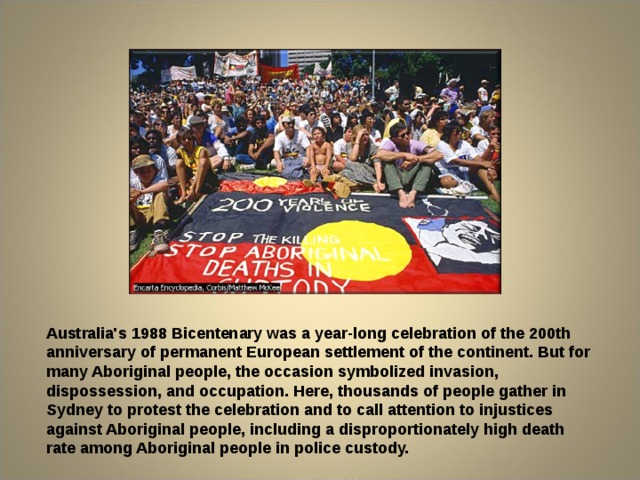
Australia's 1988 Bicentenary was a year-long celebration of the 200th anniversary of permanent European settlement of the continent. But for many Aboriginal people, the occasion symbolized invasion, dispossession, and occupation. Here, thousands of people gather in Sydney to protest the celebration and to call attention to injustices against Aboriginal people, including a disproportionately high death rate among Aboriginal people in police custody.

Вебинар для учителей

Свидетельство об участии БЕСПЛАТНО!