






© 2019 959 7


СДЕЛАЙТЕ СВОИ УРОКИ ЕЩЁ ЭФФЕКТИВНЕЕ, А ЖИЗНЬ СВОБОДНЕЕ
Благодаря готовым учебным материалам для работы в классе и дистанционно
Скидки до 50 % на комплекты
только до
Готовые ключевые этапы урока всегда будут у вас под рукой
Организационный момент
Проверка знаний
Объяснение материала
Закрепление изученного
Итоги урока

Conjunctions...
Категория:
Английский язык
11.01.2019 16:13

Просмотр содержимого документа
«Conjunctions...»
Conjunctions
by: Donerbek Hakimov

TABLE OF CONTENTS
List of Conjunctions………………….........slide 3
What is a conjunction?..............................slide 4
Types of Conjunctions…………….....slides 5-13
Coordinating Conjunctions
Subordinate Conjunctions
Correlative Conjunctions
Conjunctive Adverbs
Quiz and Answers…………………....slide 14-15

All of these words, and many more,
are conjunctions ! ! !
or
for
if
before
than
even though
whether
while
wherever
nor
and
since
so
then
although
unless
yet
because
until
but
where
Let us take a closer look . . .

WHAT IS A CONJUNCTION ?
- Conjunction is the name for those common words that are used to join ( conjoin ) parts of sentences. Also, conjunctions may be used to begin certain sentences.
- There are two different types of conjunctions:
coordinating conjunctions and subordinating conjunctions .
- Conjunctions sometimes work in pairs and are called correlative conjunctions .
- Conjunctive adverbs are also frequently used to provide logical connections in sentences.

- COORDINATING CONJUNCTIONS THESE CONJUNCTIONS ARE SEVEN VERY COMMON WORDS. THEY ARE VERY SMALL, MADE UP OF THREE OR FEWER LETTERS.
When to Use Each Coordinating Conjunction:
Reason Coordinating Conjunction
To communicate addition and
To communicate contrast but, yet
To communicate a result/effect so
To communicate a reason/cause for
To communicate a choice or
To communicate a negative choice nor
Use them between two independent clauses.

Coordinating Conjunctions cont….
Coordinating conjunctions are used to join words, phrases, and independent clauses.
Examples of coordinating conjunctions in sentences:
Ex . He only wears striped ties and polka dotted bow ties. ( And joins two words.)
Ex . The shoes were not blue suede nor black leather. ( Nor joins two phrases.)
Ex . It wasn’t a costume party, yet many came dressed as literary villains. ( Yet joins two independent clauses.)

- More Coordinating Conjunctions ... These are likely used less often; however, they serve an important function.
When to Use Each Coordinating Conjunction:
Reason Coordinating Conjunction
To communicate additional consequently
information furthermore
however
indeed
moreover
nevertheless
then
therefore
Use them between two independent clauses.

Coordinating Conjunctions cont….
These coordinating conjunctions are used to join independent clauses.
Examples of coordinating conjunctions in sentences:
Ex . He only wears brown wingtips; consequently , he does not wear white socks. ( Consequently joins two independent clauses.)
Ex . The shoes were not suede; however , they were leather. ( However joins two independent clauses.)
Ex . It was not a Halloween party; nevertheless , many came dressed in costumes. ( nevertheless joins two independent clauses.)
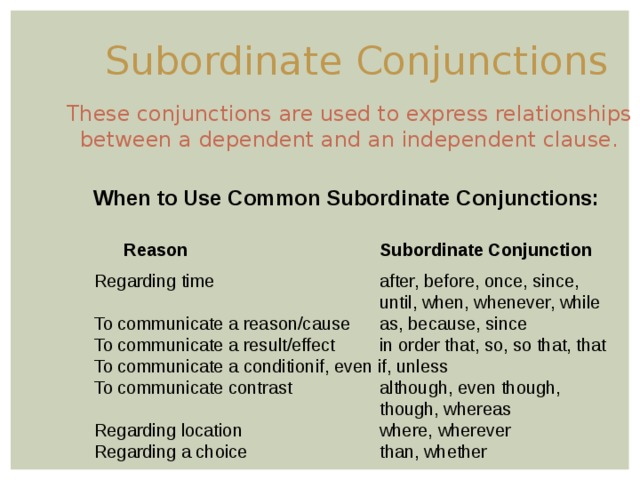
Subordinate Conjunctions
These conjunctions are used to express relationships between a dependent and an independent clause.
When to Use Common Subordinate Conjunctions:
Reason Subordinate Conjunction
Regarding time after, before, once, since, until, when, whenever, while
To communicate a reason/cause as, because, since
To communicate a result/effect in order that, so, so that, that
To communicate a condition if, even if, unless
To communicate contrast although, even though, though, whereas
Regarding location where, wherever
Regarding a choice than, whether
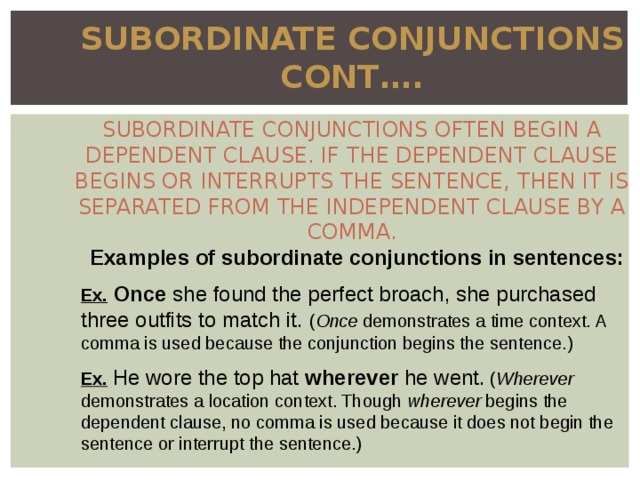
SUBORDINATE CONJUNCTIONS CONT…. SUBORDINATE CONJUNCTIONS OFTEN BEGIN A DEPENDENT CLAUSE. IF THE DEPENDENT CLAUSE BEGINS OR INTERRUPTS THE SENTENCE, THEN IT IS SEPARATED FROM THE INDEPENDENT CLAUSE BY A COMMA.
Examples of subordinate conjunctions in sentences:
Ex. Once she found the perfect broach, she purchased three outfits to match it. ( Once demonstrates a time context. A comma is used because the conjunction begins the sentence.)
Ex. He wore the top hat wherever he went. ( Wherever demonstrates a location context. Though wherever begins the dependent clause, no comma is used because it does not begin the sentence or interrupt the sentence.)
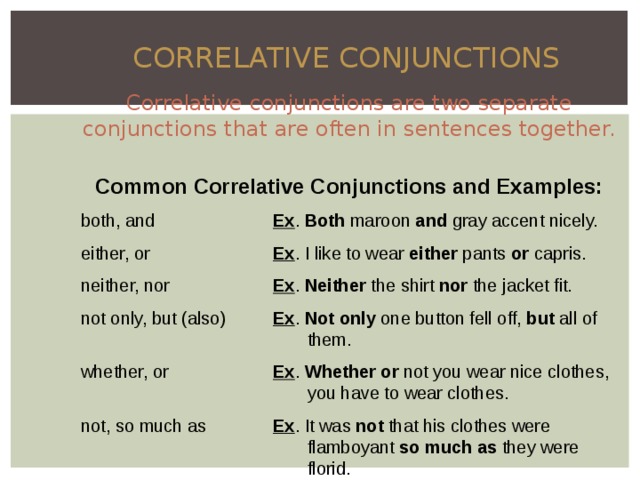
CORRELATIVE CONJUNCTIONS
Correlative conjunctions are two separate conjunctions that are often in sentences together.
Common Correlative Conjunctions and Examples:
both, and Ex . Both maroon and gray accent nicely.
either, or Ex . I like to wear either pants or capris.
neither, nor Ex . Neither the shirt nor the jacket fit.
not only, but (also) Ex . Not only one button fell off, but all of them.
whether, or Ex . Whether or not you wear nice clothes, you have to wear clothes.
not, so much as Ex . It was not that his clothes were flamboyant so much as they were florid.

CONJUNCTIVE ADVERBS CONJUNCTIVE ADVERBS PROVIDE CONNECTIONS AND TRANSITIONS THAT CLARIFY OR LIMIT THE MEANING OF WORDS.
When to Use Common Conjunctive Adverbs:
Reason Conjunctive Adverb
To communicate addition also, furthermore, besides
To communicate contrast however, still, nevertheless, instead, otherwise
To communicate comparison similarly, likewise
To introduce a result/summary therefore, thus, consequently, accordingly, hence, then
To indicate time next, then, meanwhile, finally
To communicate emphasis indeed, certainly

CONJUNCTIVE ADVERBS CONT….
Conjunctive adverbs can appear anywhere in a sentence. They should be followed by a comma and, when in the middle of a sentence, preceded by a semicolon.
Examples of conjunctive adverbs in sentences:
Ex . Furthermore , stiletto heels are not a fad; they are classic! ( Furthermore communicates an additional statement and is followed by a comma.)
Ex . His crimson cape caught on the skyscraper; therefore , his flying ended abruptly. ( Therefore communicates a result and is preceded by a semicolon because it is in the middle of the sentence.)
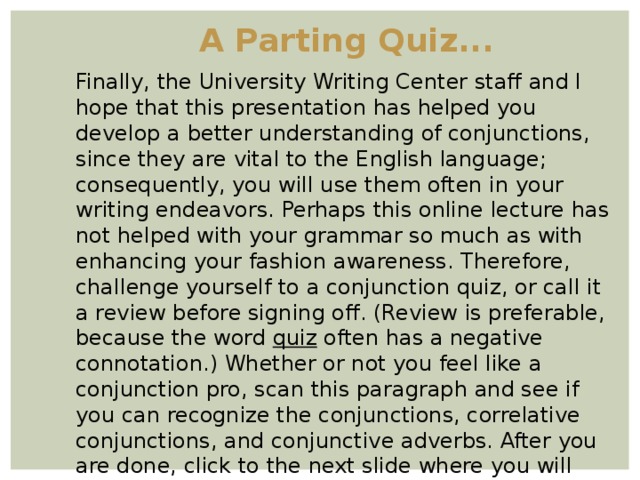
A Parting Quiz...
Finally, the University Writing Center staff and I hope that this presentation has helped you develop a better understanding of conjunctions, since they are vital to the English language; consequently, you will use them often in your writing endeavors. Perhaps this online lecture has not helped with your grammar so much as with enhancing your fashion awareness. Therefore, challenge yourself to a conjunction quiz, or call it a review before signing off. (Review is preferable, because the word quiz often has a negative connotation.) Whether or not you feel like a conjunction pro, scan this paragraph and see if you can recognize the conjunctions, correlative conjunctions, and conjunctive adverbs. After you are done, click to the next slide where you will find the answers.

Answers...
cc : correlative conjunction sc : subordinate conjunction
ca : conjunctive adverb c2 : correlative conjunction
Finally (ca) , the University Writing Center staff and (cc) I hope that this presentation has helped you to develop a better understanding of conjunctions, since (sc) they are vital to the English language; consequently (ca) , you will use them often in your writing endeavors. Perhaps this online lecture has not (c2) helped with your grammar so much as (c2) with enhancing your fashion awareness. Therefore, challenge yourself to a conjunction quiz, or call it a review before (sc) signing off. (Review is preferable, because (sc) the word quiz often has a negative connotation.) Whether or (c2) not you feel like a conjunction pro, scan this paragraph and see if (sc) you can recognize the conjunctions, correlative conjunctions, and conjunctive adverbs. After (sc) you are done, click to the next slide where (sc) you will find the answers.
Вебинар для учителей

Свидетельство об участии БЕСПЛАТНО!



