
«Daily routines»
Урок в 5 классе с углубленным изучением английского языка на тему: "Daily routines". Отработка Present Simple Tense.Учебник: Starlight 5 класс.
Автор: Гензе Ольга Владимировна, МБОУ «Школа 132» Ново-Савиновского района г.Казани, учитель английского языка первой квалификационной категории. Открытый урок по теме «Day after day» в 5 А,Б классе МБОУ «Школа №132» г. Казани
Образовательные цели урока:
- активизация лексики
-закрепление грамматического материала
- тренировать учащихся в развитии навыков аудирования
Воспитательные цели урока:
- соблюдать режим дня
- уважительно относиться к людям разных профессий
I. Организационный момент
II. Vocabulary practice. (SB p.44)Look at the board. What are we going to discuss today?(Daily routines)
Yes, we are going to discuss daily routines.
III. Speaking
Listen to the sounds and make up the sentences about yourself using time expressions.(слайд со звуками, по мере того, как отгадывается действие, появляется картинка с этим действием).
IV. Vocabulary. Learning words can be fun. Let’s revise our daily activities singing our song. (исполняется песня This is the way…)
V. Look at the board. Do you know this man? Is his job interesting? Well, we are going to speak about his daily routines. Open your textbooks to page 45. Learning new words, vocabulary is very important. Let me see how well you know the words. You have cards on your desks. Make up word combinations with new words. Good job!!!(учащиеся узнают персонажа из учебника, составляют словосочетания по теме из слов на карточках )(получаются следующин словосочетания:dangerous job, die without antivenin, catch from their enclosures, to molk snakes in the laboratory, )
VI. Reading. Now, open your SB to p.45 and read the sentences that show what Bill does in the morning, in the afternoon, in the evening. I see that you understand this text.(учащиеся находят в тексте предложения и зачитывают их….)
VII. Grammar. Well done! Learning new words is good, but this is not enough, there is NO language without grammar. What time do we use when we speak about every day activities?
Right. The Present Simple tense. What do we use the Pr Simple tense for? What can we express with this tense? Yes, daily routines, habits and permanent states. Give me an example, please, of daily routine, habit and permanent state.
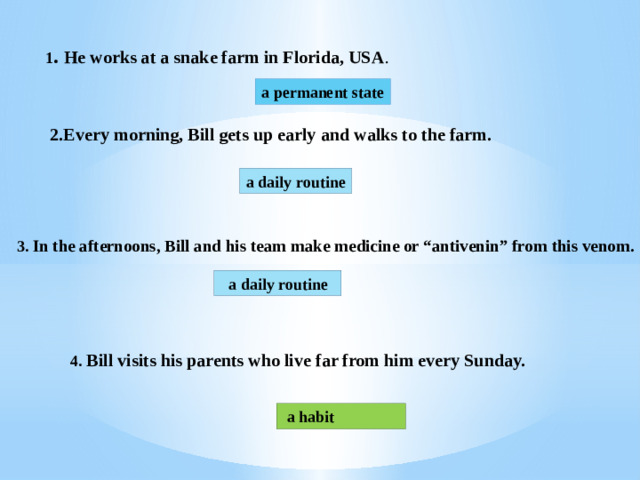
Read the sentences and tell me if it is a daily activity, a habit or a permanent state(на слайде появляются предложения, учащиеся зачитывают их и определяют его тип(a daily activity, a habit or a permanent state.)
Good job!
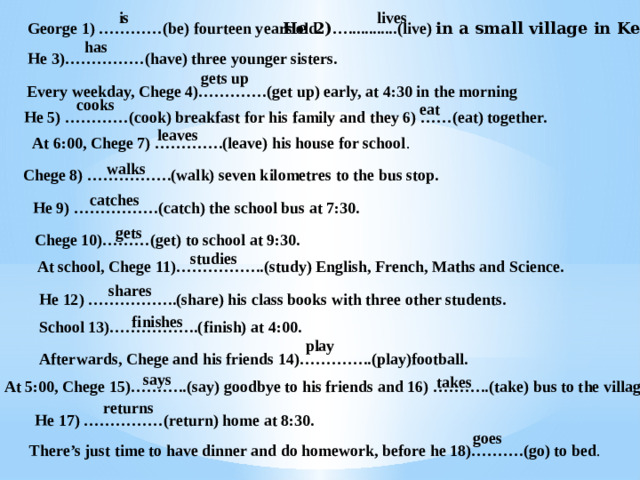
VIII. Let’s have some grammar practice. Open the brackets using the Pr Simple Tense. (на слайде презентации появляются предложения, учащинся открыват скобки, использую время Present Simple Tense).
IX. I see that you are tired. Let’s relax. Stand up and let’s dance and sing our Penguin Song. (далее следует физкультминутка с аудио и видеосопровождением).
X. Listening.Do you want to know about the daily routines in other countries? Ok. I have a surprise for you. I’ve got a sound letter from Louise. She is from the USA.
Before we listen to her, let’s study the questions you are going to answer after we listen to Louise.(звучит запись интервью, далее учащиеся отвечают на вопросы по аудированию).
Well done.
XI. You we very active today. But you need to do some work at home. Let’s put it down.
XII. Reflexion
Просмотр содержимого документа
«"Daily routines"»
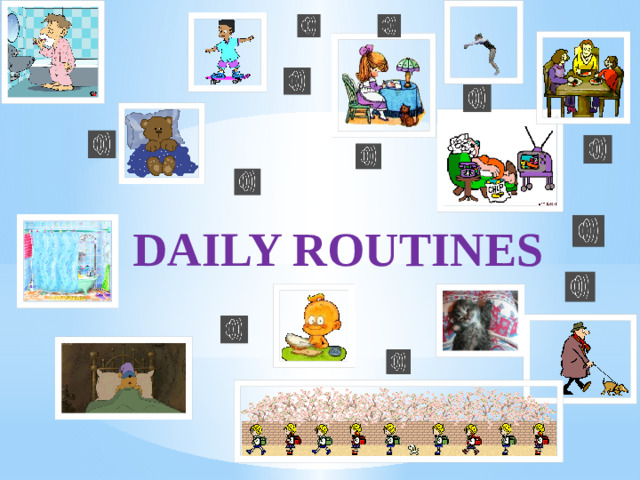
DAILY ROUTINES

1 . He works at a snake farm in Florida, USA .
a permanent state
2.Every morning, Bill gets up early and walks to the farm.
a daily routine
3. In the afternoons, Bill and his team make medicine or “antivenin” from this venom.
a daily routine
4. Bill visits his parents who live far from him every Sunday.
a habit
is
lives
George 1) …………(be) fourteen years old.
He 2) …............(live) in a small village in Kenya.
has
He 3)……………(have) three younger sisters.
gets up
Every weekday, Chege 4)………….(get up) early, at 4:30 in the morning
cooks
eat
He 5) …………(cook) breakfast for his family and they 6) ……(eat) together.
leaves
At 6:00, Chege 7) ………….(leave) his house for school .
walks
Chege 8) …………….(walk) seven kilometres to the bus stop.
catches
He 9) …………….(catch) the school bus at 7:30.
gets
Chege 10)………(get) to school at 9:30.
studies
At school, Chege 11)……………..(study) English, French, Maths and Science.
shares
He 12) ……………..(share) his class books with three other students.
finishes
School 13)……………..(finish) at 4:00.
play
Afterwards, Chege and his friends 14)…………..(play)football.
says
takes
At 5:00, Chege 15)………..(say) goodbye to his friends and 16) ………..(take) bus to the village .
returns
He 17) ……………(return) home at 8:30.
goes
There’s just time to have dinner and do homework, before he 18)……….(go) to bed .

likes
It’s a very long day for Chege but he 19)………….(like) going to school.
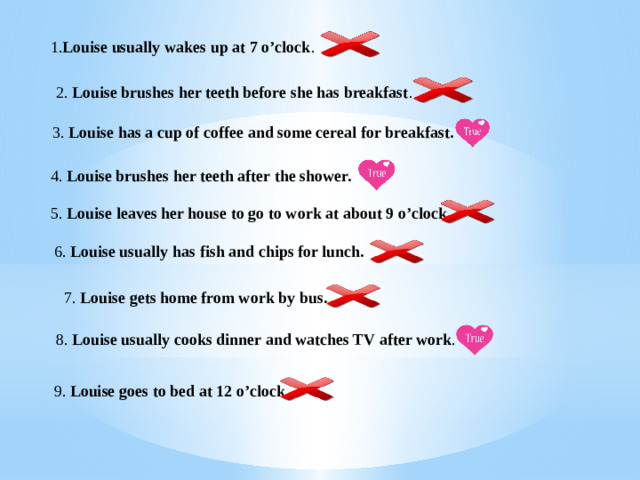
1. Louise usually wakes up at 7 o’clock .
2. Louise brushes her teeth before she has breakfast .
3. Louise has a cup of coffee and some cereal for breakfast.
4. Louise brushes her teeth after the shower.
5. Louise leaves her house to go to work at about 9 o’clock .
6. Louise usually has fish and chips for lunch.
7. Louise gets home from work by bus.
8. Louise usually cooks dinner and watches TV after work .
9. Louise goes to bed at 12 o’clock .

Write about your daily routine