Россия, Саратов

СДЕЛАЙТЕ СВОИ УРОКИ ЕЩЁ ЭФФЕКТИВНЕЕ, А ЖИЗНЬ СВОБОДНЕЕ
Благодаря готовым учебным материалам для работы в классе и дистанционно
Скидки до 50 % на комплекты
только до
Готовые ключевые этапы урока всегда будут у вас под рукой
Организационный момент
Проверка знаний
Объяснение материала
Закрепление изученного
Итоги урока
Была в сети 17.04.2026 07:04

Рогоза Надежда Александровна
учитель английского языка
29 лет
 2 006
2 006
 35 167
Местоположение
Презентация на тему: "Definition of Case"
Категория:
Английский язык
18.06.2019 00:34

Просмотр содержимого документа
«Презентация на тему: "Definition of Case"»

Definition of Case. Number of Case.
Rogoza N., 412

- Case is a morphological category which has a distinct syntactic significance, as it denotes relations of nouns towards other words in the word-group or sentence.

J.C. Nesfield mentions 5 cases:
nominative
genitive
vocative
accusative
dative

Rain falls.
- When a noun is used as subject, it is said to be in the nominative case

Are you coming, my friend ?
- When a noun is used for the sake of address, it is said to be in the vocative case

Mary took the money.
- When a noun is a direct object, it is said to be in the accusative case

I gave the boy a penny.
- When a noun is an indirect object, it is said to be in the dative case

According to B.S. Khaimovich and B.L. Rogovskaya
- Every grammatical category should comprise a limited number of members.
- Analytical forms are generally singled out as opposed to synthetic forms.
the house of your neighbour
=
your neighbour’s house
- There is much subjectivity in the choice of prepositions

According to A.I. Smirnitsky
- Nouns and personal pronouns belong to different parts of speech
- The group of personal pronouns is rather small.
- Nouns lack special inflections for the nominative and the objective
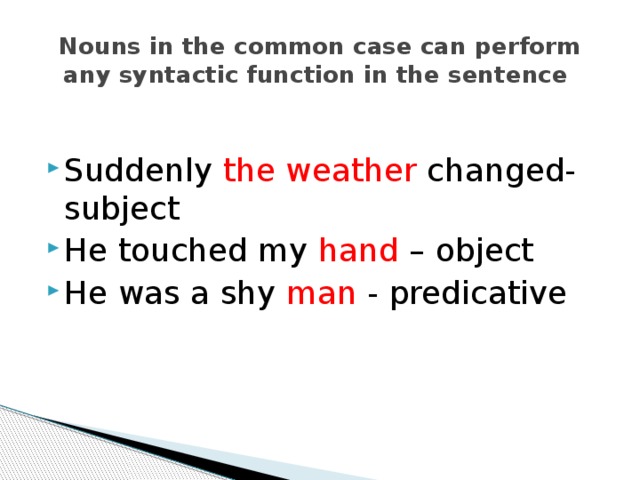
Nouns in the common case can perform any syntactic function in the sentence
- Suddenly the weather changed- subject
- He touched my hand – object
- He was a shy man - predicative
Вебинар для учителей

Свидетельство об участии БЕСПЛАТНО!