Россия, Екатеринбург

СДЕЛАЙТЕ СВОИ УРОКИ ЕЩЁ ЭФФЕКТИВНЕЕ, А ЖИЗНЬ СВОБОДНЕЕ
Благодаря готовым учебным материалам для работы в классе и дистанционно
Скидки до 50 % на комплекты
только до
Готовые ключевые этапы урока всегда будут у вас под рукой
Организационный момент
Проверка знаний
Объяснение материала
Закрепление изученного
Итоги урока
Была в сети 05.06.2026 18:24

Тигранян Астхик Ишхановна
педагог дополнительного образования
43 года
 1 422
1 422
 49 350
Местоположение
Специализация
Driving in Great Britain
Категория:
Английский язык
13.01.2021 07:08

Просмотр содержимого документа
«Driving in Great Britain»

What is it like to drive in Britain?
- What side of the road do the British drive on?
- What is the minimum age for driving a car in GB?
- What is a lane?
- What is the difference between “motorway” and “dual carriageway”?
- Who has priority at the roundabout?


In Britain
we drive on the left-hand
side of the road,
so the steering wheel
is on the right .
However, the pedals are in the same position as in left-handed cars,
with the accelerator (gas pedal) on the right.
The gears and almost always the handbrake (parking brake) is operated with the left hand.

Petrol
- Petrol (Gas) in Britain is one of the most expensive in the world.
- We pay on average 95 pence a litre.

You can park only if you see this sign and pay for the parking at the parking meter

SEATBELTS
- The wearing of front seat belts was made mandatory for motorists in 1983.
- We have seatbelts even in coaches. It is against the law not to wear them while travelling.

Minimum driving age in the UK
- The minimum age for driving a car in the UK is 17,
- and 16 for riding a moped or motorbike with a maximum engine capacity of 50cc.

Roads
- There are some 225,000 miles (362,000 km) of roads in Britain.
- Many of the roads are built on the old roads laid down by the Romans centuries ago.
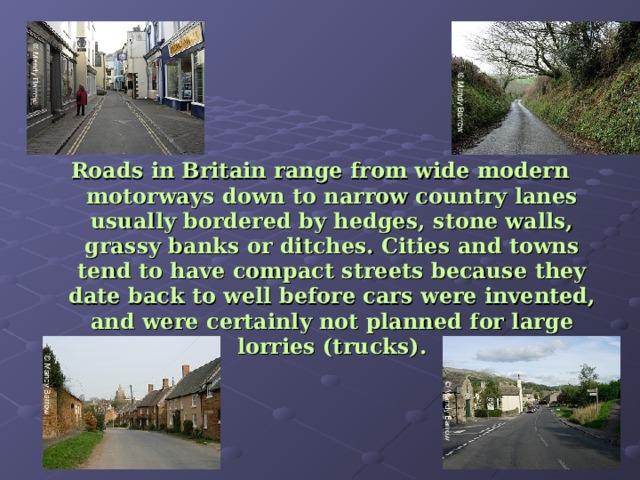
Roads in Britain range from wide modern motorways down to narrow country lanes usually bordered by hedges, stone walls, grassy banks or ditches. Cities and towns tend to have compact streets because they date back to well before cars were invented, and were certainly not planned for large lorries (trucks).

In Britain, our three main roads are
- " M " roads, " A " roads, and " B " roads.
- " M " roads are like American freeways. They are known as motorways and are fast roads. They have three or four lanes .
- " A " roads are not controlled-access: they range from two-lane divided highways ("dual carriageways") down to one-lane roads . They are the main routes between towns.
- " B " roads are the smaller of the three. They may be in the open or have impenetrable foliage right up to the road. Road markings (curves, etc.) may be sparse.

M25 motorway

Some motorways have tolls
- You pay a fee to drive there.
- The first toll motorway , the M6 Toll, opened in December 2003 to ease motorway congestion in the West Midlands.
- The 43-kilometre expressway cuts journey times around Birmingham by an estimated 45 minutes.

What is the National Speed Limit for driving in the UK?
- All speed limits and distances, on signs, are given in miles or miles per hour.
- 1 mile is about 1.6 km.
- Round signs indicate speed limits
with the limit amount circled by a red band. When the speed limit has stopped then there is a black line at an angle crossing over a white circle.

The National Speed limits
- Motorways and dual carriage ways: 112km/h / 70mph
- Unrestricted single carriageway roads: 96km/h / 60mph
- Built up areas e.g. towns and villages: 48km/h / 30mph
- Residential areas:
- 35km/h / 20mph

Type of Vehicles
Built-up Areas
National Speed limits - unless you are one of the following groups
30
Cars towing caravans & t railers
Single Carriageway
30
Buses and Coaches (Less than 12 meters long)
60
Dual Carriageway
70
Goods Vehicles (less than 7.5 tonnes max laden weight)
30
Motorways
50
HGV's (more than 7.5 tonnes max laden weight)
70
30
60
50
30
60
60
50
40
70
60
70
50
60

Roundabouts
- We have many roundabouts (traffic circles) in Britain.
- Traffic on the roundabouts have priority over cars coming
onto the roundabout.



Вебинар для учителей
Свидетельство об участии БЕСПЛАТНО!