Казахстан, Кызылорда

СДЕЛАЙТЕ СВОИ УРОКИ ЕЩЁ ЭФФЕКТИВНЕЕ, А ЖИЗНЬ СВОБОДНЕЕ
Благодаря готовым учебным материалам для работы в классе и дистанционно
Скидки до 50 % на комплекты
только до
Готовые ключевые этапы урока всегда будут у вас под рукой
Организационный момент
Проверка знаний
Объяснение материала
Закрепление изученного
Итоги урока
Была в сети 03.06.2025 22:28
Байдүйсенова Жансая Нурланқызы
учитель английского языка
 2 768
2 768
 25 433
Местоположение
Специализация
Food for Thought
Категория:
Английский язык
28.01.2018 20:04

Просмотр содержимого документа
«Food for Thought»
 Approved:
________________________
Kyzylorda region, Shiely district
English teacher of
№ 45 “Ak Orda” school-gymnasium
Kussepova Gulzat Tungushbaevna
LESSON PLAN
| I quarter | Grade: 10 “Ә” |
| 45 minutes | Subject: English |
| The theme | Food for Thought | |||
| The aims of the lesson |
| |||
| The expected result
|
| |||
| The main idea | They will listen to the text and do tasks according to the text. Work individually to read the text. | |||
| Steppes | Warm-up “Questionnaire” Team work “Reading for gist” Team work “Discussion” Individual work “Find out” | |||
| Assessment |
| |||
| Homework | ex.18 p.66 Use Infinitives | |||
| Next reading | Ecological Associations. Ecological problems | |||
Teacher’s notes about the lesson (what will teacher and students do during the lesson?)
Organization moment
Greeting
Warm-up
*Compete the diagramme.
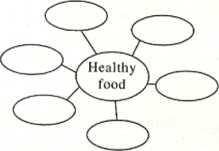
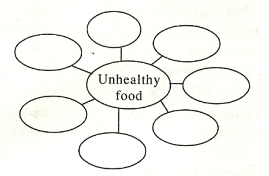
*Discuss the following questions in small groups.
Are you healthy?
Do you eat things that are good for you?
Do you think about your diet?
Do you ever eat too much / too little?
Do you take vitamins?
Dividing the class into groups (two groups)
Divide the class with using numbers
Team work “Reading for gist”
*Read the letter to a teenage magazine.
*Read Mary’s letter again. Make a list of criticisms and suggestions, like this: She shouldn't have worried about putting on a little weight
*In a small group discuss what methods of losing weight you can suggest.
I'm writing about the weight problem I had. I always weigh seven stone. And I wanted to stay that way. But a year ago I put on weight. Half a stone to be precise. I was worrying about my weight. I started to exercise madly and to cut down seriously on the amount of food that I ate. At home, I started to skip breakfast, I didn't eat much dinner either, but in the mirror I still seemed fat and I hated myself. For school my parents made me a packed lunch every day, but each lunch time I always gave it to the birds. Once my teacher phoned my parents and told what was going on. When they found out they were so worried about me. I didn't want to let them down. I tried to eat more, but I couldn't. I realized that it was serious when I collapsed. I was taken to the anorexia clinic. I feel much better now.
The worst is over.
Mary
half a stone = 3.175 kilos seven stone = 44.45 kilos
Assessment: memory tree
Team work “Discussion”
*Read and discuss
• You know it will make you feel guilty.
• You think it might give a headache.
• You know it’s not exactly a health-food.
• You know it can cause skin problems, like spots.
• But you’re still going to eat a whole box of chocolates without stopping because you've just got to.
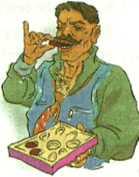
Remember!
The word chocolate is both countable and uncountable.
• Would you like some chocolate? (a piece of a block)
•Would you like a chocolate? (an individual sized chocolate from a box)
Assessment: discussion
Individual work “Find out”
*Read the short text.
CHOCOMANIA
If you do a survey among your friends you might discover an amazing thing. The addiction that affects most people is neither alcohol nor nicotine. It’s chocolate. Most people can’t resist soft, sweet, fresh chocolate and they eat it quite regularly. Apart from the effect on your pocket and your waistline, the habit is neither harmful nor illegal and most chocolate addicts get away
| happily with at least one a day. |
|
| b) Conduct a class survey to see how much chocolate everyone eats in | |
| Identify how many |
|
| The chocophilies (those who like chocolate) - | □ |
| the chocomanies (those who love it) - | □ |
| the chocophobes (those who hate it) - | □ |
Find out
• about their favourite type of chocolate
• when / in what situations they have a chocolate snack
• how often they eat chocolate
• if there are any harmful consequences of eating too much chocolate
• if it’s possible to give it up
Two stars and a wish
Expression of students about the lesson
What was difficult for you today?
Why was it difficult?
How can you solve this problem?
Вебинар для учителей
Свидетельство об участии БЕСПЛАТНО!