

Казахстан, Алматы

СДЕЛАЙТЕ СВОИ УРОКИ ЕЩЁ ЭФФЕКТИВНЕЕ, А ЖИЗНЬ СВОБОДНЕЕ
Благодаря готовым учебным материалам для работы в классе и дистанционно
Скидки до 50 % на комплекты
только до
Готовые ключевые этапы урока всегда будут у вас под рукой
Организационный момент
Проверка знаний
Объяснение материала
Закрепление изученного
Итоги урока
Была в сети 08.06.2017 08:50

Cерикбаева Асия Умбетбаевна
учитель английского языка
 1 802
1 802
 39 513
Местоположение
GERUND and INFINITIVE
Категория:
Английский язык
01.06.2017 06:34

Просмотр содержимого документа
«GERUND and INFINITIVE»

GERUNDS. INFINITIVES.
CONSTRUCTIONS.
ГЕРУНДИЙ
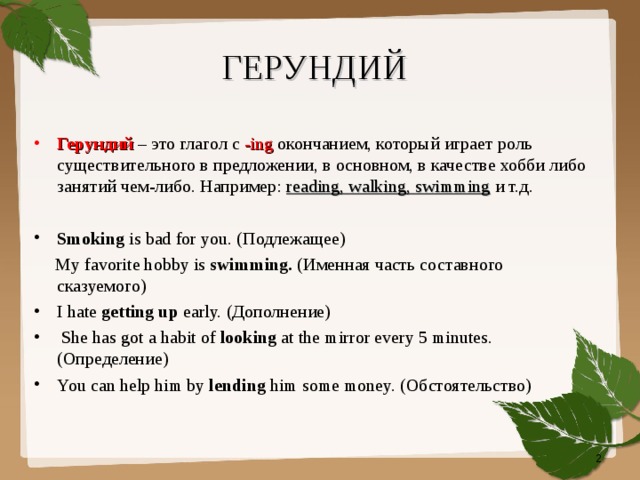
- Герундий – это глагол с -ing окончанием, который играет роль существительного в предложении, в основном, в качестве хобби либо занятий чем-либо. Например: reading, walking, swimming и т.д.
- Smoking is bad for you. ( Подлежащее)
My favorite hobby is swimming. ( Именная часть составного сказуемого)
- I hate getting up early. ( Дополнение)
- She has got a habit of looking at the mirror every 5 minutes. ( Определение)
- You can help him by lending him some money. ( Обстоятельство)
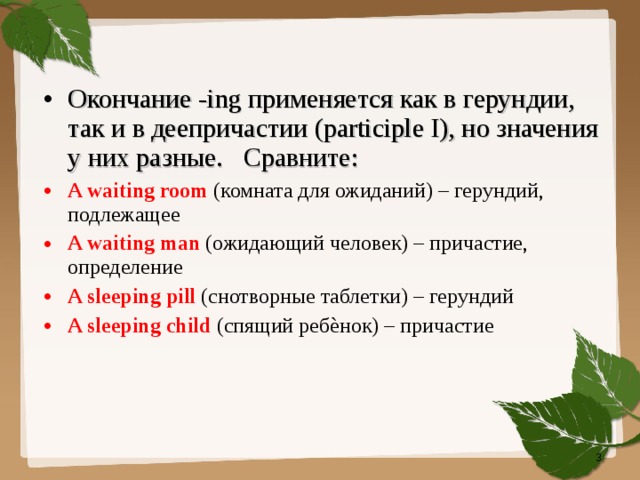
- Окончание -ing применяется как в герундии, так и в деепричастии (participle I), но значения у них разные. Сравните:
- A waiting room (комната для ожиданий) – герундий, подлежащее
- A waiting man (ожидающий человек) – причастие, определение
- A sleeping pill (снотворные таблетки) – герундий
- A sleeping child (спящий ребѐнок) – причастие

Герундий имеет формы времени Indefinite/Perfect и залога Active/Passive.
Если действие, выраженное герундием, совершается лицом (или предметом), то герундий употребляется в форме Active.
John likes washing his dog. ( Джону нравиться мыть свою собаку.)
I remember having told the news. ( Я помню, как рассказал новости.)
Если же действие, выраженное герундием, совершается над лицом
(предметом), то употребляется герундий в форме Passive.
The dog likes being washed by John. ( Собаке нравится быть мытой
Джоном.)
I remember having been told the news. ( Я помню, как мне рассказали
новость.)
They are angry about not having been invited. ( Они злы на то, что их не
пригласили.)
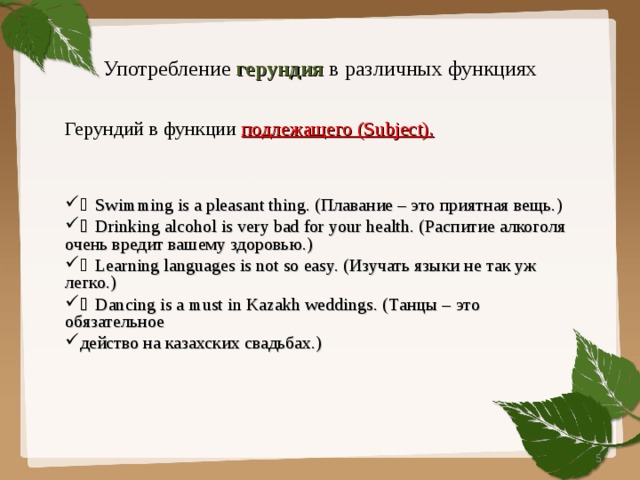
Употребление герундия в различных функциях
Герундий в функции подлежащего ( Subject).
- Swimming is a pleasant thing. ( Плавание – это приятная вещь.)
- Drinking alcohol is very bad for your health. ( Распитие алкоголя очень вредит вашему здоровью.)
- Learning languages is not so easy. ( Изучать языки не так уж легко.)
- Dancing is a must in Kazakh weddings. ( Танцы – это обязательное
- действо на казахских свадьбах.)

Герундий в функции части составного именного/глагольного сказуемого ( Complement Predicative)
- Герундий в функции части составного именного/глагольного
сказуемого ( Complement Predicative), где сказуемыми являются глагол “ to be” и глаголы, требующие после себя глагольного герундия.
- My favorite activity is reading novels. ( часть сост.имен.сказ.) (Моѐ любимое занятие – это чтение романов.)
- The greatest pleasure was dancing in the rain. ( часть сост.имен.сказ.) (Самым большим удовольствием были танцы под дождѐм.)
- He began reading the text. ( часть сост.глагольн.сказ.) (Он начал читать текст.)
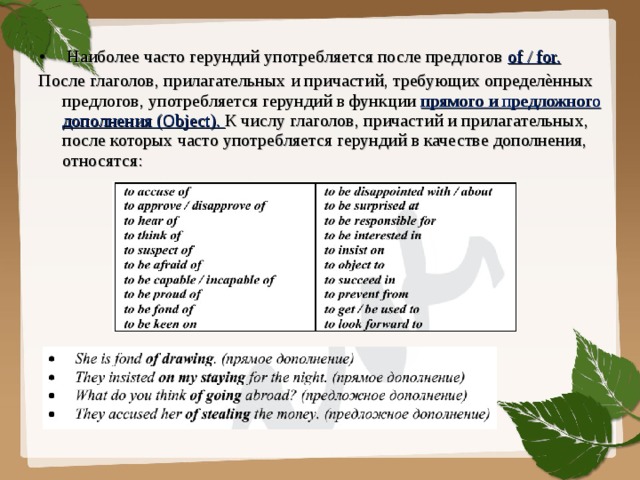
- Наиболее часто герундий употребляется после предлогов of / for.
После глаголов, прилагательных и причастий, требующих определѐнных предлогов, употребляется герундий в функции прямого и предложного дополнения (Object). К числу глаголов, причастий и прилагательных, после которых часто употребляется герундий в качестве дополнения, относятся:

- Герундий может употребляться без предшествующего предлога в функции прямого дополнения (direct object). К числу глаголов, после которых употребляется герундий без предлога, относятся:
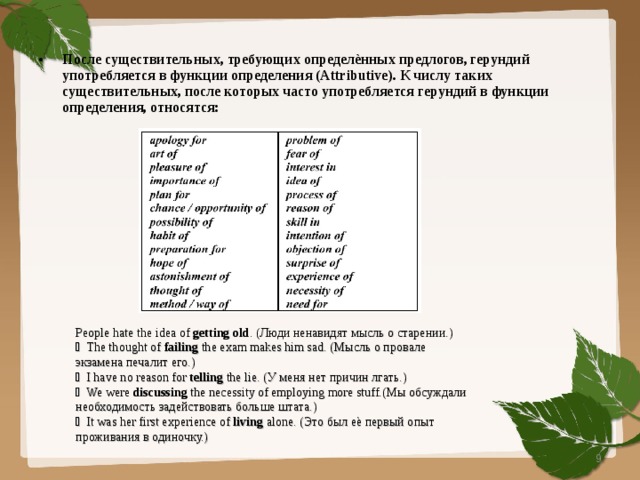
- После существительных, требующих определѐнных предлогов, герундий употребляется в функции определения (Attributive). К числу таких существительных, после которых часто употребляется герундий в функции определения, относятся:
People hate the idea of getting old . ( Люди ненавидят мысль о старении.)
The thought of failing the exam makes him sad. ( Мысль о провале
экзамена печалит его.)
I have no reason for telling the lie. ( У меня нет причин лгать.)
We were discussing the necessity of employing more stuff.( Мы обсуждали
необходимость задействовать больше штата.)
It was her first experience of living alone. ( Это был еѐ первый опыт
проживания в одиночку.)
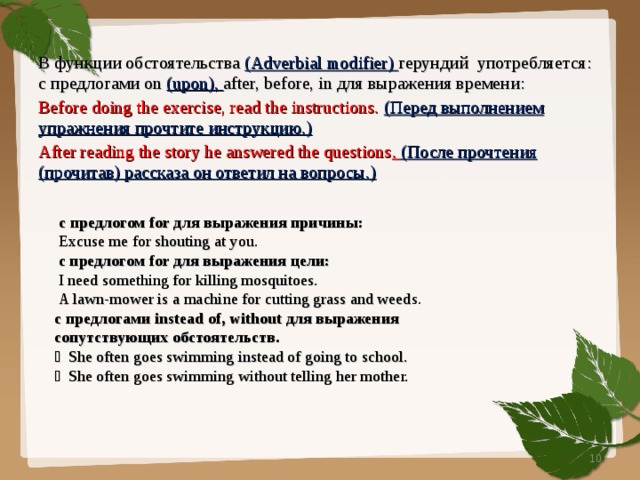
В функции обстоятельства ( Adverbial modifier) герундий употребляется: с предлогами on (upon), after, before, in для выражения времени:
Before doing the exercise, read the instructions. ( Перед выполнением упражнения прочтите инструкцию.)
After reading the story he answered the questions . ( После прочтения (прочитав) рассказа он ответил на вопросы.)
с предлогом for для выражения причины:
Excuse me for shouting at you.
с предлогом for для выражения цели:
I need something for killing mosquitoes.
A lawn-mower is a machine for cutting grass and weed s.
с предлогами instead of, without для выражения сопутствующих обстоятельств.
She often goes swimming instead of going to school.
She often goes swimming without telling her mother.
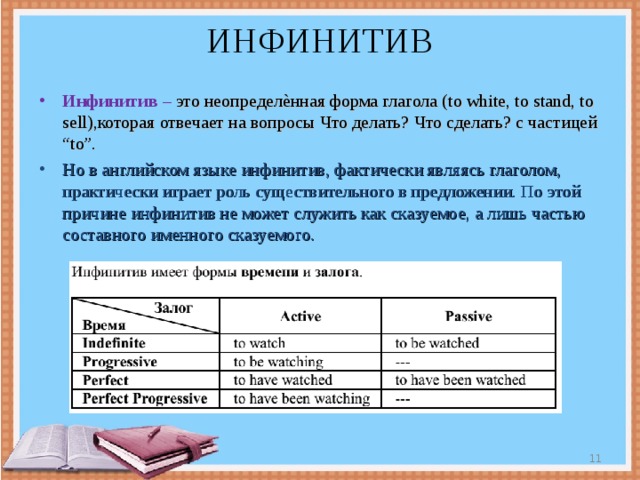
ИНФИНИТИВ
- Инфинитив – это неопределѐнная форма глагола (to white, to stand, to sell),которая отвечает на вопросы Что делать? Что сделать? с частицей “to”.
- Но в английском языке инфинитив, фактически являясь глаголом, практически играет роль существительного в предложении. По этой причине инфинитив не может служить как сказуемое, а лишь частью составного именного сказуемого.
![Indefinite (Simple) Infinitive Active [to V1] I want to see the manager. ( Я хочу видеть менеджера.) He planned to study abroad. ( Он планировал учиться за рубежом.) Indefinite (Simple) Infinitive Passive [to be V3] She hopes to be chosen for the national team. ( Она надеется быть избранной в национальную команду.) She loves to be loved. ( Ей нравится быть любимой.) Progressive (Continuous) Infinitive Active [to be Ving] It’s nice to be talking here with you.( Приятно вот так вот с вами здесь беседовать.) He is said to be living here. ( Говорят, что он здесь живѐт.) Perfect Infinitive Active [to have V3] It’s nice to have read his book. ( Приятно прочесть его книгу.) I’m glad to have seen her. ( Я рад, что увидел еѐ.) He is said to have lived in village. ( Говорят, что он жил в деревне.) The ship is thought to have returned to India. ( Считают, что корабль вернулся в Индию.) We hope to have finished the job soon. ( Надеемся, что скоро закончим работу.)](https://static.multiurok.ru/multiurok/html/2017/06/01/s_592f8b1930c30/img11.jpg)
- Indefinite (Simple) Infinitive Active [to V1]
- I want to see the manager. ( Я хочу видеть менеджера.)
- He planned to study abroad. ( Он планировал учиться за рубежом.)
- Indefinite (Simple) Infinitive Passive [to be V3]
- She hopes to be chosen for the national team. ( Она надеется быть избранной в национальную команду.)
- She loves to be loved. ( Ей нравится быть любимой.)
- Progressive (Continuous) Infinitive Active [to be Ving]
- It’s nice to be talking here with you.( Приятно вот так вот с вами здесь беседовать.)
- He is said to be living here. ( Говорят, что он здесь живѐт.)
- Perfect Infinitive Active [to have V3]
- It’s nice to have read his book. ( Приятно прочесть его книгу.)
- I’m glad to have seen her. ( Я рад, что увидел еѐ.)
- He is said to have lived in village. ( Говорят, что он жил в деревне.)
- The ship is thought to have returned to India. ( Считают, что корабль вернулся в Индию.)
- We hope to have finished the job soon. ( Надеемся, что скоро закончим работу.)
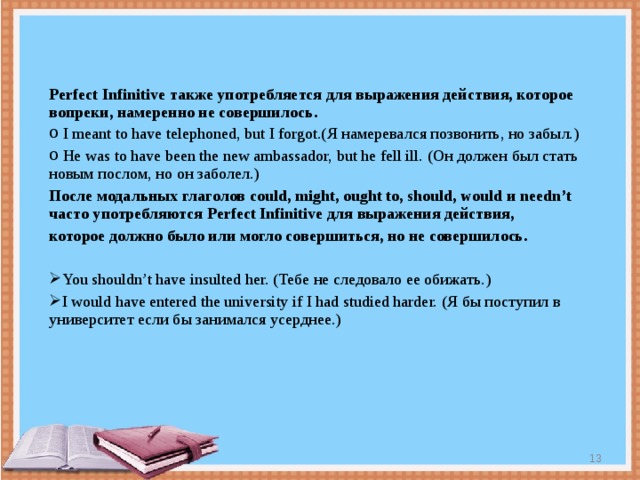
Perfect Infinitive также употребляется для выражения действия, которое вопреки, намеренно не совершилось.
- I meant to have telephoned, but I forgot.( Я намеревался позвонить, но забыл.)
- He was to have been the new ambassador, but he fell ill. ( Он должен был стать новым послом, но он заболел.)
После модальных глаголов could, might, ought to, should, would и needn’t часто употребляются Perfect Infinitive для выражения действия,
которое должно было или могло совершиться, но не совершилось.
- You shouldn’t have insulted her. ( Тебе не следовало ее обижать.)
- I would have entered the university if I had studied harder. ( Я бы поступил в университет если бы занимался усерднее.)
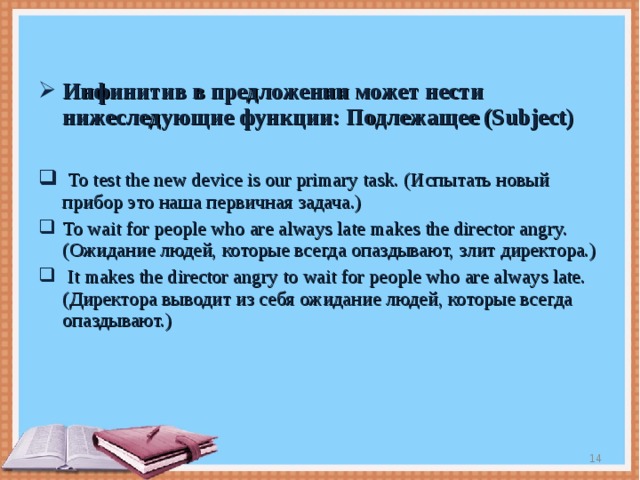
- Инфинитив в предложении может нести нижеследующие функции: Подлежащее ( Subject)
- To test the new device is our primary task. ( Испытать новый прибор это наша первичная задача.)
- To wait for people who are always late makes the director angry.( Ожидание людей, которые всегда опаздывают, злит директора.)
- It makes the director angry to wait for people who are always late.( Директора выводит из себя ожидание людей, которые всегда опаздывают.)

Дополнение (Object)
Инфинитив употребляется в функции дополнения, если стоит после определенных глаголов-сказуемых (см. ниже).
She asked to wait for her a little. (Она попросила подождать еѐ немного.)
They want to dance. ( Они хотят танцевать.)
I am planning to finish my project by midnight. ( Я планирую закончить
свой проект к полуночи.)

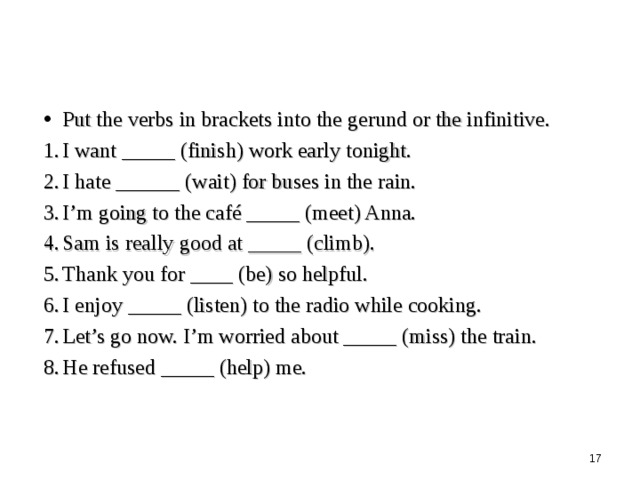
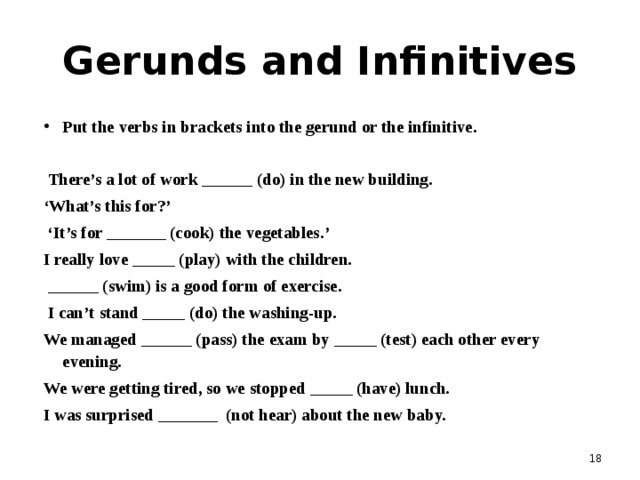
- Put the verbs in brackets into the gerund or the infinitive.
- I want _____ (finish) work early tonight.
- I hate ______ (wait) for buses in the rain.
- I’m going to the café _____ (meet) Anna.
- Sam is really good at _____ (climb).
- Thank you for ____ (be) so helpful.
- I enjoy _____ (listen) to the radio while cooking.
- Let’s go now. I’m worried about _____ (miss) the train.
- He refused _____ (help) me.
Gerunds and Infinitives
- Put the verbs in brackets into the gerund or the infinitive.
There’s a lot of work ______ (do) in the new building.
‘ What’s this for?’
‘ It’s for _______ (cook) the vegetables.’
I really love _____ (play) with the children.
______ (swim) is a good form of exercise.
I can’t stand _____ (do) the washing-up.
We managed ______ (pass) the exam by _____ (test) each other every evening.
We were getting tired, so we stopped _____ (have) lunch.
I was surprised _______ (not hear) about the new baby.
Exercises
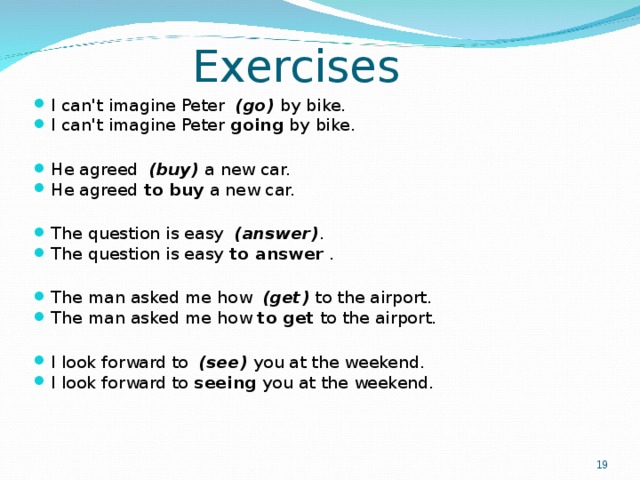
- I can't imagine Peter (go) by bike.
- I can't imagine Peter going by bike.
- He agreed (buy) a new car.
- He agreed to buy a new car.
- The question is easy (answer) .
- The question is easy to answer .
- The man asked me how (get) to the airport.
- The man asked me how to get to the airport.
- I look forward to (see) you at the weekend.
- I look forward to seeing you at the weekend.

Exercises
- Are you thinking of (visit) London?
- Are you thinking of visiting London?
- I can't imagine Peter (go) by bike.
- I can't imagine Peter going by bike.
- The question is easy (answer) .
- The question is easy to answer .
- I learned (ride) the bike at the age of 5.
- I learned to ride the bike at the age of 5.
- I look forward to (see) you at the weekend.
- I look forward to seeing you at the weekend.
- We decided (run) through the forest.
- We decided to run through the forest.
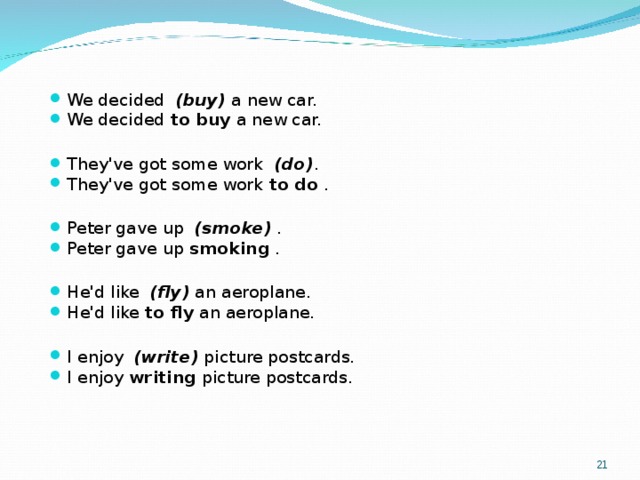
- We decided (buy) a new car.
- We decided to buy a new car.
- They've got some work (do) .
- They've got some work to do .
- Peter gave up (smoke) .
- Peter gave up smoking .
- He'd like (fly) an aeroplane.
- He'd like to fly an aeroplane.
- I enjoy (write) picture postcards.
- I enjoy writing picture postcards.

- David Beckham _______play for Manchester United.
- We _______ have a computer, but we do now.
- _______ (they) work together?
- That restaurant _________ be a clothes shop.
- She________ like him, but now they're married.
- Where_________(you) go to school?
- There ________ be a police station here.
- I _________ like vegetables, but I do now.
Complete the sentences with the affirmative, negative or interrogative form of used to
used to didn't use to didn't use to Did they use to
used to did you use to didn't use to used to
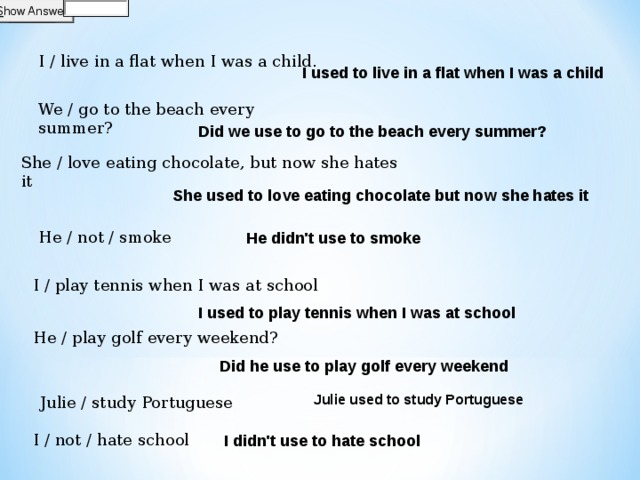
I / live in a flat when I was a child.
I used to live in a flat when I was a child
We / go to the beach every summer?
Did we use to go to the beach every summer?
She / love eating chocolate, but now she hates it
She used to love eating chocolate but now she hates it
He didn't use to smoke
He / not / smoke
I / play tennis when I was at school
I used to play tennis when I was at school
He / play golf every weekend?
Did he use to play golf every weekend
Julie / study Portuguese
Julie used to study Portuguese
I didn't use to hate school
I / not / hate school
The end





Вебинар для учителей

Свидетельство об участии БЕСПЛАТНО!



