




© 2019 1312 1


СДЕЛАЙТЕ СВОИ УРОКИ ЕЩЁ ЭФФЕКТИВНЕЕ, А ЖИЗНЬ СВОБОДНЕЕ
Благодаря готовым учебным материалам для работы в классе и дистанционно
Скидки до 50 % на комплекты
только до
Готовые ключевые этапы урока всегда будут у вас под рукой
Организационный момент
Проверка знаний
Объяснение материала
Закрепление изученного
Итоги урока

Gerunds and infinitives
Категория:
Английский язык
10.01.2019 07:24

Просмотр содержимого документа
«Gerunds and infinitives»

Gerunds and infinitives

ENGLISH PROJECT
GERUNDS

Form Simple, Active
Dancing is her favorite habit.
I prefer eating ice-cream.
Form Simple, Passive
Mary prefers being taught by a stern teacher.
The actress stayed at her hotel to avoid being seen by her fans.

Form Perfect, Active
I regret having made the remark abort her hairdo.
I regret having seen the film.
Form Perfect, Passive
The film was banned after having been seen by thousands of people.
I regret having been transferred
to another class this year.

The gerund can be used:
1. As the subject of a verb
2. As the object of a verb
3. As the object of a preposition
4. After a possessive or the possessive form
of nouns
5. After certain verbs
6. Special combination
7. F ormed by adding “not” before it.

As the subject of a verb
When a gerund is used as the subject of a verb ,
it is placed at the beginning of a sentence.
Reading romantic novels is my favourite pastime.
Smoking is hazardous to health .
Climbing mountains can be dangerous if we are not careful.
A baby’s crying woke me up last.
Walking from here to the local supermarket takes only five minutes.

Notes: The gerund is also used in the following
constructions :
1) It is no use/It is no good
e.g It is no use trying to make her change
her mind.
It is no good interfering with other people’s
business.
2) There is no
e.g There is no joking about such matters .
There is no denying the fact that the Clean
Hong Kong Campaign is a success.

3) It’s worth / It’s not worth
E.g. Is the film worth seeing ?
It is not worth going to see that film.
4) It’s a waste of money / time
E.g. It’s a waste of time writing the report.
It’s a waste of money buying the doll.

5 ) Have difficulty
E.g. Mary has difficulty doing her Maths homework .
I’m sorry I’m late. I had difficulty finding the
place.
6 ) Go-ing
E.g. Did you go shopping yesterday ?
How often do you go swimming in the
summer ?

As the object of a verb
When a gerund is used as the object of a verb
in a sentence, it is placed after the verb .
She tried to avoid getting involved in their quarrels.
He enjoys acting .
Mary disliked listening to pop music.
They hate eating fatty foods.
We all enjoy reading a good book.
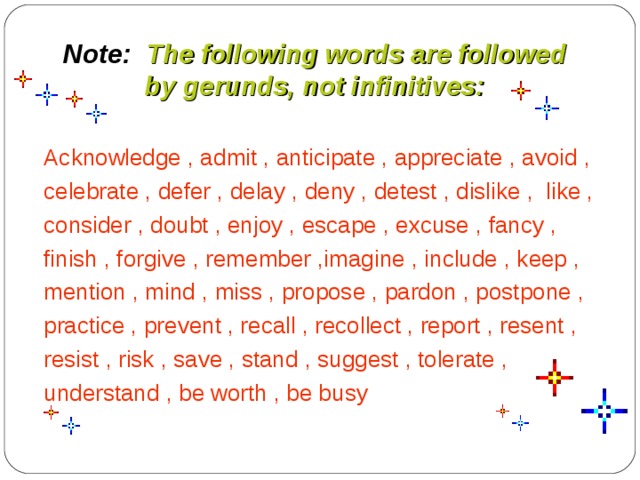
Note: The following words are followed
by gerunds, not infinitives:
Acknowledge , admit , anticipate , appreciate , avoid ,
celebrate , defer , delay , deny , detest , dislike , like ,
consider , doubt , enjoy , escape , excuse , fancy ,
finish , forgive , remember ,imagine , include , keep ,
mention , mind , miss , propose , pardon , postpone ,
practice , prevent , recall , recollect , report , resent ,
resist , risk , save , stand , suggest , tolerate ,
understand , be worth , be busy
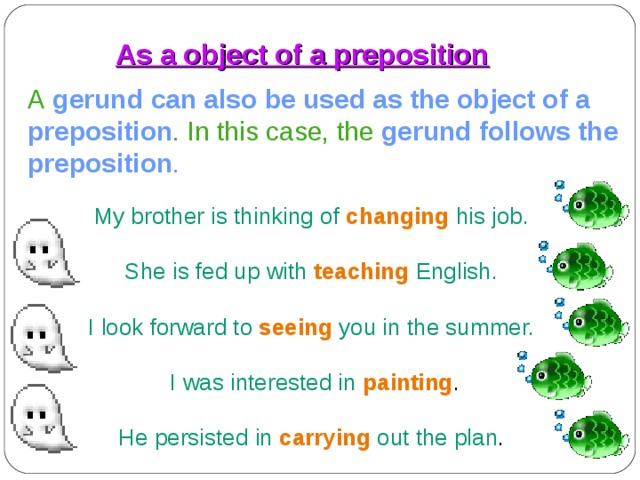
As a object of a preposition
A gerund can also be used as the object of a
preposition . In this case, the gerund follows the
preposition .
My brother is thinking of changing his job.
She is fed up with teaching English.
I look forward to seeing you in the summer.
I was interested in painting .
He persisted in carrying out the plan .

Notes1: There are two exceptions----
except and but .
e.g There was nothing left for us to do except complain
to the Consumer Council.
He did nothing but (to) watch television yesterday.
Notes2: In the following phrases, to is a
preposition.
used to , averse to , closed to , object to , devoted to ,
when it comes to , opposed to , susceptible to ,
look forward to , accustomed to , confessed to , key to
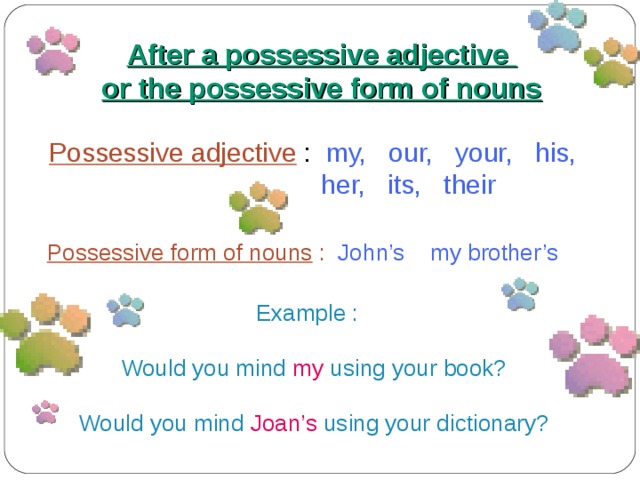
After a possessive adjective
or the possessive form of nouns
Possessive adjective : my, our, your, his,
her, its, their
Possessive form of nouns : John’s my brother’s
Example :
Would you mind my using your book?
Would you mind Joan’s using your dictionary?

After certain verbs
Avoid enjoy miss recall
appreciate finish oppose mind
resist dislike prevent waste
Examples :
1. I dislike having lunch with John.
2. Would you mind answering my question ?
3. When will you finish talking ?

7 . F ormed by adding “not” before it.
Example: I apologize for not being able to see
you off at the airport tomorrow.
He resented not having been invited
to the party.

English Project
Infinitives

Infinitive:-- bare - inf.--
- (1) After auxiliary verb
- "do , does , did , shall , should, will , would , can , could , may , might , must"
- Alice could not find the key.
- I will be glad to help you.
- (2)After verbs of perception
- "see , notice , observe , watch ,hear , feel , smell"
- I saw her get on the bus.
- He heard her say that.
- (3)After "make" & "let’’
- His joke made us laugh.
- She did not let her sister go to the party.
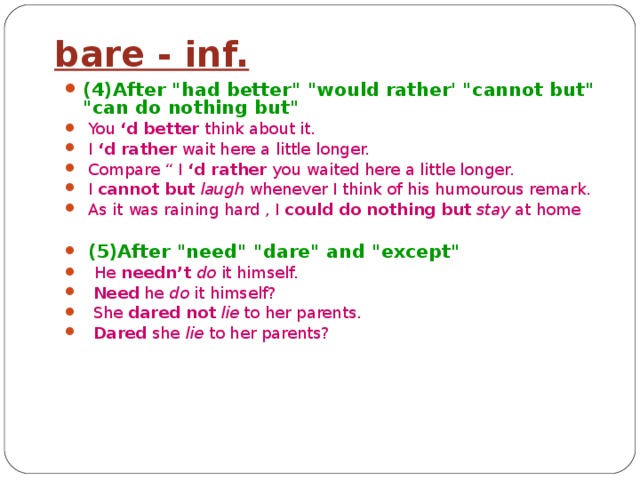
bare - inf.
- (4)After "had better" "would rather' "cannot but" "can do nothing but"
- You ‘d better think about it.
- I ‘d rather wait here a little longer.
- Compare “ I ‘d rather you waited here a little longer.
- I cannot but laugh whenever I think of his humourous remark.
- As it was raining hard , I could do nothing but stay at home
- (5)After "need" "dare" and "except"
- He needn’t do it himself.
- Need he do it himself?
- She dared not lie to her parents.
- Dared she lie to her parents?
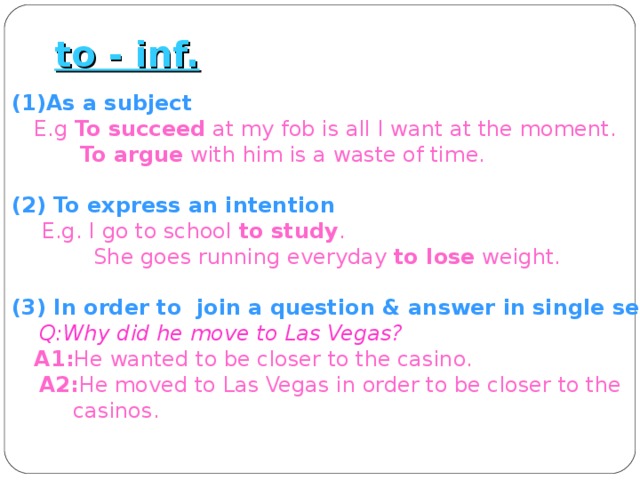
to - inf.
(1)As a subject
E.g To succeed at my fob is all I want at the moment.
To argue with him is a waste of time.
(2) To express an intention
E.g. I go to school to study .
She goes running everyday to lose weight.
(3) In order to join a question & answer in single sentence.
Q:Why did he move to Las Vegas?
A1: He wanted to be closer to the casino.
A2: He moved to Las Vegas in order to be closer to the
casinos.
to - inf.
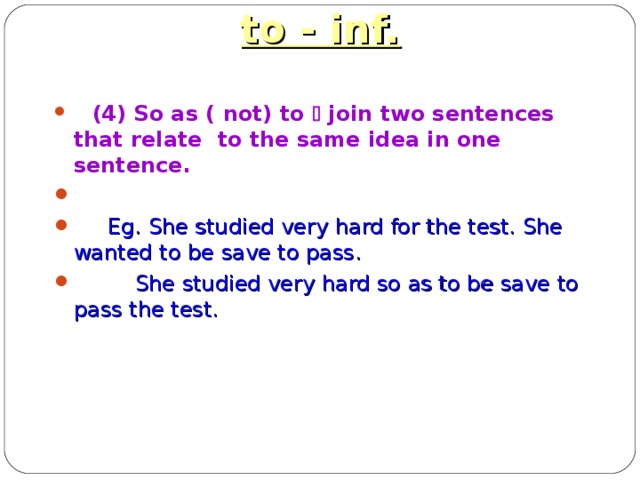
- (4) So as ( not) to join two sentences that relate to the same idea in one sentence.
- Eg. She studied very hard for the test. She wanted to be save to pass.
- She studied very hard so as to be save to pass the test.
to - inf.
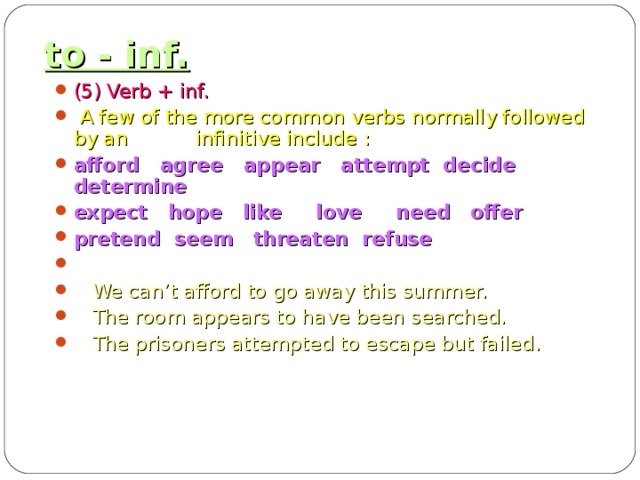
- (5) Verb + inf.
- A few of the more common verbs normally followed by an infinitive include :
- afford agree appear attempt decide determine
- expect hope like love need offer
- pretend seem threaten refuse
- We can’t afford to go away this summer.
- The room appears to have been searched.
- The prisoners attempted to escape but failed.

to - inf.
- (6) Verb + object +inf.
- A few of the more common verbs normally followed by an object + an infinitive include:
- advise allow ask encourage help invite
- know order teach tempt tell warn
- The doctor advised me to take a complete break.
- Please allow me to carry that bag for you.
- We must appoint a time to meet again.
to - inf.
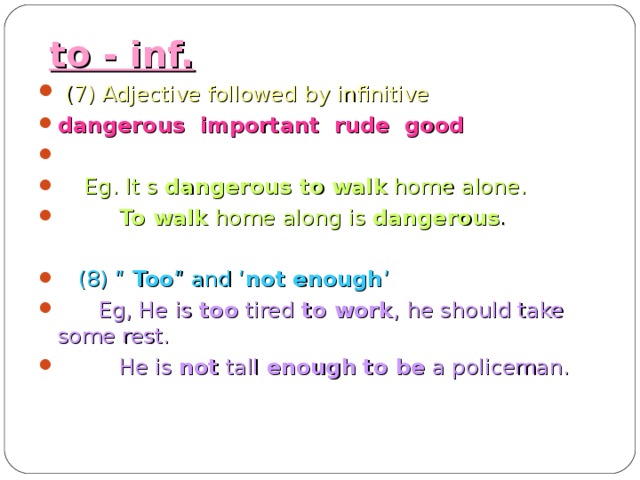
- (7) Adjective followed by infinitive
- dangerous important rude good
- Eg. It s dangerous to walk home alone.
- To walk home along is dangerous .
- (8) “ Too ” and ‘ not enough ’
- Eg, He is too tired to work , he should take some rest.
- He is not tall enough to be a policeman.

Comparison between GERUNDS and INFINITIVE

Comparison between GERUNDS and INFINITIVE
- (1) Some verbs followed by GERUNDS or INFINITIVES w ithout there being any change in meaning .
- Such verbs include ‘ start , begin ,cease, continue and can’t bear’ .
- ( 2) Those which can be followed by either without any difference in meaning.
- Eg. They continued to - work after lunch.
- - working
- - working
- - working
Comparison between GERUNDS and INFINITIVE
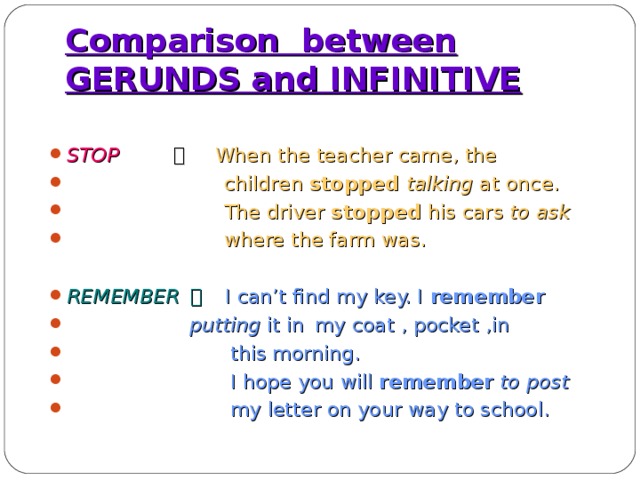
- STOP 。 When the teacher came, the
- children stopped talking at once.
- The driver stopped his cars to ask
- where the farm was.
- REMEMBER 。 I can’t find my key. I remember
- putting it in my coat , pocket ,in
- this morning.
- I hope you will remember to post
- my letter on your way to school.

Comparison between GERUNDS and INFINITIVE
- FORGET 。 He has forgotten asking me the same
- question yesterday.
- He has asked me to lend him my
- dictionary because he has forgotten to
- bring it again. mountain .
- TRY 。 After failing twice, they tried climbing
- from the other side of the maintain.
- This year they will try to climb a high mountain.
Comparison between GERUNDS and INFINITIVE
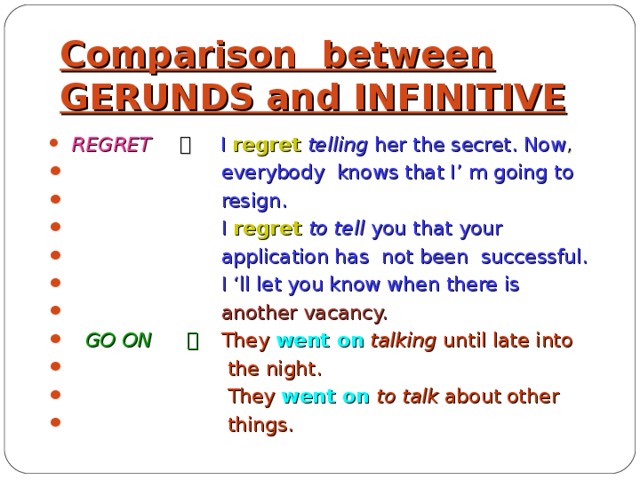
- REGRET 。 I regret telling her the secret. Now ,
- everybody knows that I’ m going to
- resign.
- I regret to tell you that your
- application has not been successful.
- I ‘ll let you know when there is
- another vacancy.
- GO ON 。 They went on talking until late into
- the night.
- They went on to talk about other
- things.

Comparison between GERUNDS and INFINITIVE
- Eg. “ Allow , advise , acknowledge , encourage , permit “, can be followed by an Object + infinitive.
- She advised us to start early.
- Compare: she advised starting early.
- Eg. “ deserve , need , want , and require “
- Can be followed by either an active gerund or a passive infinitive without change of meaning.
- This needs - painting
- - to be painted.

~THE END~
~THE END~
Вебинар для учителей
Свидетельство об участии БЕСПЛАТНО!