
Россия, р.п. Ржакса


СДЕЛАЙТЕ СВОИ УРОКИ ЕЩЁ ЭФФЕКТИВНЕЕ, А ЖИЗНЬ СВОБОДНЕЕ
Благодаря готовым учебным материалам для работы в классе и дистанционно
Скидки до 50 % на комплекты
только до
Готовые ключевые этапы урока всегда будут у вас под рукой
Организационный момент
Проверка знаний
Объяснение материала
Закрепление изученного
Итоги урока

Была в сети 17.02.2025 15:30

Черкасова Елена Николаевна
учитель английского языка
 1 321
1 321
 51 928
Местоположение
Специализация
Использование английских артиклей
Категория:
Английский язык
03.11.2020 10:57

Просмотр содержимого документа
«Использование английских артиклей»
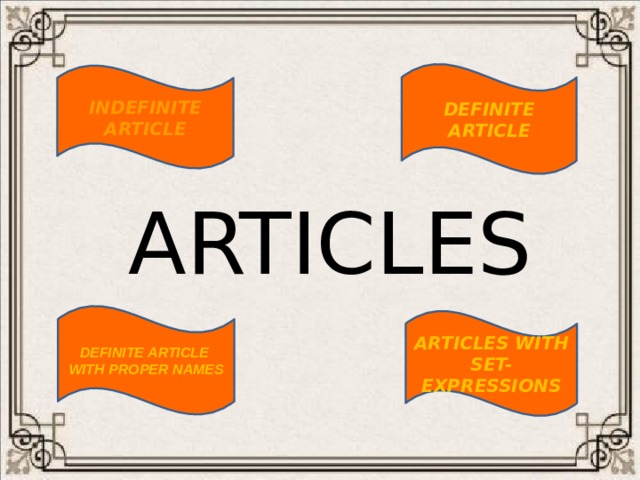
DEFINITE ARTICLE
INDEFINITE ARTICLE
ARTICLES
DEFINITE ARTICLE
WITH PROPER NAMES
ARTICLES WITH
SET-EXPRESSIONS
р
РАБОТУ ПОДГОТОВИЛИ
УЧИТЕЛЯ ИНОСТРАННОГО ЯЗЫКА
Черкасова Е.Н.
2020ГОД
Артикли являются основными определителями имен существительных. Прежде чем употреблять какое-нибудь существительное, необходимо решить, определенное оно или неопределенное, т.е. надо представить, о каком предмете идет речь: о конкретном или любом.
В английском языке перед существительными почти всегда употребляется артикль.
Артикли a и an носят название неопределенного артикля
(the Indefinite Article)
The носит название определенного артикля
( the Definite Article)
Рассмотрим три случая: когда перед существительным употребляется неопределенный артикль, когда употребляется определенный артикль, и когда артикль перед существительным
не употребляется .
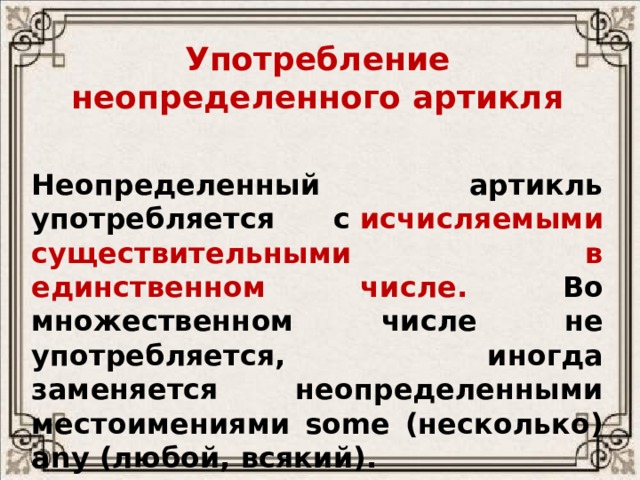
Употребление неопределенного артикля
Неопределенный артикль употребляется с исчисляемыми существительными в единственном числе. Во множественном числе не употребляется, иногда заменяется неопределенными местоимениями some (несколько) any (любой, всякий).
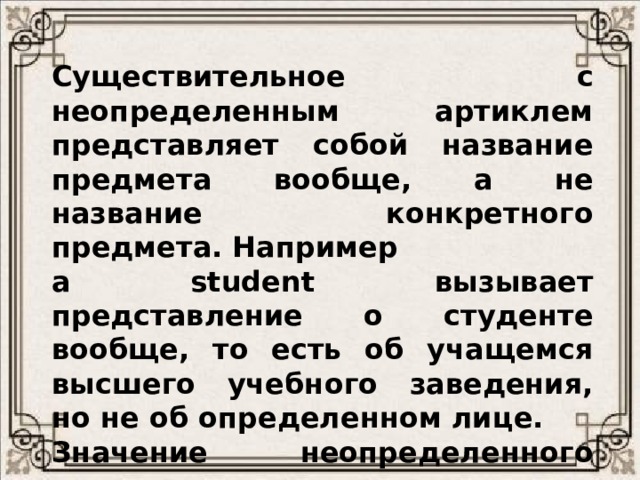
Существительное с неопределенным артиклем представляет собой название предмета вообще, а не название конкретного предмета. Например
a student вызывает представление о студенте вообще, то есть об учащемся высшего учебного заведения, но не об определенном лице.
Значение неопределенного артикля можно выразить в русском языке такими словами как один, один из, какой-то, какой-нибудь, некий, всякий, любой, каждый.
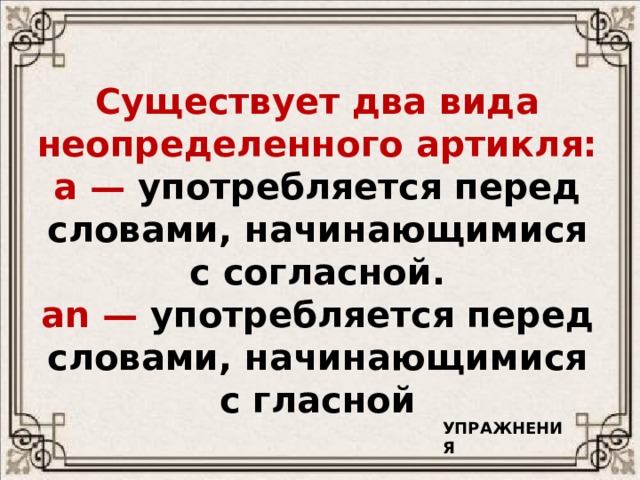
Существует два вида неопределенного артикля:
a — употребляется перед словами, начинающимися с согласной. an — употребляется перед словами, начинающимися с гласной
УПРАЖНЕНИЯ
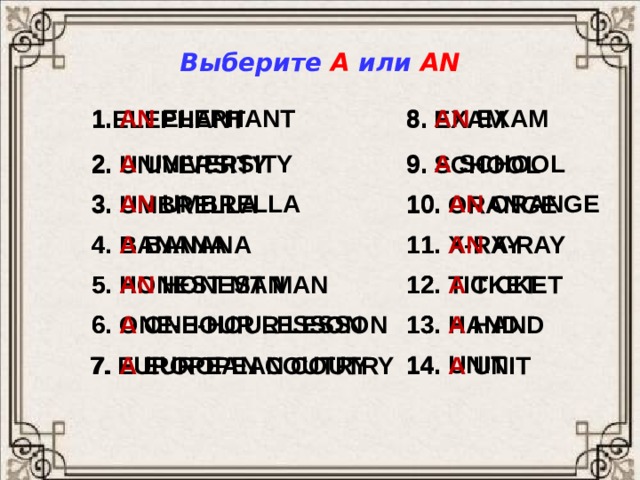
Выберите A или AN
1. AN ELEPHANT
8. AN EXAM
8. EXAM
1.ELEPHANT
9. A SCHOOL
2. A UNIVERSITY
9. SCHOOL
2. UNIVERSITY
10. AN ORANGE
3. AN UMBRELLA
3. UMBRELLA
10. ORANGE
11. AN X-RAY
4. A BANANA
4. BANANA
11. X-RAY
12. TICKET
5. HONEST MAN
12. A TICKET
5. AN HONEST MAN
13. HAND
6. ONE-HOUR LESSON
13. A HAND
6. A ONE-HOUR LESSON
14. UNIT
14. A UNIT
7. EUROPEAN COUTRY
7. A EUROPEAN COUTRY
СЛУЧАИ УПОТРЕБЛЕНИЯ НЕОПРЕДЕЛЕННОГО АРТИКЛЯ
Вставьте артикль, где необходимо.
- Перед существительными, обозначающими время, количество, цена и т.д.
I bought a kilogram of sugar.
Summer comes once a year.
- Перед словами dozen, hundred, thousand, million
I want a dozen of eggs.
- Перед словами few, little в значении немного
There were a few apples in the tree.
4. После слов many, such, quite, rather с последующим существительным в
единственном числе:
He is such a clever boy.
5. После what в восклицательных предложениях:
What a nice day!
6. После глаголов be и have:
She is a teacher.
7. Перед существительным в приложении:
Pete , a sixth-form pupil, is our best chess player.
8. Часто используется в значении каждый
A child can understand it. ( every child)
9. После прилагательных, перед которыми стоят so и too
It is not so simple a question as it seems.
1. This is ... pen. ... pen is red.
1. This is a pen. The pen is red.
2. These are …pencils. ... pencils are black.
2. These are pencils. The pencils are black.
3. This is ... soup. ... soup is tasty.
3. This is soup. The soup is tasty .
4. In the morning I eat ... sandwich and drink ... tea.
4. In the morning I eat a sandwich and drink tea.
5. She gave me ... coffee and ... cake. ... coffee was hot.
5. She gave me coffee and a cake. The coffee was hot.
... cake was tasty.
The cake was tasty .
6. Do you like ice-cream?
6. Do you like ... ice-cream?
7. I see ... book in your ... hand. Is ... book interesting?
7. I see a book in your hand. Is the book interesting?
8. She bought ... meat, ... butter and ... potatoes yesterday. She also bought … cake. … cake was very tasty. We ate ... cake with ... tea.
8. She bought meat, butter and potatoes yesterday. She also bought a cake. The cake was very tasty. We ate the cake with tea.
9. This is my ... table. On ... table I have ... book, two ... pencils, ... pen and ... paper.
9. This is my table. On the table I have a book, two pencils, a pen and paper.
10. This is ... bag. ... bag is brown. It is my sister's ... bag. And this is my ... bag. It is ... yellow.
10. This is a bag. The bag is brown. It is my sister's bag. And this is my bag. It is yellow.
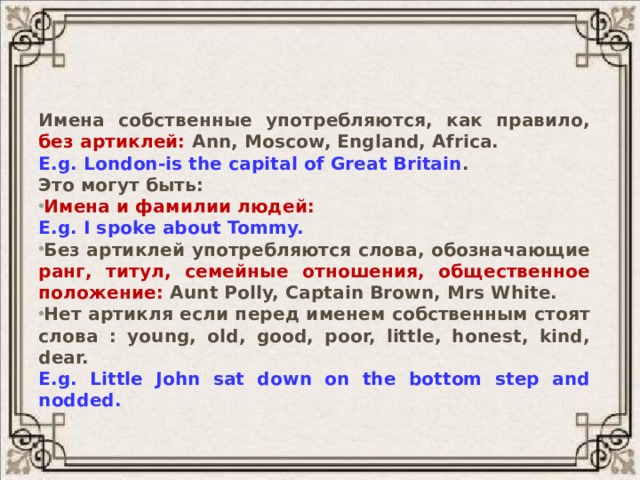
Определенный артикль с именами собственными.
Имена собственные употребляются, как правило, без артиклей: Ann, Moscow, England, Africa.
E.g. London-is the capital of Great Britain .
Это могут быть:
- Имена и фамилии людей:
E.g. I spoke about Tommy.
- Без артиклей употребляются слова, обозначающие ранг, титул, семейные отношения, общественное положение: Aunt Polly, Captain Brown, Mrs White.
- Нет артикля если перед именем собственным стоят слова : young, old, good, poor, little, honest, kind, dear.
E.g. Little John sat down on the bottom step and nodded.
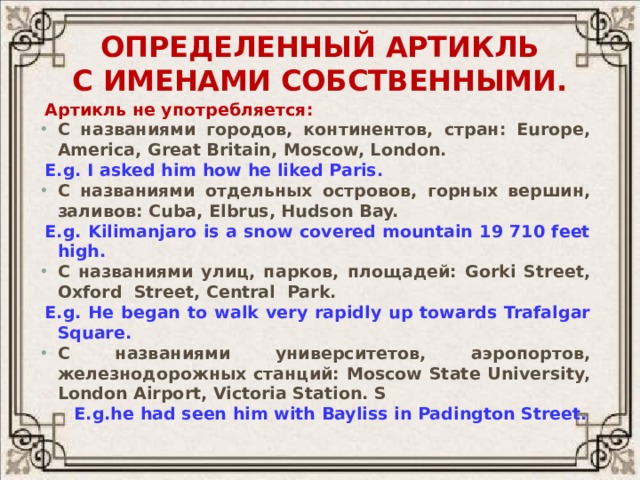
Определенный артикль с именами собственными.
Артикль не употребляется:
- C названиями городов, континентов, стран: Europe, America, Great Britain, Moscow, London.
E.g. I asked him how he liked Paris.
- С названиями отдельных островов, горных вершин, заливов: Cuba, Elbrus, Hudson Bay.
E.g. Kilimanjaro is a snow covered mountain 19 710 feet high.
- С названиями улиц, парков, площадей: Gorki Street, Oxford Street, Central Park.
E.g. He began to walk very rapidly up towards Trafalgar Square.
- С названиями университетов, аэропортов, железнодорожных станций: Moscow State University, London Airport, Victoria Station. S
E.g.he had seen him with Bayliss in Padington Street.
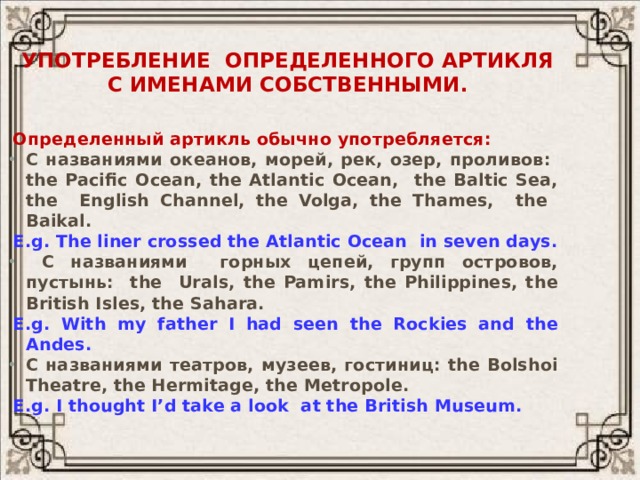
Употребление определенного артикля с именами собственными.
Определенный артикль обычно употребляется:
- С названиями океанов, морей, рек, озер, проливов: the Pacific Ocean, the Atlantic Ocean, the Baltic Sea, the English Channel, the Volga, the Thames, the Baikal.
E.g. The liner crossed the Atlantic Ocean in seven days.
- С названиями горных цепей, групп островов, пустынь: the Urals, the Pamirs, the Philippines, the British Isles, the Sahara.
E.g. With my father I had seen the Rockies and the Andes.
- С названиями театров, музеев, гостиниц: the Bolshoi Theatre, the Hermitage, the Metropole.
E.g. I thought I’d take a look at the British Museum.
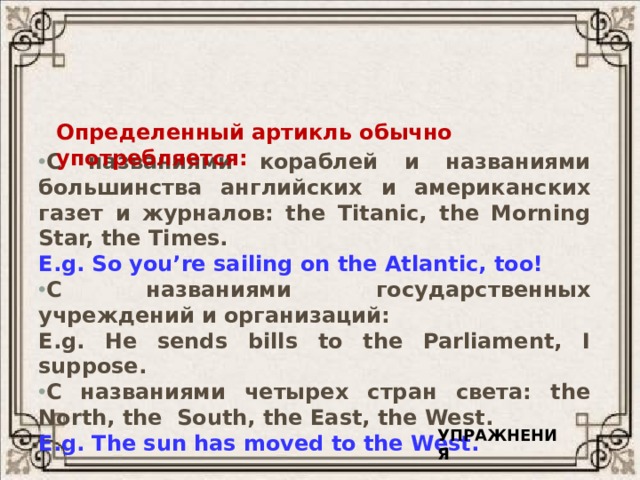
Употребление определенного артикля с именами собственными.
Определенный артикль обычно употребляется:
- С названиями кораблей и названиями большинства английских и американских газет и журналов: the Titanic, the Morning Star, the Times.
E.g. So you’re sailing on the Atlantic, too!
- С названиями государственных учреждений и организаций:
E.g. He sends bills to the Parliament, I suppose.
- С названиями четырех стран света: the North, the South, the East, the West.
E.g. The sun has moved to the West.
УПРАЖНЕНИЯ
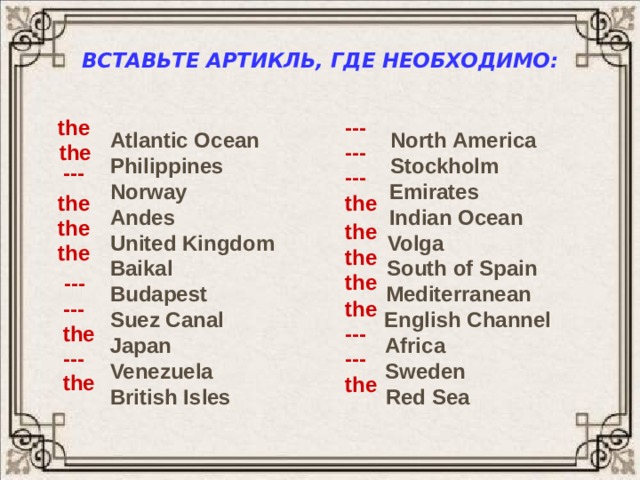
Вставьте артикль, где необходимо:
the
---
Atlantic Ocean North America
Philippines Stockholm
Norway Emirates
Andes Indian Ocean
United Kingdom Volga
Baikal South of Spain
Budapest Mediterranean
Suez Canal English Channel
Japan Africa
Venezuela Sweden
British Isles Red Sea
the
---
---
---
the
the
the
the
the
the
the
---
---
the
the
---
---
---
the
the
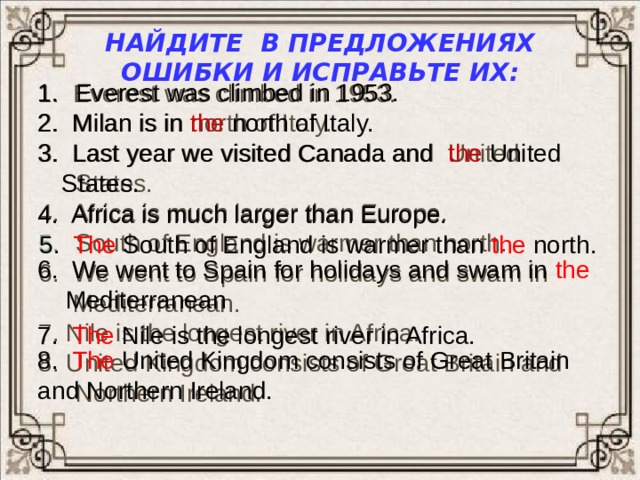
Найдите в предложениях ошибки и исправьте их:
- Everest was climbed in 1953.
1. Everest was climbed in 1953.
2. Milan is in north of Italy.
3. Last year we visited Canada and United States.
4. Africa is much larger than Europe.
- South of England is warmer than north.
6. We went to Spain for holidays and swam in
Мediterranean.
7. Nile is the longest river in Africa.
8. United Kingdom consists of Great Britain and Northern Ireland.
2. Milan is in the north of Italy.
3. Last year we visited Canada and the United States.
4. Africa is much larger than Europe.
5. The South of England is warmer than the north.
6. We went to Spain for holidays and swam in the Mediterranean
7. The Nile is the longest river in Africa.
8. The United Kingdom consists of Great Britain and Northern Ireland.
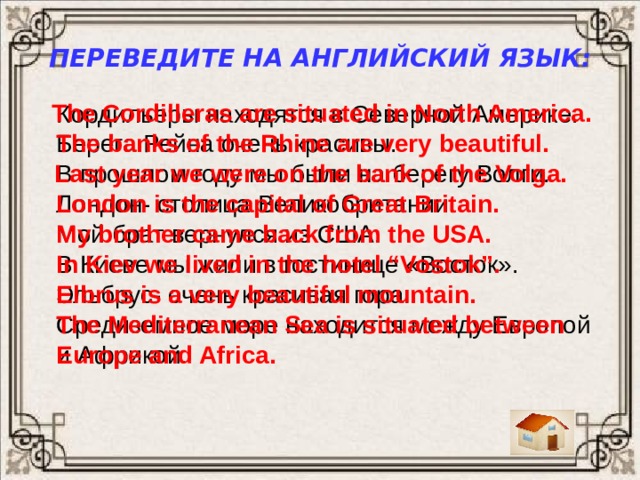
Переведите на английский язык:
The Cordilleras are situated in North America.
Кордильеры находятся в Северной Америке.
Берега Рейна очень красивы.
The banks of the Rhine are very beautiful.
Last year we were on the bank of the Volga.
В прошлом году мы были на берегу Волги.
Лондон- столица Великобритании.
London is the capital of Great Britain.
My brother came back from the USA.
Мой брат вернулся из США.
В Киеве мы жили в гостинице «Восток».
In Kiev we lived in the hotel “Vostok”.
Эльбрус- очень красивая гора.
Elbrus is a very beautiful mountain.
Средиземное море находится между Европой
The Mediterranean Sea is situated between Europe and Africa.
и Африкой.
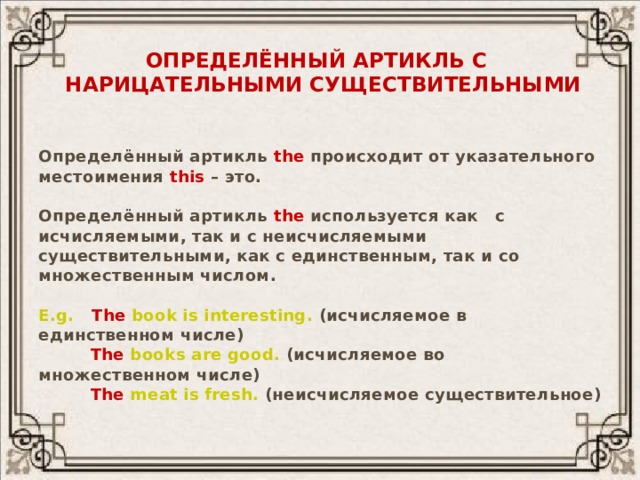
Определённый артикль с нарицательными существительными
Определённый артикль the происходит от указательного местоимения this – это.
Определённый артикль the используется как с исчисляемыми, так и с неисчисляемыми существительными, как с единственным, так и со множественным числом.
E.g. The book is interesting. (исчисляемое в единственном числе)
The books are good. (исчисляемое во множественном числе)
The meat is fresh. (неисчисляемое существительное)
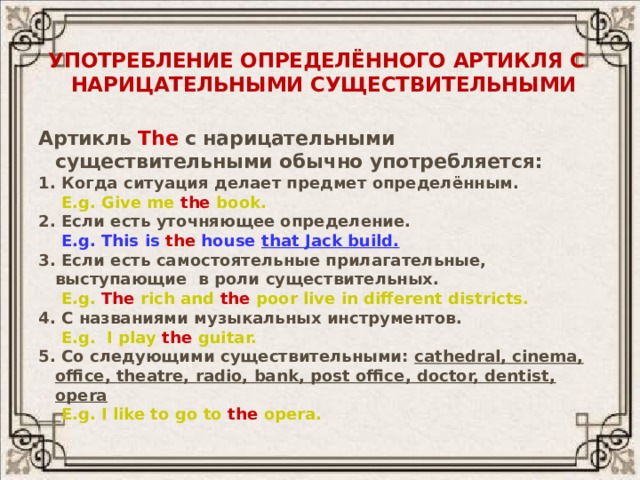
Употребление определённого артикля с нарицательными существительными
Артикль The с нарицательными существительными обычно употребляется:
1. Когда ситуация делает предмет определённым.
E.g. Give me the book.
2. Если есть уточняющее определение.
E.g. This is the house that Jack build.
3. Если есть самостоятельные прилагательные, выступающие в роли существительных.
E.g. The rich and the poor live in different districts.
4. С названиями музыкальных инструментов.
E.g. I play the guitar.
5. Со следующими существительными: cathedral, cinema, office, theatre, radio, bank, post office, doctor, dentist, opera
E.g. I like to go to the opera.
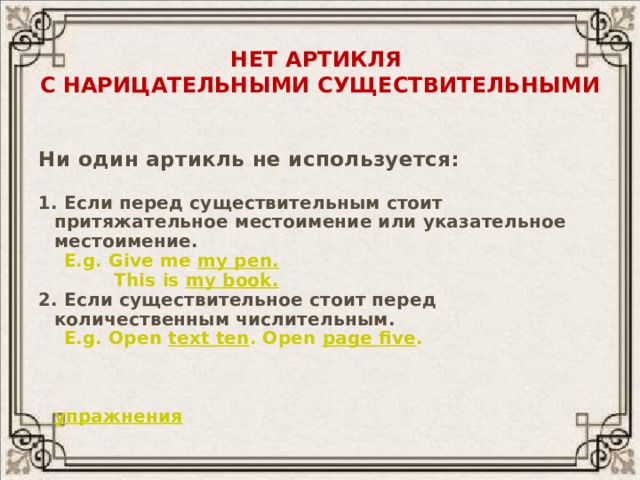
Нет артикля с нарицательными существительными
Ни один артикль не используется:
1. Если перед существительным стоит притяжательное местоимение или указательное местоимение.
E.g. Give me my pen.
This is my book.
2. Если существительное стоит перед количественным числительным.
E.g. Open text ten . Open page five .
упражнения
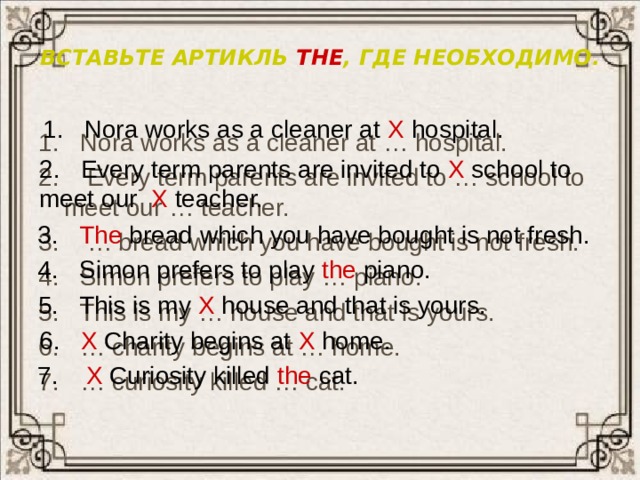
Вставьте артикль The , где необходимо.
1. Nora works as a cleaner at Х hospital.
1. Nora works as a cleaner at … hospital.
2. Every term parents are invited to … school to meet our … teacher.
3. … bread which you have bought is not fresh.
4. Simon prefers to play … piano.
5. This is my … house and that is yours.
6. … charity begins at … home.
7. … curiosity killed … cat.
2. Every term parents are invited to Х school to meet our Х teacher.
3. The bread which you have bought is not fresh.
4. Simon prefers to play the piano.
5. This is my Х house and that is yours.
6. Х Charity begins at Х home.
7. Х Curiosity killed the cat.
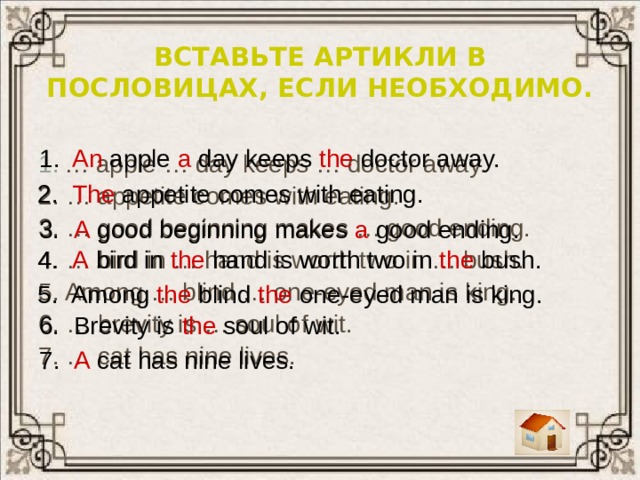
Вставьте артикли в пословицах, если необходимо.
1. An apple a day keeps the doctor away.
- … apple … day keeps … doctor away.
2. … appetite comes with eating.
3. … good beginning makes … good ending.
4. … bird in … hand is worth two in … bush.
5. Among … blind … one-eyed man is king.
6. … brevity is … soul of wit.
7. … cat has nine lives.
2. The appetite comes with eating.
3. A good beginning makes a good ending.
4. A bird in the hand is worth two in the bush.
5. Among the blind the one-eyed man is king.
6. Brevity is the soul of wit.
7. A cat has nine lives.
Использование артиклей с «застывшими словосочетаниями»
Существует огромное количество так называемых «застывших словосочетаний», в которых артикль употребляется или отсутствует традиционно. Эти словосочетания необходимо заучивать наизусть.
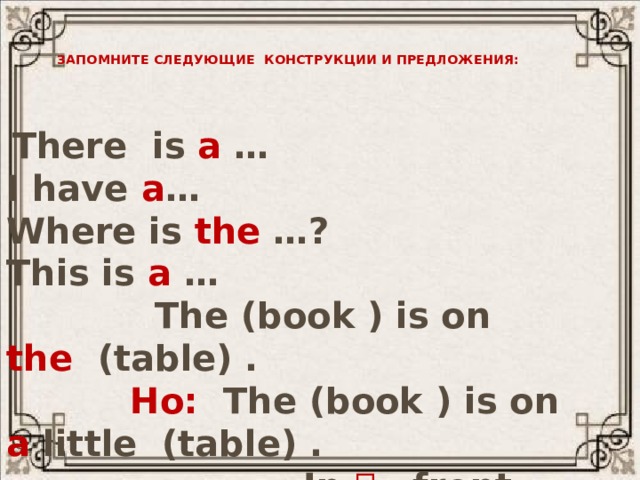
Запомните следующие конструкции и предложения:
There is a … I have a …
Where is the …? This is a …
The (book ) is on the (table) .
Но: The (book ) is on a little (table) .
In front
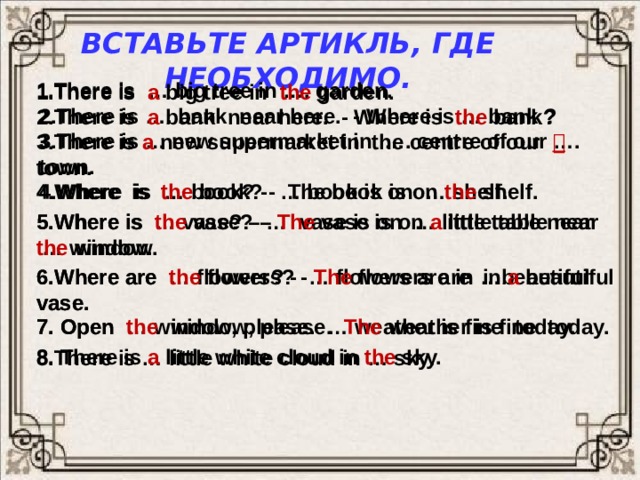
Вставьте артикль, где необходимо.
1.There is … big tree in …. garden.
1.There is a big tree in the garden.
2.There is …. bank near here. - Where is … bank ?
2.There is a bank near here. - Where is the bank?
3.There is … new supermarket in …. centre of our …. town.
3.There is a new supermarket in the centre of our town.
4.Where is the book? - The book is on the shelf.
4.Where is … book? - … book is on … shelf.
5.Where is … vase? – … vase is on … little table near
5.Where is the vase? – The vase is on a little table near
… window.
the window.
6.Where are … flowers? - … flowers are in …beautiful vase.
6.Where are the flowers? - The flowers are in a beautiful vase.
7. Open … window, please. … weather is fine today.
7. Open the window, please. The weather is fine today.
8. There is a little white cloud in the sky.
8.There is … little white cloud in … sky .
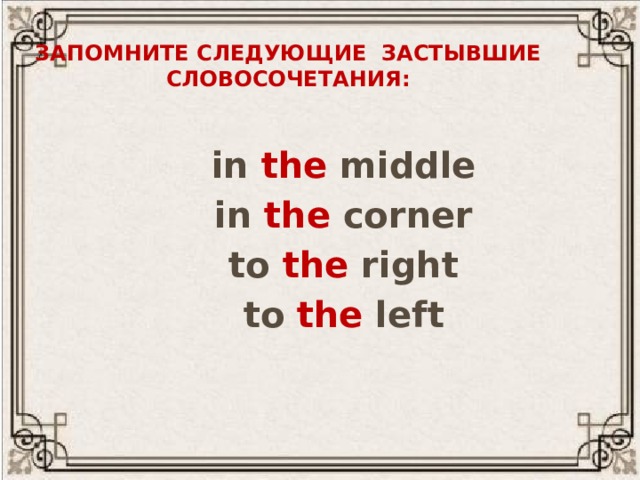
Запомните следующие застывшие словосочетания:
in the middle
in the corner
to the right
to the left
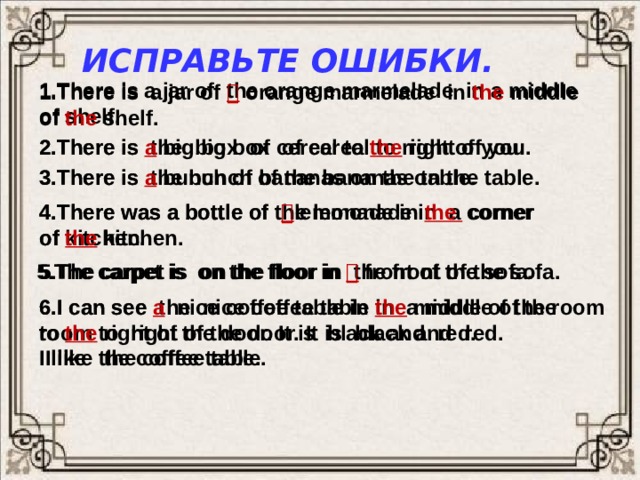
Исправьте ошибки.
1.There is a jar of the orange marmelade in a middle
of shelf.
1.There is a jar of orange marmelade in the middle
of the shelf.
2.There is the big box of cereal to right of you.
2.There is a big box of cereal to the right of you.
3.There is the bunch of the bananas on the table.
3.There is a bunch of bananas on the table.
4.There was a bottle of lemonade in the corner
4.There was a bottle of the lemonade in a corner
of kitchen.
of the kitchen.
5.The carpet is on the floor in the front of the sofa.
5.The carpet is on the floor in front of the sofa.
6.I can see the nice coffee table in a middle of the room to right of the door. It is black and red.
6.I can see a nice coffee table in the middle of the room
I like the coffee table.
to the right of the door. It is black and red.
I like the coffee table.
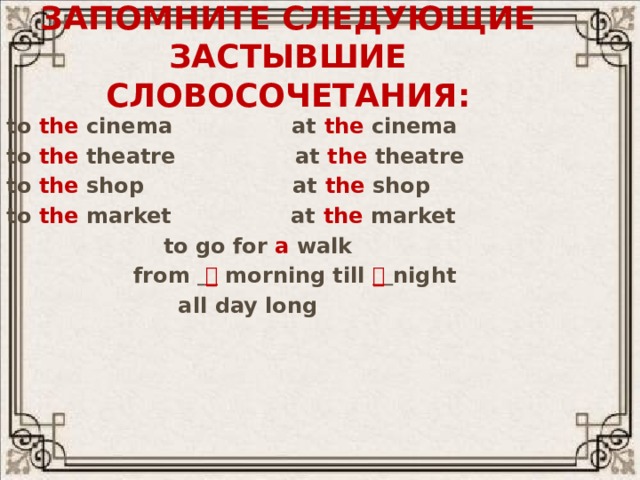
Запомните следующие застывшие словосочетания:
to the cinema at the cinema
to the theatre at the theatre
to the shop at the shop
to the market at the market
to go for a walk
from morning till night
all day long
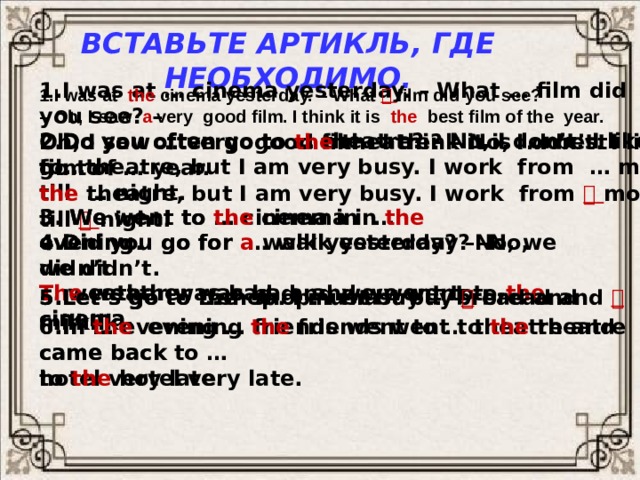
Вставьте артикль, где необходимо.
1.I was at … cinema yesterday. – What … film did you see? –
Oh, I saw … very good film. I think it is … best film of … year.
1.I was at the cinema yesterday. – What film did you see?
– Oh, I saw a very good film. I think it is the best film of the year.
2.Do you often go to … theatre? – No, I don’t. I like to go
to…theatre, but I am very busy. I work from … morning
till … night.
2.Do you often go to the theatre? – No, I don’t. I like to go to
the theatre, but I am very busy. I work from morning
till night.
3. We went to … cinema in … evening.
3. We went to the cinema in the evening.
4.Did you go for … walk yesterday? –No, we didn’t.
4.Did you go for a walk yesterday? –No, we didn’t.
… weather was bad, and we went to … cinema.
The weather was bad, and we went to the cinema.
5.Let’s go to …shop. I must buy … bread and … milk.
5.Let’s go to the shop. I must buy bread and milk.
6.In … evening … friends went to … theatre and came back to …
6.In the evening the friends went to the theatre and came back
hotel very late.
to the hotel very late.
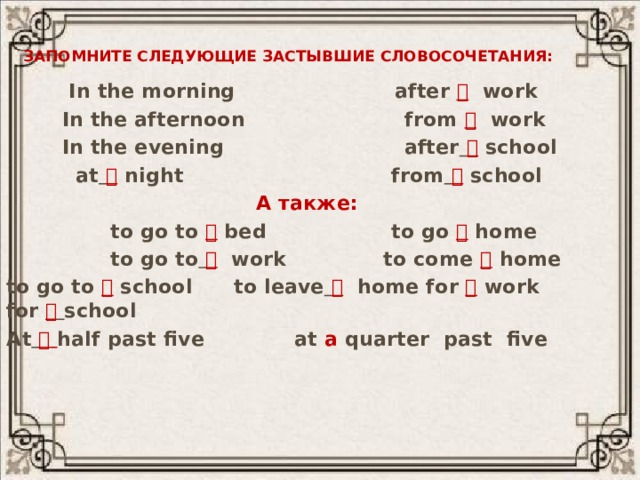
Запомните следующие застывшие словосочетания:
In the morning after work
In the afternoon from work
In the evening after school
at night from school
А также:
to go to bed to go home
to go to work to come home
tо go to school to leave home for work for school
At half past five at a quarter past five
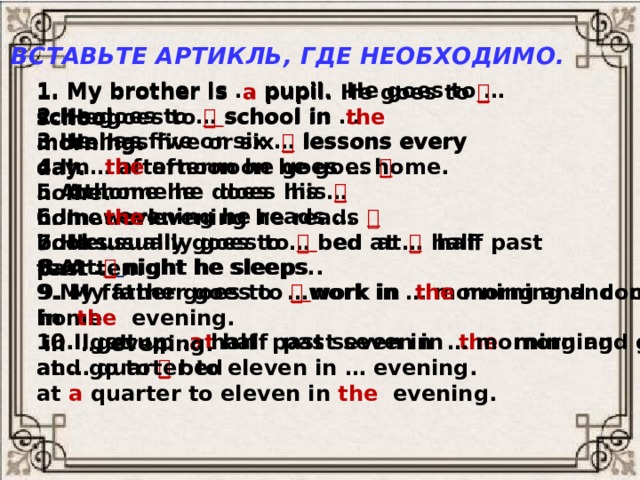
Вставьте артикль, где необходимо.
1. My brother is … pupil. He goes to … school.
1. My brother is a pupil. He goes to school.
2.He goes to … school in … morning.
2. He goes to school in the morning.
3.He has five or six … lessons every day.
3. He has five or six lessons every day.
4.In … afternoon he goes … home.
4. In the afternoon he goes home.
5.At home he does his … homework.
5. At home he does his homework .
6.In … evening he reads … books.
6. In the evening he reads books.
7.He usually goes to … bed at … half past ten.
7. He usually goes to bed at half past ten.
8.At … night he sleeps.
8. At night he sleeps .
9.My father goes to …work in … morning and comes home
9. My father goes to work in the morning and comes home
in … evening.
in the evening.
10. I get up at half past seven in the morning and go to bed
10.I get up … half past seven in … morning and go to … bed
at a quarter to eleven in the evening.
at … quarter to eleven in … evening.
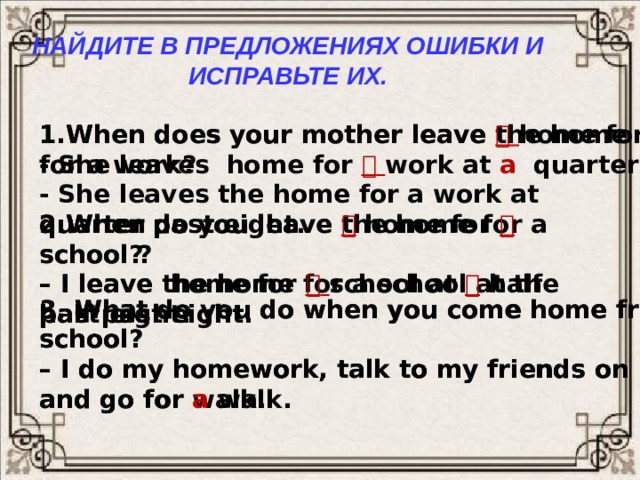
Найдите в предложениях ошибки и исправьте их.
1.When does your mother leave the home for a work?
1.When does your mother leave home for work?
- She leaves the home for a work at quarter past eight.
- She leaves home for work at a quarter past eight.
2.When do you leave the home for a school ?
2.When do you leave home for school?
– I leave the home for a school at the half past eight.
– I leave home for school at half past eight.
3. What do you do when you come home from a school?
3. What do you do when you come home from school?
– I do my homework, talk to my friends on phone
– I do my homework, talk to my friends on phone
and go for walk.
and go for a walk.
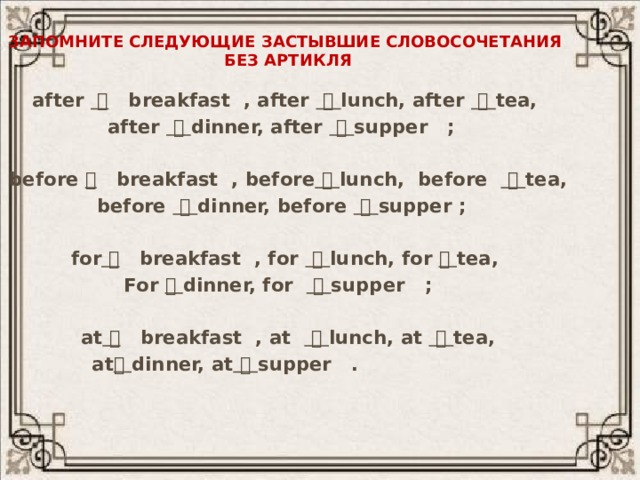
Запомните следующие застывшие словосочетания без артикля
after breakfast , after lunch, after tea,
after dinner, after supper ;
before breakfast , before lunch, before tea,
before dinner, before supper ;
for breakfast , for lunch, for tea,
For dinner, for supper ;
at breakfast , at lunch, at tea,
at dinner, at supper .
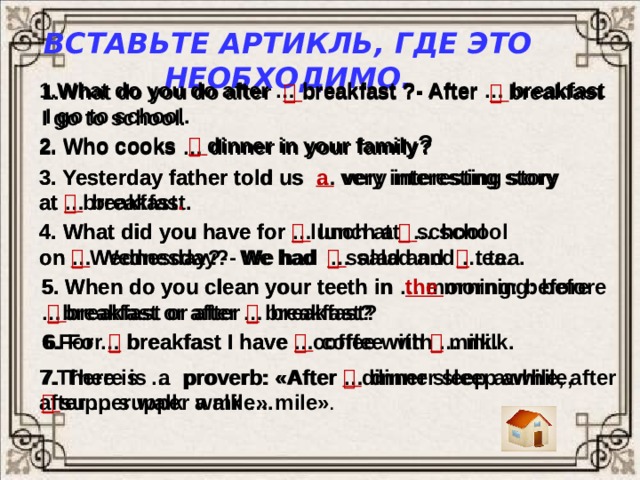
Вставьте артикль, где это необходимо.
1.What do you do after … breakfast ?- After … breakfast
I go to school.
1.What do you do after breakfast ?- After breakfast
I go to school.
2. Who cooks dinner in your family ?
2. Who cooks … dinner in your family?
3. Yesterday father told us … very interesting story
3. Yesterday father told us a very interesting story
at … breakfast.
at breakfast .
4. What did you have for lunch at school
4. What did you have for … lunch at … school
on … Wednesday?- We had … salad and … tea.
on Wednesday?- We had salad and tea.
5. When do you clean your teeth in … morning: before …breakfast or after … breakfast?
5. When do you clean your teeth in the morning: before
breakfast or after breakfast?
6.For … breakfast I have … coffee with … milk.
6. For breakfast I have coffee with milk.
7.There is … proverb: «After … dinner sleep awhile,
7. There is a proverb: «After dinner sleep awhile, after
after … supper walk … mile» .
supper walk a mile».
МЫ УВЕРЕНЫ, ЧТО ТЕПЕРЬ ВЫ СТАЛИ
НАСТОЯЩИМИ ЭКПРЕТАМИ В ТЕМЕ
«АРТИКЛИ В АНГЛИЙСКОМ ЯЗЫКЕ», ПОЭТОМУ
ПРЕДЛАГАЕМ ВАМ ПРОВЕРИТЬ СВОИ ЗНАНИЯ В
ИНТЕЛЛЕКТУАЛЬНОЙ ИГРЕ
“BIG BOARD GAME”
Использованные ресурсы
- http://study-english.info/exercises-article.php#ixzz2qmLsjjDJ
- http://study-english.info/
- http://study-english.info/exercises-article.php#ixzz2qmLJ2HQd
- http://study-english.info/
Вебинар для учителей

Свидетельство об участии БЕСПЛАТНО!