


ЛНР, Луганск


СДЕЛАЙТЕ СВОИ УРОКИ ЕЩЁ ЭФФЕКТИВНЕЕ, А ЖИЗНЬ СВОБОДНЕЕ
Благодаря готовым учебным материалам для работы в классе и дистанционно
Скидки до 50 % на комплекты
только до
Готовые ключевые этапы урока всегда будут у вас под рукой
Организационный момент
Проверка знаний
Объяснение материала
Закрепление изученного
Итоги урока

Была в сети 14.04.2026 10:33

Алюшина Екатерина Васильевна
преподаватель иностранного языка
38 лет
 1 425
1 425
 49 067
Местоположение
Специализация
Китайские поезда
Категория:
Английский язык
10.03.2022 10:24

Просмотр содержимого документа
«Китайские поезда»

High-speed Chinese trains and roads

China is the world leader of high-speed Railways
- China in the shortest time expanded its domestic rail network, have mastered the technology of high-speed traffic on these indicators has become a world leader. China is already an exporter of high-speed technologies and draws on the map of Eurasia of different scheme silk road. Formally, the first railroad in China was built during the British colonial rule in 1825 and linked the city of Tangshan and Sulejman. But later with the development of the rail network the Chinese somehow did not happen. The situation began to change only after 1949. At that moment a huge help to the Chinese railway modernization was provided by the Soviet Union. But then too many things had to be built in the country, weakened by civil wars and feudal fragmentation, and developing PRC for all projects simply would not be enough funds.
High-speed modernization
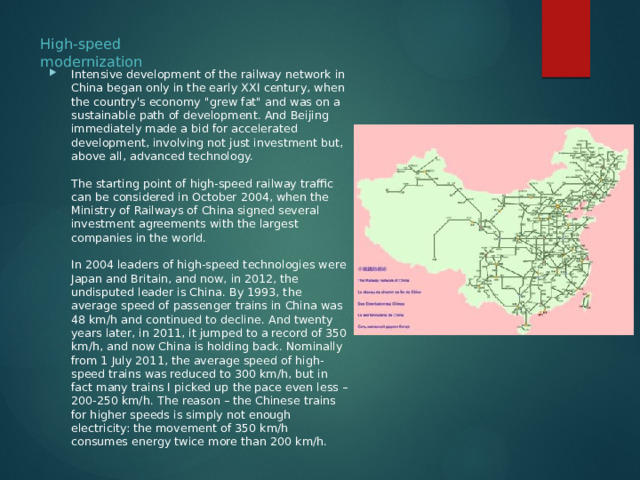
- Intensive development of the railway network in China began only in the early XXI century, when the country's economy "grew fat" and was on a sustainable path of development. And Beijing immediately made a bid for accelerated development, involving not just investment but, above all, advanced technology. The starting point of high-speed railway traffic can be considered in October 2004, when the Ministry of Railways of China signed several investment agreements with the largest companies in the world. In 2004 leaders of high-speed technologies were Japan and Britain, and now, in 2012, the undisputed leader is China. By 1993, the average speed of passenger trains in China was 48 km/h and continued to decline. And twenty years later, in 2011, it jumped to a record of 350 km/h, and now China is holding back. Nominally from 1 July 2011, the average speed of high-speed trains was reduced to 300 km/h, but in fact many trains I picked up the pace even less – 200-250 km/h. The reason – the Chinese trains for higher speeds is simply not enough electricity: the movement of 350 km/h consumes energy twice more than 200 km/h.
In General, the development of high-speed Railways in China performs a number of strategic objectives
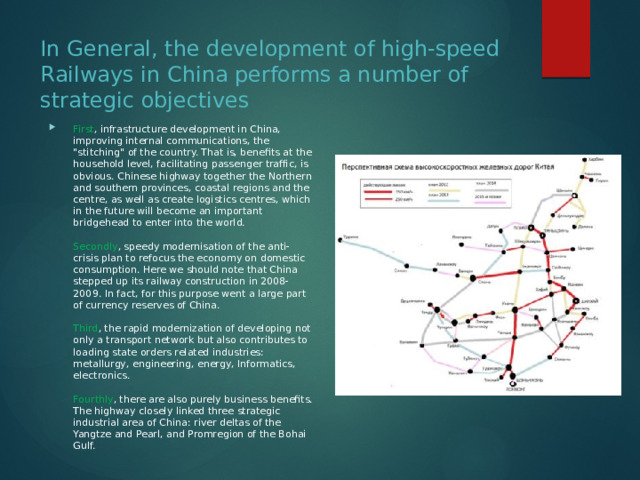
- First , infrastructure development in China, improving internal communications, the "stitching" of the country. That is, benefits at the household level, facilitating passenger traffic, is obvious. Chinese highway together the Northern and southern provinces, coastal regions and the centre, as well as create logistics centres, which in the future will become an important bridgehead to enter into the world. Secondly , speedy modernisation of the anti-crisis plan to refocus the economy on domestic consumption. Here we should note that China stepped up its railway construction in 2008-2009. In fact, for this purpose went a large part of currency reserves of China. Third , the rapid modernization of developing not only a transport network but also contributes to loading state orders related industries: metallurgy, engineering, energy, Informatics, electronics. Fourthly , there are also purely business benefits. The highway closely linked three strategic industrial area of China: river deltas of the Yangtze and Pearl, and Promregion of the Bohai Gulf.
Chinese highway
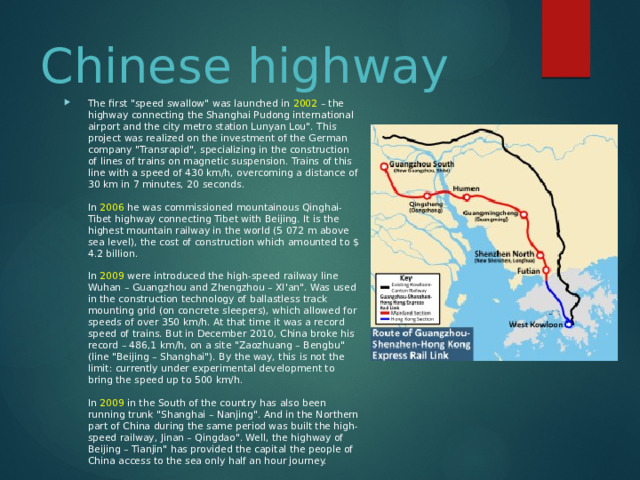
- The first "speed swallow" was launched in 2002 – the highway connecting the Shanghai Pudong international airport and the city metro station Lunyan Lou". This project was realized on the investment of the German company "Transrapid", specializing in the construction of lines of trains on magnetic suspension. Trains of this line with a speed of 430 km/h, overcoming a distance of 30 km in 7 minutes, 20 seconds. In 2006 he was commissioned mountainous Qinghai-Tibet highway connecting Tibet with Beijing. It is the highest mountain railway in the world (5 072 m above sea level), the cost of construction which amounted to $ 4.2 billion. In 2009 were introduced the high-speed railway line Wuhan – Guangzhou and Zhengzhou – XI'an". Was used in the construction technology of ballastless track mounting grid (on concrete sleepers), which allowed for speeds of over 350 km/h. At that time it was a record speed of trains. But in December 2010, China broke his record – 486,1 km/h, on a site "Zaozhuang – Bengbu" (line "Beijing – Shanghai"). By the way, this is not the limit: currently under experimental development to bring the speed up to 500 km/h. In 2009 in the South of the country has also been running trunk "Shanghai – Nanjing". And in the Northern part of China during the same period was built the high-speed railway, Jinan – Qingdao". Well, the highway of Beijing – Tianjin" has provided the capital the people of China access to the sea only half an hour journey.
Chinese highway
- Network of high-speed rail lines in China can be arranged in a clear system. The Northern direction. High-speed passenger line, Beijing – Shenyang – Harbin", including "branch" "Shenyang – Dalian and Panjin – Yingkou". The total length of the highway – 1700 km Parallel to the line between Beijing and Shenyang, there is another high-speed route Tianjin – Shenyang". Railway Qingdao – Taiyuan" consists of three parts. The total length of 870 km. including "Qingdao – Jinan" (362 km), Jinan – Shijiazhuang" (319 km, the launch is scheduled for 2015) and "Shijiazhuang – Taiyuan" (189 km). The Western direction. High-speed passenger line Xuzhou Lanzhou" and continue the highway "Lanzhou – Urumqi" nominally designed for 350 km/h. In particular, the "Zhengzhou – Xuzhou" (362 km) will be constructed in 2013; the "Zhengzhou – XI'an" (456 km) has already been put into operation; "XI'an, Baoji" (138 km); "of Baoji – Lanzhou" (401 km) will be built by 2017; "Lanzhou – Urumqi" (1776 km) will be built by the end of 2013. The strategic importance of the Western direction, first of all, that it is a springboard for entering in the country of Centrasia and forth on the highways of the Eurasian silk roads. The southern direction. Coastal passenger line, Shanghai – Hangzhou – Fuzhou – Shenzhen. Until 2020 it is planned to build more railway bridge across the Hangzhou Bay, which will allow to build a railroad from Ningbo to Shanghai, passing Hangzhou. High-speed passenger line, Shanghai – Wuhan – Chengdu". This route length of about 2000 km across the country is based on sites. In the last section of the road from Yichang to Chongqing, and from Chongqing to Chengdu are assumed to be two parallel tracks, the fastest of which will be commissioned in 2014-2015, and slower – used to be. The total length of high speed line Shanghai – Kunming" is 2066 km. Road "Shanghai – Hangzhou" (202 km) has already been put into operation, and Hangzhou – Changsha" (921 km) and "Changsha – Kunming" (1167 km) is scheduled for launch in 2014. The North – South. High-speed passenger line, Beijing – Hong Kong". Including the Beijing – Shijiazhuang" (281 km), "Shijiazhuang – Wuhan" (840 km), "Wuhan to Guangzhou (968 km), Guangzhou – Shenzhen – Hong Kong" (142 km). Finally, speaking about Chinese expressways, it should also be mentioned Taiwan and Hong Kong (Hong Kong). In Taiwan since 2007 operates a high-speed line Taipei – Kaohsiung", crossing the whole island down. The total length of the road – 335,5 km Until 2015 it is planned to complete the construction of individual internal stations. As for the main line linking the mainland with Hong Kong, then this "Hansenian-Express" on the route "Guangzhou — Shenzhen — Hong Kong", which is gradually being introduced from 2011 to 2016. Road connects Kowloon (Hong Kong), Shenzhen city, district of Panyu in Guangdong province and Guangzhou.

Chinese highway
- Grinchenka section (Guangzhou – Shenzhen) was opened to passengers on December 26, 2011. It is expected to extend it for another 14 km to the border crossing at Futian station, and then build the Hong Kong section by 2015-2016. Full length of the road will be 142 km, and travel time from Hong Kong to Guangzhou will take 48 minutes. In Shenzhen this highway connects with the line Shanghai – Hangzhou – Fuzhou – Shenzhen. ....In total, in 2006-2010 in the construction of highways spent more than $ 1 trillion. Chinese yuan (about $ 150 billion. in 2010 prices.). In addition, the company China Rail Investment Corp is also partly resorted to replenishment due to partial IPO. In 2014, the expected peak payments on its obligations. The high-speed pace of construction is quite high, projects are often executed over the plan, but the industry has three main problems: first, long-term planning; second, a too high price of admission and, thirdly, the accumulation of debt. However, with the tasks of internal modernization of the railway of China has coped and stepped up efforts in the global game, close hand in the implementation of the "silk roads" on the map of Eurasia. About it in the next part..








Вебинар для учителей

Свидетельство об участии БЕСПЛАТНО!



