Россия, Комсомольск-на-Амуре


СДЕЛАЙТЕ СВОИ УРОКИ ЕЩЁ ЭФФЕКТИВНЕЕ, А ЖИЗНЬ СВОБОДНЕЕ
Благодаря готовым учебным материалам для работы в классе и дистанционно
Скидки до 50 % на комплекты
только до
Готовые ключевые этапы урока всегда будут у вас под рукой
Организационный момент
Проверка знаний
Объяснение материала
Закрепление изученного
Итоги урока

Была в сети 07.11.2026 01:18

Полещук Евгения Сергеевна
учитель английского языка
 232
 166 795

Местоположение
Конспект урока английского языка "London Tour"
Категория:
Английский язык
06.07.2026 11:05

Просмотр содержимого документа
«Конспект урока английского языка "London Tour"»
КОНСПЕКТ УРОКА АНГЛИЙСКОГО ЯЗЫКА
ТЕМА: «LONDON TOUR»
УМК ДЛЯ 4 КЛАССА АВТОРОВ И. Н. ВЕРЕЩАГИНОЙ, О. В. АФАНАСЬЕВОЙ
Полещук Е. С.
учитель английского языка МОУ гимназия №1
Тема. London Tour
Цели.
Образовательные. 1. Формирование навыков монологической и диалогической речи, навыков аудирования с пониманием основного содержания, навыков просмотрового чтения.
2. Активизация лексики по теме «Лондон».
3. Повторение грамматического материала: употребление артиклей.
Развивающие. 1.Развитие интереса к изучению иностранного языка.
2. Развитие внимания и памяти.
Воспитательные. 1. Прививать уважение к культурному и историческому наследию народа страны изучаемого языка.
Оборудование. ЦОР, план города Лондона на доске, листы для отработки артиклей, карточки с заданиями на аудирование и чтение.
Ход урока.
T.: (slide1) Good afternoon, children. Today we are having an excursion around London. What places of interest can we visit? Divide the words into 2 groups: the or no article (Westminster, Trafalgar Square, Downing Street, Big Ben, Westminster Abbey, Вuckingham Palace, City, Tower of London, National Gallery, William Conqueror).
T.: We have read and spoken much about London. But first of all listen to the history of London.
St.1.: (slide2) The Romans went to England many years ago. They built a town on the River Thames. The name of the town was Londinium. The Romans built Londinium near the river. The place for the town was very good. Soon the Romans built a bridge over the river Thames. The old London Bridge looked very strange. There were houses and shops on the bridge. (slide3)
In those days people usually built houses of wood, and they often were near one another. Sometimes there were fires in the city, but they were usually very small. Then came 1666, the year of the Great Fire of London. (slide4)
On Saturday, 2nd September 1666 there was a strong wind from the river and a big fire began. It started in the house of the king’s baker, near London Bridge. The fire burnt until Thursday. Many houses of London were burnt. More than 250 thousand people didn’t have home any more.
T.: Let’s sing the song about the Great Fire. (slide5)
London’s Burning
London’s burning, London’s burning.
Fetch the engines. Fetch the engines.
Fire, fire! Fire, fire!
Pour on water, pour on water.
T.: After the Great Fire people built a new city with many new houses and sights. Let’s begin our excursion from the heart of London. What do I mean?
The heart of London is the City. It is the oldest part of London. Many people work in the City but very few live there. You can visit some interesting places in the City or near it. One of them is the Tower of London.
St 2.: (slide6-8) The Tower of London was a fortress, a palace, a prison and the King’s Zoo. Now it is a museum. You can see a lot of interesting things in the rooms of the White Tower. Its square walls are white and very tall. William the Conqueror built it in the eleventh century. There are always black ravens in the Tower of London. People look after them very well as they believe that London will be rich while ravens live there.
St 3.: (slide9-10) One of the greatest English churches, St Paul’s Cathedral, is not far from the Tower of London. The famous English architect Sir Christopher Wren built it in the 17th century after the Great Fire. It took Sir Christopher Wren 35 years. It is a beautiful building with many columns and towers.
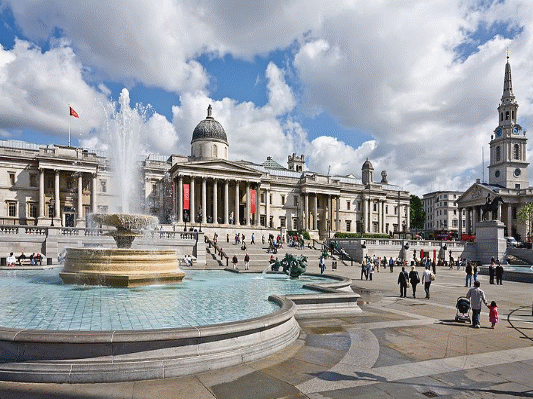
St 4.: (slide11-15) Trafalgar Square is in the centre of London. In the middle of the square stands a tall column. It is a monument to Admiral Nelson. Four Bronze lions look at the square from the monument. There are 2 beautiful fountains in the square. They are in front of the National Gallery which is one of the best picture galleries in the world.
T.: Thank you. It is really very interesting. The political centre of London is Westminster. We can visit Big Ben, Westminster Abbey, the Prime Minister’s house, Buckingham Palace. We’ll travel by bus. Pay attention that all buses in London are red. They are double-deckers. Look at the map. Let’s read the names of the streets and places of interest in Westminster.
Listen and match.
Let’s check up.
Listen to the dialogue of the two Londoners. What are they speaking about? Think of your own dialogue. Use these words: turn left, turn right, go out of, go along, on the left, on the right, turn (right, left )into, how can I get to..?
Now I see you won’t be lost in London.
Children, Buckingham Palace is in front of you. You have a good chance to meet the Queen.
St 5.: Good afternoon! I’m the Queen of England, Elizabeth the Second. I live in Вuckingham Palace, built in 1703. It’s the London home of the kings and queens of this country. In fact it serves two functions, not one. It’s a family home, where my grandchildren play and grow up. It’s also the place where presidents, kings and politicians come to meet me. Buckingham Palace is like a small town with a police station, two post offices, a bar, two sports clubs, a disco, a cinema and a swimming pool. There are 600 rooms and 3 miles of red carpet. Two men work to look after 300 clocks. About 700 people work in my house.
Every day at Buckingham Palace there’s a famous ceremony the Changing of the Guard, at 11 a.m. Every day a new guard of 30 guardsmen marches to the Palace and takes the place of the old guard. A large crowd of people gather to see this famous and traditional ceremony.
T.: Thank you very much. Say good bye to the Queen and let’s visit Westminster Abbey.
St 6.: Westminster Abbey is one of the most famous and beautiful churches in London. It is very old too. It is more than one hundred years old. There are so many monuments and statues there. Many English kings and queens are buried there. Westminster Abbey is famous for its Poets’ Corner too. Many great writers are buried there. The Abbey with its 2 tall towers is really wonderful.
T.: Thank you children. We’ve listened to many interesting stories about places of interest in London. Now it’s time to know who learnt more about London. Read and match.
At the blackboard you can see 3 tables «Who?» « Where?» « When?». Take any question you like and answer it.
What-questions
What is the oldest part of London?
What is the political centre of London?
What is Big Ben?
When- questions
When was the Great Fire?
When did William the Conqueror build the White Tower?
When did Sir Christopher Wren build St Paul’s Cathedral?
Where- questions
Where does the Queen live?
Where are English kings and queens buried?
Where can you see many famous paintings?
T.: I hope you’ve had wonderful time with us.Выставление оценок за работу на уроке. Your homework is to do the test.
T.: Our lesson is over. I have enjoyed our travelling. And you? Choose a red ticket, if you like it. A green ticket if, our trip is not bad. A blue ticket, if you don’t like it.
Your homework is a test.
Choose the correct words:
1. _____is the work of the famous architect Sir Christopher Wren.
a) The chapel of King’s College
b) St. Paul’s Cathedral
c) Globe Theatre
2. It took Sir Christopher Wren ... years to build St. Paul’s Cathedral
a) 65
b) 45
c) 35
3. The interior of the Cathedral is very beautiful, it’s full of…
a) paintings
b) monuments
c) flower-beds
4. ...live in the Tower.
a) Ravens
b) Bears
c) Rabbits
5. _____was buried in the Cathedral
a) Christopher Wren
b) William Shakespeare
c) Charles Dickens
6. Christopher Wren is now known as…
a) “the architect of London”
b) “the architect of Europe”
c) “the architect of the World”


Вебинар для учителей
🎓 Свидетельство об участии ✨БЕСПЛАТНО!✨