


Россия, р.п. Красные Баки

СДЕЛАЙТЕ СВОИ УРОКИ ЕЩЁ ЭФФЕКТИВНЕЕ, А ЖИЗНЬ СВОБОДНЕЕ
Благодаря готовым учебным материалам для работы в классе и дистанционно
Скидки до 50 % на комплекты
только до
Готовые ключевые этапы урока всегда будут у вас под рукой
Организационный момент
Проверка знаний
Объяснение материала
Закрепление изученного
Итоги урока
Была в сети 18.07.2026 19:58
Воронина Марина Владимировна
преподаватель английского и немецкого языка, преподаватель информатики
 88 868
 196
196 
Местоположение
Специализация
Методические указания 1 курс 3 часть
Категория:
Английский язык
07.11.2020 21:06

Просмотр содержимого документа
«Методические указания 1 курс 3 часть»
Государственное бюджетное образовательное учреждение
среднего профессионального образования Нижегородской области
«Краснобаковский лесной колледж»
Методические указания к курсу английского языка
для студентов I курса
Тема 7. Описание местоположения объекта
Тема 8. Магазины, товары, совершение покупок
Тема 9. Еда, способы приготовления пищи, традиции питания
Составила:
преподаватель
иностранного языка
Воронина М.В.
Красные Баки
2020 год
Lesson 1
How Do I Get There?
1. Study the vocabulary and write your full address:
block – корпус
entrance –подъезд
highway –шоссе
embankment – набережная
lane –переулок
drive –проезд
dead-end street –тупик
settlement –поселок
village –село, деревня
autonomous district –автономный округ
postcode – почтовый индекс
Building (№) ….
Block …
Flat …
Entrance …
Floor …
Street ….
Settlement/Village/Town/City …
Region …
Autonomous District …
Postcode …
Country …
2. Study the words, read and translate the text:
to get off – выходить
up the stairs –наверх (по лестнице)
square – площадь
exit– выход
straight – прямо
side street –переулок
down the stairs –вниз
crowded –переполненный
towards – по направлению к, в сторону чего-либо.
crossroads – перекресток
Today Alexander and his foreign friends are going to the rock concert “Music, help!” in the Polytechnic Museum. Alex lives on the outskirts of Moscow. He does not know how to get to this place, so he asks his father:
- Dad, can you tell me the way to the Polytechnic Museum? How can I get there quickly?
- Sure. It’s situated in the very centre of Moscow. Take the metro and get off at the Lubianka station. Then go up the stairs to the street. There is a square opposite the exit, called Novaya Ploshchad. The Polytechnic Museum is a big long building just in front of you. Go straight across the Square. It is behind the bus stop.
- Thanks, Dad.
Alexander goes to the local metro station. He leaves the entrance to his block of flats, walks along the side street, turns left and then right. It takes him only a ten-minute walk to get to the metro station. Alex goes down the stairs and takes a train. In forty minutes he is at the Lubianka station. He turns left to the escalator. Today the station is not so crowded. He goes up. He sees the old building of the Polytechnic Museum across the square and walks straight towards it. At the crossroads next to the Museum he meets with his friends – Peter, Jane and Nora. They are glad to see Alex. They come into Museum hall. The concert starts in a quarter of an hour.
3. Are these statements true or false? Correct the false ones.
1. Alexander goes to the Polytechnic Museum for the first time.
2. He knows a quick way to get there.
3. He lives on the outskirts of Moscow and far from the metro station.
4. There are a lot of people at the Lubianka station.
5. The Polytechnic Museum is in Lubianskaya Ploshchad.
6. It’s a modern tall building.
7. There is a bus stop just in front of you.
8. His groupmates are at the entrance waiting for him.
9. The concert starts in fifteen minutes.
10. The friends want to attend this concert as they are fond of country music.
4. Match the words with the correct definitions:
1. cinema a) park your car
2. disco b) eat and drink
3. post office c) change money
4. sports centre d) catch a plane
5. supermarket e) dance
6. hospital f) see paintings by famous artists
7. bank g) buy stamps
8. restaurant h) watch a play
9. car park i) see a film
10. airport j) catch a train
11. museum k) watch a football match
12. theatre l) buy fruit and vegetables
13. church m) pray
14. library n) report a robbery
15. market o) buy food, drinks and home articles
16. police station p) take the underground
17. underground station q) read a book
18. school r) have lessons
19. stadium s) have a surgery
20. rail station t) swim and play sports
5. Match the words and the pictures:
| 1 | 2 | 3 |
a. school
b. bridge
c. bus station
d. airport
e. hospital
f. museum
g. bank
h. stadium
i. railway station
j. fire station
k. hotel
l. post office
m. cinema
n. theatre
o. cafe |
| 4 | 5 | 6 | |
| 7 | 8 | 9 | |
|
10 | 11 | 12 | |
| 13 | 14 | 15 |
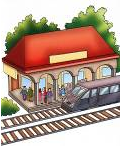


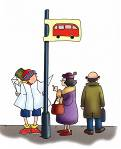
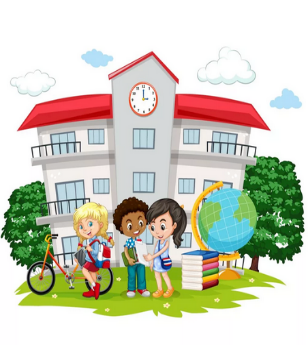



Expressions of place and directions
drive straight on along- ехать прямо по;
walk straight on- идти прямо вперёд;
go along- идти вдоль по;
stop next to- остановиться рядом с;
go across- пересечь;
cross over- перейти через;
turn round- развернуться;
turn off- свернуть с;
go down- спуститься вниз;
go up- подняться вверх;
walk through- пройти через, сквозь;
take a left turn- повернуть налево;
on the left- слева;
on the right- справа;
to the left- налево;
to the right- направо;
to the bottom- к низу;
to the top- кверху;
at the end of- в конце, на конце;
c- на углу;
opposite- напротив;
on the other side of- на другой стороне;
forward- вперёд;
back -назад.
6. Look at the map and answer the questions, using the preposition of place in brackets.
1 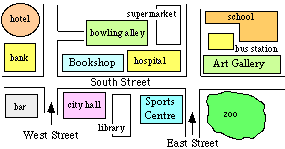 .- Where is the Art Gallery? (between)
It’s ….
2.- Where is the bowling alley?
(behind)
3.- Where is the hotel? (next to)
4.- Where is the zoo? (opposite)
7. Use the information to practice asking and answering questions. i.e.
Bank/Queen Street
A) Excuse me, is the Bank near here?
B) Yes, it is. The Bank is on Queen Street.
Post Office/Central Avenue
Bookstore/Ocean Way
Hospital/Dunlop Road
Park/Acorn Avenue
London School of English/St. Peter’s Street
Thompsons Department Store/Oxford Street
Lesson 2
Why we drive on the left in the UK
1. Read the text
The «rule of the road» in the mainland Europe and the majority of countries in the world, including the United States, is «to drive on the right»
In the United Kingdom and some of her Former dominions: Australia, New Zealand, Kenya, Zambia, South Africa, Zimbabwe, some Caribbean Islands including Barbados and St Lucia. India and Pakistan and the Mediterranean island of Malta, the rule of the road remains to drive on the left. This also applies in Japan and Thailand.
The origin of this rule dates back to how people traveled in feudal societies. As most people are right –handed, it made sense to carry any protective weapon in this hand. When passing a stranger on the road, it would be safer to walk on the left, so ensuring that your weapon was between yourself and a possible opponent. Knights would hold their lances in their right hand, therefore passing on each other’s left.
Revolutionary France changed this historic practice, as part of its social rethink. Their military general and Emperor Napoleon Bonaparte was left-hand, therefore his armies had to march on the right, so he could keep his sword arm between him and the advancing enemy. From that time any part of the world that was colonized by the French would travel on the right, and the rest would remain traveling on the left.
2. Put the words in the right order.
1. from / left / to get to / turn / Red Square / here.
2. get off / at / third / stop / the train / the.
3. it / safer / to walk / would be / on the left
4. Napoleon / general / left-hand / Emperor / the / Bonaparte / and / military / was
5. part / the French / the world / colonized / of / was / any / by
6. coming / give way / to cars / at crossroads / from the right.
3. Match the questions with the answers.
| 1. Excuse me, sir. Can you show me the way to the British Museum? 2. Excuse me. Where is the nearest post office here? 3. Is the bank around the corner? 4. How long does it take you to get to the station? 5. Where is the cafe here? | а. You turn left, and it is right there. By the way, they have a special menu this week. b. Only ten minutes. c. No. It is at the right-hand corner of Darwin Street. Can you see that bank machine? d. Yes, sure. It is over there. This way. e. It is on the left to the crossroads. |
4. Write, how you get to:
your college?
your favourite shopping centre?
the nearest bank?
5. Write the odd one:
1. turn off, sit down, go up, take a left turn
2. left-hand, on the left, at the end of, to the right
3. bus station, airport, railway station, fire station
4. café, hospital, restaurant, bar
5. school, college, hotel, university
6. Insert the preposition: on, in, at
His office is _____the top of the stairs.
I spent this weekend ______a small village ______the mountains.
Jane bought a three-room flat ______ the third floor.
Let's meet ______the exit to the Supermarket.
She met ______the shop ______the beginning of Central Park.
There are a lot of shops ______the end of the street.
There's somebody______ the door.
You are the only one ______the world who knows it!
7. Insert the preposition: back (2) , around, near, down, far (2), up, left, down, right, straight
Carry turned ______ and looked ______ to see him running to her.
Go ______ the street, then turn ______ and you will see the Square.
He left _____, ______ away and never came _______.
Sometimes you need to fall ______ to fly _____.
The street goes ____________ and after few km. turns ___________.
They live _____ the station.
Lesson 3
Special Questions
Специальный вопрос задают для выяснения дополнительных сведений. Поставить специальный вопрос в английском языке можно к любому члену предложения, в зависимости от того, какие именно сведения вам необходимы. Второе название специального вопроса в английском языке — это «wh-question». Так определяют эти вопросы из-за вопросительных слов, которыми они начинаются:
Wh-words:
who — кто, кого, кому
what — что, какой
whose — чей
whom — кого, кому
which — который (из нескольких)
when — когда
where — где, куда (также where to)
how - как, каким образом
why - почему
how much — сколько
how often — как часто
how many — сколько (с исчисляемыми существительными)
how long — как долго, сколько
Построение специального вопроса
| Вопросительное слово | Вспомогательный глагол или модальный глагол | Подлежащее | Сказуемое | Дополнение | Обстоятельство | |
| места | времени | |||||
| Why | do | you | go | with Kate | to college | on Friday? |
But!
Построение специального вопроса к подлежащему происходит иначе. В английском языке вопрос к подлежащему мы задаем с помощью слов:
who — кто (для живых существ: людей, животных, птиц и т. д.)
what — что (для неживых предметов: растения, вещи, природа и т. д.)
Для построения такого вопроса, мы берем утвердительное предложение и вместо действующего лица на первое место ставим who/what.
Например:
Who goes to college every day?
What was broken?
What makes me happy?
Who is fixing the computer?
1. Complete the quiz questions with a question word from the box. You need to use some words more than once. Then do the quiz and match the questions (1- 26) with the answers (a- z).
| When Where Whose Who Why How many Which What |
| 1. … discovered America? 2. … discovered Australia? 3. … do people go surfing in Australia? 4. … is the queen of the United Kingdom? 5. … is the national emblem of England? 6. … were the Beatles from? 7. … countries are there in Great Britain? 8. … was the first president of the USA? 9. … is summer in Australia? 10. … is Toronto? 11. … picture is on the Australian dollar? 12. … city is the capital of Australia? 13. … city can you see from the top of Sears Tower? 14. … is Alcatraz Island? 15. … countries are there in the UK? 16. … is the symbol of Scotland? 17. … is Kate Middleton’s title? 18. … was America discovered? 19. … is the capital city of the USA? 20. … can you find a famous opera in Australia? 21. … son is Prince William? 22. … daughter was Queen Elizabeth I? 23. … queen ruled in England in the 19th century? 24. … do some people visit Australia? 25. … is the name of Prince William’s son? 26. … children does Prince Charles have? | A) In San Francisco Bay. B) Two. C) Elizabeth II. D) Queen Elizabeth’s. E) In December, January and February. F) Because they want to see kangaroos. G) HRH Duchess of Cambridge. H) Captain Cook. J) Washington. K) Prince Charles’s. L) King Henry VIII’s. M) George Washington
N) The red rose. O) Queen Victoria. P) Because there are a lot of big waves. Q) In Canada. R) Three. S) New York. T) Canberra.
U) Four. V) George. W) Christopher Columbus.
X) The thistle. Y) Liverpool.
Z) In Sydney |
2. Put the words in the right order.
1. when / start / competitions / your / do?
3. in / popular / kind / of transport / what / is / China / a?
4. she / does not / why / the hospital / take / the metro / to get to?
5. he / does / play / football / how often?
6. rides / a motorbike / your / who / family / in?
7. old / this / bridge / is / how?
8. lead / side / does / to where / this / street?
3. Match the question words to the answers.
| 1. Why? 2. When? 3. Where? 4. How? 5. How many? 6. What? 7. Whose? 8. How old? | a) Twelve years old b) Chocolates c) Because I like them. d) Twenty-seven e) Quickly f) Yesterday g) At home. h) Michael's |
4. Ask special questions to the sentences beginning with the words given in brackets
Some children do stupid things. (why?)
I am looking for my watch (what?)
His penfriend lives in London. (where?)
We met after school yesterday. (when?)
She'll come to the party. (with whom?)
English is spoken in many countries. (what countries?)
He was not prepared for the test. (why?)
They were playing a game when I came. (what game?)
I have made some mistakes in this exercise (how many?)
He has given me his old camera. (what?)
5. Put questions to the words in the italics:
1. Kate likes to walk along streets in good weather.
2. You need to turn to the right.
3. His father leaves his car in the street.
4. Alex has his English lessons three times a week.
5. He drives fast.
6. They drive on the right side of the road in that country.
7. We have several thousand books in our home library.
8. Peter's granny cooks very tasty dishes.
9. She is looking for a map to find that workshop.
10. A waiter brings the customers their desserts.
Lesson 4
Shops and shopping
Study the following words and expressions:
grocer`s – бакалея
baker`s – булочная
greengrocer`s – магазин «Овощи - фрукты»
dairy – молочный магазин
butcher`s – мясной магазин
ready-made – готовый
fabric – ткань
china – фарфор
electrical appliances – электроприборы
linen – постельное белье
customer – покупатель
counter – прилавок
underwear – нижнее белье
knitwear – трикотаж
pasta – макаронные изделия
flour – мука
poultry – мясо птицы
beetroot –свекла
ready-weighed and packed - расфасованный
1. Read the text and translate it:
What Do Shops Offer?
When we want to buy something, we go to a shop. Although every town or city has many kinds of shops, many of these are typical: a supermarket, a department store, men's and women's clothing stores, a grocer's, a baker's, a greengrocer's, a dairy and a butcher's.
Alexander's family like to do their shopping at big department stores and supermarkets. These sell various goods under one roof and this is very convenient. A department store, for example, true to its name, consists of many departments: ready-made clothes, fabrics, shoes, sports goods, toys, china and glass, electrical appliances and electronics, cosmetics, linen, curtains, books, gifts, jewelry etc. You can buy anything you like there.
There are also escalators in big stores which take customers to different floors. The goods for sale are on the counters so that they can be easily seen. In the women's clothing department you can find dresses, suits, blouses, skirts, coats, beautiful underwear and many other things. In the men's clothing department you can choose suits, trousers, overcoats, ties etc. In the knitwear department one can buy sweaters, cardigans, short-sleeved and long-sleeved pullovers, woolen jackets. In the cosmetic department they sell perfume, face creams and powders, lipsticks, lotions, shower gels, soap, shampoos…
In the supermarket we can also buy many different things in the same location: meat and sausages, fish, sugar, pasta, flour, cereals, tea, coffee, bread and whatnot.
At the butcher's there is a wide choice of meat and poultry. At the baker's you can buy white or brown bread, rolls and biscuits.
Another shop we frequently go to is the greengrocer's, which is stocked with cabbage, potatoes, onions, cucumbers, carrots, beetroots, green peas and various fruits. Everything is sold here ready-weighed and packed.
If you call round at a dairy, you can buy milk, cream, cheese, butter and many other milk products.
2. Are these statements true or false? Correct the false ones.
You can buy vegetables in the greengrocer’s.
To buy various goods under one roof is very convenient.
To buy meat and poultry you have to go to the butcher’s.
The dairy sells milk, cheese and sausages.
Cereals are sold in the baker’s.
Everything in the greengrocer’s is ready-made.
You can find various fruits in the Frut & Veg shop.
The department store is a store with escalators.
The knitwear department offers everything for knitting.
To buy china one needs to go to China.
3. Describe how you do your shopping.
I like/hate doing shopping.
I shop (exclusively) online/offline because it's ... (cheap, easy, convenient, better choice, fun etc).
I do my weekly shopping on ... (Sunday).
My favourite stores are ...
I do my food shopping at...
I usually buy ... there.
I have / don't have a passion for buying clothes.
I spend a lot of money on .. .
I (often) buy ...
To save time and/or money I stick to a routine:... (make a shopping list, check the supermarket catalogue, buy goods in the sale, collect coupons, use a discount card etc).
4. Fill in the gaps with the words in the box
| shopping cosmetic things for sale basket clothes counter in fashion ready-weighed and packed select cashier food comfortable quality | 1. There is a...... department in this shop where you can buy perfume. 2. You can come to the....... and choose your purchase. 3. In our greengrocer's you can buy...... vegetables. You pay money to the......... You can........ food and put it into the.......... She does the........ in their family. I enjoy going shopping for new....... They spend quite a lot of money on........ 9. I don't feel........ in these shoes. 10.1 always try to be |
5. Match the phrases in the right column with the replies in the left column
| a. No, I haven't. b. I'd love to, but I don't need anything. d. Here you are. That's £6.50. e. Here is some aspirin for you. f. Do you have batteries for this camera? g. Yes, we do. h. Let me check for you. Yes, I've got one here. i. Yes, here they are, on this upper shelf. j. It's £19.99. It's a little expensive.
| I'd like a kilo of tomatoes, please. How can I help you? Why don't you come to the mall with me? How much is this scarf? I'd like my money back, please. Have you got the receipt, sir? Can you give me something for a headache? Have you got it in a smaller size? Do you accept credit cards? Do you sell dictionaries?
|
6. Choose the right variant and write the answer:
1. Where could you buy a saucepan?
A jewelers
A butcher
A florist
A hardware store
2. Where could you buy some chocolate?
A sweet shop
A jewelers
A butcher
A florist
A hardware store
3. Where could you buy a holiday?
A bakery
A greengrocer
A travel-agency
A book shop
A shoe shop
4. Where could you buy a necklace?
A jewelers
A travel-agency
A record shop
A chemist
5. Where could you buy some milk?
A sweet shop
A dairy
A butcher
A florist
A hardware store
6. Where could you buy some steak?
A tobacconist
A jewelers
A butcher
A record shop
A chemist
7. Where could you buy a newspaper?
A sweet shop
A dairy
A newsagent
A florist
A hardware store
8. Where could you buy a Barbie doll?
A sweet shop
A dairy
A newsagent
A toy shop.
A hardware store
9. Where could you buy a puppy?
A sweet shop
A dairy
A newsagent
A toy shop
A pet shop
10. Where could you buy fruit?
A bakery
A greengrocer
A fishmonger
A book shop
A shoe shop
11. Where could you buy some flowers?
A tobacconist
A jewelers
A butcher
A florist
A chemist
12. Where could you buy some glasses?
An optician
A dairy
A newsagent
A toy shop
A pet shop
13. Where could you buy some cigarettes?
A tobacconist
A greengrocer
A travel-agency
A record shop
A chemist
14. Where could you buy some writing paper?
An optician
A stationers
A newsagent
A toy shop
15. Where could you buy some cod?
An optician
A stationers
A fishmonger
A toy shop
A pet shop
16. Where could you buy bread?
A bakery
A stationers
A fishmonger
A book shop
A shoe shop
17. Where could you buy a CD by the Beatles?
A bakery
A greengrocer
A travel-agency
A record shop
18. Where could you buy some aspirin?
A bakery
A greengrocer
A travel-agency
A record shop
A chemist
19. Where could you buy a novel?
An optician
A stationers
A fishmonger
A book shop
A pet shop
20. Where could you buy a new pair of sneakers?
An optician
A stationers
A fishmonger
A book shop
A shoe shop
Pronouns
| Личные | Притяжательные | Возвратные | ||||
| Именительный падеж | Объектный падеж | Основная форма | Абсолютная форма |
| ||
| кто? что? | кого? чего? кому? чему? | чей? чья? чьё? чьи? | чей? чья? чьё? чьи? |
| ||
| I – я | me – меня, мне | my – мой | mine – мой | myself – сам | ||
| we – мы | us – нас, нам | our – наш | ours – наш | ourselves –сами | ||
| you – ты, вы | you – тебя, тебе, вас, вам | your – твой, ваш | yours – твой, ваш | yourselves – сам, сами | ||
| he – он | him – ему, его | his – его | his – его | himself – сам | ||
| she – она | her – ей, её | her – её | hers – её | herself – сама | ||
| it – он, она, оно | it – ему, ей, его, её | its – его, её | its – его, её | itself – сам, сама | ||
| they – они | them – им, их | their – их | theirs – их | themselves – сами | ||
Упражнения
№ 1. Распределите существительные в таблицу
Kate, my parents, auntie, Jacob, car, sister, cousins, two chairs, chair, the Queen, Ann, brother, uncle, Bill, cat, table, my father, my house, cars, balls.
| He | She | It | They |
|
|
|
|
|
№ 2. Добавьте в предложения he, she, it, we, or they
Molly is very nice. _____'s my best friend.
Molly and I aren't English. ______'re from Sydney.
Greg is my brother. ______'s 25 years old.
Greg and Alison are married. _______'ve got two children.
Emily is 22 years old. ______'s a nurse in
№3. Заполните предложения соответствующими местоимениями:
I’m Pearl and this is………… garden.
My mother’s Jenny and this is…………….. hat.
They are Rogers and Adam and this is ……… bedroom.
He is Lewis and this is ……………..living room.
We are Betty and Barbara and this is …. favourite book. …..title is Twilight.
She is Rachel and this is …………….sister.
These are my teachers. ……………………… names are Paul and Rita.
This is my brother. ………………. name is Peter. He is a student in Hungary.
We are friends. …………………….hobbies are gardening and walking.
I’m Sophie and this is …………… dog. …………… name is Aladdin.
№4. Допишите возвратные местоимения
1. My little sister can dress _______________.
2. I wash my clothes ___________________.
3. We repaired the computer ____________.
4. My uncle shaves __________ every morning.
5. I don’t like to talk about _______________.
6. My sister lives by ____________________.
7. Sarah looks at ___________ in the mirror for hours.
8. We hurt ____________ in the accident.
9. You are going to enjoy ____________ if you go to the party.
10. Kids don’t hurt ____________ when they are in the park.
№5. Переведите предложения на английский:
1 . Она ничего не сказала.
2 . Он посмотрел на нее с удивлением.
3 . Она не захотела пойти с ним.
4 . Я попросил его налить немного молока.
5 . Когда ему было 3 года, он мог сам одеваться.
6 . Простите, но у меня нет времени.
7 . Какая красивая картина! Она твоя?
8 . Возьми свою чашку. Эта чашка — моя.
Lesson 5
Countable and uncountable nouns
Существительные могут быть как исчисляемыми, так и неисчисляемыми.
К исчисляемым существительным (countable) относятся названия предметов, которые можно пересчитать. Они употребляются как в единственном, так и во множественном числе.
К неисчисляемым существительным (uncountable) относятся названия предметов, которые нельзя пересчитать. К ним принадлежит существительные вещественные и отвлеченные.
Неисчисляемые существительные:
Вещества: жидкости (coffee, milk, tea, water, juice), твёрдые вещества (bread, butter, cheese, china, coal, food, fruit, glass, ice, iron, fish [meaning food], silver), газы (air, oxygen, pollution, smoke, smog), частицы (corn, dust, flour, hair, paper, pepper, rice, salt, sand, sugar).
Bread is more than just a food.
Предметы (науки): chemistry, economics, literature, mathematics, physics, phonetics.
Phonetics is a branch of linguistics.
Языки: Chinese, English, French.
Игры: billiards, chess, golf, soccer, tennis, darts.
Болезни: flu, measles, mumps.
Природные явления: darkness, grass, hail, heat, light, rain (but: the rains = season of continuous rain in tropical countries), humidity, thunder, snow, etc.
Абстрактные существительные: accommodation, advice, anger, applause, assistance, behaviour, business, chaos, countryside, courage, damage, dirt, education, evidence, excitement, fear, help, housework, homework, hope, information, intelligence, knowledge, leisure, life, love, luck, music, news, peace, permission, progress, seaside, shopping, traffic, trouble, truth, wealth, weather, work, etc.
He gave me some good advice. – Он дал мне несколько хороших советов.
| Исчисляемые существительные | Неисчисляемые существительные |
| a lot of (много) | a lot of (много) |
| many (много) | much (много) |
| a few (несколько) few (мало) | a little (немного) little (мало) |
| How many …? (сколько) | How much …? (сколько) |
1. Are the nouns usually countable or uncountable? Put C or U.
| a. rice | U | i. grape |
|
| b. money |
| j. biscuit |
|
| c. apple |
| k. fruit |
|
| d. stamp |
| l. sandwich |
|
| e. wine |
| m. cheese |
|
| f. cat |
| n. cup |
|
| g. bread |
| o. juice |
|
| h. potato |
| p. egg |
|
2. Choose the correct word: many or much.
I have ___________ information about this person.
There is _____________ milk at home. You should buy it tomorrow.
There are _____________ children in our street.
There are _____________ seas in the world.
I like to put ____________ sugar in my tea.
3. Complete the questions. Use How much and How many.
How many eggs are in the fridge?
1. ___________ water is there in the glass?
2. ___________ rice is there in Ben`s plate?
3. ___________ bread is there in the cupboard?
4. ___________ crisps are there in the pocket?
5. ___________ people are there in the island?
4. Choose uncountable noun in each line:
1) glass/ cup/ jar/ water
2) magazine/ newspaper/ news/ article
3) cloud/ weather/ tree/ flower
4) event/ information/ reporter/ programme
5) money/ wallet/ coin/ banknote
6) bookcase/ furniture/ wardrobe/ armchair
7) sheep/ ox/ meat/ cow
8) bag/ luggage/ purse/ suitcase
9) music/ song/ piano/ sound
10) tomato/ potato/ carrot/ soup
5. Translate from Russian into English.
несколько стульев
немного воды
несколько человек
несколько минут
несколько дней
немного соли
несколько ложек
несколько машин
немного сахару
немного сыра.
6. Use some or any:
1.We need ____ flour, ____ eggs and ___ sugar.
2. Do you buy _____bread and _____coffee?
3. I don’t bring you ____ice cream.
4. We have ____ orange juice, but we don’t have ___ cake.
5. Are there ___ onions in the basket?
7. Translate the sentences
1. В чашке чай. В чашке много чая.
2. На блюдце варенье. На блюдце немного варенья.
3. На столе еда. На столе много еды.
4. В тарелке каша. В тарелке мало каши.
5. В стакане сок. В стакане немного сока.
Lesson 6
Healthy eating
1. Read the text:
Your body needs about 13 different vitamins nowadays there are many kinds of food in the shops. On TV we can many advertisements of different food. But what food does your body need is order to be strong and healthy? All the foods may be divided into few basic types which your body need. These food types are carbohydrates, proteins and fats. They contain other things your body needs-fiber, vitamins and minerals, and water.
Carbohydrates are your body’s main source of energy. Foods which high in carbohydrates include fruits, bread, cereals, rice, pasta, potatoes, peal, and beans. Sugar in candy is also a carbohydrate, but the candy usually has no other nutrients in it. This is an important reason why it is better for you, to eat a piece of fresh fruit than a candy for dessert. Proteins are the building blocks of life. Proteins help your body to repair and replace cells, build muscle, and control many of the important chemical reactions inside you. Good sources of protein, but a single type of plant may not contain all the amino acids you need. Vegetables and grain foods combined with dairy products can give you all the amino acids. Do you know that fats are also an important part of a healthy diet? They provide your body with cheese, milk butter, margarine and nuts.
For your eyes and skin, you need vitamin A. It also helps you grow. Vitamin A is found in in liver, carrots, squash, and spinach. Vitamin B helps your body turn food into energy, repair tissues, build muscles, and make red blood cells. Liver, pork, whole-grain cereals, dark leafy vegetables, and peanuts contain vitamin B. Vitamin C is for healthy teeth, gums, and bones. It is found in citrus fruits, tomatoes, strawberries, and spinach. Vitamin D gives you strong bones. Milk is a good source for this vitamin. Your skin gets vitamin D directly from the sunlight!
You should drink several glasses of water every day.
You should do exercises every day. They are useful for your muscles, lungs, heart, and blood circulation.
You should have a good rest. Reading, swimming, hobbies, games, etc. are wonderful way to rest.
Good food, good rest and exercise help make you strong and healthy inside. But bright eyes, energetic body are only one part of what it takes to look your best. This is called grooming.
You should clean your teeth after every meal and at bedtime.
You should take care of your hair. Brushing your hair daily helps make it shiny and health. Wash your hair several times a week.
You should wear fresh, clean, and neat clothes. They make you look and feel good.
2. Answer the questions:
Have you a good appetite?
What have you eaten for breakfast today?
What do you usually like to eat?
What do you usually like to drink?
What are your favorite fruits?
What are your favorite vegetables?
Do you like to eat sweets? What kind?
Do you like pickled food? What kind?
Do you like dried food? What kind?
Do you like canned food? What kind?
How often do you eat fast food? Do you like it?
3. Try to match English proverbs to their Russian equivalents:
| 1) Tastes differ.
2) An apple a day keeps the doctor away.
3) The appetite comes with eating.
4) Every vegetable has its season.
5) After dinner sit a while, after supper walk a mile.
6) Too much butter won’t spoil the porridge.
7) Breakfast like a king, lunch like a queen and dinner like a pauper. | a) Аппетит приходит во время еды.
b) Каждый овощ имеет своё время года
c) О вкусах не спорят.
d) Кашу маслом не испортишь.
e) Завтрак съешь сам, обед раздели с другом, ужин отдай врагу.
f) После обеда посиди немного, после ужина с милю пройдись.
g) Кто по яблоку в день съедает, у того доктор не бывает. |
4. Match the parts of the proverbs about health.
Health is better a) than sorry
An apple a day b) in a healthy body
A happy heart c) than wealth
A healthy mind d) keeps the doctor away
5. Early to bed, early to rise e) is a good medicine
6. Better to be safe f) makes a man healthy, wealthy and wise
5. Find the odd:
meat, sausage, milk
sandwich, hot-dog, fruit
chocolate, lemon, candy
vegetables, pizza, milk
carrot, onion, orange
juice, tea, soup.
6. Divide these things into 2 categories: useful – unuseful
Chocolate, eggs, carrot, sweets, honey, bread, meat, cake, milk, hot dog, butter, fish, candy, apple, chips, cheese, hamburger, orange, tomato, pizza.
7. Complete the text. Use these words: sugar, diet, vitamins, protein, fat, vegetables, minerals
I eat healthy food. I drink milk for ------. I don’t eat lots of cake. Cakes have lots of ----. Sometimes I eat sausages. They have lots of good -----, but they’ve got -----. I eat lots of fruit and----. There are different types of ----in milk, vegetables, eggs, meat, cereals and many other foods. I eat soup every day. It’s very good for you. I drink lots of water every day. I have a healthy ---.
8. Are these sentences true or false?
Vitamins are important for your eyes, your skin, your bones, for hair and for other parts of your body.
There are some vitamins in milk.
There isn’t any sugar in cake.
Sausages haven’t got fats.
Protein is good for you.
Water is important for your blood.
Fruit isn’t healthy.
9. Read the poem and follow it.
If you want to live the healthy way,
Eat FIVE fruits every day.
Have juice for breakfast, carrots with lunch,
Grapes for snack (eat a big bunch).
Peas and potatoes with tour dinner-
That adds up to five, and you are a winner!
Lesson 7
ПРИТЯЖАТЕЛЬНЫЙ ПАДЕЖ СУЩЕСТВИТЕЛЬНЫХ
№1. Сделайте конспект в тетради:
Форму притяжательного падежа обычно имеют одушевленные существительные, обозначающие живое существо, которому принадлежит какой-нибудь предмет, качество или признак. Она образуется при помощи окончания -s, перед которым стоит апостроф: the girl - девочка — the girl’s bag сумка девочки.
| Примеры образования притяжательного падежа | ||
| № | Правило | Пример |
| 1 | Если существительное оканчивается на -s, то возможны два варианта | Dickens′ novels = Dickens′s novels романы Диккенса |
| 2 | Если существительное во множественном числе оканчивается на -s, то притяжательный падеж образуется путем добавления апострофа | workers′ caps кепки рабочих, cats′ paws лапы кошек, nurses′ toys игрушки нянек |
| 3 | Существительные, не имеющие во множественном числе окончания -s, в притяжательном падеже приобретают окончание -s, перед которым стоит апостроф | children′s toys детские игрушки, men′s coats мужские пальто women′s umbrellas женские зонты |
| 4 | Если предмет или признак принадлежит нескольким лицам, то апостроф и окончание -s ставятся после последнего из них, если же каждому в отдельности, то после каждого | Ilf and Petrov′s novel Shelly′s and Byron′s poems |
| 5 | В сложных существительных апостроф и окончание -s ставят после последнего элемента | the teacher of art′s room комната учителя искусства, the sister-in-law′s bag |
| 6 | Неодушевленные существительные обычно не имеют притяжательного падежа | the roof of this house крыша этого дома |
Среди неодушевленных существительных есть исключения, которые можно поставить в форму притяжательного падежа через ’s:
Существительные, обозначающие время и расстояние: today’s newspaper, a mile’s distance
Названия стран и городов: Germany’s industry, New York’s streets
Названия газет и организаций: the Guardian’s article, Red Cross’s volunteers
Слова nation, country, city, town: country’s treasures
Слова ship, car, boat: ship’s name, car’s speed
Слова nature, water, ocean: ocean’s temperature, nature’s beauty
Названия месяцев и времени года: January’s frosts, summer’s days
Названия планет: Saturn’s rings
Некоторые устойчивые выражения: at death’s door, at arm’s length, a hair’s breadth, at a snail’s pace и другие.
какое-либо место (магазин, дом, мастерская и т.д.): at the grocer’s, at the buther’s, at the dentist’s
https://youtu.be/uLsen2d-x5Q
№2. Переведите на русский язык:
a man’s bag, a girl’s doll, the women’s right, the actress’s voice, James’ room, fox’s tricks, boy’s games, students’ songs, Eugene’s works, Marx’ letters.
№3. Перепишите предложения, используя притяжательный падеж существительных. Переведите предложения.
Например: This car belongs to Sam. – This is Sam’s car. (Это машина Сэма.)
This notebook belongs to Kate.
These suitcases belong to our friends.
This bedroom belongs to my daughter.
These keys belong to Dan.
This picture belongs to Picasso.
№4. Напишите, чем является ‘s в каждом предложении: притяжательным падежом существительного или сокращенной формой глагола is.
Например: Helen is George’s wife. - ‘s обозначает притяжательный падеж.
Ann’s a wonderful friend. - ‘s является сокращением глагола is
Lena’s day was very hard.
Sam’s a doctor.
My son’s girlfriend speaks two foreign languages.
He’s a talented tennis-player.
It’s warm today.
№5. Прочитайте текст и определите родственные связи героев, используя притяжательный падеж.
George and Mary are married. They have 2 children: John and Laura. Mary has a sister, Kelly. George has a brother, Rob.
George is Mary’s husband.
Mary is ______ wife.
George is __________ father.
Mary is _________ mother.
John is __________ son.
Laura is _______ daughter.
№6. Переведите словосочетания, используя притяжательный падеж существительных.
Например: отец Кэрол – Carol’s father
1. работа Петра
2. имя учителя
3. машина Ника
4. телефон Ани
5. компьютер моих сыновей
№7. Перефразируйте следующие словосочетания и предложения, употребляя притяжательный падеж.
1. The ball of the dog.
2. The skateboard of that man.
3. The songs of the children.
4. The umbrella of my grandmother.
5. The room of my brother.
Lesson 8
Eating Traditions
1. Study the following words and expressions
meal — еда, прием пищи
roll — маленькая круглая булочка
porridge — овсяная каша на молоке
corn flakes — кукурузные хлопья
cream — сливки
marmalade — апельсиновый джем
buttered — намазанный маслом
boiled — вареный
ham — ветчина
pickles — маринованные овощи
mutton chop — отбивная из баранины
chips — жареный картофель
biscuit — печенье
light beer — светлое пиво
sociable sort of thing — мероприятие для общения
roast — жареный (в духовке, на огне)
sweet — сладкое, десерт
nut — орех
2. Read a text "British Meals”
The usual meals are breakfast, lunch, tea and dinner. Most families have three meals a day. Breakfast is from 07.00 to 9.00. A typical English breakfast consists of а plate of cereals, a slice of toast, a glass of orange juice and a cup of coffee or tea. The traditional English breakfast consists of eggs, bacon, sausages, fried bread, baked beans and mushrooms. Many English people now take such a full breakfast only on Sunday evening.
They generally have lunch between 12.00 and 14.00. It usually consists of a light meal of soup, sandwiches or salad, cheese and fruit and a cup of coffee or tea. The businessman in London usually finds it impossible to come home for lunch, and so he goes to a cafe or restaurant; but if they can make it home for lunch, they have cold meat (left over probably from yesterday's dinner), potatoes, salad and pickles, with a pudding or fruit to follow. Sometimes British have a mutton chop, or steak and chips, followed by biscuits and cheese, and some people like a glass of light beer with lunch.
Afternoon tea you can hardly call a meal, but it is a sociable sort of thing, as friends often come in then for a chat while they have their cup of tea, cake or biscuits.
In some houses dinner is the biggest meal of the day. It is usually in the evening (at about 19.00). They begin with soup, followed by fish, roast chicken, potatoes and vegetables, a sweet, fruit and nuts, coffee. But in a great many English homes they make the midday meal the chief of the day, and in the evening they have simple dinner - an omelette, or sausages, sometimes bacon and eggs and sometimes just bread and cheese, a cup of coffee or cocoa and fruit.
2. Answer the questions:
1. What are the usual meals in England?
2. What time do they have breakfast?
3. What is a traditional English breakfast?
4. What are the two substantial meals of the day?
5. When is lunch usually taken?
6. What does lunch include?
7. Is tea popular among the English?
8. When do they usually have dinner?
9. Do the British enjoy tasting delicious food from other countries?
3. Complete the sentences:
Most families have … …
A typical English breakfast consists of … …
The traditional English breakfast consists of … …
Lunch consists of… ….
In some houses dinner is … ….
They begin with … ….
They have simple dinner - … …
4. Read the text again and mark the sentences as true (T) or false (F)
1. Most English families have five meals a day.
2. A typical English breakfast consists of plate of cereals, a slice of toast, a glass of orange juice and a cup of coffee or tea.
3. The traditional English breakfast consists of eggs, bacon, sausages, fried bread, baked beans and mushrooms.
4. Lunch usually consists of a big hamburger, a glass of cola, and an ice-cream.
5. The main lunch meal is usually in the morning (at about 9.00).
6 The evening meal is usually called “Afternoon tea”.
5. Read the following text and answer the questions:
In Japan it is possible for people to slurp loudly noodles and similar food. Thus you demonstrate that you are enjoying the food. There is no custom of tipping in Japan.
In China people usually leave a small amount of food uneaten on their plates. If you leave an empty plate, you are sending an insulting message that not enough food was served to you.
In Egypt you can express your satisfaction and compliment the cook with a loud belch after a meal.
In Mexico it is considered rude to leave the table until a respectable amount of time has passed after a meal. You are expected to keep your hands above the table at all times
In Sweden, even on a date, it is customary to pay their share of the bill. This is calculated precisely, it isn’t enough to estimate it roughly.
In Crete people seldom eat the last meal of the day until 9 p.m. Restaurants will be largely empty during what is considered the dinner rush in America.
In Brazil people have their dinner very late- at about 10 o’clock at night. They never eat with their hands. They always use a folk and knife. They drink a lot of coffee and fruit drinks during the day. They like eating with their friends and family.
In Germany it is polite to have both hands above the table at all times. You shouldn’t rest your elbows on the table. It is considered impolite to leave food on the plate. Waiters expect a 5 to 10 percent tip after serving a meal.
In Italy people take food seriously. They prefer to dine in a leisurely fashion.
1. How can you demonstrate that you like the meal in Japan?
2. What is impolite in Germany?
3. What does it mean to leave an empty plate in China?
4. Who pay for the meal in Sweden?
5. Who never eats food without a folk and knife?
6. Who takes food very seriously?
7. What is rude in Mexico?
6. Write about Russian eating traditions:
Breakfast:
Lunch:
Afternoon meal:
Dinner:
7. Complete the sentences:
When I am hungry I want to…
When I am thirsty I want to…
People cannot live without…
There are a lot of … in vegetables and fruit.
Plants cannot live without …
English people drink tea with …
In summer everybody likes to eat …
… is the biggest meal of the day.
8. Guess what it is:
1. This is a vegetable. This is not a sweet vegetable. It is long. Its colour is green. You can eat it in a salad. What is it?
2. This is a vegetable. This is a sweet vegetable. It is long. Its colour is red or orange. You can eat it in a salad or soup. What is it?
3. This is a fruit. This is a sweet fruit. It is round. Its colour is red or yellow or green. What is it?
4. This is a fruit. This is not a sweet fruit. It’s not round. It’s not long. It’s oval. Its colour is yellow. You can have it in your tea. What is it?
5. This is a vegetable. This is usually a round vegetable. Its colour is red. You can eat it in a salad. What is it?
6. This is a fruit. It is sweet and juicy. It is small and round. It grows on trees. What is it?
7. This is a vegetable. It is not sweet. It is big and round. Its colour is green. You can eat it in a salad. What is it?
9. Find an odd word:
1) tea, sausage, meat, fish;
2) potatoes, apples, plums, peaches;
3) hamburger, sandwich, pizza, sugar;
4) lunch, dinner, cheese, breakfast;
5) juice, milk, bacon, coffee;
6) salad, soup, honey, cereal;
7) vinegar, salt, ketchup, lemonade.
10. Match the foods with the countries where they are eaten
1. Africa a. corn, rice, other grains
2. Britain b. fish, onions, garlic
3. China c. rice, curry
4. Italy d. rice, spicy fried foods with noodles
5. France e. rice, vegetables, raw or cooked fish
6. Germany f. roast beef, Yorkshire pudding
7. India g. sauces
11. Food and Food-Related Words
1. Lemons taste ___.
a. salty
b. sour
c. bitter
d. crunchy
e. bland
2. Potato chips are not ___.
a. crisp
b. salty
c. crunchy
d. juicy
e. junk food
3. Smooth foods don't include ___.
a. crackers
b. ice cream
c. pudding
d. whipped cream
e. avocado
4. Finger food ___.
a. makes your fingernails grow longer
b. is only in eaten in countries where they don't have silverware
c. is slang for a bad gesture
d. is food you can politely eat with your hands
e. is the name of a really tasty candy bar
5. Light food is the opposite of ___.
a. heavy food
b. rich food
c. bland food
d. junk food
e. health food
6. If something is tasty, you ___.
a. don't really enjoy eating it
b. think it tastes good
c. hate eating it
d. only eat it for breakfast
e. think it is unappetizing
7. Spicy food includes ___.
a. milk
b. lemons
c. chili peppers
d. bananas
e. hamburgers
8. If milk is sour it is ___.
a. delicious
b. too old
c. too fresh
d. from a goat
e. from a coconut
9. A beverage is ___.
a. Beverley's birthday
b. something red
c. an alcoholic drink
d. any drink
e. normally crunchy
10. Sweet foods don't include ___.
a. cake
b. pickles
c. ice cream
d. candy
e. strawberries
Комплекты видеоуроков для учителей
Скачать
© 2020, Воронина Марина Владимировна 1945 12
Похожие файлы
Вебинар для учителей

Свидетельство об участии БЕСПЛАТНО!



