


Kyrgyztan, Osh

СДЕЛАЙТЕ СВОИ УРОКИ ЕЩЁ ЭФФЕКТИВНЕЕ, А ЖИЗНЬ СВОБОДНЕЕ
Благодаря готовым учебным материалам для работы в классе и дистанционно
Скидки до 50 % на комплекты
только до
Готовые ключевые этапы урока всегда будут у вас под рукой
Организационный момент
Проверка знаний
Объяснение материала
Закрепление изученного
Итоги урока
Была в сети 05.08.2020 20:10
Narmatova Gulzina Kaldarovna
English teacher
 1 045
1 045
 65 203
Местоположение
Специализация
Modal verbs and Test
Категория:
Английский язык
21.04.2020 07:41

Просмотр содержимого документа
«Modal verbs and Test»
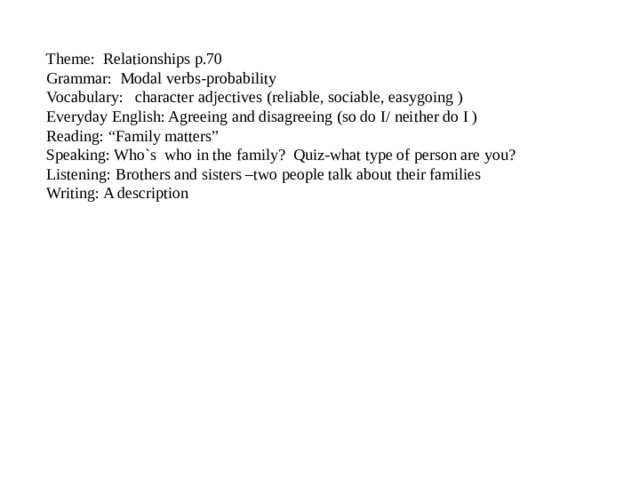
Theme: Relationships p.70 Grammar: Modal verbs-probability Vocabulary: character adjectives (reliable, sociable, easygoing ) Everyday English: Agreeing and disagreeing (so do I/ neither do I ) Reading: “Family matters” Speaking: Who`s who in the family? Quiz-what type of person are you?
Listening: Brothers and sisters –two people talk about their families Writing: A description
Plan of the lesson:
- Warm up
- Introduction to conditionals
There are many different ways of making sentences with if. It is important to understand the difference between sentences that express real possibilities, and those that express unreal situations.
1.Expressing possibility/probability:
must and can`t express the logical conclusion of a situation: must=logically probable;
can`t=logically improbable. We don`t have all the facts, so we are not absolutely sure, but we are pretty certain.
A walk in this weather! You must be joking!
Is there no answer? They must be in bed.
They can`t be out this late!
He must be exhausted. He can`t even stand up. She can`t have a ten-year-old daughter! She is only 24! He is in great shape, even though he must be at least 60! A walk in the
Could and may/might express possibility in the present or future. May/might+not is the negative.
- Couldn`t is rare in this use:
- He might be lost.
- They could move to a different place.
- Dave and Betty aren`t at home. They could be at the concert, I suppose.
- We may go to the Greece for our vacation. We haven`t decided yet.
- Take your umbrella. It might rain later.
- I might not be able to come tonight.
- I might have to work late.
The continuous infinitive
- Must/could/can`t/might+be+ing make the continuous form in the present.
- Peter might be working late.
- They can`t be working very hard.
- Compare:
- Bolot`s grass is lovely. He must cut it regularly. (habit)
- What`s Bolot doing in the garden? He might be cutting the grass (now)
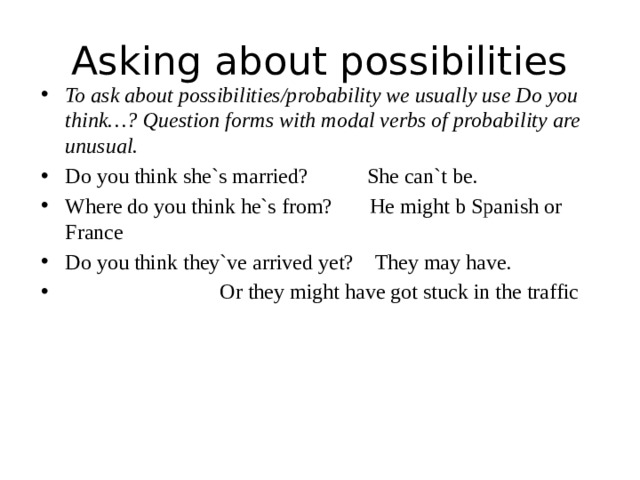
Asking about possibilities
- To ask about possibilities/probability we usually use Do you think…? Question forms with modal verbs of probability are unusual.
- Do you think she`s married? She can`t be.
- Where do you think he`s from? He might b Spanish or France
- Do you think they`ve arrived yet? They may have.
- Or they might have got stuck in the traffic
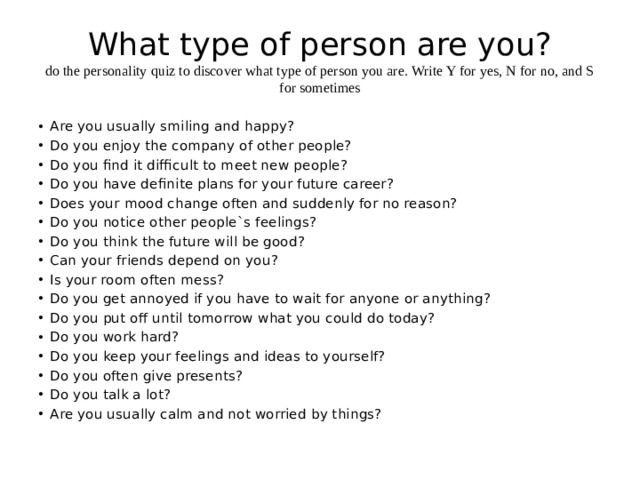
What type of person are you? do the personality quiz to discover what type of person you are. Write Y for yes, N for no, and S for sometimes
- Are you usually smiling and happy?
- Do you enjoy the company of other people?
- Do you find it difficult to meet new people?
- Do you have definite plans for your future career?
- Does your mood change often and suddenly for no reason?
- Do you notice other people`s feelings?
- Do you think the future will be good?
- Can your friends depend on you?
- Is your room often mess?
- Do you get annoyed if you have to wait for anyone or anything?
- Do you put off until tomorrow what you could do today?
- Do you work hard?
- Do you keep your feelings and ideas to yourself?
- Do you often give presents?
- Do you talk a lot?
- Are you usually calm and not worried by things?
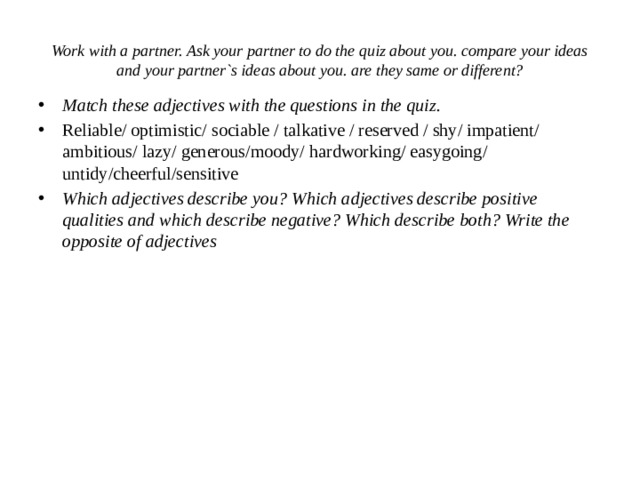
Work with a partner. Ask your partner to do the quiz about you. compare your ideas and your partner`s ideas about you. are they same or different?
- Match these adjectives with the questions in the quiz.
- Reliable/ optimistic/ sociable / talkative / reserved / shy/ impatient/ ambitious/ lazy/ generous/moody/ hardworking/ easygoing/ untidy/cheerful/sensitive
- Which adjectives describe you? Which adjectives describe positive qualities and which describe negative? Which describe both? Write the opposite of adjectives
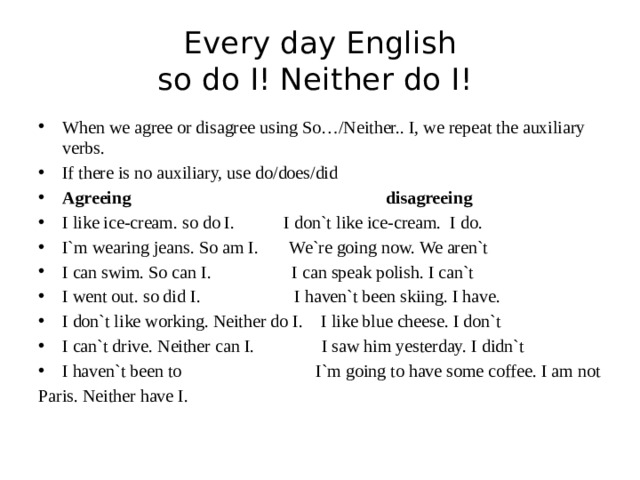
Every day English so do I! Neither do I!
- When we agree or disagree using So…/Neither.. I, we repeat the auxiliary verbs.
- If there is no auxiliary, use do/does/did
- Agreeing disagreeing
- I like ice-cream. so do I. I don`t like ice-cream. I do.
- I`m wearing jeans. So am I. We`re going now. We aren`t
- I can swim. So can I. I can speak polish. I can`t
- I went out. so did I. I haven`t been skiing. I have.
- I don`t like working. Neither do I. I like blue cheese. I don`t
- I can`t drive. Neither can I. I saw him yesterday. I didn`t
- I haven`t been to I`m going to have some coffee. I am not
Paris. Neither have I.
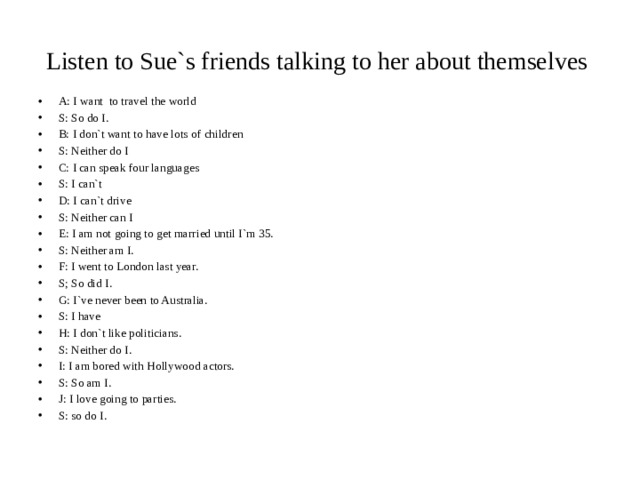
Listen to Sue`s friends talking to her about themselves
- A: I want to travel the world
- S: So do I.
- B: I don`t want to have lots of children
- S: Neither do I
- C: I can speak four languages
- S: I can`t
- D: I can`t drive
- S: Neither can I
- E: I am not going to get married until I`m 35.
- S: Neither am I.
- F: I went to London last year.
- S; So did I.
- G: I`ve never been to Australia.
- S: I have
- H: I don`t like politicians.
- S: Neither do I.
- I: I am bored with Hollywood actors.
- S: So am I.
- J: I love going to parties.
- S: so do I.
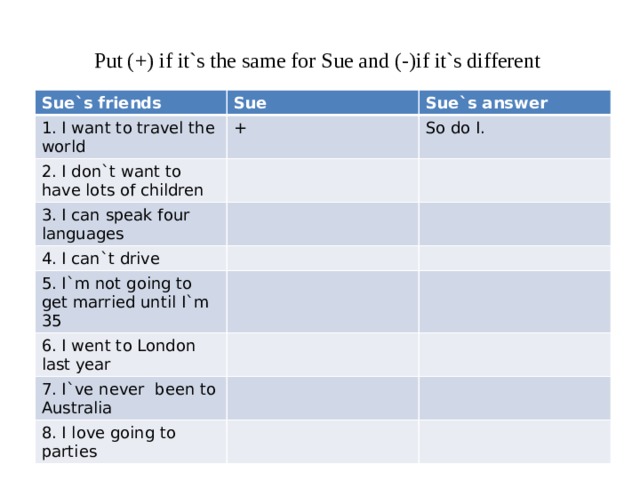
Put (+) if it`s the same for Sue and (-)if it`s different
Sue`s friends
Sue
1. I want to travel the world
Sue`s answer
+
2. I don`t want to have lots of children
So do I.
3. I can speak four languages
4. I can`t drive
5. I`m not going to get married until I`m 35
6. I went to London last year
7. I`ve never been to Australia
8. I love going to parties

What does Sue say when it is the same for her? What does she say when it is different?
- Reading and speaking
- A father and daughter
- Discuss these questions with a partner and then with class.
- Who do you look more like, your mother or your father?
- Who are you more like in character, your mother or your father?
- Do you want to bring up your children in the same way you were brought up?
- Work in 2 groups
- G A: Read what Oliver Darrow says about his daughter, Carmen
- G-B: read what Carmen Darrow says about her father, Oliver
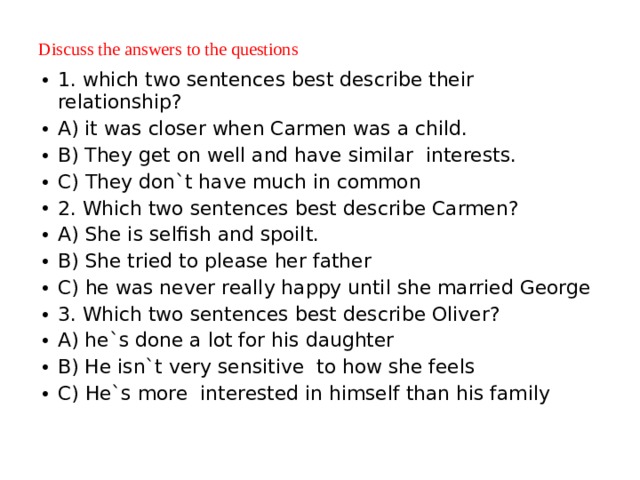
Discuss the answers to the questions
- 1. which two sentences best describe their relationship?
- A) it was closer when Carmen was a child.
- B) They get on well and have similar interests.
- C) They don`t have much in common
- 2. Which two sentences best describe Carmen?
- A) She is selfish and spoilt.
- B) She tried to please her father
- C) he was never really happy until she married George
- 3. Which two sentences best describe Oliver?
- A) he`s done a lot for his daughter
- B) He isn`t very sensitive to how she feels
- C) He`s more interested in himself than his family
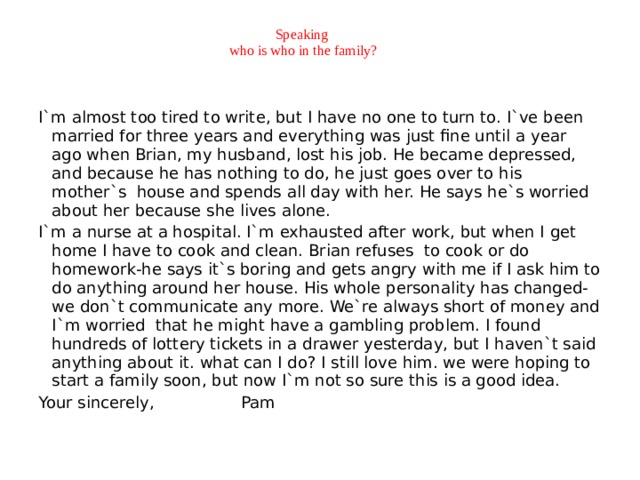
Speaking who is who in the family?
I`m almost too tired to write, but I have no one to turn to. I`ve been married for three years and everything was just fine until a year ago when Brian, my husband, lost his job. He became depressed, and because he has nothing to do, he just goes over to his mother`s house and spends all day with her. He says he`s worried about her because she lives alone.
I`m a nurse at a hospital. I`m exhausted after work, but when I get home I have to cook and clean. Brian refuses to cook or do homework-he says it`s boring and gets angry with me if I ask him to do anything around her house. His whole personality has changed-we don`t communicate any more. We`re always short of money and I`m worried that he might have a gambling problem. I found hundreds of lottery tickets in a drawer yesterday, but I haven`t said anything about it. what can I do? I still love him. we were hoping to start a family soon, but now I`m not so sure this is a good idea.
Your sincerely, Pam
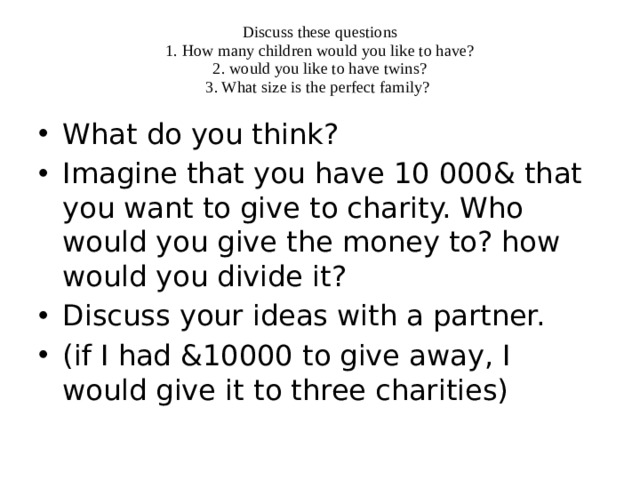
Discuss these questions 1. How many children would you like to have? 2. would you like to have twins? 3. What size is the perfect family?
- What do you think?
- Imagine that you have 10 000& that you want to give to charity. Who would you give the money to? how would you divide it?
- Discuss your ideas with a partner.
- (if I had &10000 to give away, I would give it to three charities)
Listen about two people talking about their families
L: I`m the youngest of seven children. my oldest sister is still alive, age ninety three, and there are sixteen years between us. There were four girls, two boys, and then me.
I: Seven children! Wow! How did you all get on together when you were children?
L: Amazingly well. Being the youngest, my two brothers and I called our sisters `the others` because they were either married or working by time we were born. But the seven of us all got along very well. But it`s different now, of course
I: really? How?
L: well when we were small, my older sisters often took care of us. Now my brothers and I are busy taking care of them.
I: tell me about your big sister Julia.
L: Julia was the sister who used to .. On her holidays.. Used to me for walks and so on. But then she became a nun and went to Africa for 23 years. We wrote to one another and I was still her little sister. When she came back, it was shortly after my husband died. We became very close and our whole relationship changed and became great friends.
I: what do you see as the main advantage and disadvantage of coming from such a large family?
L: Hmmm. I think the main advantage was that we learned how to enjoy life without having a lot of money. I think our other relatives, my rich cousins in the city, envied us. We had old bikes, old clothes, but we had lots of freedom. In the city, they had to wear nice and behave correctly
I; I think it was very difficult sometimes to have hand-me-down clothes, especially for a little girl like me. And I was sad that we didn`t go away on holiday like some other children. but the advantages outweighed the disadvantages enormously, there`s no doubt about that
I: six out of seven of you are still alive. How closely have you kept in touch over years?
L: very closely. Of course we still phone each other all the time and see each other. whenever we can. And we have a big family reunion every year. my granddaughter`s just had twins. That means we`ll have four generations there this year. how marvellous!
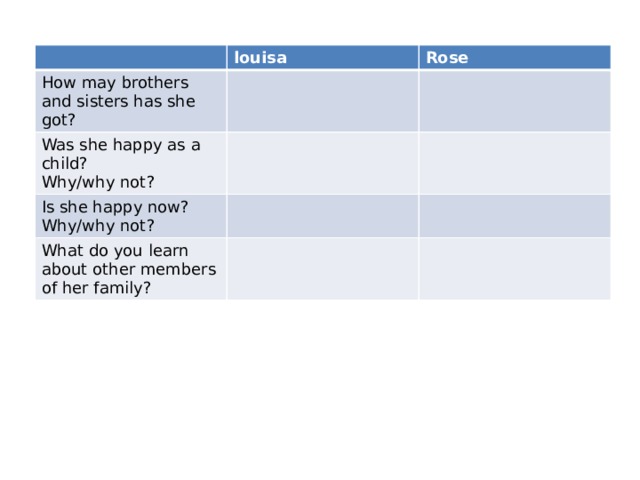
louisa
How may brothers and sisters has she got?
Rose
Was she happy as a child?
Why/why not?
Is she happy now? Why/why not?
What do you learn about other members of her family?
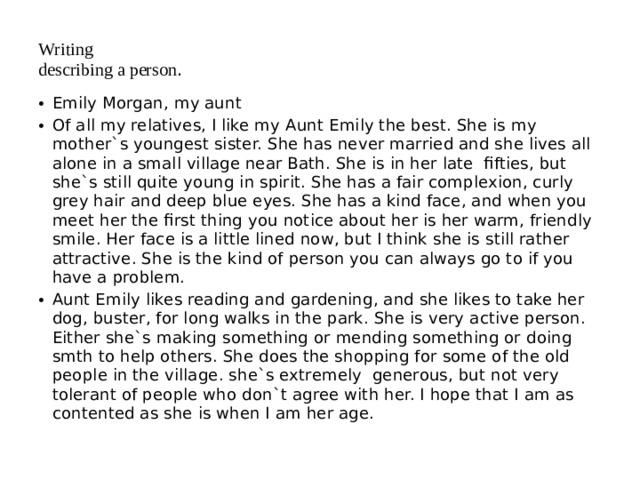
Writing describing a person .
- Emily Morgan, my aunt
- Of all my relatives, I like my Aunt Emily the best. She is my mother`s youngest sister. She has never married and she lives all alone in a small village near Bath. She is in her late fifties, but she`s still quite young in spirit. She has a fair complexion, curly grey hair and deep blue eyes. She has a kind face, and when you meet her the first thing you notice about her is her warm, friendly smile. Her face is a little lined now, but I think she is still rather attractive. She is the kind of person you can always go to if you have a problem.
- Aunt Emily likes reading and gardening, and she likes to take her dog, buster, for long walks in the park. She is very active person. Either she`s making something or mending something or doing smth to help others. She does the shopping for some of the old people in the village. she`s extremely generous, but not very tolerant of people who don`t agree with her. I hope that I am as contented as she is when I am her age.
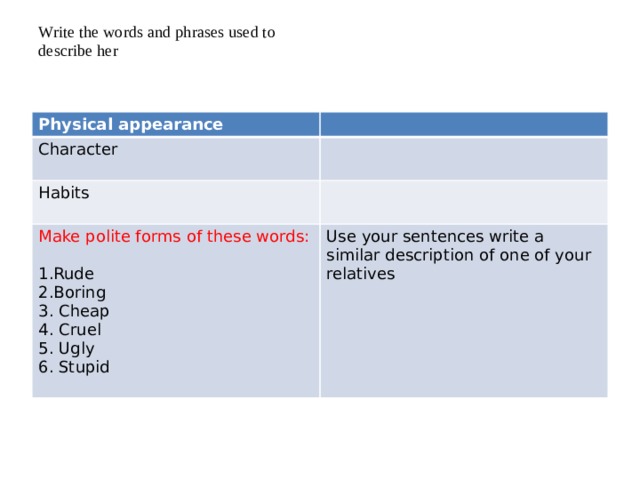
Write the words and phrases used to describe her
Physical appearance
Character
Habits
Make polite forms of these words:
Use your sentences write a similar description of one of your relatives
1.Rude
2.Boring
3. Cheap
4. Cruel
5. Ugly
6. Stupid





Вебинар для учителей

🎓 Свидетельство об участии ✨БЕСПЛАТНО!✨



