


Россия, Воронеж


СДЕЛАЙТЕ СВОИ УРОКИ ЕЩЁ ЭФФЕКТИВНЕЕ, А ЖИЗНЬ СВОБОДНЕЕ
Благодаря готовым учебным материалам для работы в классе и дистанционно
Скидки до 50 % на комплекты
только до
Готовые ключевые этапы урока всегда будут у вас под рукой
Организационный момент
Проверка знаний
Объяснение материала
Закрепление изученного
Итоги урока

Был в сети 29.06.2020 15:30

Ермаков Сергей Алексеевич
преподаватель английского языка
58 лет
 1 791
1 791
 39 209
Местоположение
Специализация
My Profession is a Cook.
Категория:
Английский язык
16.02.2019 10:26

Просмотр содержимого документа
«My Profession is a Cook.»
My profession is a cook
Ермаков Сергей
Алексеевич
ГБПОУ ВО ВПТ
Who is the cook and his variety!
The cook is a specialist in cooking. A good chef is sometimes called a wizard, because he can make a real masterpiece from the most ordinary products that will bring joy and pleasure to people.
"A good cook is a lot of character,
fantasies and feelings ” - EMIL YUN, chef
Strasbourg restaurant «Au Crocodile»
“ Even the masterpieces of cooking can not be saved in any museums. They are eaten the faster, the more beautiful they are ” - V. Pokhlebkin.
Short description:
The cook prepares dishes according to special recipes, but can alter them to your liking, that is, approach the process creatively.
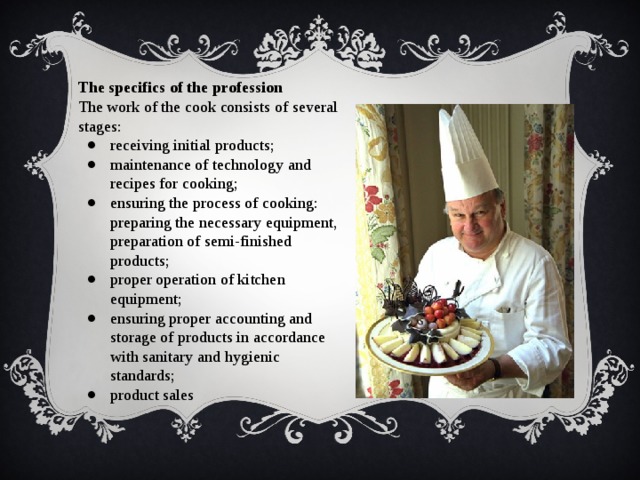
The specifics of the profession
The work of the cook consists of several stages:
- receiving initial products;
- maintenance of technology and recipes for cooking;
- ensuring the process of cooking: preparing the necessary equipment, preparation of semi-finished products;
- proper operation of kitchen equipment;
- ensuring proper accounting and storage of products in accordance with sanitary and hygienic standards;
- product sales
In Russia there is a classification of the profession of the cook , which is different from European and American:
The chef is the highest level in the profession. He prepares applications for the necessary products, ensures their timely receipt from the warehouse, controls the timing, range, quantity and quality of their receipt and sale. Studying the demand of buyers, it forms the range of dishes and culinary products, makes up the daily menu. Controls the technology of cooking and workers compliance with sanitary requirements and hygiene rules. Organizes accounting and reporting on the activities of the enterprise.
The pastry chef specializes in the manufacture of confectionery, which requires refined taste, imagination and ingenuity.
Cook-technologist organizes the process of cooking products. Determines the quality of raw materials, calculates its quantity to obtain servings of finished products, the caloric content of the daily diet. He develops recipes for new specialties and draws up technological maps for them. Draws up the necessary documentation, instructs the chefs.
The cook-cultivator calculates the raw materials and the yield of finished products, prepares dishes, performs straining, kneading, grinding, molding, stuffing, stuffing products, regulates the temperature, determines the readiness of dishes, products on instrumentation, as well as on appearance, smell, color, taste, decorates dishes and confectionery, divides them into portions
Pros and cons of the profession!
“ +” The profession of a cook is demanded and creative, it has a place of fantasy and ingenuity. Good chefs have a high salary.
“ -” Work requires a great deal of physical endurance and responsibility. Stand at the hot stove full time can not stand every person. At the same time, constant stress of attention, when it is necessary to monitor the preparation of many dishes and there is no way to relax or distract.
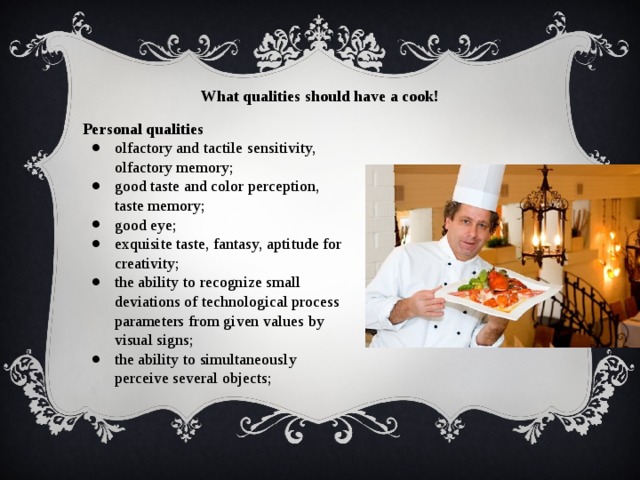
What qualities should have a cook!
Personal qualities
- olfactory and tactile sensitivity, olfactory memory;
- good taste and color perception, taste memory;
- good eye;
- exquisite taste, fantasy, aptitude for creativity;
- the ability to recognize small deviations of technological process parameters from given values by visual signs;
- the ability to simultaneously perceive several objects;
- well-developed sense of timing;
- dynamic thinking;
- knowledge of measures, the ability to quickly and accurately determine the right amount of liquid, bulk products, spices
- ability to understand the quality and freshness of meat, fish, vegetables and fruits
- knowledge of fast food technologies
- good coordination of movements of both hands, firmness of the hand, stability of the hands;
- ability to perform fine precise movements;
- physical endurance: the ability to work intensively for a long time without reducing performance;
- energy;
- ability to improvise;
- punctuality, pedantry;
- ability to switch from one activity to another;
- pursuit of professional excellence
Cooking history!
The ancient world knew chefs as people capable of giving pleasure, which was so appreciated by the wasteful Romans and unrestrained Greeks. At first, the cooks in the Roman houses were mistresses or slaves. Subsequently, the Romans increasingly began to hire cooks for a particular occasion, and later regular cooks appeared. The first schools of cooks were organized in ancient Rome, their father was the famous chef and gourmet Aptizius. In ancient Persia, the inventors of new unusual dishes were generously rewarded by the king. There were, of course, exceptions - for example, Spartans, who were used to the harsh living conditions, did not at all recognize the pleasures of culinary delights, and were disdainful of the chef's profession.
Over time, the chefs have improved more and more in their art. Began exchanging recipes among themselves, went on a journey.
- In Russia, the first professional chefs appeared in the courtyards of Kiev princes. Already in the 17th century, during the reign of Peter the Great, not only new unusual products, but also skilled chefs from different countries, began to be brought to Russia. At the end of the 19th century, culinary schools begin to open in Russia, where they prepare professional chefs.
- The first cook school in Europe appeared in the 19th century in England, then culinary schools began to appear in other countries. In France, it was believed that one should learn to cook since 6-7 years old, otherwise the cook would not be able to be truly skilled.
- The chefs who served at the court of one or another prince, for example, depended on the mood of their master. Cooks could create the reputation of noble houses and even entire states.
- In Russia, the chief cook was called ARCHIMAGIRUS
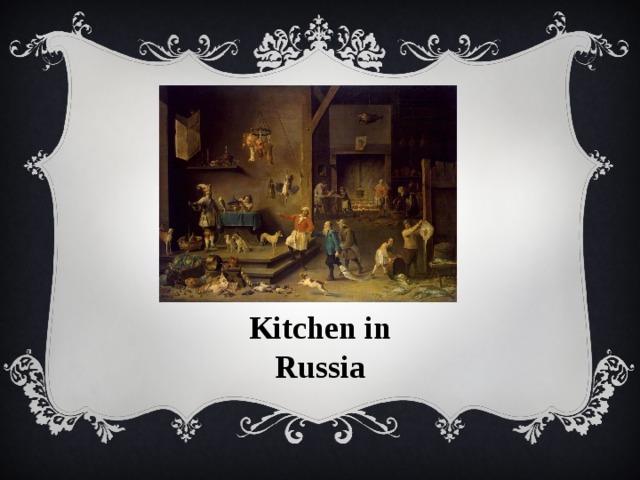
Kitchen in Russia
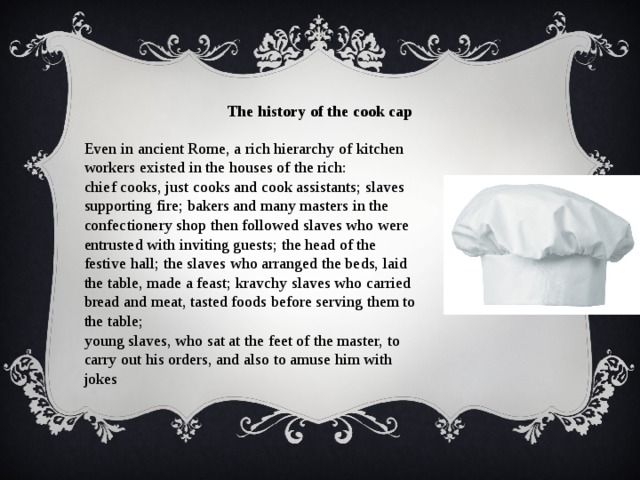
Even in ancient Rome, a rich hierarchy of kitchen workers existed in the houses of the rich:
The history of the cook cap
chief cooks, just cooks and cook assistants; slaves supporting fire; bakers and many masters in the confectionery shop then followed slaves who were entrusted with inviting guests; the head of the festive hall; the slaves who arranged the beds, laid the table, made a feast; kravchy slaves who carried bread and meat, tasted foods before serving them to the table;
young slaves, who sat at the feet of the master, to carry out his orders, and also to amuse him with jokes
Antonio Latini won loud fame in 1692 thanks to his book “The Modern Butler”, which became the first work in European history devoted to a daunting task - to convey court customs and the structure of a noble house, which was nothing but “reduced and Simplified "copy of the royal palace.
It contains the following hierarchy:
- errand boys
- cook assistant
- cook ("soup bowl", "cakeman" and "responsible for entreme")
- senior cook
- Chef
- the butlers
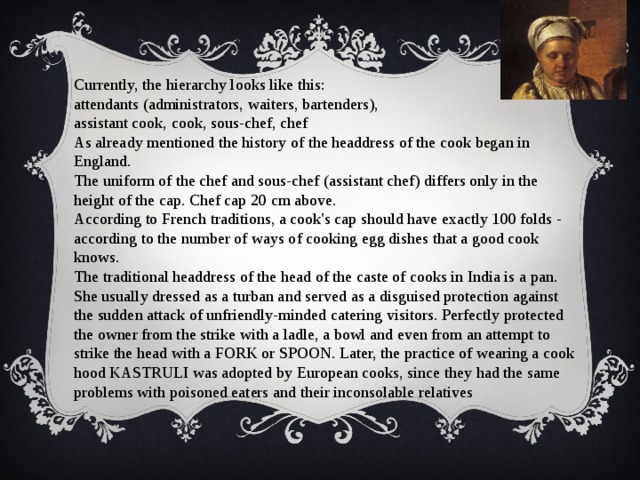
Currently, the hierarchy looks like this:
attendants (administrators, waiters, bartenders),
assistant cook, cook, sous-chef, chef
As already mentioned the history of the headdress of the cook began in England.
The uniform of the chef and sous-chef (assistant chef) differs only in the height of the cap. Chef cap 20 cm above.
According to French traditions, a cook's cap should have exactly 100 folds - according to the number of ways of cooking egg dishes that a good cook knows.
The traditional headdress of the head of the caste of cooks in India is a pan. She usually dressed as a turban and served as a disguised protection against the sudden attack of unfriendly-minded catering visitors. Perfectly protected the owner from the strike with a ladle, a bowl and even from an attempt to strike the head with a FORK or SPOON. Later, the practice of wearing a cook hood KASTRULI was adopted by European cooks, since they had the same problems with poisoned eaters and their inconsolable relatives
The form of chefs has undergone relatively few changes in the past two hundred years. The most characteristic part of it is the cook cap, according to tradition it has from 48 to 100 folds, depending on the height of the cap. Of course, the highest cap wears the most important cook. The cook cap appeared in the XVI century (some, however, believe that it originated in Byzantium), when unsuccessful cooks were often harassed and found refuge in monasteries. There, to hide, they dressed the same way as priests.
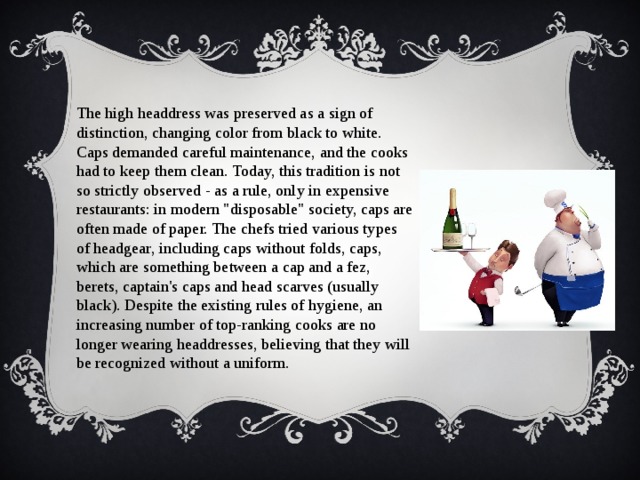
The high headdress was preserved as a sign of distinction, changing color from black to white. Caps demanded careful maintenance, and the cooks had to keep them clean. Today, this tradition is not so strictly observed - as a rule, only in expensive restaurants: in modern "disposable" society, caps are often made of paper. The chefs tried various types of headgear, including caps without folds, caps, which are something between a cap and a fez, berets, captain's caps and head scarves (usually black). Despite the existing rules of hygiene, an increasing number of top-ranking cooks are no longer wearing headdresses, believing that they will be recognized without a uniform.
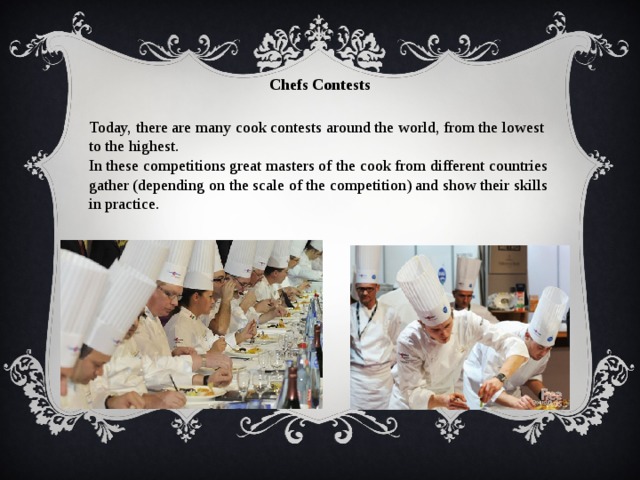
Chefs Contests
Today, there are many cook contests around the world, from the lowest to the highest.
In these competitions great masters of the cook from different countries gather (depending on the scale of the competition) and show their skills in practice.
Why I chose this particular profession!
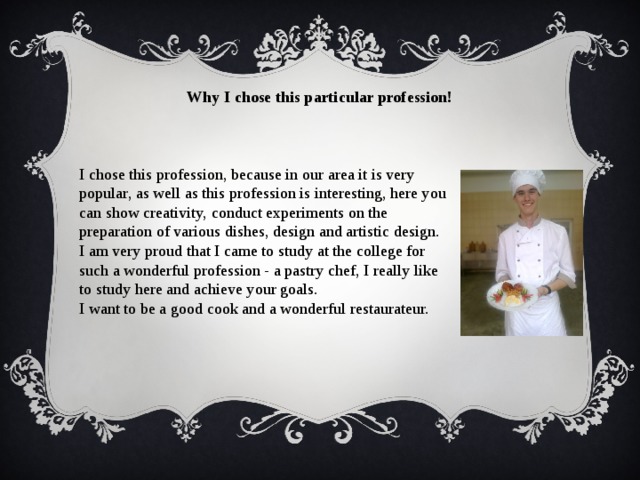
I chose this profession, because in our area it is very popular, as well as this profession is interesting, here you can show creativity, conduct experiments on the preparation of various dishes, design and artistic design.
I am very proud that I came to study at the college for such a wonderful profession - a pastry chef, I really like to study here and achieve your goals.
I want to be a good cook and a wonderful restaurateur.

Thanks for attention!








Вебинар для учителей

Свидетельство об участии БЕСПЛАТНО!



