


Россия, Чебоксары


СДЕЛАЙТЕ СВОИ УРОКИ ЕЩЁ ЭФФЕКТИВНЕЕ, А ЖИЗНЬ СВОБОДНЕЕ
Благодаря готовым учебным материалам для работы в классе и дистанционно
Скидки до 50 % на комплекты
только до
Готовые ключевые этапы урока всегда будут у вас под рукой
Организационный момент
Проверка знаний
Объяснение материала
Закрепление изученного
Итоги урока

Была в сети 18.11.2019 20:28

Петрова Кристина Владимировна
учитель английского языка
 2 452
2 452
 28 601
Местоположение
Специализация
Об английском языке: презентация к тексту
Категория:
Английский язык
09.09.2019 20:25

Просмотр содержимого документа
«Об английском языке: презентация к тексту»
A. English is basically a Germanic language with a lot of Latin words in it. In simple terms , that means that the grammar and many of the most frequent words are Germanic, and the more formal or technical vocabulary is Latinate. The linguistic mixture is a result of historical events . But the simple historical facts appear not to explain everything about the development of the language . One interesting question is why the British did not learn Latin from the Romans.
B. It came as a surprise to many people when a survey showed that 172 languages were spoken by children in London schools: Chinese, Turkish, Italian, Spanish, Punjabi and others. Some of these, like the West African language Ga, only have a couple of speakers. But others, like Punjabi, are quite significant linguistic community, with their own radio programmes and newspapers, and classes for children – to ensure that they don’t forget the language of their grandparents.
C. A nasty shock awaits many visitors to Britain. Imagine you have learnt English for years, you can read newspapers and you have no problem following the television , but when you go into a shop in Newcastle you can’t understand a word they are saying. It is the accent , mostly the vowels , which gives the visitor a problem in the shop. Some accents are so strong that they present problems for British people, too. Intonation patterns also differ between regions.

D. Billions of people speak English, two-thirds of the planet’s scientists write in English, and over 80% of the world’s electronic information is stored in English . But not all the British are really self-satisfied about the status of their language. But they are quite well aware that today it is out of their hands : the reasons for the popularity of English are either lost in history, or something to do with the superpower on the other side of the Atlantic .
E. Let’s look at the speech of young people in Britain. Here we can find several interesting developments. One is a spread of a light London accent over much of the country. Another is an openness, through the media , to American and Australian influences. The Australian effect is quite recent, and the results from the huge popularity of Australian TV soap operas . It is the phrases, idioms and grammatical forms which are catching .
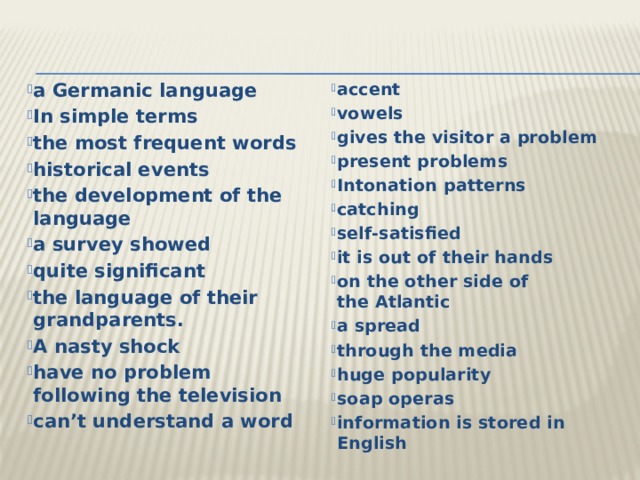
- a Germanic language
- In simple terms
- the most frequent words
- historical events
- the development of the language
- a survey showed
- quite significant
- the language of their grandparents.
- A nasty shock
- have no problem following the television
- can’t understand a word
- accent
- vowels
- gives the visitor a problem
- present problems
- Intonation patterns
- catching
- self-satisfied
- it is out of their hands
- on the other side of the Atlantic
- a spread
- through the media
- huge popularity
- soap operas
- information is stored in English

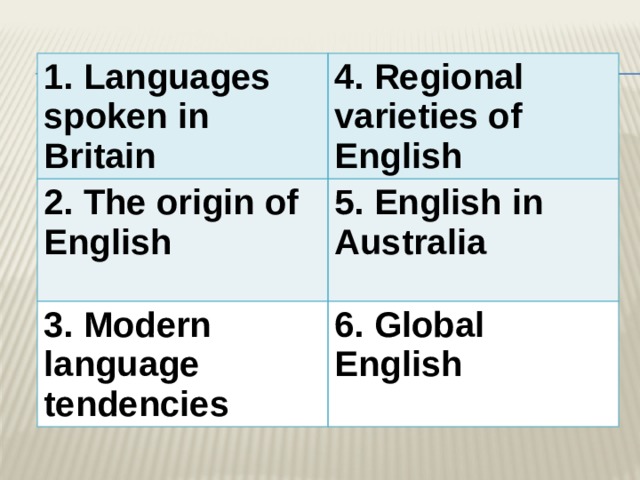
1. Languages spoken in Britain
4. Regional varieties of English
2. The origin of English
5. English in Australia
3. Modern language tendencies
6. Global English

1. Languages spoken in Britain
4. Regional varieties of English
2. The origin of English
5. English in Australia
3. Modern language tendencies
6. Global English
A. English is basically a Germanic language with a lot of Latin words in it. In simple terms , that means that the grammar and many of the most frequent words are Germanic, and the more formal or technical vocabulary is Latinate. The linguistic mixture is a result of historical events . But the simple historical facts appear not to explain everything about the development of the language . One interesting question is why the British did not learn Latin from the Romans.
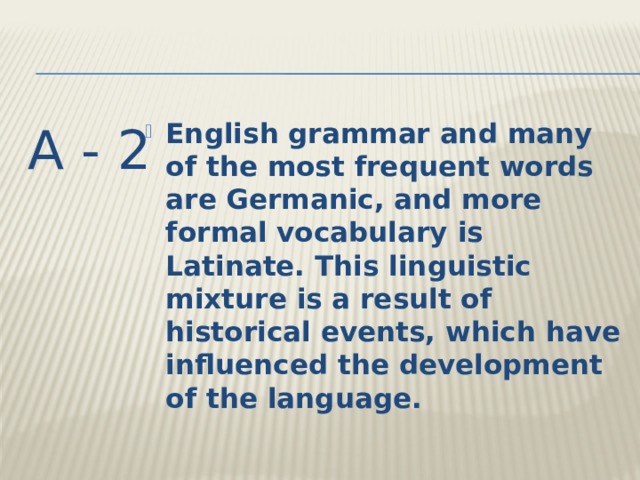
A - 2
- English grammar and many of the most frequent words are Germanic, and more formal vocabulary is Latinate. This linguistic mixture is a result of historical events, which have influenced the development of the language.
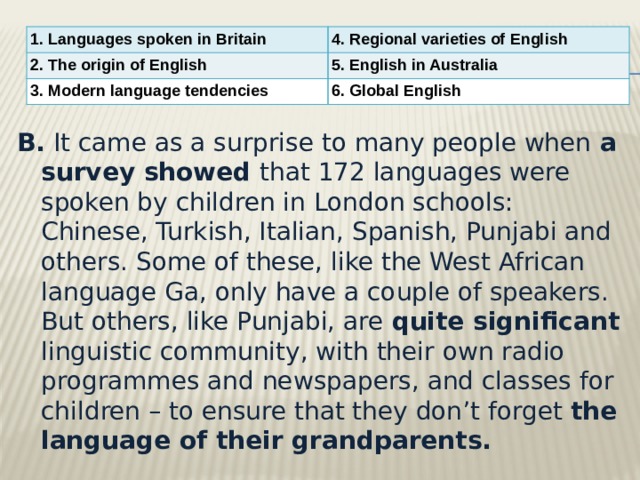
1. Languages spoken in Britain
4. Regional varieties of English
2. The origin of English
5. English in Australia
3. Modern language tendencies
6. Global English
B. It came as a surprise to many people when a survey showed that 172 languages were spoken by children in London schools: Chinese, Turkish, Italian, Spanish, Punjabi and others. Some of these, like the West African language Ga, only have a couple of speakers. But others, like Punjabi, are quite significant linguistic community, with their own radio programmes and newspapers, and classes for children – to ensure that they don’t forget the language of their grandparents.
- A survey showed that 172 languages were spoken by children in London schools. Some of these only have a couple of speakers, but others are quite significant linguistic community, with their own radio programmes and newspapers, and classes for children.
B - 1
1. Languages spoken in Britain
4. Regional varieties of English
2. The origin of English
5. English in Australia
3. Modern language tendencies
6. Global English
C. A nasty shock awaits many visitors to Britain. Imagine you have learnt English for years, you can read newspapers and you have no problem following the television , but when you go into a shop in Newcastle you can’t understand a word they are saying. It is the accent , mostly the vowels , which gives the visitor a problem in the shop. Some accents are so strong that they present problems for British people, too. Intonation patterns also differ between regions.
- Imagine you have learnt English for years, you have no problem reading newspapers or following the television, but in Newcastle you can’t understand a word they are saying. It is the accent, mostly the vowels, which gives us problems.
C - 4
1. Languages spoken in Britain
4. Regional varieties of English
2. The origin of English
5. English in Australia
3. Modern language tendencies
6. Global English
D. Billions of people speak English, two-thirds of the planet’s scientists write in English, and over 80% of the world’s electronic information is stored in English . But not all the British are really self-satisfied about the status of their language. But they are quite well aware that today it is out of their hands : the reasons for the popularity of English are either lost in history, or something to do with the superpower on the other side of the Atlantic .
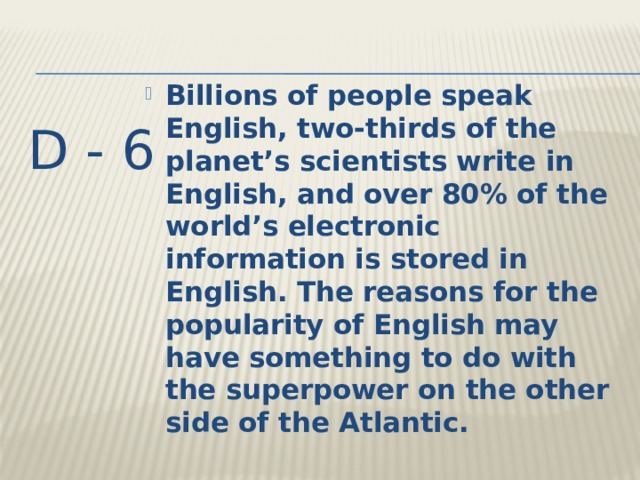
- Billions of people speak English, two-thirds of the planet’s scientists write in English, and over 80% of the world’s electronic information is stored in English. The reasons for the popularity of English may have something to do with the superpower on the other side of the Atlantic.
D - 6
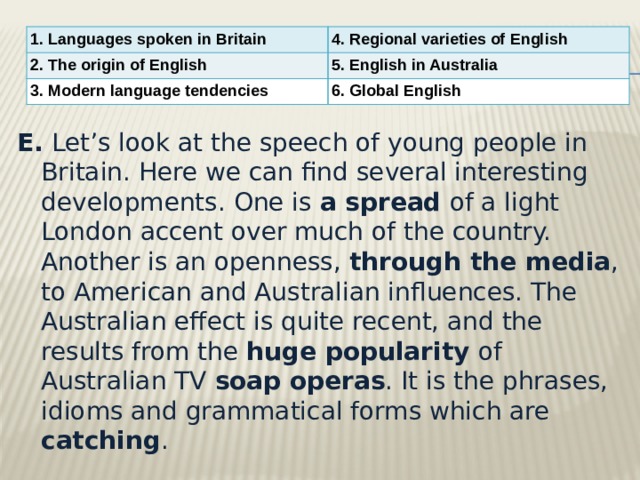
1. Languages spoken in Britain
4. Regional varieties of English
2. The origin of English
5. English in Australia
3. Modern language tendencies
6. Global English
E. Let’s look at the speech of young people in Britain. Here we can find several interesting developments. One is a spread of a light London accent over much of the country. Another is an openness, through the media , to American and Australian influences. The Australian effect is quite recent, and the results from the huge popularity of Australian TV soap operas . It is the phrases, idioms and grammatical forms which are catching .

- In speech of young people in Britain we can find several interesting developments: a spread of a light London accent over much of the country and the openness, through the media, to American and Australian influences.
E - 2
Комплекты видеоуроков для учителей

Скачать
© 2019, Петрова Кристина Владимировна 470 0
Похожие файлы
Вебинар для учителей

Свидетельство об участии БЕСПЛАТНО!



