Россия, Белорецк

СДЕЛАЙТЕ СВОИ УРОКИ ЕЩЁ ЭФФЕКТИВНЕЕ, А ЖИЗНЬ СВОБОДНЕЕ
Благодаря готовым учебным материалам для работы в классе и дистанционно
Скидки до 50 % на комплекты
только до
Готовые ключевые этапы урока всегда будут у вас под рукой
Организационный момент
Проверка знаний
Объяснение материала
Закрепление изученного
Итоги урока
Была в сети 15.01.2022 21:11
Горбатова Миннисур Галеевна
учитель русского языка и литературы
10 лет
 1 617
1 617
 43 224
Местоположение
Открытый урок. Lead the way!
Категория:
Английский язык
22.11.2020 16:10

Просмотр содержимого документа
«Открытый урок. Lead the way!»

Spotlight 7
Lead the way!
Lesson 3a
MODULE 3
.


What does the word “Hobby” mean? What is it?
- activity somebody an enjoys which in somebody’s time free doing
Hobby is ….

writing
stories
skateboarding
sewing
ice-skating
knitting
collecting
stamps
playing chess
boxing
fencing
songwriting
football
painting

Which of these hobbies are not popular with teenagers today?
- Sewing
- Writing stories
- Skateboarding
- Ice – skating
- Knitting
- Collecting stamps
- Playing chess
- Boxing
- Fencing
- Football
- Painting
- songwriting

What qualities do you need to do different hobbies?
artistic –
creative –
daring –
fit –
patient –
athletic –
sociable –
curious –
determined –
imaginative –

Character
- What qualities do you need to have to do the activities above?
Artistic creative daring fit patient athletic sociable curious determined imaginative
Answer: You need to be ….
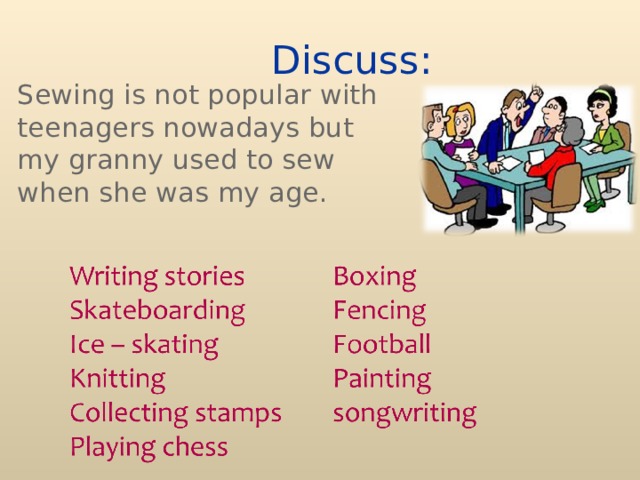
Discuss:
Sewing is not popular with teenagers nowadays but my granny used to sew when she was my age.

Have you got any hobbies?
-Yes, I`m fond of ………………………….. and I`m very keen on…………………………….
- What other interest have you got? Do you collect anything?
-Yes, I collect……………………. and I`ve got a big collection of…………. It`s amusing (interesting, enjoyable)
or (No, I collect nothing, but I used to collect…………………… It was amusing (interesting, enjoyable)

Have you got any hobbies?
-Yes, I`m fond of ………………………….. and I`m very keen on……………………………. And what about you?
-Well , I like…………………………………………..
- What other interest have you got? Do you collect anything?
-Yes, I collect……………………. and I`ve got a big collection of…………. It`s amusing (interesting, enjoyable)
or (No, I collect nothing, but I used to collect…………………… It was amusing (interesting, enjoyable)

CIRCLE THE ODD-ONE-OUT
NOISY
- COINS STAMPS BELLS
- CREATIVE FIT CURIOUS
- KNITTING FENCING FISHING
- TO BOX TO SKATE TO PAINT
- BACKGAMMON CHESS SCRABBLE
RAFT
GOSSIP
FORTRESS
HUGE

Multiple meaning words
- Are words that have several meanings depending on the context

design
Проектировать, конструировать
Try out
Set up
Испытывать, опробовать
Staple
Создавать, основывать
скреплять
In charge of
Fashion empire
Быть ответственным за что-либо
latest
Империя моды
Determined
последний
Piece together
Полный решимости
Собрать из кусочков \ деталей
Be jealous of
Be afraid of
Завидовать кому-либо
Бояться чего-либо
award
награда

Reading and listening
p. 27

Reading and listening
Read the title of the text
- What does drive mean: ambition or trip?

Grammar : Relative pronouns & adverbs
Для связи придаточных предложений подлежащих, сказуемых и дополнительных с главным употребляются местоимения who кто (whom кого), whose чей, what кто, какой, which который, какой, кто, что. Они являются, таким образом, теми же вопросительными местоимениями, но употребленными не для вопроса, а для связи предложений):

Relative pronouns – относительные местоимения
Who/that относятся к людям.
Is he the man who stole your bag? – Это тот, кто украл твою сумку?
Which/that относятся к предметам и животным.
My car which cost me a fortune was badly damaged in the accident – Моя машина, которая стоила мне состояние, сильно пострадала в ДТП

- Whose - чтобы выразить принадлежность, никогда не опускается.
- That’s the boy whose bicycle was stolen yesterday – Это мальчик, чей велик вчера угнали
Who/ which/that можно опустить, если они относятся к дополнению в придаточном определительном, а не к подлежащему.

Relative adverbs - Относительные наречия
- Where относится к месту, особенно после существительных типа place, house, street,town, country… Он заменяем на ( which/that) + предлог.
The hotel where we stayed was very luxurious = The hotel we stayed at was very luxurious – Наша гостиница была очень роскошной
- When относится ко времени, особенно после существительных типа time, period,moment, day, year, summer… Он заменяем на ( that) .
That was the year (when) she graduated – В тот год она выпустилась
- Why описывает причину, особенно после reason . Заменяем на ( that) .
The reason (why) she left her job was that she didn’t get on with her boss – Работу она оставила потому что неполадила с начальником
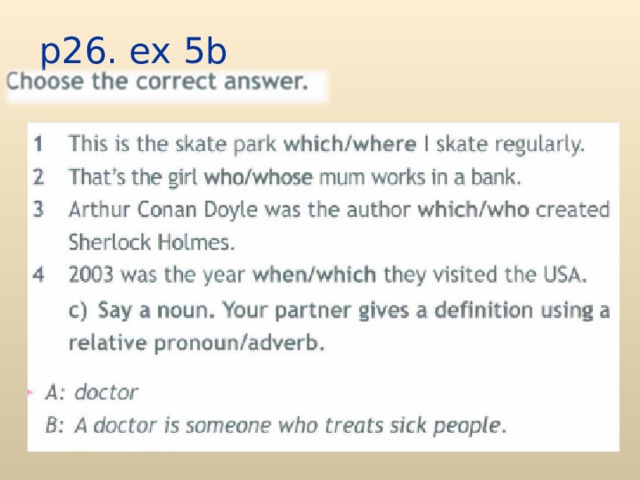
p26. ex 5b

Speaking

Writing (an e-mail)

Akiano`s favourite hobby is knitting.
Akiano doesn`t pay a lot of attention to details.
Akiano finished 60 paintings.
Some younger students tried out Raynece`s project.
Raynece`s project helped students to learn literature.
Esteban is in charge of a growing fashion empire.
Esteban recently showed his latest fashion collection in the UK.
Chase Austin loves fencing.
Chase Austin won a lot of awards.
F
F
F
T
F
T
F
F
T

Whose hobbies did you find the most interesting? Why? …….`s hobby is the most interesting?

- Your homework :
- SB. p.26, ex.7
Вебинар для учителей

Свидетельство об участии БЕСПЛАТНО!