Россия, Улан-Удэ

СДЕЛАЙТЕ СВОИ УРОКИ ЕЩЁ ЭФФЕКТИВНЕЕ, А ЖИЗНЬ СВОБОДНЕЕ
Благодаря готовым учебным материалам для работы в классе и дистанционно
Скидки до 50 % на комплекты
только до
Готовые ключевые этапы урока всегда будут у вас под рукой
Организационный момент
Проверка знаний
Объяснение материала
Закрепление изученного
Итоги урока
Была в сети 08.09.2026 05:25

Малахирова Жанна Дугаровна
учитель английского языка
 13 186
 3 460
3 460 
Местоположение
Специализация
Открытый урок по медиаграмотности
Категория:
Английский язык
31.05.2023 09:56

Просмотр содержимого документа
«Открытый урок по медиаграмотности»
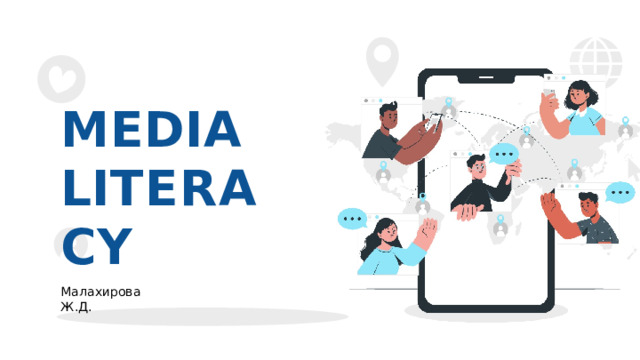
MEDIA L I TER A CY
Малахирова Ж.Д.
Media literacy is...
… about helping students become competent, critical and literate in all media forms, so that they control the interpretation of what they see or hear.
… knowing how and when to raise the right questions about what you are watching, reading or listening to.
Information, News
Reliable Information
Updates on COVID-19
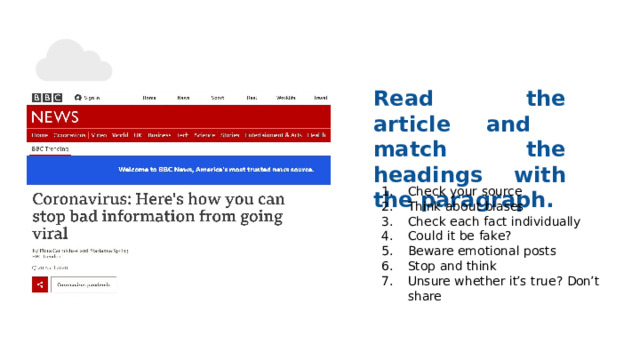
Read the article and match the headings with the paragraph.
- Check your source
- Think about biases
- Check each fact individually
- Could it be fake?
- Beware emotional posts
- Stop and think
- Unsure whether it’s true? Don’t share
Coronavirus: Here’s how you can stop bad information from going viral
Coronavirus misinformation is flooding the internet.
A UK parliamentary sub-committee is asking members of the public to submit examples. The committee has particularly requested submissions of disinformation spread in private groups and closed apps such as WhatsApp.
Meanwhile, experts are calling on the public to practise "information hygiene". So what can you do to stop the spread of bad information online?
1. ___________________________
You want to help family and friends and keep them in the loop. So when you receive fresh advice - whether by email, WhatsApp, Facebook or Twitter - you might quickly forward it on to them.
But experts say the number one thing you can do to halt misinformation is to simply stop and think. If you have any doubts, pause, and check it out further.
2. ______________________________
Before you forward it on, ask some basic questions about where the information comes from. It's a big red flag if the source is "a friend of a friend" or "my aunt's colleague's neighbour".
We recently tracked how a misleading post from someone's "uncle with a master's degree" went viral. Some of the details in the post were accurate - some versions, for example, encouraged hand washing to slow the spread of the virus. But other details were potentially harmful, making unproven claims about how to diagnose the illness.
"The most reliable sources of information remain public health bodies like the NHS, the World Health Organisation, or the Centers for Disease Control and Prevention in the USA." says Claire Milne, deputy editor of UK-based fact-checking organisation Full Fact.
Experts are not infallible. But they are much more reliable than a stranger's distant relative on WhatsApp.
3.
Appearances can be deceptive.
It is possible to impersonate official accounts and authorities, including BBC News and the government. Screenshots can also be changed to make it look like information has come from a trusted public body.
Check known and verified accounts and websites. If you can't easily find the information, it might be a hoax. And if a post, video or a link looks fishy - it probably is.
Capital letters and mismatched fonts are something fact-checkers use as an indicator a post might be misleading, according to Claire Milne from Full Fact.
5. ____________________
There's a voice note that has been circulating on WhatsApp. The person speaking in the note says she's translating advice from a "colleague who has a friend" working at a hospital. It's been sent to the BBC by dozens of people around the world.
But it's a mix of accurate and inaccurate advice.
When you get sent long lists of advice, it's easy to believe everything in them just because you know for certain that one of the tips (say, about hand washing) is true.
But that's not always the case.
6. ________________________
It's the stuff that gets us fearful, angry, anxious, or joyful that tends to really go viral.
"Fear is one of the biggest drivers that allows misinformation to thrive," says Claire Wardle of First Draft , an organisation that helps journalists tackle online misinformation.
Urgent calls for action are designed to ramp up anxiety - so be careful.
"People want to help their loved ones stay safe, so when they see 'Tips for preventing the virus!' or 'Take this health supplement!' people want to do whatever they can to help," she says.
7. ______________________________
Are you sharing something because you know it's true - or just because you agree with it?
Carl Miller, research director of the Centre for the Analysis of Social Media, says we're more likely to share posts that reinforce our existing beliefs.
"It's when we're angrily nodding our head that we're most vulnerable," he says. "That's when, above everything else, we just need to slow down everything that we do online."
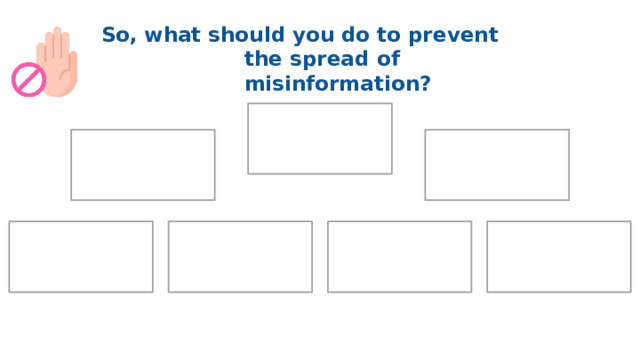
So, what should you do to prevent the spread of misinformation?
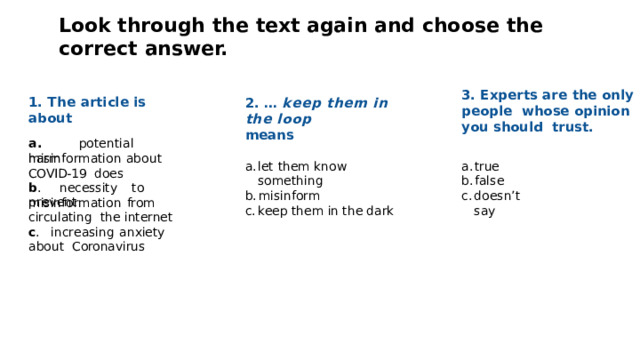
Look through the text again and choose the correct answer.
3. Experts are the only people whose opinion you should trust.
1. The article is about
2. … keep them in the loop
means
a . potentia l harm
misinformation about COVID-19 does
- let them know something
- true
- misinform
- false
- keep them in the dark
- does n ’ t s a y
b . necessit y t o p r e v ent
misinformation from circulating the internet
c . inc r easing anxiety about Coronavirus
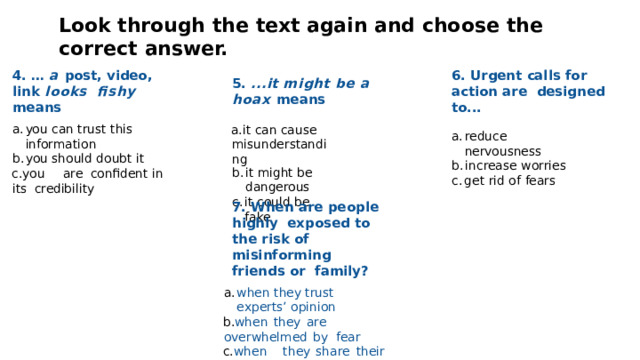
Look through the text again and choose the correct answer.
4. … a post, video, link looks fishy means
6. Urgent calls for action are designed to...
5. ...it might be a hoax means
- you can trust this information
- it can cause misunderstanding
- you should doubt it
- it might be dangerous
- y o u a r e confiden t i n its credibility
- it could be fake
- reduce nervousness
- increase worries
- get rid of fears
7. When are people highly exposed to the risk of misinforming friends or family?
- when they trust experts’ opinion
- when they are overwhelmed by fear
- whe n th e y sha r e thei r own prejudice and beliefs with the post
Which recommendations can you give to your friends or family?
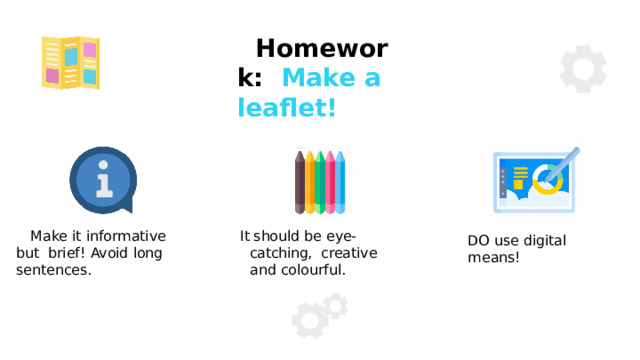
Homework: Make a leaflet!
Make it informative but brief! Avoid long sentences.
It should be eye-catching, creative and colourful.
DO use digital means!

Вебинар для учителей
🎓 Свидетельство об участии ✨БЕСПЛАТНО!✨