Казахстан, Талгар

СДЕЛАЙТЕ СВОИ УРОКИ ЕЩЁ ЭФФЕКТИВНЕЕ, А ЖИЗНЬ СВОБОДНЕЕ
Благодаря готовым учебным материалам для работы в классе и дистанционно
Скидки до 50 % на комплекты
только до
Готовые ключевые этапы урока всегда будут у вас под рукой
Организационный момент
Проверка знаний
Объяснение материала
Закрепление изученного
Итоги урока
Был в сети 26.11.2025 08:27

Кахаров Иминжан Тельманович
Учитель английского языка
31 год
 4 217
4 217
 15 331
Местоположение
Специализация
Our world (8 grade)
Категория:
Английский язык
26.11.2020 08:59

Просмотр содержимого документа
«Our world (8 grade)»
Short term plan 1
| Long-term plan unit: Starter Section | School: Azat | |||||||
| Date: | Teacher`s name: Kakharov I
| |||||||
| Grade: 8 | Number present: | absent: | ||||||
| Theme of the lesson: | Our world. | |||||||
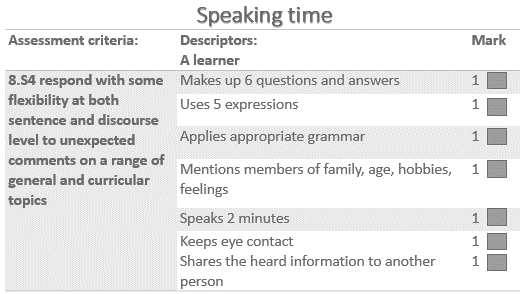
| Learning objectives(s) that this lesson is contributing to | 8.C2 use speaking and listening skills to provide sensitive feedback to peers 8.S4 respond with some flexibility at both sentence and discourse level to unexpected comments on a range of general and curricular topics | |||||||
| Lesson objectives | All students will be able to: - apply a few learnt vocabulary in speech Most students will be able to: - apply some learnt vocabulary in speech Some students will be able to: - apply most learnt vocabulary in speech | |||||||
| Assessment criteria | Students achieve the objective if they are able to apply given words in speaking about family | |||||||
| Kazakh culture | Students will think about the influence of the environment on them | |||||||
| Value links | Respect and concern | |||||||
| Cross curricular links | Social studies | |||||||
| Intercultural awareness | Identify their difference from students around them | |||||||
| ICT skills | The students will be able to develop their speaking skill with the help of PPT, video | |||||||
| Previous learning | Vocabulary on family | |||||||
| Health and Safety | Make sure power cords are not a tripping hazard Everyday classroom pre-cautions | |||||||
| Plan | ||||||||
| Planned timings | Planned activities | Resources | ||||||
| [0-3] [4-7] [8-10] [11-16]
[17-25] [26-30] [31-35] [35-38] [39-40]
| Greetings (W, I) Teacher introduces himself, the school and lesson rules, answers the students’ questions. Warm-up (W, I) Students are asked with the question “What is “Our world” for you?” Students write their answers on the whiteboard. The possible answers are: Family, hobbies, pets, friends, school, entertainment, nature, city, country, Earth.
Introducing lesson and learning objectives (W, I) Student reads learning and lesson objectives from the slide. Teacher can ask students about their predictions about the lesson and activities.
Watching video (W, I) Teacher asks students to watch the video and then they are asked to answer the question “Which words or expressions from the video are you going to use in your speech?”
Vocabulary (W, I) Students get to know the phrases that will help them in future conversations. Teacher give HO1 to students who need some support with translation. Teacher can discuss the words with the students to make sure they understand the meaning of those. In addition, teacher can bring any examples with the phrases to show how these colocations are used. To consist of –
Pre-speaking Students are ready to make conversations about their families, as some support they need to read some short text with learnt vocabulary and try to apply those in their own speech. First, they need to create some questions and get ready answer others.
Speaking Practicing knowledge (P)
Peer-assessment (P) Students assess each other in pairs using the suggested checklist. For more practice, they can change the roles and the partners. (Depends on time).
Post-speaking Having finished the pair discussion the students have to share the information with other classmates in the form of story. Feedback Teacher give constructive feedback on the heard information about families of their classmates. So they answer the question “Which family is more interesting and why?” |
PPT Whiteboard
PPT
https://www.youtube.com/watch?v=vXI2lRCnTKw
HO 1 - vocabulary
PPT
HO2 PPT
HO 3
PPT
| ||||||
| Additional information | ||||||||
| Differentiation – how do you plan to give more support? How do you plan to challenge the more able learners? | Assessment – how are you planning to check learners’ learning?
| Health and safety check | ||||||
| Students will work in pairs according their levels. Some support with vocabulary is planned too. Teacher helps student where necessary. | Peer-assessment. Teacher monitors the process. | Safety precautions are planned in the lesson process. | ||||||
| Reflection
Were the lesson objectives/learning objectives realistic? Did all learners achieve the LO? If not, why? Did my planned differentiation work well? Did I stick to timings? What changes did I make from my plan and why?
| Use the space below to reflect on your lesson. Answer the most relevant questions from the box on the left about your lesson. | |||||||
|
| ||||||||
| Summary evaluation
What two things went really well (consider both teaching and learning)? 1:
2:
What two things would have improved the lesson (consider both teaching and learning)? 1:
2:
What have I learned from this lesson about the class or achievements/difficulties of individuals that will inform my next lesson?
| ||||||||

Вебинар для учителей
Свидетельство об участии БЕСПЛАТНО!