Россия, Карачев

СДЕЛАЙТЕ СВОИ УРОКИ ЕЩЁ ЭФФЕКТИВНЕЕ, А ЖИЗНЬ СВОБОДНЕЕ
Благодаря готовым учебным материалам для работы в классе и дистанционно
Скидки до 50 % на комплекты
только до
Готовые ключевые этапы урока всегда будут у вас под рукой
Организационный момент
Проверка знаний
Объяснение материала
Закрепление изученного
Итоги урока
Был в сети 08.10.2025 14:38

Бадеев Павел Алексеевич
Учитель английского языка
26 лет
 203
203
 171 177
Местоположение
Специализация
Презентация к уроку
Категория:
Английский язык
08.10.2025 12:43

Просмотр содержимого документа
«Презентация к уроку»
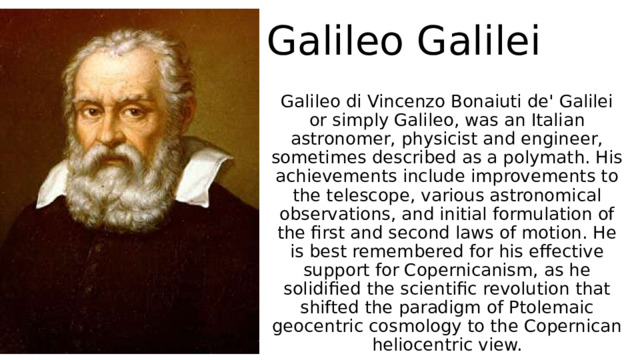
Galileo Galilei
Galileo di Vincenzo Bonaiuti de' Galilei or simply Galileo, was an Italian astronomer, physicist and engineer, sometimes described as a polymath. His achievements include improvements to the telescope, various astronomical observations, and initial formulation of the first and second laws of motion. He is best remembered for his effective support for Copernicanism, as he solidified the scientific revolution that shifted the paradigm of Ptolemaic geocentric cosmology to the Copernican heliocentric view.
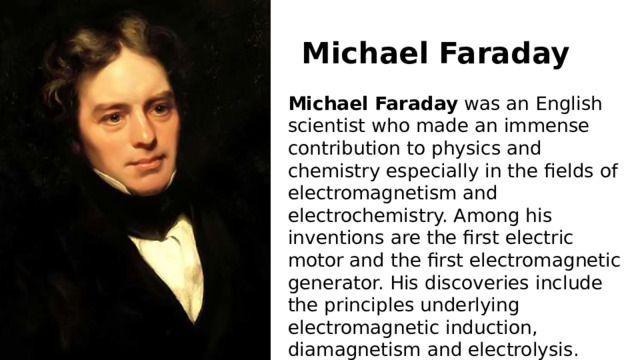
Michael Faraday
Michael Faraday was an English scientist who made an immense contribution to physics and chemistry especially in the fields of electromagnetism and electrochemistry. Among his inventions are the first electric motor and the first electromagnetic generator. His discoveries include the principles underlying electromagnetic induction, diamagnetism and electrolysis.
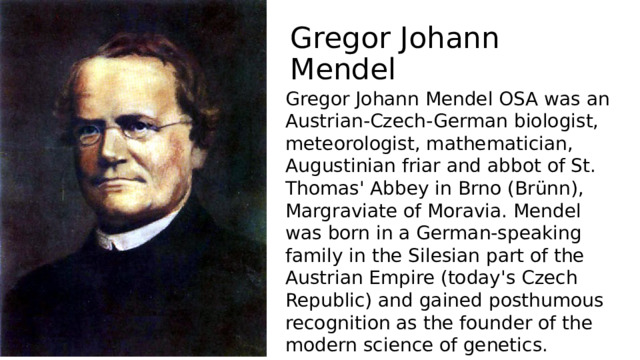
Gregor Johann Mendel
Gregor Johann Mendel OSA was an Austrian-Czech-German biologist, meteorologist, mathematician, Augustinian friar and abbot of St. Thomas' Abbey in Brno (Brünn), Margraviate of Moravia. Mendel was born in a German-speaking family in the Silesian part of the Austrian Empire (today's Czech Republic) and gained posthumous recognition as the founder of the modern science of genetics.
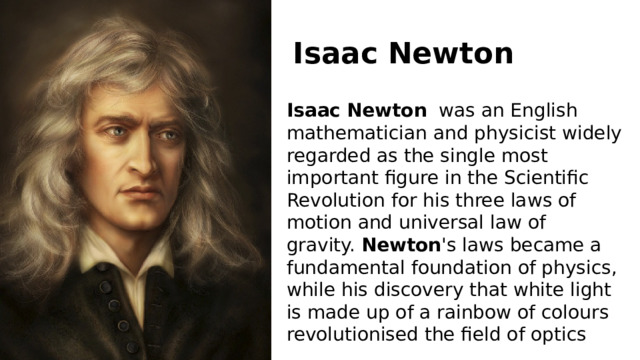
Isaac Newton
Isaac Newton was an English mathematician and physicist widely regarded as the single most important figure in the Scientific Revolution for his three laws of motion and universal law of gravity. Newton 's laws became a fundamental foundation of physics, while his discovery that white light is made up of a rainbow of colours revolutionised the field of optics
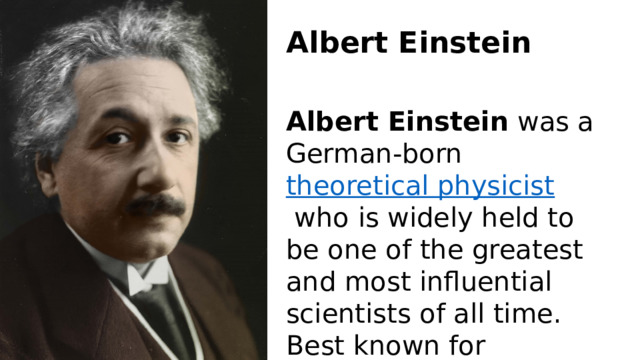
Albert Einstein
Albert Einstein was a German-born theoretical physicist who is widely held to be one of the greatest and most influential scientists of all time. Best known for developing the theory of relativity
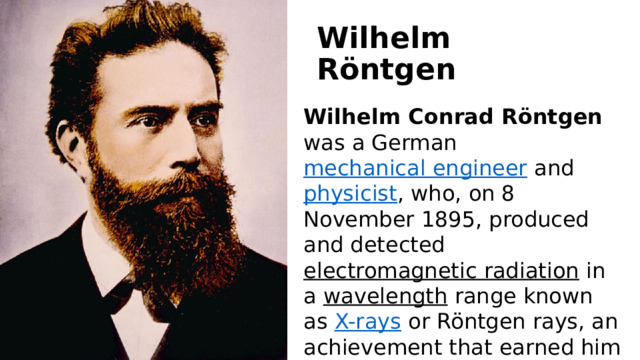
Wilhelm Röntgen
Wilhelm Conrad Röntgen was a German mechanical engineer and physicist , who, on 8 November 1895, produced and detected electromagnetic radiation in a wavelength range known as X-rays or Röntgen rays, an achievement that earned him the inaugural Nobel Prize in Physics in 1901.
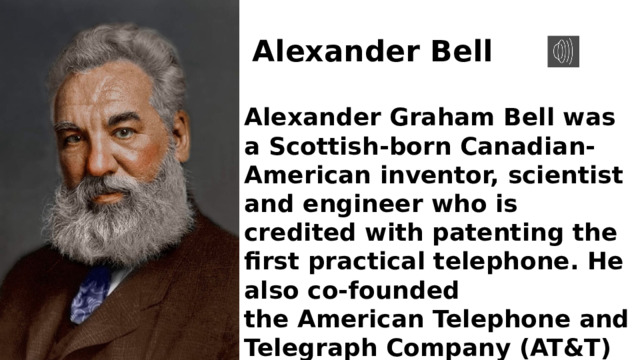
Alexander Bell
Alexander Graham Bell was a Scottish-born Canadian-American inventor, scientist and engineer who is credited with patenting the first practical telephone. He also co-founded the American Telephone and Telegraph Company (AT&T) in 1885.
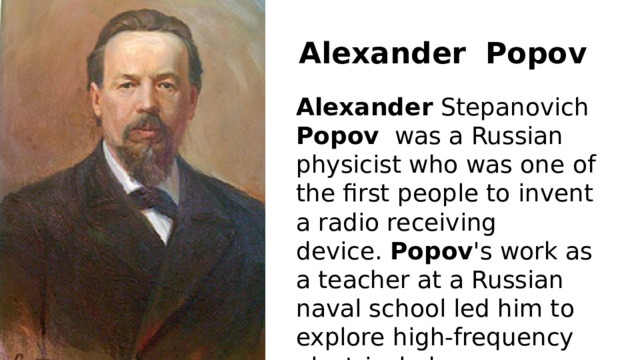
Alexander Popov
Alexander Stepanovich Popov was a Russian physicist who was one of the first people to invent a radio receiving device. Popov 's work as a teacher at a Russian naval school led him to explore high-frequency electrical phenomena.
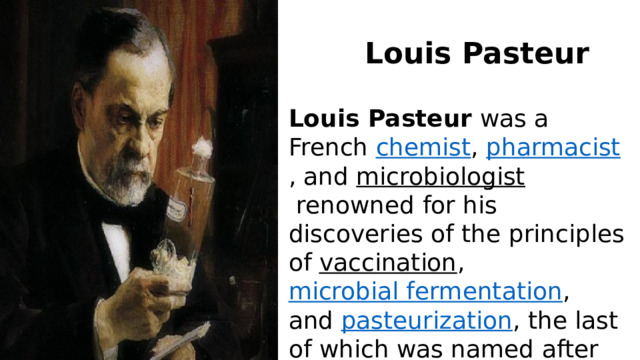
Louis Pasteur
Louis Pasteur was a French chemist , pharmacist , and microbiologist renowned for his discoveries of the principles of vaccination , microbial fermentation , and pasteurization , the last of which was named after him.
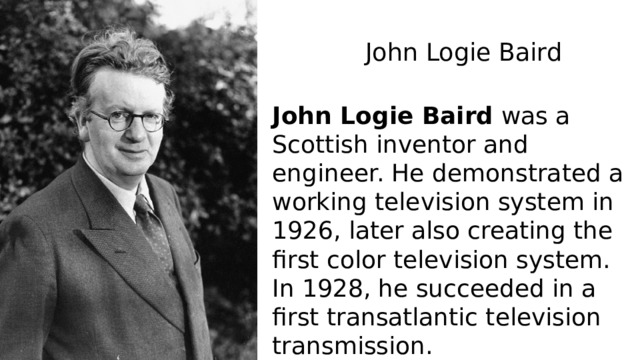
John Logie Baird
John Logie Baird was a Scottish inventor and engineer. He demonstrated a working television system in 1926, later also creating the first color television system. In 1928, he succeeded in a first transatlantic television transmission.
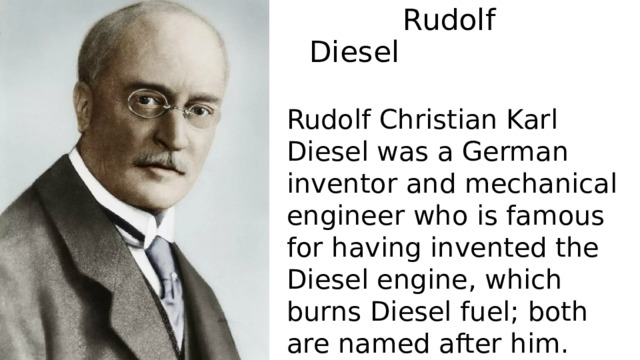
Rudolf Diesel
Rudolf Christian Karl Diesel was a German inventor and mechanical engineer who is famous for having invented the Diesel engine, which burns Diesel fuel; both are named after him.
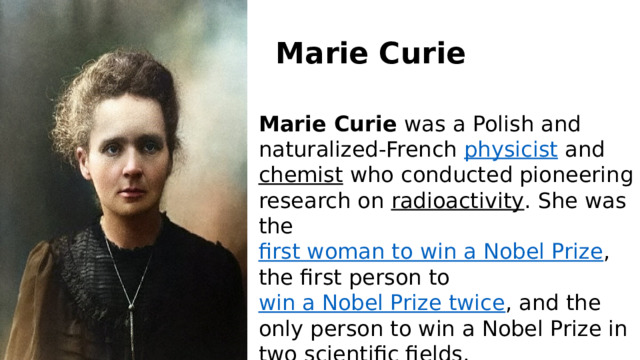
Marie Curie
Marie Curie was a Polish and naturalized-French physicist and chemist who conducted pioneering research on radioactivity . She was the first woman to win a Nobel Prize , the first person to win a Nobel Prize twice , and the only person to win a Nobel Prize in two scientific fields.
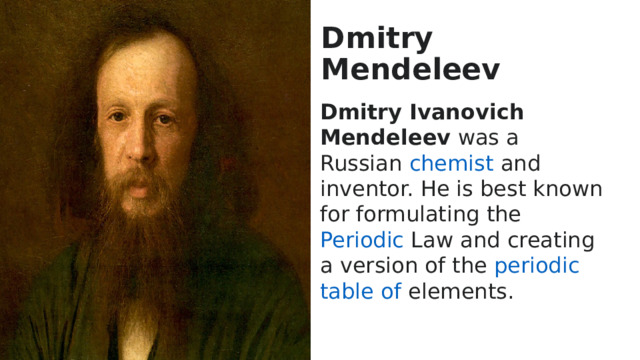
Dmitry Mendeleev
Dmitry Ivanovich Mendeleev was a Russian chemist and inventor. He is best known for formulating the Periodic Law and creating a version of the periodic table of elements .
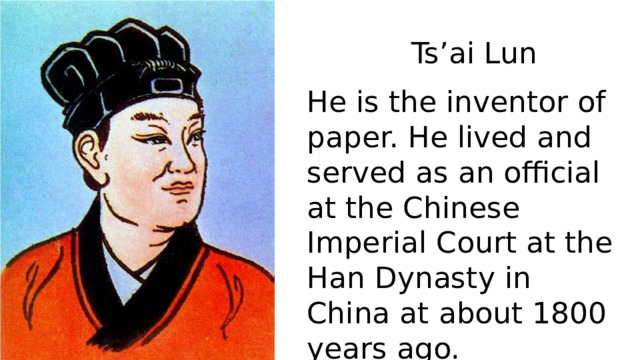
Ts’ai Lun
He is the inventor of paper. He lived and served as an official at the Chinese Imperial Court at the Han Dynasty in China at about 1800 years ago.
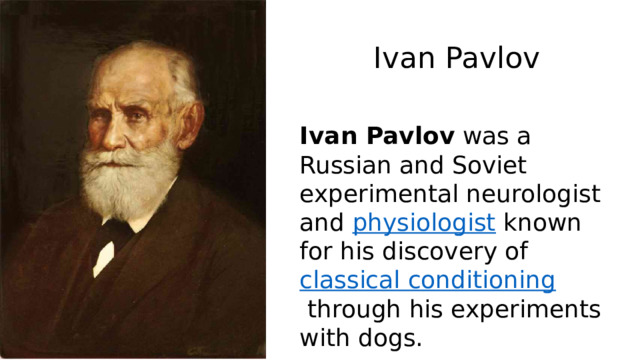
Ivan Pavlov
Ivan Pavlov was a Russian and Soviet experimental neurologist and physiologist known for his discovery of classical conditioning through his experiments with dogs.
Вебинар для учителей

Свидетельство об участии БЕСПЛАТНО!