Россия, Москва

СДЕЛАЙТЕ СВОИ УРОКИ ЕЩЁ ЭФФЕКТИВНЕЕ, А ЖИЗНЬ СВОБОДНЕЕ
Благодаря готовым учебным материалам для работы в классе и дистанционно
Скидки до 50 % на комплекты
только до
Готовые ключевые этапы урока всегда будут у вас под рукой
Организационный момент
Проверка знаний
Объяснение материала
Закрепление изученного
Итоги урока
Была в сети 28.07.2025 07:51

Кузьмичева Ольга Ивановна
Учитель английского языка
64 года
 2 312
2 312
 30 270
Местоположение
Специализация
Презентация по теме "Past Continuous vs Past Perfect"
Категория:
Английский язык
23.09.2021 17:27

Просмотр содержимого документа
«Презентация по теме "Past Continuous vs Past Perfect"»
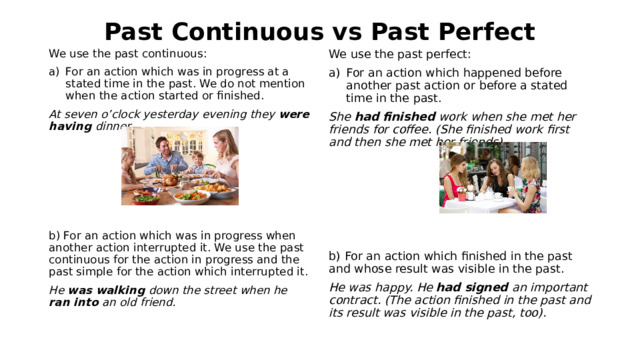
Past Continuous vs Past Perfect
We use the past continuous:
We use the past perfect:
- For an action which happened before another past action or before a stated time in the past.
- For an action which was in progress at a stated time in the past. We do not mention when the action started or finished.
At seven o’clock yesterday evening they were having dinner.
She had finished work when she met her friends for coffee. (She finished work first and then she met her friends).
b) For an action which was in progress when another action interrupted it. We use the past continuous for the action in progress and the past simple for the action which interrupted it.
b) For an action which finished in the past and whose result was visible in the past.
He was walking down the street when he ran into an old friend.
He was happy. He had signed an important contract. (The action finished in the past and its result was visible in the past, too).
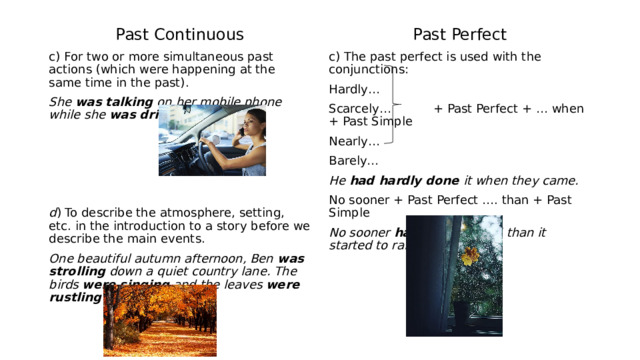
Past Continuous
Past Perfect
c) For two or more simultaneous past actions (which were happening at the same time in the past).
c) The past perfect is used with the conjunctions:
Hardly…
She was talking on her mobile phone while she was driving to work.
Scarcely… + Past Perfect + … when + Past Simple
Nearly…
Barely…
He had hardly done it when they came.
d ) To describe the atmosphere, setting, etc. in the introduction to a story before we describe the main events.
No sooner + Past Perfect …. than + Past Simple
One beautiful autumn afternoon, Ben was strolling down a quiet country lane. The birds were singing and the leaves were rustling in the breeze.
No sooner had they arrived than it started to rain.
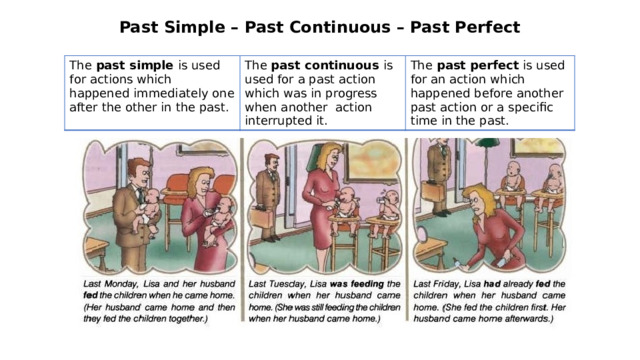
Past Simple – Past Continuous – Past Perfect
The past simple is used for actions which happened immediately one after the other in the past.
The past continuous is used for a past action which was in progress when another action interrupted it.
The past perfect is used for an action which happened before another past action or a specific time in the past.
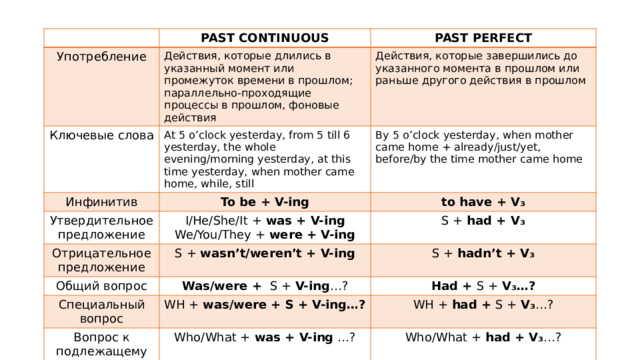
PAST CONTINUOUS
Употребление
Действия, которые длились в указанный момент или промежуток времени в прошлом; параллельно-проходящие процессы в прошлом, фоновые действия
PAST PERFECT
Ключевые слова
Действия, которые завершились до указанного момента в прошлом или раньше другого действия в прошлом
At 5 o’clock yesterday, from 5 till 6 yesterday, the whole evening/morning yesterday, at this time yesterday, when mother came home, while, still
Инфинитив
By 5 o’clock yesterday, when mother came home + already/just/yet, before/by the time mother came home
To be + V-ing
Утвердительное предложение
Отрицательное предложение
to have + V₃
I/He/She/It + was + V-ing
Общий вопрос
We/You/They + were + V-ing
S + wasn’t/weren’t + V-ing
S + had + V₃
S + hadn’t + V₃
Was/were + S + V-ing …?
Специальный вопрос
Had + S + V₃…?
WH + was/were + S + V-ing…?
Вопрос к подлежащему
WH + had + S + V₃ …?
Who/What + was + V-ing …?
Who/What + had + V₃ …?
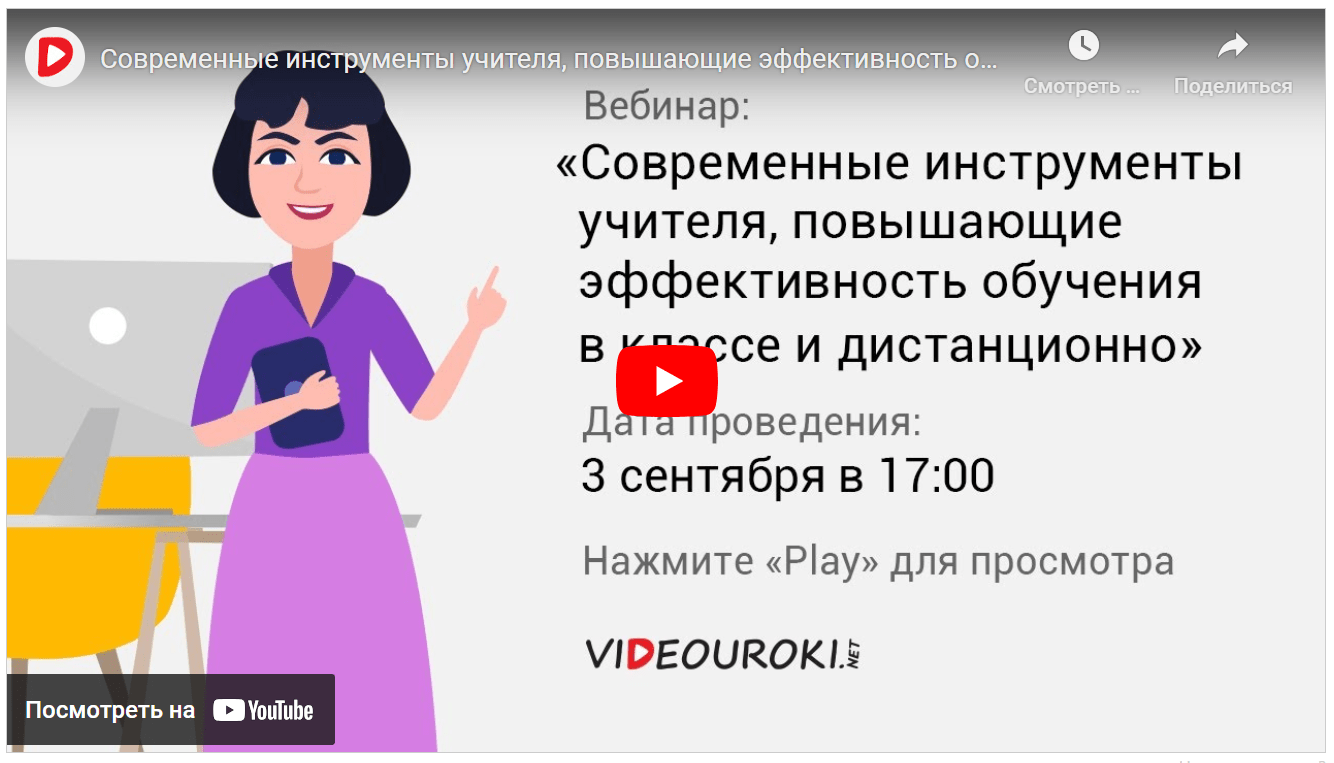
Вебинар для учителей
Свидетельство об участии БЕСПЛАТНО!